
By Archbishop Thomas Wenski - The Archdiocese of Miami
Photographer: ANA RODRIGUEZ-SOTO | FC
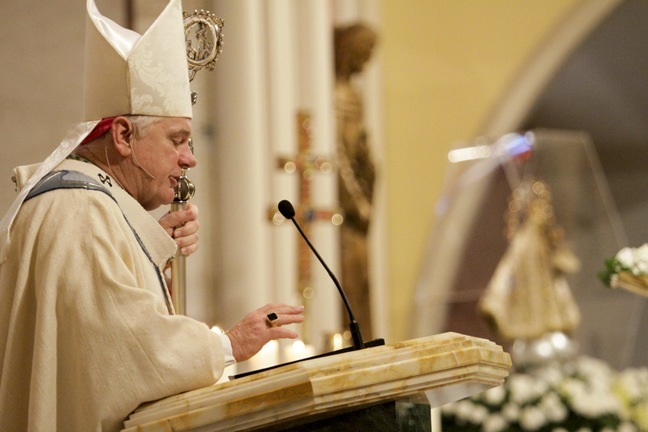
Framed by the image of Our Lady of Charity, Archbishop Thomas Wenski preaches the homily at the funeral Mass for Bishop Agustin Roman.
Photographer: ANA RODRIGUEZ-SOTO | FC
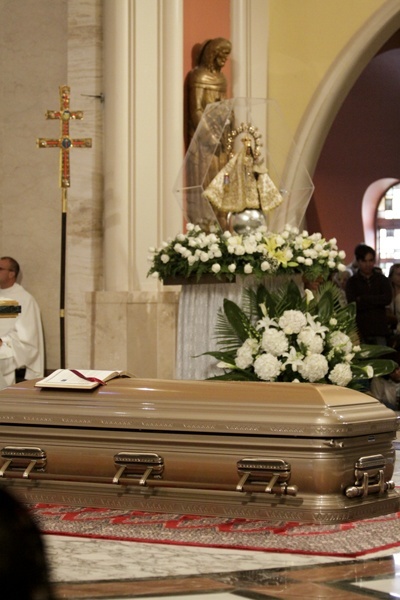
The pilgrim image of Our Lady of Charity watches over the body of Bishop Agustin Roman on the sanctuary of St. Mary Cathedral.
Let me begin by greeting his Excellency, Archbishop Carlo Maria Vigan�, the papal nuncio to the United States. This Church of Miami welcomes you; and, we thank you for representing the Holy Father today at Bishop Rom�n�s funeral Mass. And, of course, Pope Benedict is doubly represented today with the presence also of the Apostolic Nuncio to Haiti, Archbishop Bernardito Auza.
I also greet Archbishop John Favalora and my Brother Bishops from the Ecclesiastical Province of Florida as well as Archbishop Dionisio Garc�a of Santiago de Cuba, Bishop Mario Mestril of Ciego de Avila, and Bishop Emilio Aranguren of Holgu�n who are here to represent the Church in Cuba. Your solidarity with us today is a living witness to the theme of the Jubilee of the 400th Anniversary of the Discovery and the Presence of the Virgin of Charity in Cuba: A Jes�s por Mar�a, la Caridad nos une.
To Bishop Rom�n�s brother and sisters, to his nephews and nieces, we present our condolences. For the many priests here, Bishop Rom�n was also a brother and a father. This entire community � Catholics and non-Catholics, Cubans and non-Cubans � we all feel somewhat orphaned today � not only the hundreds of us who join you here at St. Mary�s Cathedral to pray for your brother but also the thousands more who visited the shrine Thursday night and all day yesterday as well as those who are following this Mass by television or by radio throughout the United States, Latin America, and Cuba. The cross of grief is never easy but you � we - do not bear it alone.
These last three weeks have been days of great intensity: the visit of the Holy Father to Cuba; the liturgical observances of Holy Week and then Easter Sunday and its octave which concludes tomorrow.
Photographer: ANA RODRIGUEZ-SOTO | FC
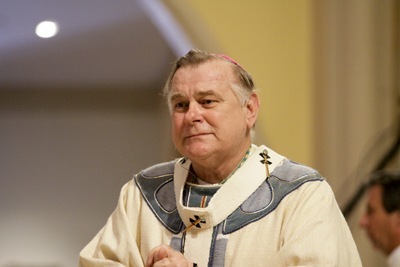
A visibly moved Archbishop Thomas Wenski processes into St. Mary Cathedral for Bishop Agustin Roman's funeral Mass.
On Easter Sunday, the �alleluias� sung to announce Our Lord�s Resurrection were made even more joyful by the announcement that the Pope had declared Father Felix Varela �venerable�.
We, of course, are still in the octave of Easter, eight days celebrated as if they were only one day of Easter. And, it was during this octave of Easter, with its joyfulness of new birth and renewed hopes, that God in his inscrutable ways called Bishop Rom�n home after a life of dedicated and selfless service both to the Church and to the Cuban nation. When I learned of Bishop Rom�n�s death on Wednesday evening, I said: The Archdiocese of Miami has lost a great evangelizer who preached the gospel to all. And the Cuban nation has lost a great patriot. Bishop Rom�n was the Felix Varela of our times.
In his book, Memoria e identidad, Blessed John Paul II wrote of the difference between a constructive patriotism and a destructive nationalism. �Patriotism is love for everything to do with our native land: its history, its traditions, its language, its natural features. It is a love which extends also to the works of our compatriots and the fruits of their genius. Whereas nationalism involves recognizing and pursuing the good of one�s own nation alone, without regard for the rights of others, patriotism�is a love for one�s native land that accords rights to all other nations equal to those claimed for one�s own. Patriotism, in other words, leads to a properly ordered social love.�
La patria es el patrimonio com�n de todos los ciudadanos y como tal impone un deber serio. Like Varela who said �No hay patria sin valores�, Bishop Rom�n understood that he was not less of a Patriot for being a Catholic and not less of a Catholic for being a patriot. This Varelan synthesis of religious faith and civic duty also explains the importance of the Ermita for the Cuban Diaspora � and for the work that Bishop Rom�an did here.
We could say that the Shrine was built as a rebuke to the lie of Marxist Leninism that enslaved Cuba 53 years ago. Ideological materialism pretended that God did not exist and tried to erase all trace of God from Cuban history and to destroy the religious identity of Cuban nation. The mural that adorns the shrine tells the true story of Cuban history � a history which acknowledges the contributions of men and women of faith in the life and the identity of the Cuban nation.
But also Bishop Rom�n saw the shrine as an antidote to the practical materialism that threatens the life of faith even in this land of great freedom and opportunity. This practical materialism, which values people for what they have than for who they are, pretends that God doesn�t matter.
A few months ago, friend of Bishop Rom�n told me how the Bishop had changed the course of his life. When he began his career in health care, he had allowed, for what he thought was for good business reasons, some doctors to perform abortions at his clinics. Padre Roman had found out � and went to call on him. �Do you believe in God�, Padre Roman asked him. �Yes�, he replied. And then Padre Roman � who embodied at the same time both profound humility and ardent courage said to him: �ni uno m�s; ni uno m�s�. And there were no more.
Photographer: ANA RODRIGUEZ-SOTO | FC
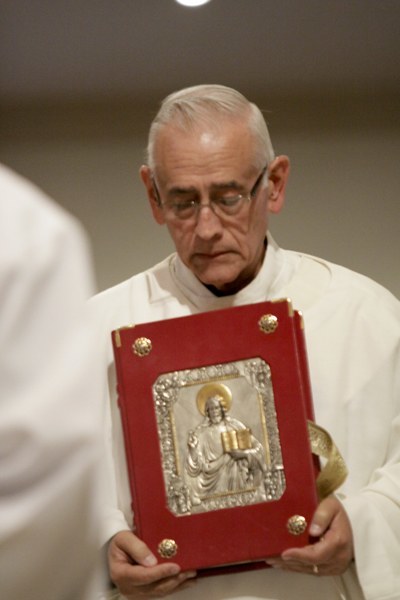
Deacon Manolo Perez, who served as Bishop Agustin Roman's master of ceremonies for 28 years, carries the book of the Gospels before proclaiming the Gospel at the funeral Mass.
En la Vigilia Pascual, la noche de la nueva creaci�n, la Iglesia presenta el misterio de la luz con un s�mbolo del todo particular y muy humilde: el cirio pascual. Esta es una luz que vive en virtud del sacrificio. La luz de la vela ilumina consumi�ndose a s� misma. Da luz d�ndose a s� misma. As�, representa de manera maravillosa el misterio pascual de Cristo que se entrega a s� mismo, y de este modo da mucha luz. Otro aspecto sobre el cual podemos reflexionar es que la luz de la vela es fuego. El fuego es una fuerza que forja el mundo, un poder que transforma. Y el fuego da calor. Tambi�n en esto se hace nuevamente visible el misterio de Cristo. Cristo, la luz, es fuego, es llama que destruye el mal, transformando as� al mundo y a nosotros mismos
St. Catherine of Siena once said: �If you are what you should be, you will set the whole world on fire.� His last hours were spent in the same way he spent his entire life: evangelizing, preaching the gospel. He was what he should have been: a friend of the poor, the sick, the imprisoned, the exile and the immigrant. He was a friend to us all � because he was first of all and above all a friend of Jesus. He was light; he was fire. His passion for evangelization, for catechesis, was never about making people follow him but rather to lead them to Jesus.
In the Haitian Creole language, the word for �saint� is simply translated �zanmi Bondye�, a friend of God. Bishop Rom�n was a holy man and a totally committed priest � he was a �friend of God�. He befriended us and worked tirelessly simply to make us also �Zanmi Bondye�.
Ruega por nosotros Santa Mar�a Madre de Dios.
Para que seamos dignos de alcanzar las promesas y gracias de Nuestro Se�or Jesucristo.
�Virgen de la Caridad, ruega por nosotros! �Virgen de la Caridad, salva a Cuba!


Comments from readers
Desde el cielo est� bendiciendo a esa tierra que tanto quiso y a la que nunca volvi�, Monse�or nosotros los cubanos que estamos diseminados por todo el mudo no lo olvidaremos ni tampoco olvidaremos lo que hizo por muestros hermanos cada vez que se ha presentado una cr�sis y ha sido requerida su presencia, hoy descansa junto al Padre....que El lo bendiga siempre.Amen