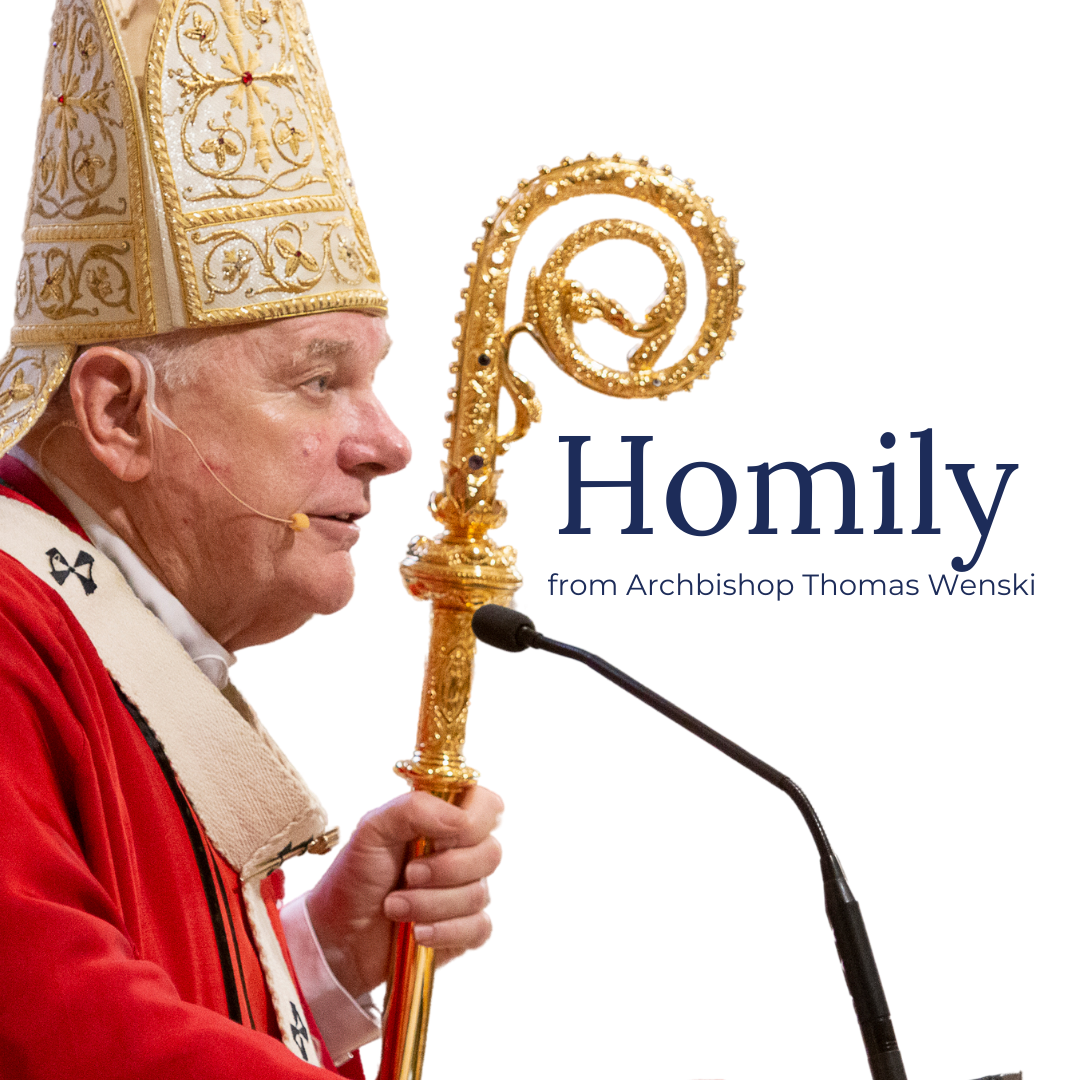
By Archbishop Thomas Wenski - The Archdiocese of Miami
Homily by Archbishop Thomas Wenski at Ordination Mass of 12 new priests for the Priestly Fraternity of St. Peter (FSSP). Omaha, Nebraska. May 28, 2026.
Today we welcome the families and friends of these deacons – soon to be ordained priests. Many here have traveled long distances to be here. We also welcome our seminary rectors and faculty members; we welcome our priests and parishioners and all who had a role in the discernment of their vocations and formation. Also, we thank God for the “yes” given to God by these young men so generously and uncompromisingly today. Just as we pray for them today, we must continue to pray for them and for all our priests. By the “laying on of hands” in this sacred rite of Holy Orders, they are configured to Christ the eternal High Priest and, joined to the priesthood of the bishops, they are consecrated as true priests of the New Testament and sharers in the very mission of Christ — sowing the seed of his Word, dispensing his Divine Mercy in the Sacrament of Penance, and nourishing the faithful at the table of His Body and Blood. I am reminded of the words of the mother of Saint John Bosco on the day of his ordination to the priesthood. Though illiterate, she possessed great faith and wisdom. She told him, “Giovanni, today you are a priest. You will begin saying Mass, so from henceforth, you will be closer to Jesus. Remember that to begin to celebrate Mass also means to begin to suffer. You will not realize this immediately, but little by little you will see that what your mother told you is the truth”. Priests offer the Holy Sacrifice of the Mass every day; sacrifice must be the condition of their lives. In an increasingly secularized world where many have lost the sense of the transcendent, the priest is an enigma, a sign of great contradiction. Today, many view religious faith with hostility, or at best, with indifference. In such a world, the Church will always seem “out of step” and irrelevant. Such a church will often be regarded, if not with scorn and ridicule, then with utter incomprehension. As Jesus said once, “If the world hates you, realize that it has hated me first.” Yet, by Christ’s design, though we do not belong to the world, we are "in" the world "for the life of the world." We are not men “out for ourselves” but men for others. Our vocation to priestly ministry is a call to reflect Christ’s “patience and tenderness”. Pope Pius X, who served at the beginning of the 20th century, began his pontificate under the motto of “Restoring all things to Christ.” He is remembered for his resolute condemnation of the heresy of modernism but also for allowing children as young as seven to take Holy Communion. There was no question about this pope’s zeal for souls. In fact, today he is invoked as St. Pius X. In his first encyclical, E Supremi, Pius X wrote: “that Christ may be formed in all, be it remembered that no means is more efficacious than charity.” He adds: “it is vain to hope to attract souls to God by a bitter zeal. On the contrary, harm is done more often than good by taunting men harshly with their faults andreproving their vices with asperity.” A “bitter zeal,” rather than witnessing to the Truth, will undermine it. And instead of restoring all things to Christ who prayed that all his followers be one, bitter zeal will fracture the unity of his Body, the Church. Indeed, the cause of so many ruptures in the Body of Christ that resulted in schisms over the course of history can be traced to such “bitter zeal” among those who fancied themselves as “reformers.” AChurch that embraces sinners will always need reform but always under the direction and orders of the bishops “who preside in charity”. However, without this direction from the bishops “who preside in charity,” those who insist on “their own views” can easily become consumed with a bitter zeal. Brothers, imitate the Lord in his perfect charity towards all. Do not shun the excluded or sinners but help them to turn, to convert, and return to the right path. With simplicity and generosity, be close to the sick and the poor. Face the challenges of your ministry without anxiety or mediocrity and don’tallow yourself to be intimidated or swayed by those who make power, wealth, or pleasure the main criteria of their lives. Rather, offer the witness of a life deeply rooted in Christ, a witness that will draw people to Christ by attraction. Your witness will be made more compelling by your detachment from material comforts and signs of status, by your readiness to obediently be available wherever your superior to whom you pledge obedience, will send you, and by your chaste celibacy which affirms that all human intimacy finds its deepest meaning and fulfillment when experienced as a participation in intimacy with God himself. The demands of the ministry with its inevitable trials and disappointments and the fact that we carry the “treasure” of the Gospel in “earthen vessels” can sometimes tempt us priests to give into discouragement — and, perhaps, sometimes even try the patience of our people. Priests, of course, forgive sins in the name of Christ and his Church. I ask you to be generous with your time making yourself readily available to hear the confessions of the people. At the same time, I encourage you and the other priests here this morning that you do not neglect to avail yourselves of the consolations of the Sacrament of Penance. The Mercy of God is always greater than their — or our own — weakness and unworthiness. No one wants you to burn out — a candle that burns out leaves a sooty mess. A burned-out priest is a mess too. But you are expected to work hard: you are not to burn out, but you are supposed to burn yourself up, to consume yourself in the service of Christ and his Church.