By Cristina Cabrera Jarro -
MIAMI| A new decade in the U.S. means it’s time for a new census, and everyone must be counted.
“No matter their status, no matter their station in life, no matter their income, no matter their location, every person needs to be counted,” said Randy McGrorty, chief executive officer of Catholic Legal Services of the Archdiocese of Miami.
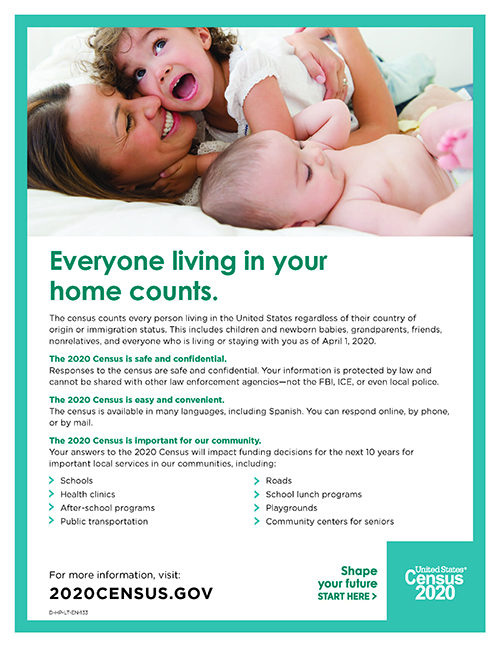
After much controversy and a Supreme Court ruling, a question inquiring about the citizenship status of individuals residing in the U.S. has been excluded from the census form. Personally identifiable information is protected, and by law, answers from the census cannot be used by any government agency for purposes of law enforcement.
By law, everyone must fill out the census. The hope now is that all residents, regardless of their status in the U.S., will do so without fear.
“We should not have invisible populations,” said Archbishop Thomas Wenski.
The archbishop is encouraging all archdiocesan priests to educate their parishioners on the importance of filling out the census. Once data is collected and released to the public, religious institutions and dioceses can access that information to apply for grants, determine locations for new facilities, and even connect with potential new parishioners.
“The census is working with all of these community organizations,” the archbishop said during an episode of the archdiocesan podcasts, What the Faith, Miami? and Cuéntame Católico. “They have outreached to the Archdiocese of Miami asking our cooperation and our assistance and we are glad to give it to them because of the benefits that the census will bring to the greater community. As Catholics we are called to be faithful citizens and therefore participating in the promotion of the common good is not optional for us.”
The taking of, and participation in, a decennial census is mandated by the U.S. Constitution, with the first one taking place in 1790. But censuses date back even longer. The Gospel of Luke begins with the story of the Holy Family traveling to Bethlehem to be counted in a census ordered by Roman Emperor Caesar Augustus over 2000 years ago.
FEDERAL FUNDING
As of July 2019, the U.S. Census Bureau estimated the U.S. population at 328 million. Florida alone has seen its population grow from over 18 million in 2010 to over 21 million in 2019. The city of Miami took the top spot for most populous in the state, with an estimated 470,914 residents as of July 2018.
In Congress, the number of state representatives is affected by a state’s population. Every decade, that number increases or decreases in any given state based on census results.
The census also aids with government funding. More than $675 billion will be distributed across the country in financial assistance to states, providing them with additional resources to build hospitals, centers for the elderly, roads and highways, and schools, all of which create jobs.
Iani Carvalho, regional director of Elderly Services for Catholic Charities of the Archdiocese of Miami, pointed out that the funds impact the services her agency can provide to the community. Census data helps Catholic Charities find the communities that are in most need of help, information which provides the basis to apply for federal funding.
“Those federal funds go towards paying Medicaid and Medicare, towards a lot of the food programs like SNAP (Supplemental Nutrition Assistance Program), a lot of the programs included in the schools, for childcare, for Head Start schools, for senior centers, for our roads and bridges. Those funds are critical,” said Carvalho.
2020’s census count will definitely impact Catholic Charities’ Elderly Services, considering the population of aging baby boomers (born between 1944 and 1964) and generation Xers (born between 1965 and1980) who are next in line for retirement.
“A lot of the funding in elderly services comes from the Older Americans Act, which is federally funded, and goes towards adult day cares, nursing homes, ALF’s (assisted living facilities), congruent meal sites, home health aides. That funding is important for us,” said Carvalho.
While it may sound that the funding is going only to the aging population, millennials (born between 1981 and 1996) and gen z’ers (born 1997 and later) also must make sure they are counted as the resources available for them in the next decade will be determined by the 2020 count. Even small children born on or before April 1, 2020 must be counted.
“Today they may be zero to five, but tomorrow they will be 10 to 15 and at that point they will need to have those extremely important resources to be able to get them on the path that we would all love to see our children,” said Vanessa Joseph, senior staff attorney and outreach coordinator for Catholic Legal Services of the Archdiocese of Miami.
Although they have no permanent residence, the homeless population also will be accounted for in the census. Camillus House, the Homeless Trust, and other agencies will head to the streets to assist with the count as it will determine the need for more shelters and even affordable housing.
“It’s one of the most important population groups that needs to be counted,” said Sophia Arevalo, coordinator of social services in the Child Development Division of Catholic Charities. Arevalo’s department often assists families who are homeless.
“We don’t have enough resources in Miami-Dade County right now to sustain that population,” Arevalo said. “We are actually third in the nation, last I checked, for crisis in low income housing. We are hoping that after this year’s census we will receive more funding, and that companies will be willing to build low income housing to serve the population in that way.”
For more information, visit 2020census.gov and miamiarch.org.
QUICK FACTS ON THE 2020 CENSUS
When will I receive the U.S. Census?
Official mail from the census, with instructions on how to respond online, by mail or by phone, will arrive at your home between March 12 and 20. People are expected to answer by April 1.
What happens if I don’t return my census form?
Every household that has not responded by April 1 will receive reminder letters in the mail. From May to July all homes that did not answer the census will be visited by a census employee.
What if I don’t speak English?
The U.S. Census Bureau is providing glossaries and other tools in a total of 59 languages to assist with people in filling out the census.
What kind of questions will the census ask?
Questions will be asked regarding the residents in your household, including:
Beware of scams: The census will never ask for your Social Security number, bank or credit card information, nor will they ask for donations.
- The number of people living at your home address, whether permanently or temporarily
- Owner/renter information
- Phone number
- Name
- Age and date of birth
- Sex
- Hispanic, Latino or Spanish origin and race
- Relationship of each person in the household to one central person