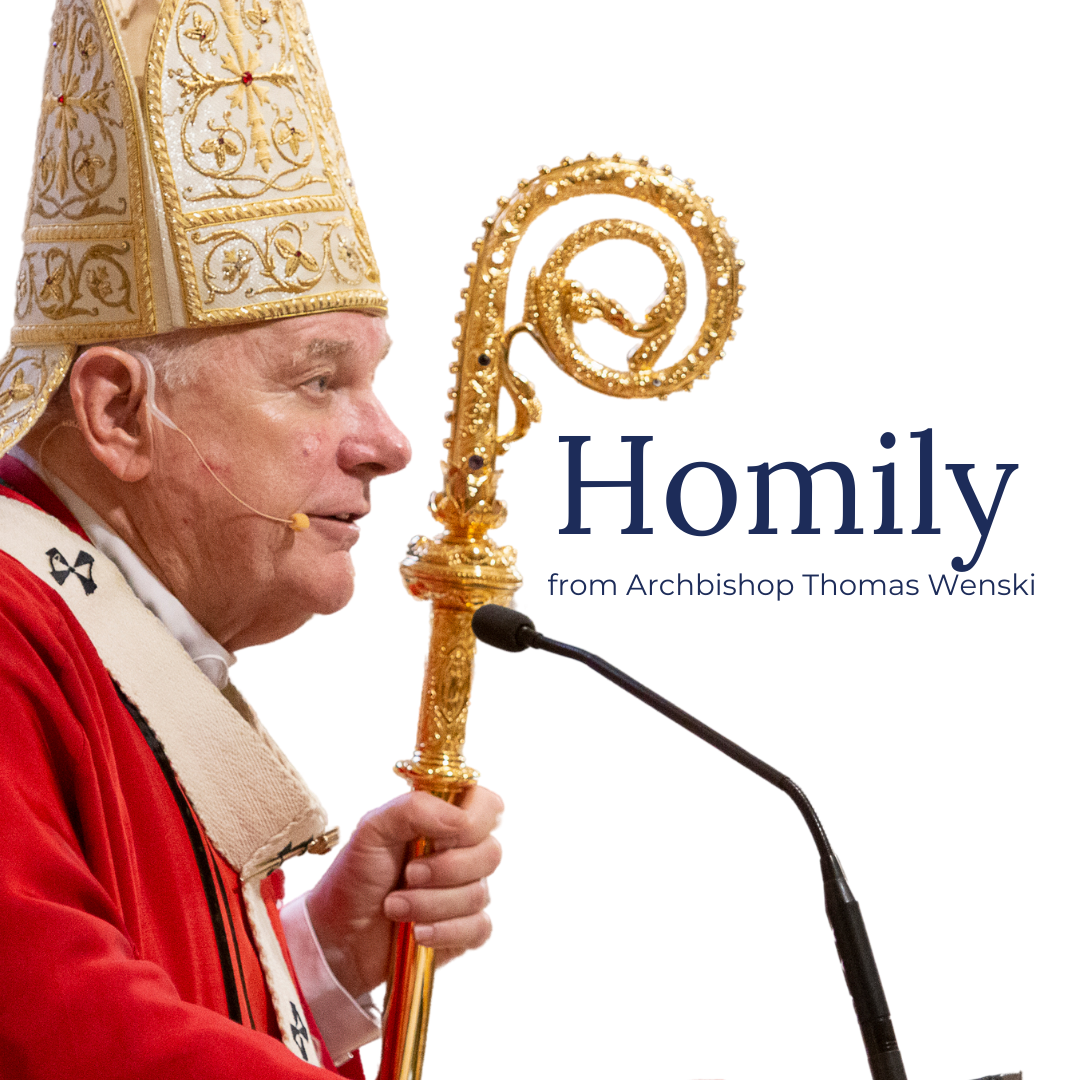
By Archbishop Thomas Wenski - The Archdiocese of Miami
Homily by Archbishop Thomas Wenski at 2026 Wedding Anniversary Mass with couples from around the archdiocese celebrating their first, silver or gold+ wedding anniversary. St. Mary Cathedral, Saturday, February 21, 2026.
60 years ago, at the Second Vatican Council, the bishops reminded us, man can only realize himself through the sincere gift of himself. The secret for human fulfillment is not found through self-seeking or self-assertion but through self-giving, self-sacrifice.
St. John Paul II would later speak of the “nuptial meaning” of the body; for the human body, constituted male or female, reveals man and woman’s call to become a gift for one another, a gift fully realized in their “one flesh” union.
Our vocation is to love, our capacity to do so was wounded by that original sin of Adam and Eve. Because of that wound, we can find the responsibilities of love very challenging, if not impossible.
The Russian novelist, Leo Tolstoy, in “Anna Karenina” says, “Happy families are all alike; every unhappy family is unhappy in its own way.” In other words, there are many ways to go wrong; but one way to go right: the way of love. The hopes that people place in marriage are capable of being fulfilled only by acceptance of the Gospel.
That is to say, one cannot just build a marriage and a family on the sands of fleeting emotions. Emotions are like shifting sands; you cannot build anything solid on that; rather, one must build on solid foundations, the solid rock of God's love as revealed to us in the passion, death and resurrection of Jesus Christ.
I think it was last year, there was a couple celebrating 70 years of marriage. I joked with the wife saying to her: You must be a patient woman. And she said, “For man this is impossible but for God nothing is impossible.” In other words, what cannot be done by our own efforts can be accomplished through God’s grace.
On your wedding day, God pledged you the life-long support of that grace through the Sacrament of Matrimony you received. Today you thank him, for his grace was not wanting in your lives as husband and wife. Self-giving, patient and persevering self-giving, sacrifice, can be very difficult and irksome; it usually is. Only love can make it easy, and perfect love can make it joy.
Today is also the First Sunday of Lent, and the Gospel tells of Jesus being “led by the Spirit” into the desert where he was tempted. The temptations the devil put to Jesus, and the temptations the devil puts to you and me, all deal with putting self-first and ignoring what God wants us to do in order to be the persons He wants us to be.“Turn stones into bread,” the devil suggested. The Evil One wasn’t talking about feeding all the starving people of our world. Rather he was tempting us all by suggesting that all of our appetites should always be satisfied. “If you have a need, an urge, a desire, or if you have any bodily hunger, satisfy it,” the devil tells us, and forget about everybody else; and forget about that deeper hunger you feel in your soul, forget about that spiritual hunger for meaning and purpose, and forget about that hunger for God.
The second temptation is to simply give up on the struggle to be good and surrender to the world as it is; or as the devil tells you it is. Just grab what you can, get what is yours, and let everyone else fend for himself or herself.
The third temptation is to turn your religion into something that you do to make God act. Prayer? Well, prayer is so you can tell God what He needs to do for you. It’s praying, “My will be done” instead of “Thy will be done.” In other words, don’t put yourself to the test, instead put God to the test. Then whatever happens is God’s fault.
Lent is a time to combat all these ancient and yet very modern temptations. Lent is dying to our own selfish self-centeredness in order to bring life into our lives and to share life, and the good things of life, with others. Fasting and self-denial allow us to share with others and be available to them, to put others first instead of ourselves first.
Lent calls us to the conversion of heart and mind that makes the gift of self possible. The day you were married you had no idea what the future would bring you. That future, with its hopes and disappointments, its successes and its failures, its pleasures and its pains, its joys and its sorrows, was hidden from your eyes, even though these elements are mingled in every life and were to be expected in your own.
You didn’t know what was before you then but nevertheless you made a gift of yourself to your spouse, you took each other for better or for worse, for richer or for poorer, in sickness and in health, until death. As you celebrate your anniversaries, you can look back and see how God's grace was with you, helping you along the way.
And so, on this vigil of the First Sunday of Lent we congratulate you and ask you to renew once again that gift of self you made many years ago on your wedding day, a commitment that has been tested and refined over the years, and a commitment that is now blessed and enriched by the wisdom of age. And we thank you for your witness to the “good news” of marriage.