By Jim Davis - Florida Catholic
Photographer: Courtesy of Franciscan Sisters of Perpetual Adoration
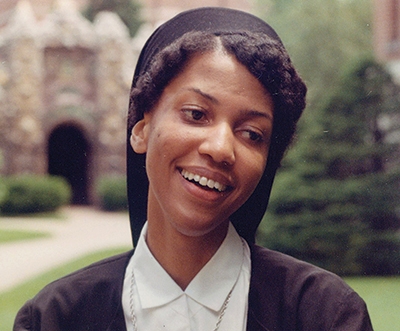
Sister Thea Bowman, whose cause is being promoted for canonization, in an undated photo.
BALTIMORE | The nation’s bishops took twin shots at racism at their annual fall plenary assembly, condemning the practice in a joint letter and endorsing the cause for sainthood of an African American nun.
Based on a year’s work by its cultural diversity committee, the United States Conference of Catholic Bishops on Nov. 14 approved “Open Wide Our Hearts: The Enduring Call to Love,” its first formal statement on racism in nearly four decades.
The bishops also offered unanimous support for the effort to canonize Sister Thea Bowman, a member of the Franciscan Sisters of Perpetual Adoration, who spent her 52 years promoting education among blacks and raising their profile in the U.S. Church.
The letter on racism was approved by an overwhelming vote of 241 to 3, with one abstention. Bishop Shelton J. Fabre, chairman of the Ad Hoc Committee Against Racism, said the joint statement was needed “after witnessing the deterioration of the public discourse, and episodes of violence and animosity with racial and xenophobic overtones, that have re-emerged in American society in the last few years.”
“Pastoral letters from the full body of bishops are rare, few and far between,” Bishop Fabre, of Houma-Thibodaux, said in a statement. “But at key moments in history the bishops have come together for important pronouncements, paying attention to a particular issue and with the intention of offering a Christian response, full of hope, to the problems of our time. This is such a time.”
Producing the letter was one of the main goals of the ad hoc committee when the bishops formed it in August 2017. Other objectives were to address the sin of racism in society and in the Church, and to prod society to unite in finding solutions.
Among the letter’s points:
- All humans are brothers and sisters, all equally made in the image of God. Racism is therefore a moral and theological problem that manifests institutionally and systematically.
- Only individual conversion of hearts, which then multiplies, will compel change and reform in institutions and society. It is imperative to confront racism’s root causes and the injustice it produces.
- The love of God binds us together and should overflow into relationships among all people. The conversions needed to overcome racism require a deep encounter with God through Christ, who can heal all division.
“Open Wide Our Hearts: The Enduring Call to Love,” builds on the bishops’ collective 1979 statement “Brothers and Sisters to Us: A Pastoral Letter on Racism in Our Day.” That document declares, “Racism is a sin: a sin that divides the human family, blots out the image of God among specific members of that family, and violates the fundamental human dignity of those called to be children of the same Father.”
The full text, as well as many accompanying pastoral resources, will be posted at http://www.usccb.org/racism. Resources will include bulletin inserts, homily help, prayer materials, background information on systemic racism, and activities for primary, secondary, and higher education classroom settings.
On the same afternoon, the bishops approved the campaign to canonize Sister Thea, the only African American member of the Franciscan Sisters of Perpetual Adoration. Their unanimous vote in favor of the cause at the diocesan level came at the request of Bishop Joseph R. Kopacz of Jackson, Mississippi.
Born in 1937 as Bertha Elizabeth Bowman, she was the only child of middle-aged parents, Dr. Theon Bowman, a physician; and Mary Esther Bowman, a teacher. She converted as a child to Catholicism through the inspiration of two religious orders � the Perpetual Adoration Sisters and the Missionary Servants of the Most Holy Trinity � who were her teachers and pastors at Holy Child Jesus Church and School in Canton, Mississippi.
She learned as a girl about African-American culture and spirituality through history, stories, songs, prayers, customs and traditions. At the age of 15, she announced plans to join the Franciscan Sisters of Perpetual Adoration.
She left home and traveled to LaCrosse, Wisconsin, where she would be the only African-American member of her religious community. At her religious profession, she was given the name “Sister Mary Thea” in honor of the Blessed Mother and her father, Theon.
The young sister was trained to become a teacher and taught at all grade levels, eventually earning a Ph.D. in English at Catholic University of America in Washington, D.C. She then taught at Catholic University and at Xavier University in New Orleans.
However, in 1984, she was diagnosed with breast cancer. Despite the devastating news, Sister Thea vowed to “live until I die.” The disease caused pain and metastasized to her bones, and chemotherapy caused her to lose her hair. Yet she continued a rigorous schedule of speaking engagements, arriving in a wheelchair, wearing traditional African garb and a smile.
Her determination brought her to the spring meeting of U.S. bishops in 1989, at Seton Hall University in East Orange, New Jersey. Sister Thea spoke to the bishops as a sister having a “heart to heart” conversation with her brothers.
She told the bishops about African-American history and spirituality. She urged them to continue to evangelize among blacks and to find ways to help them take part in Church life. Finally, she invited the bishops to join in singing “We Shall Overcome.”
Sister Thea died in 1990 at age 52, but the ripples of her life are still spreading. Several institutions are named for her, including schools, an education foundation for needy students, housing units for the poor and elderly, and a health clinic.
She is also the subject of books, articles, and a stage play, as well as prayer cards, statues and stained-glass windows.