By Rocio Granados - La Voz Catolica
Photographer: Jonathan Martinez | FC
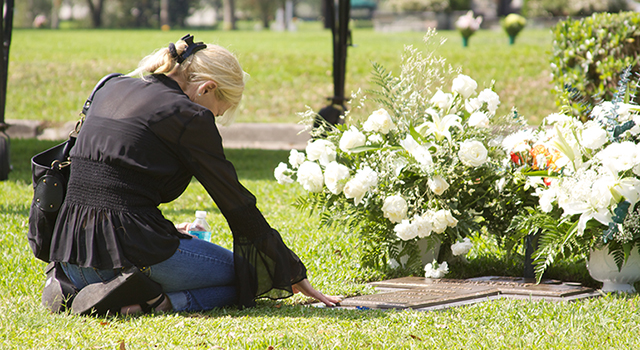
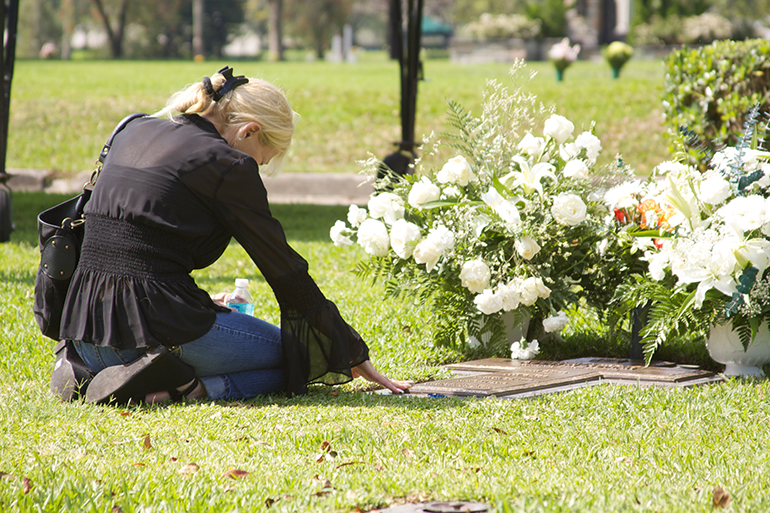
Dayami Quetgles prays at the grave of Bishop Agustín Román in this file photo from April 2013.
See related article: What to do when a loved one dies?
MIAMI | Going to the cemetery and placing flowers on a gravesite is a common tradition among believers.
“Flowers represent our hope, our life, our love for the deceased,” said Father Juan Sosa, pastor of St. Joseph Parish on Miami Beach and president of the Instituto Nacional Hispano de Liturgia (National Hispanic Institute of Liturgy).
In the old days � and even today in countries such as Mexico, Colombia and Peru � people take offerings of food to the dead as a gesture associated with the belief, common among many ancient cultures, that death is a journey toward eternal life.
When Christians do this, it’s a form of “popular religiosity,” Father Sosa said � “an expression of a traditional custom. But the most important thing is prayer, the Eucharist, holy Mass, in the chapels of the cemetery.”
Reverence for the dead is among the oldest Christian traditions, but it dates back to pre-Christian times. In America’s Inca and Aztec cultures, archeological remains have revealed the existence of burial grounds, or cemeteries. In Europe, the first Christians manifested respect and veneration for the dead in the way they buried them. However, these Christians added the concept of the soul’s immortality.
“Christian theology says that death is not the end. It transforms us. Death never does away with us, and that is the connection with the paschal mystery, with the redemption of Christ,” said Father Sosa, who also serves as a consultant for the U.S. bishops’ Committee on Divine Worship.
The body, in life, is “a temple of the Holy Spirit” and “member of Christ,” according to 1 Corinthians.
When people die, it retains that nature. The ancient tradition called for washing the bodies, anointing them, wrapping them in aromatic cloths or dressing them in exquisite clothing, and placing them in tombs. After the second century, Christians began burying their dead in the ground. That’s how the catacombs began.
The catacombs turned into sacred places for Christians, because many of the dead were martyrs for the faith. The great churches and basilicas were later built atop them.
“And from that we get the custom of always embedding a relic of a martyr in the altar, which is the symbol of Christ,” Father Sosa said.
Although in the third century, the Roman emperor Constantine stopped persecuting Christians, the catacombs continued to be used as cemeteries, and the veneration of the dead became centered around the tombs of the martyrs. Devotion to the saints began around that time, but the veneration of all the dead endured.
Because it was considered an honor to be buried next to a Church martyr, churches and basilicas turned into immense cemeteries.
To put a halt to this practice, Church leaders decided that the deceased should be brought to church before burial and placed in front of the altar, and a Mass should be celebrated with the body present. We know from the writings of St. Augustine describing the funeral for his mother, St. Monica, that this fourth-century practice has continued to modern times.
The burial of a body is the undisputed preference of the Church. However, cremation has been permitted since 1963. In 1997, the Vatican granted permission for the U.S. Church to celebrate the funeral Mass in the presence of the cremated remains, as long as the local bishop approved.
Photographer: CRISTINA CABRERA JARRO| FC
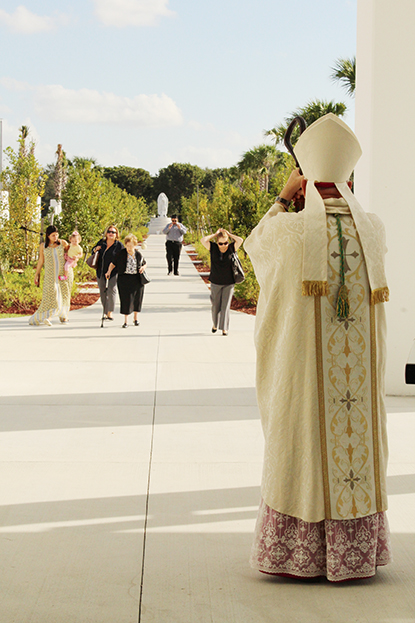
Archbishop Thomas Wenski awaits Catholics at the door to Our Lady of Guadalupe Church, where the All Souls Day Mass was celebrated this year.
On Oct. 25, the Congregation for the Doctrine of the Faith issued the instruction Ad resurgendum cum Christo (To rise with Christ), regarding the burial of the deceased and the conservation of the ashes in the case of cremation. It confirms the prohibition against storing the ashes at home, scattering them in nature or at sea, or using them as commemorative items. Cremation is licit but the ashes must be conserved in a sacred place, “that is, in a cemetery or in a church, or in an area specifically dedicated for the purpose,” the document states.
“The Church does not permit the ashes to be scattered, even if that was requested by the deceased,” Father Sosa said. “It’s very important to help families understand that the wishes of the deceased may not necessarily be in tune with the tradition of the Church. That’s why it’s important that we talk about death before the time comes and clear up any confusion.”
Ashes also cannot be kept at home except “in the case of grave and exceptional circumstances, in agreement with the episcopal conference or the synod of bishops.”
This eliminates the possibility “that they will be forgotten, disrespected, or badly treated, or used for inappropriate or superstitious practices,” Father Sosa said. “We are temples of the Holy Spirit, which is why the ashes should be placed in an urn in the cemetery. That way we all have a reference point for where to take flowers, or go pray. If not, where are they? In a photograph?”
The Church considers burial the preferred method of expressing our faith and hope in the resurrection of the body. When the body or cremains are buried, the Church maintains that “these mortal remains have been, were, and are a temple of the Holy Spirit. For that reason, they have been embraced by God and deserve special veneration,” Father Sosa said.
The entire Church pays tribute to the dead Nov. 2, the feast of All Souls.