
By Rocio Granados - La Voz Catolica
See related article: Why do we bury our dead?
MIAMI | Because of our belief in the immortality of the soul and the resurrection of the body, the Church professes hope in the face of death. We are strengthened in our faith through public funeral rites, by burying the bodily remains of the deceased, and giving them the care befitting a temple of the Holy Spirit.
When a loved one who was baptized and strengthened in faith by the Eucharist dies, the first thing to do is to notify the parish, “so that the rest of the community may know and pray for the deceased and their families at the next Mass,” said Father Juan Sosa, pastor of St. Joseph Parish in Miami Beach and president of the National Hispanic Institute of Liturgy.
Then a funeral home must be called to remove the deceased. In the United States, laws prohibit keeping the deceased in the house. Funeral procedures and funeral rites are carried out by the funeral home, which coordinates with the family and the parish to which the deceased belongs.
In the United States, the Order of Christian Funerals, adapted by the U.S. Conference of Catholic Bishops, prescribes the rites as a three-stage journey:
- Visitation in the funeral home. This is the time to remember the life of the deceased and pray to God for comfort and strength to support each other. The Church offers a series of prayers of the faithful to accompany the death of a loved one.
- The funeral rites consist of the celebration of Mass for the deceased in union with the parish community. The Church encourages the celebration of Mass. When Mass cannot be celebrated, a funeral liturgy can take place in the church or the funeral home. In the funeral liturgy, the Christian community affirms and expresses the union of the Church on earth with the Church in heaven in the great communion of saints. The family and friends of the deceased gather to praise and thank God for the victory of Christ over sin and death, and to entrust the deceased to the mercy of God.
- Burial in a cemetery is the final act of faith. Normally it is performed next to the grave or burial site. Placing the body or ashes in a resting place signifies the hope that the deceased awaits the glory of the resurrection. The burial rite is performed by a priest or deacon.
According to the Code of Canon Law, catechumens and children who die before being baptized, or those who have been baptized in non-Catholic churches, may receive Catholic funeral rites.
The Church prefers that the bodies of the dead be buried, but does not prohibit cremation, unless it is chosen for reasons contrary to Christian doctrine.
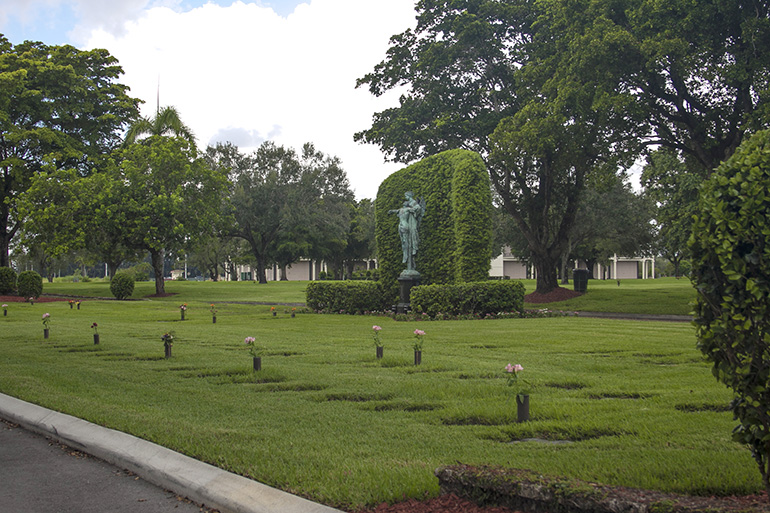
Photographer: ROCIO GRANADOS | LVC
Section of Our Lady of Mercy Cemetery where priests and bishops of the Archdiocese of Miami are buried.