The Brooklyn-born son of first-generation Irish immigrants, Msgr. Reynolds is marking his 80th birthday (Jan. 18, 1925), his 55th year in the priesthood (ordained June 3, 1950 for the Archdiocese of Brooklyn) and his 25th year as pastor of St. Henry, a parish of 1,300, as he puts it, “chronologically-gifted” families. After the vigil Mass on Saturday nights, Msgr. Reynolds is better-known as the singing and joke-telling emcee of Henry’s Hideaway, a 987-member private club which he describes as “a pastoral experiment to create community.” Msgr. Reynolds came to south Florida in 1966 on the advice of doctors who said it would alleviate his bouts with pleurisy. He holds master’s degrees in psychological counselling and religious education and was named a monsignor in 1997.
Nicknames:
“Baby, baby” for his trademark line; “gangplank Jim” for his frequent sailings on cruise ships; “God’s little bookie,” a moniker he shares with his two long-time secretaries, because “they help me make reservations for our exciting shows.”
What he did before becoming a priest:
He was an usher at Ebbett’s Field when the Brooklyn Dodgers played there. He sold lamps at Abraham and Strauss, worked in the machine shop at Sperry Gyroscope Co. and worked for a division of the Shell Oil Company in the RCA building in New York. As a seminarian, during summer vacations, he was a lecturer on the Gray Line sightseeing buses in New York City –“uptown in the morning, downtown in the afternoon, Chinatown at night.” He also worked for the Martin Travel Co. in the Empire State Building, escorting tours to Canada.
When he knew he wanted to be a priest:
At age 19 or 20: “I was impressed by the joy that priests seemingly possessed.” Seeing the movie “Going My Way” with Bing Crosby clinched it, as did his work as a tour guide. “In leading people to exciting locations on earth, I thought I might be able someday to escort people to heaven and manage perhaps to get in through a side door myself.”
What he would be doing if he had not become a priest:
“Certainly not show business—I’d starve.”
‘I might be able someday to escort people to heaven and manage perhaps to get in through a side door myself.’
What he does on his days off:
“I save them up and then sail away as a chaplain on a cruise ship.”
His love of the stage:
“I always admired entertainers… They can get before an audience and touch the hearts and minds of people of all faiths and all races.”
Where he learned to dance the cha cha and the mambo:
“Misspent youth—spent with a lot of misses.”
A priestly stereotype that he feels should be discarded:
“That a priest is above the rest of the people or better than the rest of humanity.”
Favorite priestly assignment:
“Here at the family of St. Henry. I’m hoping it will never end.”
Greatest disappointment:
“Not taking advantage of the opportunity to learn to play the piano.”
Most difficult aspect of being a priest:
“As a young priest, having to count the collection. As an old priest, receiving negative rather than constructive criticism.”
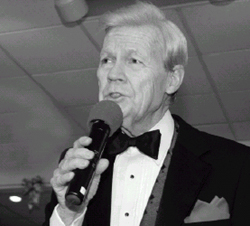
Msgr. James Reynolds performs 28 Saturdays a year at Henry’s Hideaway, his parish’s private club and “pastoral experiment.” His view of life matches that of Mame on Broadway: “Life is a banquet and most darned fools are starving themselves to death… St. Peter might say to us, ‘Did you enjoy the party?’ There’s no dress rehearsal. This is it. You only go around once.”
His description of the ideal priest:
“I could sum it up in one word: kindness.”
What the seminary did not prepare him for:
“Having a cocktail lounge.”
His greatest accomplishment:
“Creating Henry’s Hideaway, which has become so popular for people of all faiths.”
Henry’s Hideaway:
Founded with Archbishop Emeritus Edward A. McCarthy’s blessing in 1984, the club, located in St. Henry’s parish hall, has a liquor license and books 28 Big Band, Las Vegas and Broadway-style acts each year. He has never had any problems: “People seem to be aware that this is a very wholesome, high class, elegant establishment.”
Hobbies:
Travelling: He leads two parish trips a year, one to Las Vegas and the other to Hawaii or Europe. He also serves as a chaplain on two cruises a year and takes his parishioners to local theatres to see Broadway shows.
Person he most admires:
“My good friend, Father ‘Happy’ Hoyer because of his cheerful service to his parish…”
Thing he most fears:
“Growing old and being on the shelf.”
His legacy:
He jokes that when he was pastor of St. James in North Miami in the 1970s he increased the number of women religious in the parish school by building a swimming pool. “I worry what St. Peter will say to me: All you did in south Florida was build swimming pools and cocktail lounges.”
Born April 1, 1959, in Kerala, the most Catholic state of India, he is the fifth of seven children. Ordained Dec. 23, 1979, he came to the United States in 1990 and worked at St. Agnes Parish in downtown Brooklyn, N.Y. The cold winter did not suit him, however, so a priest friend invited him to come to South Florida. Since 1991, he has served at St. Coleman Parish in Pompano, St. Maximilian Kolbe in Pembroke Pines, St. John Neumann in Kendall and St. Catherine of Siena in Miami. On July 1, 2002, he was named pastor of the newly-created Blessed John XXIII Parish in Miramar.
When he knew he wanted to be a priest:
"In the third grade or fourth grade, when I was an altar boy in church." His uncle is a priest. "I think that kind of inspired me." At the time, however, he wanted to join the Salesians. "They had these youth centers and kids playing soccer all the time. That's what I thought. At that age, I was more interested in sports." His uncle vetoed the idea and told him to become a diocesan priest. "God has a way of making things work out. I ended up being a missionary here, which is nice."
What he would be doing if he had not become a priest:
"I think I would be a teacher. I like being with children, probably middle school."
Favorite TV series:
"I like comedies. I still watch Seinfeld whenever I get a chance. It's about nothing, they say, but it's interesting."
Last book read:
"The DaVinci Code," a thriller in a church setting. "Fiction, of course. There is no fact to it."
Hobbies:
"I like to travel. I like to see places. I like to enjoy God's creation."
Favorite part of being a priest:
"Going into the CCD classes and meeting children in the classrooms and talking to them."
"There are many times in life, when you feel concerned and worried and a little bit weak in your faith, the faith of your people inspires you."
Has it been difficult to start a parish?
"No. Not really. Because I met so many nice people here. They're the ones who build the parish. They make the parish here every Sunday."
On last year's sex abuse scandal:
"As priests, all of us were not having good days (back then). But I started meeting people and they picked up my faith. That's the most amazing part of being a priest - faith supplies. There are many times in life, when you feel concerned and worried and a little weak in your faith, the faith of your people inspires you. That, I experienced last year in the parish."
Most difficult aspect of being a priest:
"You feel like you are so limited. Many things you find are beyond your control. You feel powerless."
His description of the ideal priest:
"Very compassionate, understanding, listening to the people's problems, praying with them and for them. And I'm not there yet. I'm still working on it."
Sign on his desk:
"Be patient. God isn't finished with me yet."
Priestly stereotype that should be discarded:
"We need to bring the human side of priests out to the people more. I wouldn't want to stand on a pedestal."
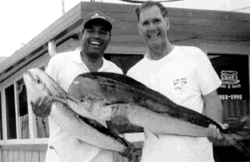
Father Joseph Kottayil, left, and Father James McCreanor, of Sacred Heart Church in Homestead, with two that did not get away. "I kept the picture to prove that I really caught one," Father Kottayil said.
His harshest critic:
"Me. I think I'm hard on myself sometimes."
When he feels he has failed:
"When I do not connect with others, my fellow human beings."
What the seminary did not prepare him for:
"The administration part of being a pastor is kind of left out. Being a pastor is sometimes being a CEO. But I guess your kindness and compassion take care of it."
His greatest accomplishment:
"I haven't gotten there yet. I'm still working on it, I think."
Person he most admires:
Gandhi: "My parents had seen him. But he inspired me because he was a non-violent person. He was influenced a lot by Jesus Christ (and his Sermon on the Mount). His doctrine was an all-inclusive doctrine, the poor as well as the rich."
Thing he most fears:
"The day I won't be able to be a part of the community, part of a family of God. I fear that because I like being in the community now."
Born Oct. 18, 1950, in West Palm Beach, Archbishop Wenski is the son of first- and second-generation Polish immigrants. He attended Sacred Heart School in Lake Worth and in ninth grade entered what was then the high school seminary of St. John Vianney. He continued his studies at St. Vincent de Paul Regional Seminary in Boynton Beach and was ordained for the Archdiocese of Miami on May 15, 1976. He was named auxiliary bishop of Miami in 1997; coadjutor Bishop of Orlando in 2003; and will assume his duties as Archbishop of Miami and Metropolitan of the Province of Florida on June 1, 2010.
Born in a storm:
“His birth took place “during the middle of Hurricane King. When I was growing up in Lake Worth my mother would talk about how difficult it was to get to St. Mary’s Hospital in West Palm because of the rain, wind and downed power lines.””
When he knew he wanted to be a priest:
Sometime during the third grade “I began telling people that I wanted to be a priest.”
Person or event that triggered his vocation:
“I am not sure, but one memory I have is when I was in the second grade my parents took me to the wake of our pastor, the priest who baptized me, Msgr. James Cann. (His nephew is Father Carl Morrison, a Miami priest). ... I still remember vividly seeing him laid out in the casket in church and what impressed me was the fact that he was dressed in his vestments as if he were about to celebrate Mass. ‘A priest forever…’”
What he would be doing if he had not become a priest:
“It’s hard to say – since I’ve always had a hard time imagining me doing anything else. Nothing else ever held the allure or the excitement that priesthood offered me.”
Favorite priestly assignment:
“Perhaps the one I did the longest. I spent 18 years as a parish priest among the Haitian communities of south Florida. ‘Favorite’ doesn’t mean it was necessarily the easiest but it afforded me the opportunity to work among the poor and disenfranchised and to be in a sense ‘a missionary priest’ in my own backyard.”
‘Nothing else ever held the allure or the excitement that priesthood offered me.’
Most difficult aspect of being a priest:
“When John the Baptist introduced his disciples to Jesus he said, ‘He must increase and I must decrease.’ I think that’s always been for us the challenge - to get out of the Lord’s way so that our failings, our idiosyncrasies, our own ego does not distract our people from encountering Jesus in and through our ministry.”
His description of the ideal priest:
“The ideal Christian, priest and bishop I have encountered has been John Paul II. He was a man happy in his own skin, proud of his ethnic and cultural identity as a son of the Polish nation, and totally given over to Christ.”
What he does on his day off:
“A lot of times, since I am so busy on my days ‘on,’ I just like to chill and do nothing; but, if I have the time and the weather is good, a motorcycle ride helps clear the ‘cobwebs’ from the mind. It’s exhilarating and, believe it or not, relaxing.”
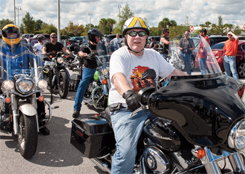
Bishop Wenski, shown here leading the "Bike with the Bishop" fundraising run in Orlando in 2009, says “a motorcycle ride helps clear the ‘cobwebs’ from the mind.”
Favorite TV series:
“When I get the time to watch TV, I like ‘House."
Last book read:
"What Your Money Means - And How to Use It Well” by Frank J. Hanna. “Not that I have any money to speak of, but Hanna writes from the conviction of his Catholic faith about how he and other persons of influence and affluence can avoid the dangers of wealth and in fact use it as a school of virtue."
Favorite type of music:
“On the CD player in my car, I have a disk of Polish folk songs, one of Haitian ‘Kompa,’ one of Cuban salsa and one of Gregorian chant.”
His greatest disappointment:
“That I haven’t learned to speak Polish well; I’ve tried but it’s a very hard language to master.”
His greatest joy:
“To pass on the priesthood of Jesus Christ through the laying on of my hands when I ordain someone a priest.”
His greatest accomplishment:
“That despite my shortcomings and human weakness I was ordained a priest 34 years ago.”
His harshest critic:
“Probably that person who wrote the last angry letter to me - today, many people are angry and frustrated and it’s amazing how vehemently and often uncharitably people will disagree with something I say in my capacity as a bishop and teacher of the faith.”
Born Nov. 19, 1961, in Chicago, Father Vega moved with his family to Manatí, Puerto Rico, at the age of 11. He entered St. John Vianney College Seminary after graduating from high school, and was ordained for the Archdiocese of Miami on May 27, 1989, in Manatí. Archbishop Edward McCarthy granted him special permission to be ordained there, and Auxiliary Bishop Agustin Roman flew in to ordain him surrounded by family, friends and nearly the entire town. Among his assignments, he served as pastor of St. Martin de Porres Parish in Leisure City from July 2001 to October 2010, when he was appointed pastor of St. Bernard.
When he knew he wanted to be a priest:
"I have a vivid memory of being in second grade and telling my mother that I wanted to be a priest. It was a feeling that never left me. When I was 16 years old I went on my first youth retreat/ encounter. That did it for me; it propelled me to follow my vocation."
Person or event that triggered his vocation:
"My mom. … She was a servant to others; she was always charitable and kind. She was a great example to me and my five siblings. She always took us to church, fed the hungry, donated her time and money to those in need and never said no. She was always willing to help."
Person most surprised by his vocation:
"My friends. In high school I was a very good student (4.0 GPA) and they thought I was going to be an architect or an engineer. When I told them I wanted to become a priest and I was going to enter the seminary, they didn't understand why I would leave everything to become a priest."
What the seminary did not prepare him for:
"I think I was in the seminary during a great time. We had wonderful world-renowned theologians come and speak to us. I learned so much. If I have to say something I would say the administration — how to run a parish. I have had to learn that on my own through time and by experience."
'I like to be around people, to talk and to share with others.'
What he would be doing if he had not become a priest:
"I would have been a math teacher. I enjoyed and was very good at calculus and algebra."
The most difficult aspect of being a priest:
"Having had to live by myself. When I was a parochial vicar at a parish, I lived with other priests and it was nice to have someone to speak with, eat dinner with or just watch TV with. As a pastor I have had to live twice by myself."
His description of the ideal priest:
"He would be humble, compassionate and would show people how Christ lived through his actions."
What he does on his day off:
"Sleep in! I like to visit other priests, friends. Go out to eat, watch a movie or go for a walk in the mall."
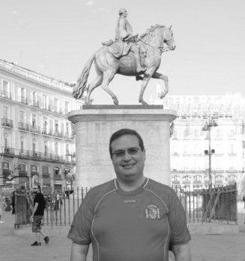
Father Carlos Vega is shown here visiting Madrid during a trip to Spain in July 2010. While he was there, the Spanish national soccer team won the World Cup.
Favorite movie:
"Any of the Harry Potter movies (and) I like sci-fi!"
Favorite TV series:
"Stargate"
Favorite type of music:
Latin and pop
What he collects?
"I don't collect anything really, but I do have lots of books, DVDs and CDs."
Person he most admires:
"My high school math teacher, Mr. Cruz. He gave me the confidence to come out of my shell. He encouraged me and taught me to speak in public. He used to let me get in front of the class and teach a lesson. It really helped me grow up and be responsible."
His greatest disappointment:
"Living far away from my family (they are all in Puerto Rico) and not being able to see them often or be there for them when they need me."
His greatest joy:
"To share Christ with others."
His greatest accomplishment:
"To teach the people of God. I like to use my homilies as teaching moments and have the people feel and understand the liturgy."
His harshest critic:
"People who don't know you and then turn around and judge or criticize you. I tend to come off as very quiet at first. I'm shy and it takes time for me to open up to people but once I do, I give of myself completely."
Thing he most fears:
"To be alone. I like to be around people, to talk and to share with others."
Born in Havana, Cuba, July 14, 1953, Father Jiménez entered the Seminary San Carlos and San Ambrosio in Havana in September 1974.
He was ordained for the Salesian congregation Jan. 24, 1982, in the parish of San Juan Bosco, Havana, and named director of the marriage ministry for the Diocese of Cienfuegos-Santa Clara. He obtained a licentiate in theology from the Pontifical Salesian University in Rome in December 1987. From 1987 to 1990, he completed a master's degree in catechetical theology at the Pontifical University of Salamanca, Spain. He returned to Cuba and was assigned to San Juan Bosco Parish in Santiago, where he was in charge of youth ministry and religious education. He also served as prison chaplain in Boniato, Cuba.
He arrived in Miami July 5, 1992, “almost at the same time as the destruction of Hurricane Andrew” and began the process of incardination as a diocesan priest. He obtained incardination in 1999 and became an American citizen the same year. In 2000, he graduated from St. Thomas University, Miami Gardens, with a master’s degree in marriage and family therapy. He has served as director of the Family Enrichment Center since 2004.
What he did before becoming a priest:
He studied at a business school in Cuba and worked as a bookkeeper.
Current responsibilities:
He celebrates weekend Masses at St. Martin de Porres Parish in Leisure City and is spiritual director of the Christian Family Movement. As director of the Family Enrichment Center, he oversees English-language marriage preparation programs, works with the ministry to divorced and separated, Pre-Cana II (for couples entering second marriages), ministry to widows and widowers and parents who have lost children, natural family planning classes and other services to families. The Family Enrichment Center also coordinates talks in the parishes regarding the annulment process and marriage convalidations, and hosts an annual Mass for couples marking wedding anniversaries.
"I feel very happy, at peace and with a great sense of gratitude."
Vocation moment:
After completing the required military service in 1969 or 1970, he attended a Mass marking the end of a vocations awareness day at a church in Santa Clara. “The priest who was leading the day told us that Cuba's young people needed to step up and say 'yes' to God to be priests. He told us that without priests there is no Eucharist, and without Eucharist there is no church because there is no community. Right then and there I went to the sacristy and offered to be a priest.” He was 17 at the time. The priest suggested that he wait until finishing high school. “I started receiving spiritual direction and served as a catechist while going to school. During my second year in high school, I felt the call to be a priest more profoundly. I accompanied a priest to the escuelas de campo (where teenagers are sent for mandatory service in Cuba's farmlands) and I decided to enter the seminary when I was 21.”
What he does on his days off:
“I have Prince, my Sheltie dog. I live with my uncle, my sister, my brother-in-law and my nephew, and I enjoy time with my family. I shop for groceries, take clothes to the dry cleaners and do other chores around the house.”
Greatest disappointment:
“I came to this ministry full of dreams and I would like to be able to do more things, such as domestic violence prevention, classes for effective parenting, etc. But so far they're not getting done.”
Greatest joy:
“Being able to mark 25 years in the priesthood. I feel very happy, at peace and with a great sense of gratitude toward God, my parents and my spiritual advisors.”
His greatest accomplishment:
“To have learned English and be able to communicate and celebrate the sacraments in English.”
What he collects:
“I like boats. For me, the ocean evokes freedom, movement, departures. Boats remind me that life is a continual journey.”
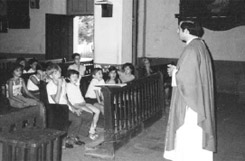
A recently ordained Father Eduardo Jiménez teaches catechism to children at Nuestra Señora del Carmen Parish in Santa Clara, Cuba. In 2006, he presided at the wedding of one of the girls in the photo.
Priestly stereotype that should be discarded:
“That of a moralist, intransigent, dominating, imposing priest who reflects a pyramidal church rather than a communitarian one.”
Thing he most fears:
“Not being faithful to Christ.”
Born April 11, 1963, in Lima, Peru, Father Rodriguez De La Viuda was the second of four children. He attended the Universidad de San Martin de Porres in Lima, where he earned a bachelor's degree in business administration. He worked for a hotel in that city, then moved to Florida 25 years ago. In 1994, he finally acted on longtime spiritual leanings and entered St. John Vianney College Seminary in Miami.He then earned a master's degree in divinity at St. Vincent de Paul Regional Seminary in Boynton Beach and was ordained for the Archdiocese of Miami on May 12, 2001. Before coming to Our Lady Queen of Martyrs in June 2011, he served at St. Rose of Lima in Miami Shores and Good Shepherd in Kendall Lakes. He is also archdiocesan chaplain to the Hermandad del Señor de los Milagros, a Peruvian-based devotional group that has branches in South Florida.
You were in hotel management before becoming a priest. Why did you switch?
"I didn't consider it a switch. I'm still in hospitality. The essence of hospitality is service. As an ordained priest, I continue practicing hospitality by bringing Christ to others. Hospitality is no longer a business to me but a mission."
Person or event that triggered his vocation:
"One event that opened my eyes was when I was still in Peru. I decided to join a young adult group that helped Vincentian priests who were evangelizing rural areas in the mountains. I thought you needed to be an accountant or lawyer or businessman to be important in the life of people. That experience opened my eyes to see that the ministry of a priest is basic to the life of communities."
Did it feel strange to enter seminary when you were almost 30?
"Not when I entered. A lot of guys were in my situation, entering the priesthood as a second career. There was a flight attendant, an accountant and a teacher. They'd worked in the secular world and decided later in life to follow the steps of the priesthood."
'I'm still in hospitality. The essence of hospitality is service.'
Did your business training help you as a priest?
"It gave me a lot of tools to be a good administrator. I learned to deal with people one to one."
Was it a shock to come to America and see the difference in the society?
"My first impression was that people who were Catholic were more involved than people in my home country, maybe because we're not the majority here. I especially saw lay people proudly participate in the life of a parish. I never saw that in Peru. There, it's more cultural than actual personal devotion. Now, throughout the years, that continues, but I've also been exposed to the secularism that prevails all over the world. People are very critical of many things, including the Church. "
Hardest part of being a priest:
"What really breaks my heart is when I see people in parishes criticizing the Church. Of course we are allowed to critique constructively. But many people criticize for the sake of criticism."
Priestly stereotype that should be discarded:
"Most of what you see in movies and soap operas, especially for Latinos. In most telenovelas, the priest is always a dummy, self-centered. And in American movies, he's usually celebrating a wedding or funeral and he's clueless."
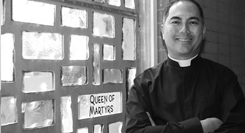
Father Jorge Rodriguez De La Viuda poses at one of the faceted glass windows at Our Lady Queen of Martyrs Church, Fort Lauderdale.
Favorite movie:
'The Mission,' the movie and the soundtrack. When it came out, I was going on mission work. It made me appreciate the work the Church has done throughout the years. And the music was awesome."
Something most people don't know about him:
"A lot of people don't realize it because my name is very Spanish, but I am also Chinese, on my mother's side. I was raised in a mostly Chinese environment. In Peru, they called me 'El Chino.' But here, people perceive me mostly as Latino."
Favorite type of music:
"I'm very eclectic. When I'm in the office, I listen to classical. I'm also into Celtic and Peruvian music. But I'm not musically inclined. My brothers play every instrument. I only play guitar."
A treasured possession:
"I have a pyx (a small container to bring Communion to the homebound) that was given to me by Pope Benedict XVI when he was Cardinal Ratzinger. I was visiting Rome, and he learned that I was from Peru. He used to travel a lot to Ecuador and Peru, so we conversed about the Church and Latin America."
Most memorable spiritual experience:
"I was working in a mission in Peru and went to a very poor village. I saw the people as suffering people. But they gave us so much love and joy by allowing us to be with them. They became the missionaries to us. We were overwhelmed. It made us better Christians."
His greatest accomplishment:
"When I finally opted to enter the seminary. I was discerning for many, many years. When I finally said 'This is enough,' and took the plunge, I was very happy that I did it. If I hadn't, I would be still doing fine, but always wondering what if."
His greatest joy:
"As a priest, it is when I see people either coming back to God, or when I see children who have been formed by their parents in the faith and have an awareness of God."
Born Oct. 2, 1967, in Tulia, Texas, Father Garza is the oldest of four children. His great-greatgrandparents were cattle ranchers from southern Spain who settled in that area of the U.S. when it was part of Mexico. His parents moved to Clewiston when he was young and he graduated from Clewiston High School before entering St. John Vianney Seminary. He was ordained for the Archdiocese of Miami on May 11, 1996, and served at St. Mary Star of the Sea in Key West before being sent to Rome to obtain a licentiate in missiology from the Gregorian University. He worked with Catholic Charities and as pastor of San Isidro Parish in Pompano Beach before being named archdiocesan vocations director in January 2009.
What he did before becoming a priest:
He worked as a bank teller while pursuing a degree in architecture. He ultimately received a two-year degree in drafting.
When he knew he wanted to be a priest:
Even though his family was religious and attended Mass faithfully, the thought never entered his mind. "I wanted to be married, have a lot of kids and be an architect." Then a friend from the youth group at San Isidro Parish insisted he attend a vocations retreat in Conyers, Ga. "I didn't know what a vocation was. … I went to the retreat just to get him off my back." By the last day, "I decided, I've heard so much, I like this. So why not try it out?" He began the discernment process and entered the seminary at age 20. "They told me, at any point, you can leave. You don't commit until you reach ordination. That was a sense of relief for me. I had nothing to lose. I said to myself, 'I'll give it a chance.'"
"They told me, at any point, you can leave. … That was a sense of relief for me. I had nothing to lose."
Person most surprised by his vocation:
"My father was adamantly against me being a priest" and did not speak to him for a year after he announced his decision. In part, his father feared the priesthood would take him too far from his family; in part, his objections were rooted in the anti-clericalism that exists in the Mexican culture. "We don't like priests but we go to Mass." Father Garza's vocation "healed a lot of my family's misconceptions about the priests and the nuns" and his father "eventually became my greatest support and my best friend." Ironically, Father Garza has remained geographically closer to his dad, who died in 2000, than any of the other children, who moved to other states. His dad is buried at Our Lady of Mercy Cemetery in Miami. When he visits there, Father Garza likes to remind him, "Here I am again; your only son who's here."
What the seminary did not prepare him for:
Parish administration: "A parish is almost like a business. You have to run it. You have to make decisions and if you're not prepared, you're going to make bad decisions."
What he would be doing if he had not become a priest:
"I probably would have pursued architecture. I still read and I have my drafting table. I still draw."
The most difficult aspect of being a priest:
"Dealing with the fact that you can't please everybody."
His description of the ideal priest:
"A priest who loves and forgives as Christ does; who does not judge."
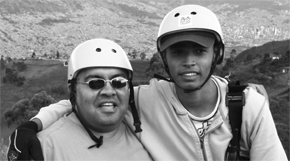
Whenever he travels to the mission in Colombia, Father Garza takes a day to go paragliding off a 9,000-foot mountain. He took up the sport three years ago. "I feel freedom." Here he poses with his paragliding instructor/partner, a young man known by his nickname, "La Garza" (the heron). A video of Father Garza paragliding can be seen at old.miamiarch.org.
Priestly stereotype that should be discarded:
"That they're perfectly holy."
What he does on his days off:
"Drive to Key West, have lunch and come back." He also spends much of his vacation time helping out at a mission in the suburbs of Medellin, Colombia. "Most of what I do is the financial part of it," raising funds in the U.S. to build a church there.
Favorite movie:
"The Mission."
Last book read:
"Road to Cana" by Anne Rice.
Favorite type of music:
"I love to dance so I like the cumbia."
What he collects:
Nativity scenes. Right now he has about 30, including one from Africa. "I never buy any. They've all been given to me and that's how I started collecting them."
Hobby:
"Trying to do anything I can for the mission in Colombia."
Person he most admires:
"My mom and dad."
His greatest joy:
Baptizing and celebrating the sacraments for his nephews and nieces.
Thing he most fears:
"Judging others."
Regrets:
None, not even on not marrying or having children. Among his parishioners and friends, "I have tons of children and brothers and sisters. … It's a mystery that you can't understand unless you're a priest and you allow yourself to live that mystery."
Born June 24, 1945, in Cork, Ireland, Father Murphy is one of seven children. He entered St. John’s Seminary in Waterford, Ireland, right after high school as a “freelance seminarian,” unattached to a diocese. He chose Miami because“ it was a new diocese.
I wanted a diocese where I had the opportunity to exercise leadership at a young age.” He was ordained in Waterford on June 7, 1970 and arrived in Miami in September. Before becoming pastor of Our Lady of the Lakes in 1996, he served as pastor of St. Patrick in Miami Beach and before that as director of youth ministry for the archdiocese.
What he did before becoming a priest:
At age 6: “My uncle was ordained then. He was a Columban missionary” who, along with two dozen others, was being sent to the Philippines and Korea. Young James and his family were at the docks seeing them off. “I can remember them sailing away. We were waving my sister’s diaper, which was nice and big. I heard 25 people say ‘Goodbye, James’ from that ship. It was literally impossible for the voices to travel that far. But that’s what I heard. I made up my mind at that time that I was going to follow them.”
His arrival in Miami:
“I had never set foot in the United States before.” He remembers being surprised because “it rains warm water here. I found that quite extraordinary.”
‘ I love to do funerals more than anything else. ’
What he would be doing if he had not become a priest:
“I’d probably be in business.” His dad was a businessman as well as both of his grandfathers. “It’s kind of in my blood. I wouldn’t have a problem being the CEO of Publix.”
What the seminary did not prepare him for:
“Dealing with the pain in people’s lives.”
Favorite priestly assignment:
“I love to do funerals more than anything else. I think at funerals there’s a reality that’s not present at other times. Mourners are going to listen to the Scriptures with a lot more intensity than people do on a Sunday. There’s a hunger for God’s word present at a funeral that you don’t see anywhere else.”
On funerals:
“I immerse myself in the pain. I grow from that. I’d like to think I’ve been preparing for my mother’s death for a long time. … I treat that casket and that family as if it were my mother.”
The most difficult aspect of being a priest:
“Unrealistic expectations on the part of just about everybody, from the bishop down to the people.”
His description of the ideal priest:
"A priest that can overcome that human element (such as crying babies and ringing cell phones) and still celebrate each sacrament with joy.”
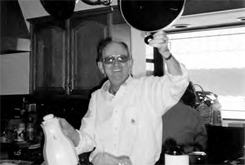
Father James Murphy, seen here among his pots and pans, loves to cook. He hosts a Thanksgiving meal every year for people from his parish who would otherwise have to celebrate the holiday alone.
Favorite TV series:
“I just watch sports and news so I couldn’t tell you what else is on."
Favorite type of music:
“When it comes to music, I’m all over the world” from classical to new age to opera to folk. “I like the folk music of just about all the world.”
What he collects:
Music CDs; he has about 1,000.
Person he most admires:
“Single mothers who struggle to raise children on their own.”
His greatest disappointment:
“I don’t know if anything qualifies. … The reform of Vatican II that threatens to be overturned, that kind of bothers me. I saw the Church going in a good direction, a positive direction, and I worry whether it will stay in that direction.”
His greatest accomplishment:
“Being able to speak in public. Shy is not even the word.”
Thing he most fears:“
“I don’t have any fears. What I have difficulty in dealing with is when people question my motivation.”
Regrets:
“If I had the wisdom 20 years ago that I have now.”
Born Aug. 9, 1941 in Jamaica Plain, N.Y., he moved to Miami in 1949 and grew up in Holy Family Parish, North Miami. He attended Archbishop Curley High School and entered the seminary during his senior year. Ordained in 1968, he served as the founding director of the archdiocesan Office of Worship from 1978 to 1984. He has spent 24 of his 35 years as a priest at St. Louis Parish in Pinecrest, including the last 21 years as pastor. "I think I'm this close to marrying one of the kids I baptized here." He also serves as dean of the South Dade Deanery.
When he knew he wanted to be a priest:
Probably around the fifth grade: "You'd be serving at Mass and there was just something very special about all that." He would also lock up the church and set out the vestments for the next morning. "The priests that I knew trusted me. ...I learned how to drive in the church truck when I was 12 years old because Msgr. (Rowan) Rastatter let me drive the truck around the parking lot. ...He was my hero."
What he would be doing if he had not become a priest:
"I haven't the vaguest idea. There isn't anything else that I ever think about being. ... I could just as easily be bagging groceries at Publix."
Why he never wanted to be a missionary:
"I wanted to be a priest and Holy Family would do just fine. To this day I get nervous going to Broward County."
What he does on his days off:
"Take a deep breath. I'll go and spend the day with a friend. Go to a movie. Get off by myself and read.
Hobbies:
"I've played at tennis. To say that I was a tennis player would dishonour the sport."
"I learned long ago that I'm not the Messiah. We only had one of those."
Best memory:
"The morning we went up to celebrate Mass with the Holy Father." He was one of the 38 priests studying at the North American College in Rome who gathered in the pope's private chapel on Nov. 30, 1989, at 6:30a.m. When it came time for the homily, the pope simply said, "'Today we let Jesus speak.' And he sat down. We all reflected on the Gospel for seven minutes."
Greatest frustration:
"Not being able to do all the things people would like me to do."
Greatest joy:
"The people who are here with me at St. Louis. I pray to God I never abuse that trust."
Most difficult aspect of being a priest:
"When things happen that you can't have any control over and you don't have all the glib answers. Or you can't wave the wand and make it all better. I learned long ago that I'm not the Messiah. We only had one of those."
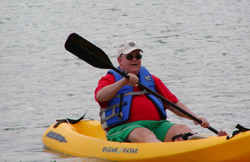
Father Fetscher kayaking on the Great Lakes during a recent vacation.
His description of the ideal priest:
"To be all things to all people. ... Jesus certainly poured himself out for people. That's the standard by which we measure ourselves."
Favourite type of music:
Peggy Lee, Louis Armstrong, Leonard Bernstein
What he collects:
"Everything" but especially books: "I had this idea that if I owned the book and it sat in the shelf, somehow, by sheer osmosis, whatever was in it would stay in my head."
On his personality:
"You're looking at a guy who voted for Barry Goldwater and George McGovern. Think about that."
Favourite priestly assignment:
"The one I'm in."
Person he most admires:
Auxiliary Bishop Agustin Román: "I'm continually amazed at his capacity for charity, gentleness and kindness. If I could have a tenth of it, I would be a happy man."
Born Dec. 5, 1960, in Sliema, Malta, Bishop Baldacchino is the second oldest of four children three boys and a girl born to Leonilda (known as Hilda) and Rinaldo (known as Rene) Baldacchino. When he was 13, his family joined the Neocatechumenal Way. He studied at St. Francis School in Msida and Mount Carmel College in Santa Venera, Malta, then studied science and chemistry at the University of Malta.
He entered the Redemptoris Mater Archdiocesan Missionary Seminary in Newark, N.J., in 1990, obtaining a bachelor's in theology, and a master's in divinity from Seton Hall University. On May 25, 1996, he was ordained a priest for the Archdiocese of Newark and assigned as parochial vicar to Our Lady of Mount Carmel in Ridgewood, N.J. In 1999, he was named chancellor of Our Lady of Divine Providence Mission in Turks and Caicos Islands, a missio sui iuris (independent mission) for which the Archbishop of Newark is responsible. He became pastor of Our Lady of Divine Providence Church in Providenciales in 2002, and in 2009 was named a Chaplain to His Holiness, with the honorary title of monsignor. Pope Francis appointed him auxiliary bishop of Miami Feb. 20, 2014.
What he did before becoming a priest:
He worked for nine years as a technical manager for Canada Dry in Malta. "I was a workaholic 36 hours straight work without going home."
When he knew he wanted to be a priest:
After attending World Youth Day in Santiago de Compostela, Spain, in 1989.
Person or event that triggered his vocation:
"The World Youth Day in Santiago de Compostela in 1989. The words of John Paul II in his homily, 'Do not be afraid to be holy,' opened a new perspective to life for me."
What the seminary did not prepare him for:
Press conferences.
His hobbies:
"I always enjoy a good fishing trip."
Most difficult aspect of being a priest:
"Comforting someone who has lost a loved one; when no words can fill that void and we can only offer to be present and share their suffering."
'The words of John Paul II in his homily, "Do not be afraid to be holy," opened a new perspective to life for me.'
His description of the ideal priest:
"Does not exist."
Favorite movie:
"Preferisco Il Paradiso" based on the life of St. Philip Neri.
Favorite sport:
Soccer.
Last book read:
"Jesus of Nazareth: The Infancy Narratives" by Pope Benedict XVI.
What he does on his day off:
"Day off is only a term."
Person he most admires:
"Blessed Pope John Paul II, because he changed my life and was instrumental in my calling to the priesthood."
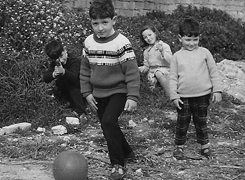
Peter Baldacchino, front, gets ready to kick a soccer ball while playing with his siblings, from left, John, Paula and Robert, in their native Malta.
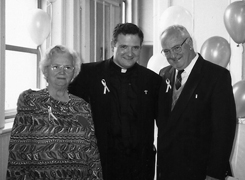
Newly ordained Father Peter Baldacchino is seen here with his parents Leonilda (known as Hilda) and Rinaldo (known as Rene).
His greatest accomplishment:
"To be an instrument in God's hand in establishing a Catholic presence in the Turks and Caicos Islands."
His greatest joy:
"The day of my ordination to the priesthood."
His greatest disappointment:
"That my father's health prohibits him from attending my consecration (as bishop)."
His greatest fear:
"Myself."
'Jet-set' producer
Father Oswaldo Agudelo, 54, comes to the priesthood after a jet-setting life as a public relations executive for Lufthansa, and later an Emmy-winning executive producer for Telemundo Internacional.
A native of El Carmen de Atrato in Colombia and the second of three siblings — his older brother will be ordained next year for the Diocese of Brooklyn — Father Agudelo studied art in Barcelona, Spain, and mass communications in his native Colombia. He is a certified expert on Old Masters paintings and even owned an art gallery in Coral Gables. He also is an expert on the conflict in the Middle East, a region he has visited countless times. He settled in Miami 21 years ago and began attending Little Flower Church in Coral Gables.
“I was a Catholic ‘light’,” he said. “I went to Mass because of the obligation.” In the meantime, he lived a “very agitated social life,” indulging a taste for nightlife, travel and luxury cars.
That changed in 2005, when Telemundo shut down its Miami-based, 24-hour news operation. He took a job with Univision in Sacramento, California, but the city bored him.
One morning, on his day off, he took a walk around the neighborhood and wound up in a Catholic cemetery. Sitting in one of the mausoleums, he told himself, “I’m going to pray an Our Father for each of these souls.”
Suddenly, he felt a hand on his shoulder. It was the groundskeeper. The cemetery was closing. He had sat down to pray at 10 a.m. and it was 7 p.m. “But I liked it,” he recalled, so he kept coming back and spending hours in prayer.
Within months he had quit his job, returned to Miami, and practically “ locked myself up,” praying for as many as 12 or 13 hours a day. He took the 2 to 3 a.m. adoration slot at St. Raymond Church in Miami, where his companion was often the pastor at the time, Father Jordi Rivero.
One night he got up the courage to ask: “Father, is it very hard to be a priest?” To which Father Rivero replied: “You’re ready. Go to the vocations office.”
“I’ve never in my whole life been happier than I am now,” Father Agudelo said.
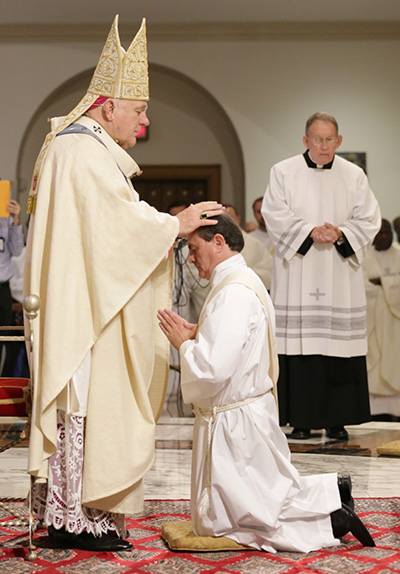
Photographer: TOM TRACY | FC
Archbishop Thomas Wenski lays hands on Oswaldo Agudelo, ordaining him to the archdiocesan priesthood.
And neither are his parents back in Colombia. When he told them he was entering the seminary, they confessed they had been praying two to three hours a day for him to leave his jet-set life behind.
“What everyone in the world considers success, they saw as taking me away from God,” Father Agudelo said. “People say, ‘What a life!’ But it really was, ‘What a fall!’ I would not change any of it for what I’m doing now.”
His first assignment was to Our Lady of the Lakes, Miami Lakes.
Watch his video interview here:
Back
‘Prodigal son’
Father Luis Pavon, who turns 36 May 20, is that rarest of breeds: a Miami native, born at Mercy Hospital, a graduate of St. Michael the Archangel School and Christopher Columbus High School. The second of four siblings, he recalls growing up in a “faith environment,” even though that did not include regular attendance at Sunday Mass.
After earning a degree in English from FIU, he worked at a marketing firm and other “odd, English-related jobs.” He also “abandoned” himself to the world. He didn’t question his faith. He didn’t search for truth. He just became convinced that “it was impossible to live like Christ has called us.”
But “the world is an unfaithful lover,” he said. “It doesn’t treat the ones who give into her very well.”
At 25, prompted by the death of Pope John Paul II, he made a radical return to the Church. He decided to become a monk and spent three months at a Trappist monastery in Conyers, Georgia. “I thought I was going to shut myself away from the world to do penance for my sins.”
When that didn’t work out, he began attending Mass at St. Augustine Church and Catholic Student Center in Coral Gables. Soon, he was leading the young adult group and serving as sacristan. He continued to discern the call to priesthood, and sensed the Lord assuaging his fears, letting him know that “this time it will be different.”
His story, he said, is biblical. “The prodigal son returns and knows who he really is.” He hopes that experience will make him a better priest, one more open to people’s need for God’s mercy.
“I have an intimate knowledge of sin and an intimate knowledge of the hunger for God,” he said. “I think I understand why that hunger (exists) in others. And the banquet that’s been offered to me, I would invite them to share it.”
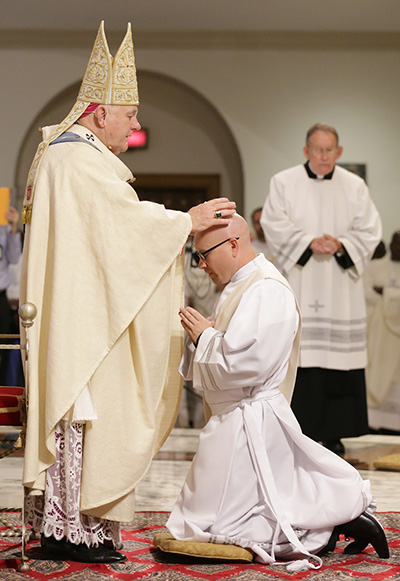
Photographer: TOM TRACY | FC
Archbishop Thomas Wenski lays hands on Luis Pavon, ordaining him to the archdiocesan priesthood.
Father Pavon has been assigned to Our Lady of Guadalupe in Doral.
Watch his video interview here:
Back
Seeking signs
Father Luis Flores, Jr., 41, admits his was a late vocation. A native of Lima, Peru, and the eldest of three brothers, his family moved to the U.S. in 1983. After a one-year stint in Miami, they moved to Washington, D.C., where his father found work in government radio. Upon returning to Miami in 1996, Luis began working as a project manager for a security systems company. His mother kept after him to stay close to the church, and he joined Our Lady of Lourdes Parish in Kendall, “but I wasn’t getting anything out of it.”
Then he went on an Emmaus retreat. “That’s when this life of service kind of began to attract me,” he recalled. “I asked God for signs.”
The biggest came through his parents. He remembers his mother’s reaction when he told her, “I think the Lord is calling me.” She lowered her head, said “thanks be to God” and whispered, “Now I understand.”
When he asked her what that meant, she replied: “Something in my heart told me about a month ago to pray that one of my three sons be consecrated to the Lord.”
“That’s when I looked up and said, ‘God, that was a good one,’” Father Flores said.
The same thing happened when he told his dad. “I had a dream” that you were already a priest, his dad told him. “That was like a two-by-four in the back of my head, from God,” Father Flores says now.
He also understands that he had to walk away from his own plans and desires to answer the call to priesthood.
“My understanding of marriage was different than the understanding of marriage that God had for me. God wanted me to have an even greater wife — the Church. He wanted me not to have two children, but many children of all types, of all races,” Father Flores said.
His first assignment was to Little Flower in Coral Gables.
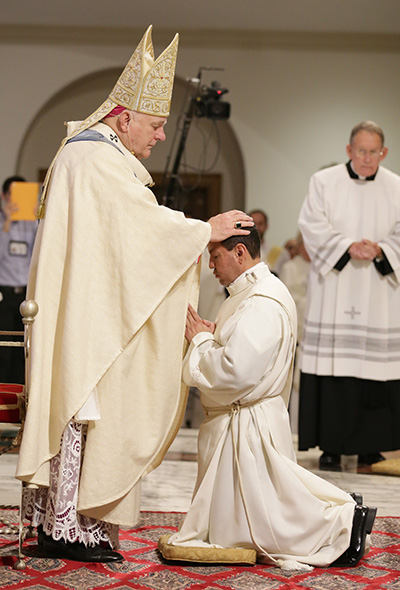
Photographer: TOM TRACY | FC
Archbishop Thomas Wenski lays hands on Luis Flores, ordaining him to the archdiocesan priesthood.
Watch his video interview here:
Back
‘Power seller’
Father Edgar “Gary” De Los Santos, 54, was born in Zamboanga City, Philippines, the youngest of six children. He has a degree in business administration and came to the U.S. in 1991 to work as an investment banker. Settling in Miami Shores, he joined St. Rose of Lima Parish, where he first assumed the duties of sacristan and eventually worked as parish manager.
An adventurous and competitive soul, he took evening culinary classes at Johnson & Wales University in North Miami and opened his own catering company. He’s run the Tough Mudder and 17 half marathons, ranked as a “power seller” on eBay, won a key lime pie-eating contest in Key West and a Honda Element from a local radio station, and even applied to compete on the Food Network’s “Chopped.”
“You won’t catch me watching TV,” he said. “Twenty years from now I can say my life is colorful. I have a lot of stories to tell.”
He began discerning a vocation to priesthood in 2009. The trigger came one night as he was closing the church after a wedding. Alone in the dark, he was walking back to the sacristy when he looked at the crucifix on the altar. “It was the only thing lit. And then suddenly I said, what if you become a priest?”
He had completely forgotten that, as a child, he used to play at being a priest, using the white cardboard under the lid of a Nescafe jar as the host.
“I want challenges,” Father De Los Santos said, and fate has obliged. He left everything behind to enter the seminary, where he was always the oldest of the men. His mother and one sister died during his first three years of study.
“Challenges are still coming, and God is helping me a lot,” he said. “God was with me all those years and will always be with me.”
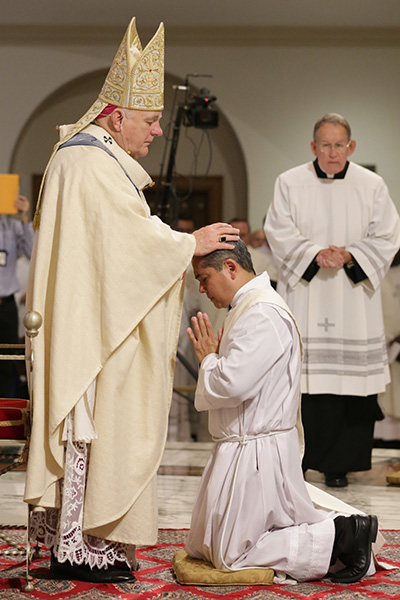
Photographer: TOM TRACY | FC
Archbishop Thomas Wenski lays hands on Edgardo "Gary" De Los Santos, ordaining him to the archdiocesan priesthood.
His first assignment was to St. Gregory in Plantation.
Watch his video interview here:
Back
Science and faith
Father Alex Rivera, 29, was born in Winston-Salem, North Carolina, but grew up in Miami. The oldest of four siblings, he graduated from Our Lady of the Lakes School in Miami Lakes and St. Thomas Aquinas High School in Fort Lauderdale. His family —Peruvian mom, Puerto Rican dad — have always been involved in the Church, and the thought of priesthood occurred to him at first in middle school.
But he also felt called to medicine, and got a full academic scholarship to Duke University in North Carolina. His first year there, “I really started feeling very strongly that desire to priesthood.” His thought: “There are plenty of people who want to be doctors but I haven’t met any who want to be priests.”
He spoke with his pastor about it, the late Father James Murphy of Our Lady of the Lakes. Father Murphy suggested he finish his bachelor’s degree and then consider the seminary. So he returned to Miami and earned his bachelor’s degree in biology from FIU while getting more involved in his parish. He finds it ironic that his stint at Duke convinced him of his vocation.
“I had to go back to where I was born, to North Carolina, to realize what the Lord wanted,” he said. “There was a lot of worry before. Am I doing the right thing? But when I said yes, there was such peace.”
He noted that Father Murphy offered “very good advice” in suggesting he continue his studies in biology. Along with everything French, it remains a passion in his life. He sees no dichotomy between science and faith.
“Contemplating nature and creation is like watching the mind of God at work. That can be prayer,” Father Rivera said.
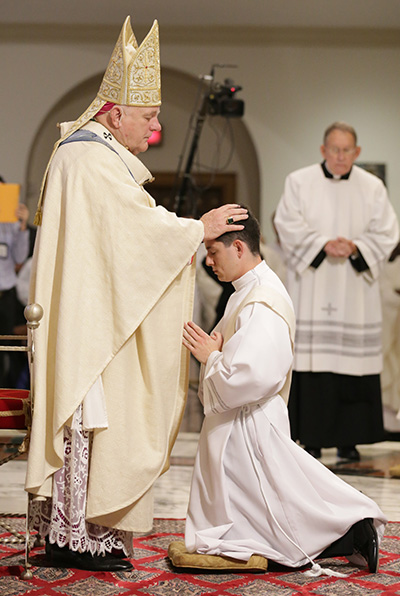
Photographer: TOM TRACY | FC
Archbishop Thomas Wenski lays hands on Alexander Rivera, ordaining him to the archdiocesan priesthood.
His first assignment was to Epiphany in Miami.
Watch his video interview here:
Back
For the deaf
Father Mathew Thomas, who turned 49 May 9, is a native of Kerala, India, who studied economics at Mahatma Gandhi University, Kottayam, India. One of six children whose oldest brother is deceased, he has many priest friends and comes from a family with “a lot of nuns.” One cousin works with the Missionaries of Charity in Libya, another is stationed in Austria, and two more serve in India.
He taught statistics and world economics before discerning a vocation to the priesthood. After thinking about it for three or four years, he entered the seminary in Bangalore, India, in 2002. A motorbike accident made him miss four years of study and left him with a slight limp. It also modified his vocation, to one focused on service to the disabled.
That’s what brought him to the U.S. three years ago, after finishing his master of divinity degree at Christ University in Bangalore. He joined a fledgling religious community, the Dominican Missionaries for the Deaf and Disabled, and has spent the last three years learning American Sign Language and perfecting his English, in Texas, New York and Missouri. He also served at Schott Communities in Cooper City.
“It is really hard for me to come to America,” Father Thomas said. None of his family could come from India for his ordination. But he looks forward to hearing confessions and celebrating Mass in sign language.
Many deaf people are joining Protestant congregations in Palm Beach County, he said, “because we don’t have any Catholic priests here” to serve them. His ordination should change that.
Father Thomas has been assigned to St. Paul the Apostle, Lighthouse Point.
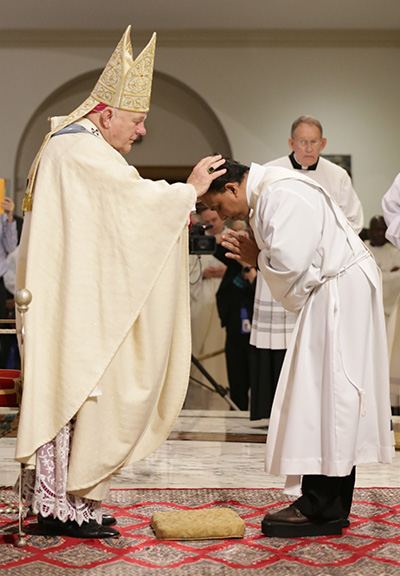
Photographer: TOM TRACY | FC
Archbishop Thomas Wenski lays hands on Mathew Padickal Thomas, ordaining him to the archdiocesan priesthood.
Watch his video interview here:
Back
‘The forgotten one’
Father James Arriola, 28, was born in a U.S. military base in Japan, the third of seven children who range in age from 33 to 10. His family is from Guam, and they moved back there when his father retired from the U.S. Navy. James was 4. He admits he felt a little lost after graduating from high school.
“I had ideas to get married, ideas to get a career. But nothing concrete.” Although he had joined a Neocatechumenal Way community at 13, “there wasn’t an inclination to the priesthood.”
Then he attended a retreat, and at the closing Mass, the priest preached: “If you feel a call, don’t be afraid. And what do you have to lose? I was thinking about my life and I thought, I have nothing to lose. Why don’t I try it?” Father Arriola recalled.
Neither the eldest nor the baby in his family, he said he often felt like “the forgotten one.” But now he realizes God “brought me to that point to show me that he loves me.” And once he experienced that love, “he showed me that this vocation is for me.”
He entered Blessed San Diego Luis de San Vitores Catholic Theological Institute for Oceania, which is affiliated with the Lateran University in Rome. When the Neocatechumenal Way’s Redemptoris Mater Seminary opened in Miami in 2011, he was chosen as one of its first 12 seminarians.
“I always felt called to go out to the missions and experience other places,” Father Arriola said. About his vocation, he added: “It’s God showing his love for me so hopefully I can show his love to the world.”
He has been assigned to St. Katharine Drexel in Weston.
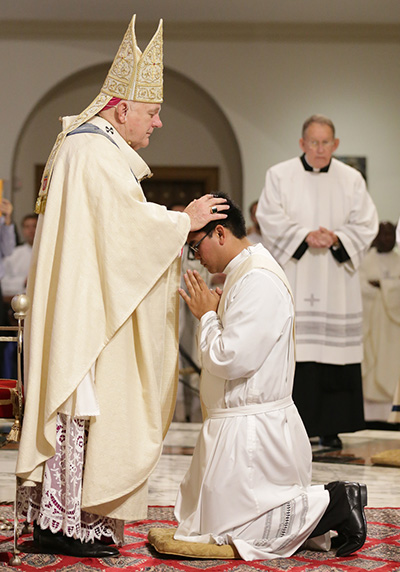
Photographer: TOM TRACY | FC
Archbishop Thomas Wenski lays hands on James Arriola, ordaining him to the archdiocesan priesthood.
‘Running to God’
At 59, Father Joseph Maalouf is the oldest of this year’s ordination class. He brings a lot of experience to the ministry. Ordained a permanent deacon for the archdiocese, the Lebanon-born, former body shop owner and manager speaks Arabic, French, English and Spanish, which he learned in Miami after arriving here in 1983. He also was married for 21 years and has two adult daughters.
“I was 11 years old when I first felt the calling,” he said. “I decided to do other things.” But the calling never left. “God’s been calling for a long time. In my human weakness, I didn’t want to give him more.”
After obtaining an annulment in 1999, he became very involved in his parish, St. John Neumann in Miami. His pastor, Msgr. Pablo Navarro, kept asking him, “What are you waiting for?”
“I was afraid,” Father Maalouf said. “Am I running away from the world? Am I going to hide in the Church? If that’s the case, I didn’t want to do it.” After “a long prayer,” he realized, “I was not doing things to run away from the world. Actually, I was running to God.”
He entered the diaconate program in 2005. But within six months of his deaconate ordination in December 2010, the call to priesthood manifested itself. He remembers the exact moment. He was assisting as a deacon at a funeral Mass when “I felt my heart exploding with joy… I realized it was a calling to the priesthood. I was called to be there consecrating.”
Instead of studying in South Florida, he was sent to what is known as a “second vocation” seminary, the Pope St. John XXIII National Seminary in Weston, Massachusetts. The past five years, away from family, friends and his parish community have not been easy, but “all of my fears, all of my doubts, God took care of them.”
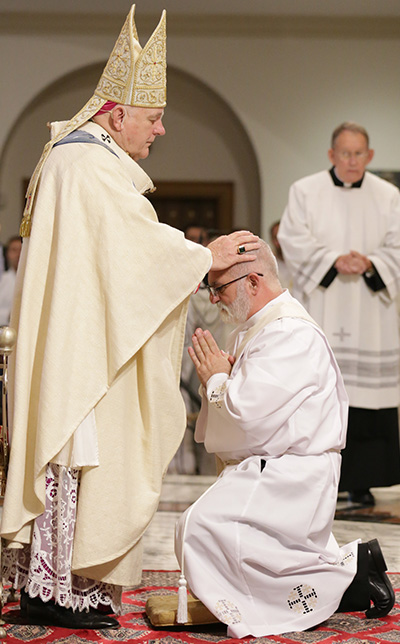
Photographer: TOM TRACY | FC
Archbishop Thomas Wenski lays hands on Joseph Maalouf, ordaining him to the archdiocesan priesthood.
He hopes to use his experience to help couples and teenagers especially. “Because I know what they’re going through. Been there, done that. Not only with myself but with my children.”
Father Maalouf has been assigned to All Saints in Sunrise.
Pandebono: good bread
Father Juan Carlos Salazar, 41, came to the U.S. at age 25 from his native Antioquia, Colombia. The second oldest and only boy among four siblings, he had a degree in business administration and worked for his family's business in Colombia, which caused him to travel frequently to New York and Los Angeles.
“That’s how I was attracted to try new horizons, new life, the American dream,” he said.
But his degree was worthless once he settled here, so he began working at a warehouse for $5.15 an hour — at first cleaning up, then keeping track of inventory, and eventually combining duties as a courier with bookkeeping tasks. He had a girlfriend, and attended Our Lady of Lourdes Church in Kendall. That’s when “God’s dream” began substituting for his own.
“I thought it was crazy that the Lord would be calling me,” he recalled. But one day, while praying before the Blessed Sacrament, he said “yes. If that’s what you want for me, open the doors. And (God) began to open the doors.”
Too quickly, it seemed. He met with the archdiocesan vocations director at the time, Father Manny Alvarez, now pastor at Immaculate Conception in Hialeah, and was informed that he would have to study for nine years, primarily philosophy and English. “I ran out,” he said, thinking, “This isn’t for me.”
By that time, he had changed jobs. Now he worked for his family’s bakery, making “pandebono” — a Colombian cheese bread whose name literally translates as “good bread.” A thought occurred to him: “I’m making this bread, and the Lord is calling me to priesthood. It’s another bread I’m going to be kneading.”
He met again with the archdiocesan vocations director, this time Msgr. Roberto Garza, now rector of St. John Vianney College Seminary in Miami. “You’re ready,” Msgr. Garza told him. Still, at every step in the process — filling out the application, undergoing the psychological evaluation — he kept thinking, “I’m going to prove that this isn’t for me.”
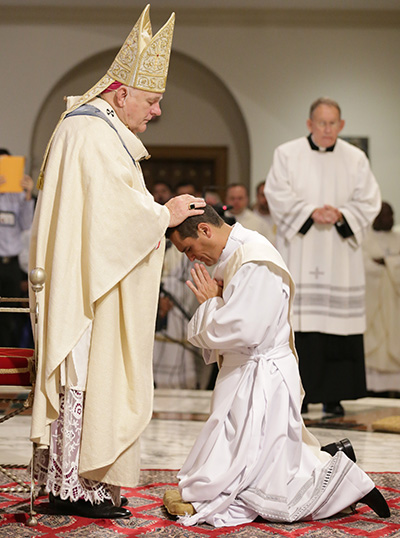
Photographer: TOM TRACY | FC
Archbishop Thomas Wenski lays hands on Juan Carlos Salazar, ordaining him to the archdiocesan priesthood.
But God kept opening doors. “You discern a vocation little by little. It’s a process also of falling in love, of getting to know yourself,” Father Salazar said.
He has been assigned to St. Thomas the Apostle in Miami.
Watch his video interview here:
Back
Born Aug. 11, 1920, in Cobh, County Cork, Ireland, Father Stack was a Presentation Brother for 35 years, beginning in 1939. He taught in, established and administered Catholic high schools in Ireland, Grenada, Barbados, Trinidad and Tobago, and St. Lucia. Later in life, he discerned "a second vocation" and entered the seminary in 1970. He was ordained a priest June 24, 1973, for the Diocese of St. Lucia, West Indies.
He came to the Archdiocese of Miami in 1978 and has served at Sacred Heart and St. Luke in Lake Worth, Holy Family in North Miami, St. John Neumann in Miami, Nativity in Hollywood, St. Ambrose in Deerfield Beach, Our Lady of the Lakes in Miami Lakes, and St. David in Davie. Since December 1997, he has served at St. Mark in Southwest Ranches from where he will retire at the end of August, after turning 90. Father Stack died Dec. 15, 2010, in his native Ireland.
When he knew he wanted to be a priest:
"All my life I was around the brothers (Congregation of Presentation Brothers). All through school they influenced me so I eventually decided to join them. I was blessed with a second vocation. I guess you can say I went to the other side of the street. It really was Vatican Council II that influenced me to become a priest because of its effects on religious communities."
Person most surprised by his vocation:
"My family was most surprised when I became a brother first and not a priest. They always knew I would become a priest."
What the seminary did not prepare him for:
"Being a good preacher. I've always been told my Irish accent is too strong and I speak very fast."
What he would be doing if he had not become a priest:
"I always liked engineering. I liked to design. Not that I could draw very well, but I liked it."
Favorite priestly assignment:
"I've been equally happy at every assignment but I really enjoyed teaching CCD, hearing reconciliation and being available to the people. I was at the airport in London once and a woman asked me to hear her confession after another woman asked me to bless her baby."
The most difficult aspect of being a priest:
The challenge to holiness.
'A priest isn't a superman; he's fully human with ups and downs.'
His description of the ideal priest:
"Simplicity and availability. I chose as my motto, 'He must increase, I must decrease.' I honestly believe that and have tried to live it."
A priestly stereotype that he feels should be discarded:
"A priest isn't a superman; he's fully human with ups and downs."
What he does on his day off:
"Up until a few years ago (before Hurricane Katrina) I used to play tennis and golf, but now I enjoy listening to music and reading."
Favorite movie:
"Life of Don Bosco" (1936).
Favorite TV series:
"I'm not into TV; I listen to music over the TV now and really only watch sports."
Last book read:
"I prefer religious newspapers and magazines. I read Our Sunday Visitor."
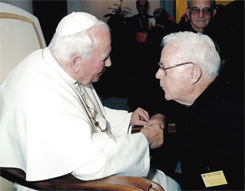
Father Mannix Stack had the privilege of a one-on-one meeting with Pope John Paul II in May 2000, during the celebration of the Jubilee for Priests and the pope's 80th birthday. Father Stack was one of 12 priests turning 80 that year who were selected to have lunch with the pope.
Favorite type of music:
Classical, but really anything other than jazz.
What he collects:
"At St. Mark I began a coin collection as a way to raise funds for the parish. I now have coins from all over the world and they are valued at quite a bit."
Person he most admires:
"I have met so many saintly brothers and priests over the years. (Miami Auxiliary Bishop) John Noonan stands out as a great person."
His greatest disappointment:
"I never got the chance to learn how to play a musical instrument."
His greatest joy:
"My family. I'm the third of 12 children. We were poor but religious and very blessed. I didn't realize it at the time, but my parents had a great love between them."
His greatest accomplishment:
"I have managed to keep breathing!"
His harshest critic:
"Myself. I always wanted to be better."
Thing he most fears:
"I don't fear dying. I fear becoming a burden on other people."
Regrets:
"Not being holier."
Born Oct. 2, 1950, in Havana, Cuba, he came to the United States in 1960 and attended Corpus Christi and St. John Bosco parishes in Miami. Ordained May 14, 1977, he served at St. Mary Cathedral, worked with farmworkers in Immokalee, and served as campus minister at the University of Miami and Florida International University before pursuing art degrees at FIU and the University of Florida. He died in a fire in his home on Sept. 14, 2004.
The priest as an artist:
"I was always the kid who was doing the posters for everybody. But I didn't take (art) seriously until I was a priest. ... It came out of a need to pray and to mature in my spirituality. Art has been an integral part of my maturing."
What he did before becoming a priest:
He entered the seminary in ninth grade: "It was a different time. I would not recommend that for anybody right now."
Who was surprised by his vocation:
Everybody: "People are surprised now."
Doubts about choosing the priesthood:
"All along. Doubts never cease. Doubts are part of life. I don't consider doubts to be the opposite of faith. Doubts are part of faith. The opposite of faith is fear."
Priests who inspire him:
The late Father Daniel Sanchez of Corpus Christi, the first Cuban exile to be ordained a priest in the archdiocese; and Msgr. William Dever, pastor of St. Helen in Fort Lauderdale, where Father Sardiñas served before going to the University of Florida.
What he does on his days off:
"I hang out at my art studio, or take my dog to the dog park, or I go to the beach and have dinner with friends."
What he would be doing if he had not become a priest:
An architect or a veterinarian: "I love animals."
Greatest disappointment:
"My disappointments have been mostly with myself, by not appreciating at times how blessed I've been."
"Doubts are part of faith. The opposite of faith is fear."
Greatest joy:
"The two places where I'm most at home, where I'm lost in time, are when I celebrate the Eucharist and when I'm in my art studio."
Most difficult aspect of being a priest:
"The public side of it. Being constantly under scrutiny. I'm a very private person. People look at what color shirt you're wearing, what kind of car you're driving, what haircut you have. ... And today, with the shortage of priests, simply overwork."
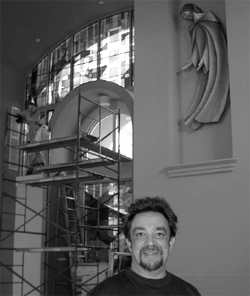
Father Sardiñas and his "Michelangelo moment" - the chapel at St. Thomas University. He designed the stained glass windows, the statues, the altar, the pulpit and the baptismal font.
Most satisfying aspect of the priesthood:
"The unique, irreplaceable relationship with people in your parish. When people call you 'father' that, to me, is not a title. That's a relationship."
Priestly stereotype that should be discarded:
"That (priests) have to be superhuman. ... I'm flawed just like everybody else."
Favourite musical artists:
Mozart, U2, Sting and Celia Cruz: "I'm a hybrid."
Person, other than Christ, that he most admires:
St. Francis of Assisi: "He was God's unique work of art. There was no one like him before him and no one like him after him."
Favourite visual artists:
Michelangelo, Raphael, El Greco, Caravaggio, Van Gogh, Matisse, Rothko, Wilfredo Lam
Thing he most fears:
"Not pleasing God by fully utilizing my God-given talents. Selling God short."
His greatest accomplishment:
Designing all the liturgical appointments for St. Thomas University's new chapel - stained glass windows, statues, Stations of the Cross, altar, pulpit and baptismal font. "My Michelangelo moment... This is the accomplishment where both the priest and the artist have come together."
"Trust Him that He's gonna lead the way"
Deacon Gomez, 27, was born Sept. 4, 1990 in Hialeah to Luis Fernando and Laura Gomez. He is the first of three brothers. He graduated from Immaculate Conception School in Hialeah in 2005 and Msgr. Edward Pace High School in Miami Gardens in 2009. He was the coordinator of Encuentros Juveniles, the youth movement of the Archdiocese of Miami. After attending St. Thomas University for a year right after high school, he entered the seminary, earning a Bachelor of Arts in philosophy from St. John Vianney Seminary in 2013. He is completing a master’s in divinity at St. Vincent de Paul Regional Seminary
His home parish is Immaculate Conception. His pastoral assignments have included service at San Lazaro, Hialeah, St. Michael the Archangel and the Shrine of Our Lady of Charity, Miami, and St. Louis in Pinecrest, as well as clinical pastoral education at the VA Health System Manhattan, New York City. He has served his diaconate year at Nativity Parish, Hollywood.
He will celebrate his first Masses Sunday, May 13, at 11 a.m. at Immaculate Conception and at 7 p.m. at San Lazaro; Sunday, May 20, at 9:30 a.m. at Nativity; and Sunday, May 27, at 12:30, 5:30 and 7:15 p.m. at St. Louis.
Watch his video interview here:
Back
"What excuse are you gonna give me now?"
Deacon Ayubi, 55, was born April 13, 1963, in Medellin, Colombia to Antonio Ayubi (deceased), and Judith Giraldo. He is the first of four siblings: one sister and two brothers. He graduated from St. Joseph High School in Colombia and obtained a degree in computer science from Universidad del Norte, Colombia. He earned a Bachelor of Arts in philosophy, cum laude, from St. John Vianney College Seminary in Miami and is completing his master’s in divinity at St. Vincent de Paul Regional Seminary in Boynton Beach.
His home parish is Mother of Our Redeemer, Miami. His pastoral assignments include service at St. John Bosco, St. Brendan and St. Agatha parishes, Miami, as well as clinical pastoral education at NCH Naples Hospital. He has served his deaconate year at St. David Parish in Davie.
He will celebrate his first Masses Sunday, May 13, at 12:30 p.m. at Mother of Our Redeemer (in Spanish); Sunday, May 20, at 10 a.m. at St. David (in English); and Sunday, May 27, at 9:30 a.m. at St. Mark in Southwest Ranches (in English).
Watch his video interview here:
Back
"Be not afraid"
Deacon Barros, 45, was born Sept. 7, 1972, in Santa Marta, Colombia to Gustavo Barros and Gloria Goenaga de Barros. He is the oldest of three siblings: one sister and one brother. He studied social communications at Universidad Autónoma del Caribe in Barranquilla, Colombia, and graduated from the University of Miami in 2008 with a master’s in journalism. He worked as a journalist in his native Colombia, Seattle and Miami before entering the seminary. He earned a Bachelor of Arts in philosophy from St. John Vianney Seminary in 2013 and is completing his master’s in divinity at St. Vincent de Paul Seminary.
His home parish is Mother of Our Redeemer, Miami. His pastoral assignments include service at Mother of Our Redeemer and Corpus Christi, Miami, as well as clinical pastoral education at New York Presbyterian, New York City. He has served his diaconate year at Assumption Parish in Lauderdale-By-The-Sea.
He will celebrate his first Masses Sunday, May 13, at 11 a.m. at Corpus Christi; and Sunday, May 20, at 12:30 p.m. at Assumption and at 7 p.m. at Mother of Our Redeemer.
Watch his video interview here:
Back
Deacon Gómez, 37, was born Oct. 30, 1980, in Acayucan, Veracruz, Mexico to Juan Gomez and Catalina Roman (deceased). He is the fifth of seven brothers and sisters. He graduated from high school in the Bachillerato in Acayucan, Veracruz, Mexico and earned a bachelor of arts from the Catholic University of America in Washington, D.C. He also earned a doctorate in sacred theology at Blessed Diego Luis de San Vitores, Catholic Theological Institute for Oceania, affiliated to the Pontifical Lateran University. He is completing a master’s in divinity at St. Vincent de Paul Seminary.
His home parish is St. Cecilia in Hialeah. His pastoral assignments have included service at Immaculate Conception parish in Marlborough, Diocese of Boston, Massachusetts; St. Patrick in Holyoke, Diocese of Denver, Colorado; and St. Anne, Diocese of Pueblo, Colorado. He has served his diaconate year at St. Joachim Parish in Miami.
He will celebrate his first Masses Sunday, May 13, at 9 a.m. and noon, at St. Joachim.
Watch his video interview here:
Back
"I give all of me to serving you"
Deacon Brevil, 38, was born Jan. 6, 1981 in Port-au-Prince, Haiti to Joseph Brevil (deceased), and Louisina Jeantilus. He is the youngest of 10 children, and has six sisters and three brothers. He grew up with his oldest sister in Haiti and joined the Redemptorist Order after graduating from high school, eventually making temporary vows (2006-2012). In 2010, after the earthquake in Haiti, the community sent him to the Dominican Republic and Colombia, where he learned Spanish. He also participated in a three week-session on religious formation in Canada. He returned to Haiti in 2012 and graduated with a degree in theology from CIFOR (Centre Institute De Formation Religieuse).
He was never ordained, however, and eventually left the Redemptorists. When he came to Florida for a family member’s funeral, he felt a renewed spirit to follow Jesus through the ministry of priesthood.In 2013, he applied to the Archdiocese of Miami and after a year of discernment was accepted as a seminarian. He studied at St. John Vianney College Seminary in Miami and St. Vincent de Paul Regional Seminary in Boynton Beach.
He served at St. Helen in Fort Lauderdale and most recently as a deacon at St. John the Apostle in Hialeah. He will celebrate his first Masses May 12, at 11 a.m. at St. John and at 5 p.m. at St. Helen.
Watch his video interview here:
Back
"Consider the priesthood"
Deacon Sierra, 54, was born Aug. 2, 1964, in Miami, to Jose (deceased) and Stella Sierra. He is the oldest of three, with one brother and a sister. He graduated from Miami Southwest Senior High School in 1982 and earned an Associate Degree in Science in Emergency Medical Services in 1994 from Miami Dade College. After 21 years working as a firefighter/paramedic for Miami-Dade Fire Rescue, he retired four years early to pursue God’s call to the priesthood. He then earned a Bachelor of Arts in philosophy from St. John Vianney in 2015 and is currently completing his formation at St. Vincent de Paul.
He has served at Our Lady of Lourdes, Miami; St. Timothy, Miami; St. Louis, Pinecrest; Blessed Trinity, Miami Springs; and most recently as deacon at St. David, Davie. He also took part in the Rome Experience, a summer program for diocesan seminarians.
Deacon Sierra’s home parish is Our Lady of Lourdes, where he will celebrate his first Mass May 12 at 1:30 p.m.
Watch his video interview here:
Back
Deacon Londoño, 32, was born in Medellin, Colombia, March 31,1987. He is the only child of Bernardo Arturo Londoño and Carmen Amanda Acosta. He went to high school in Medellin. He came to the United States in July 2009 and entered St. John Vianney Seminary that August. He earned a Bachelor of Arts in philosophy in 2014 and is currently completing his studies at St.Vincent de Paul.
Deacon Londoño spent a summer doing migrant ministry in the Diocese of Richmond, Virginia, and got his Clinical Pastoral Experience at the Veterans Administration in New York. He has served at St. Michael the Archangel, Miami; St. Maximillian Kolbe, Pembroke Pines; St. Andrew, Coral Springs; and as a deacon at Our Lady of Guadalupe, Doral.
His home parish is St. Michael. He will celebrate his first Masses May 11 at 7 p.m. at Our Lady of Guadalupe, and May 12 at 11:45 a.m. at St. Michael.
Watch his video interview here:
Back
Deacon Lopez, 28, was born Aug. 1, 1990 in Havana, Cuba, the only child of José López Fernandez and Lissette Alvarez McCullock. He went to high school in Cuba then came to Miami. Shortly thereafter he entered St. John Vianney Seminary and earned a Bachelor of Arts in philosophy. He is currently completing his studies toward a Master of Divinity degree at St. Vincent de Paul Seminary.
Deacon Lopez has served at St. Francis de Sales, Miami Beach; the Shrine of Our Lady of Charity, Miami; St. Ann Mission, Homestead; Our Lady Queen of Martyrs, Fort Lauderdale; Jackson Memorial Hospital, Miami; Corpus Christi, Miami; the Basilica of St. Mary Star of the Sea, Key West; and most recently as deacon at Assumption in Lauderdale-By-The-Sea.
His home parish is St. Joseph, Miami Beach. He will celebrate his first Masses May 12 at 9:30 a.m. at St. Francis de Sales, and at 12:30 p.m. at St. Joseph.
Watch his video interview here:
Back
Father Muñoz, 35, was born Dec. 7, 1983 in San Luis Potosi, Mexico, to Martin Muñoz and Patricia Escamilla. He is the second of four, with three sisters. He entered the seminary in 2010 and studied philosophy and pre-theology at Blessed Diego Luis De San Vitores Institute in Guam, U.S. In the summer of 2017, he came to South Florida and entered St. Vincent De Paul Seminary.
He is served as a father at St. Katharine Drexel, Weston, and celebrated his first Mass there May 12, 2019 at noon.
He is currently serving as a Parochial Vicar at Nativity Church, Hollywood.
Watch his video interview here:
Back
"When, Ryan, when?"
Father Saunders remembers the question the late Auxiliary Bishop Agustin Roman would ask him whenever he visited St. Mary Cathedral: "When, Ryan, when?"
At the time, Saunders was working fulltime as master of ceremonies at the cathedral and associate director of the archdiocesan Office of Worship. Msgr. Terence Hogan, then rector of the cathedral, had hired him for the job in 2005, while he was completing his studies in political science at Barry University in Miami Shores.
The combination of studies and work harmonized with Saunders' lifelong passion for both politics and the priesthood. He remembers as a child telling his family he would either become "president or pope."
He also remembers dragging his grandfather to the front pews of the church whenever they went to Mass. "There was always something about the liturgy that drew me in," said the Fort Lauderdale native, born at Holy Cross Hospital. "There was always something about the elevation that I loved, and I wanted to be close to that."
He also was close to Father Timothy Hannon, his pastor at St. Anthony, where he attended elementary school, taught religious education and served as an extraordinary minister of holy Communion. He also gained experience there coordinating liturgical ceremonies for the parish.
Near the end of his years at Cardinal Gibbons High School, young Ryan spoke to Father Hannon about entering the seminary. The priest, who died in 2005, advised him to get some life experience and finish college first.
"If God is calling you, you will know when he's calling you," Father Hannon advised.
So Ryan graduated from Barry and worked at the cathedral until 2010, when a friend, Chip LaMarca, asked him to run his campaign for Broward County commissioner. LaMarca, now a member of Florida's House of Representatives, won that seat and Saunders became his chief of staff.
"It was a fantastic opportunity," Father Saunders recalled. "I loved what I did," managing the office, meeting with constituents. "But there was always something missing, always something I would experience at Mass, receiving the Eucharist, a voice in the back of my head saying, 'This is what you should be doing.'"
The voice turned into a psalm one day while he took part in daily Mass at St. John the Baptist Church in Fort Lauderdale: "You are a priest forever, in the line of Melchizedek."
"It was like a lightbulb went off," Father Saunders recalled. He left church knowing he had to enter the seminary. As he was searching for his car keys, he inadvertently pulled from his pocket the holy card from Bishop Roman's funeral.
"When, Ryan, when?"
"Ok, I get it," Father Saunders recalled thinking. "To this day, I keep that holy card on my desk."
"It's in his blood"
"It's in his blood," Elsa Tomonto said of her eldest son's vocation to the priesthood.
Andrew's grandfather, the late Bob Tomonto, was a permanent deacon at the family's home parish of St. Louis in Pinecrest. He and his wife, Irene Tomonto, joined the Christian Family Movement in the 1960s. At St. Louis, they created the Covenant Experience, a parish-based enrichment program for married couples.
"I've always had very, very good priests in my life," said Father Tomonto, who was born in Mercy Hospital.
But Elsa Tomonto didn't necessarily want her son to become a priest. "She's a Colombian mom who wants to be a Colombian grandmother," he explained. His becoming a priest would cut her chance at that by one-third, as Andrew is the eldest of three sons.
"He remembers when he was 12, he told me he wanted to be a priest and I started crying," Tomonto said moments before her son's ordination. "Now we're thrilled."
Father Tomonto said he first vocalized the thought of becoming a priest in seventh grade, as a student at St. Louis Covenant School. He then moved to Marist-run Christopher Columbus High School in Miami, where a couple of archdiocesan priests — both retired now — proved deeply influential: Father Liam Quinn, who taught him theology in ninth grade, and Father Arthur Dennison, who taught him in 11th grade.
But Father Tomonto didn't realize it at the time. At 14, he thought "you couldn't be happy without a family." Looking back later, he realized how Father Quinn changed that perspective.
"This guy is happy. There's a joy in him, and it's infectious," Father Tomonto recalled. "It helped bring down a wall in my mind, a barrier to discerning."
But he moved on, to major in business at the University of Miami.
"This is where the vocation really showed itself," he said. "College was where I had that adult moment when you take ownership of your own faith."
He began "praying more profoundly." During his sophomore year, he attended a vocation awareness weekend at St. John Vianney College Seminary in Miami. He got involved in UM's Catholic campus ministry.
Still, he put off entering the seminary. "I had a good scholarship and I loved college," he said.
He entered the seminary immediately after graduating. "It was just like a puzzle piece fitting," he said. "I went into the seminary and I loved it. I knew that's where I was supposed to be."
As for not having a family: "I haven't found any life that's really that easy," he said. "Each (vocation) has its own challenges and its own joy."
His mother thinks he'll make a good priest. "He's a very comforting person. He's very calm," she said. "I think he's going to be a wonderful person to minister to the people of God."
Deacon Muñoz, 35, was born Dec. 7, 1983 in San Luis Potosi, Mexico, to Martin Muñoz and Patricia Escamilla. He is the second of four, with three sisters. He entered the seminary in 2010 and studied philosophy and pre-theology at Blessed Diego Luis De San Vitores Institute in Guam, U.S. In the summer of 2017, he came to South Florida and entered St. Vincent De Paul Seminary.
He is currently serving as a deacon at St. Katharine Drexel, Weston, and will celebrate his first Mass there May 12 at noon.
Watch his video interview here:
Back
Born Dec. 5, 1960, in Sliema, Malta, Bishop Baldacchino is the second oldest of four
children three boys and a girl born to
Leonilda (known as Hilda) and Rinaldo (known as Rene) Baldacchino. When he was 13, his family joined the Neocatechumenal Way. He studied at St. Francis School in Msida and Mount Carmel College in Santa Venera, Malta, then studied science and chemistry at the University of Malta.
He entered the Redemptoris Mater Archdiocesan
Missionary Seminary in Newark, N.J., in 1990, obtaining a bachelor’s in theology,
and a master’s in divinity from Seton Hall
University. On May 25, 1996, he was
ordained a priest for the Archdiocese of
Newark and assigned as parochial vicar to Our Lady of Mount Carmel in Ridgewood, N.J. In 1999, he was named chancellor of Our
Lady of Divine Providence Mission in Turks
and Caicos Islands, a missio sui iuris
(independent mission) for which the
Archbishop of Newark is responsible.
He became pastor of Our Lady of Divine
Providence Church in Providenciales in
2002, and in 2009 was named a Chaplain
to His Holiness, with the honorary title of monsignor. Pope Francis appointed him
auxiliary bishop of Miami Feb. 20, 2014.
What he did before becoming a priest:
He worked for nine years as a technical manager for Canada Dry in Malta. “I was a workaholic 36 hours straight work without going home.”
When he knew he wanted to be a priest:
After attending World Youth Day in Santiago de Compostela, Spain, in 1989.
Person or event that triggered his vocation:
“The World Youth Day in Santiago de Compostela in 1989. The words of John Paul II in his homily, ‘Do not be afraid to be holy,’ opened a new perspective to life for me.”
What the seminary did not prepare him for:
Press conferences.
His hobbies:
“I always enjoy a good fishing trip.”
Most difficult aspect of being a priest:
“Comforting someone who has lost a loved one; when no words can fill that void and we can only offer to be present and share their suffering.”
‘The words of John Paul II in his homily, “Do not be afraid to be holy,” opened a new perspective to life for me.’
His description of the ideal priest:
“Does not exist.”
Favorite movie:
“Preferisco Il Paradiso” based on the life of St. Philip Neri.
Favorite sport:
Soccer.
Last book read:
“Jesus of Nazareth: The Infancy Narratives” by Pope Benedict XVI.
What he does on his day off:
“Day off is only a term.”
Person he most admires:
“Blessed Pope John Paul II, because he changed my life and was instrumental in my calling to the priesthood.”
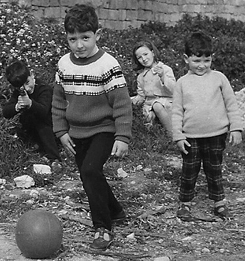
Peter Baldacchino, front, gets ready to kick a soccer ball while playing with his siblings, from left, John, Paula and Robert, in their native Malta.
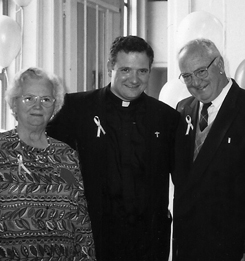
Newly ordained Father Peter Baldacchino is seen here with his parents Leonilda (known as Hilda) and Rinaldo (known as Rene).
His greatest accomplishment:
“To be an instrument in God’s hand in establishing a Catholic presence in the Turks and Caicos Islands.”
His greatest joy:
“The day of my ordination to the priesthood.”
His greatest disappointment:
“That my father’s health prohibits him from attending my consecration (as bishop).”
His greatest fear:
“Myself.”
Born Dec. 22, 1966, in San Juan, Puerto Rico, Father Hernandez considers himself a "Cuban-Rican" because he grew up on the island but his parents and grandparents are from Cuba. The middle of five children - two older brothers, two younger sisters - he studied in Passionist schools before entering the seminary in Miami in 1987. Ordained in 1994, he served at Epiphany Parish in South Miami and Sts. Peter and Paul, Miami before becoming the first Hispanic pastor of the historic St. Mary Star of the Sea Parish in 2002. It is the third oldest parish in Florida.
On studying for the priesthood:
"When I was a kid I was not much attracted to studies. I said to the Lord when I graduated from high school, the shorter the career, the better. Like always, the Lord has a good sense of humor. So he said, 'Oh, yeah, you're going to study eight years for the priesthood.'"
Why the priesthood:
"I wanted to serve people. Really, the life of the priest did not interest me. What attracted me was the service that the priest does for the community."
Seminary life:
"It was my first time away from home and I was learning English. God wanted me to stay, because it was a terrible year, difficult to adjust."
Good advice from a fellow priest:
"You cannot live better than your parishioners." - Father Juan Lopez, pastor, Sts. Peter and Paul Parish, Miami.
Good advice from a fellow priest:
"You cannot live better than your parishioners." - Father Juan Lopez, pastor, Sts. Peter and Paul Parish, Miami.
What he does on his days off:
"I go to Miami and eat with friends.
Favorite TV series:
"Friends" (he has a collection of episodes) and "The Golden Girls": "I learned English watching 'Golden Girls.'"
How he makes decisions:
"I always go to the tabernacle and pray to the Lord."
What he would be doing if he had not become a priest:
"I probably would have finished accounting and be in business - maybe selling, like my father."
Greatest frustration:
"Some of our regulations are a little strict for our people. But it's part of our faith. It's part of our tradition. And you have to follow them."
"I don't want someone to leave the church because of me."
Difficult moment:
During the height of the priestly sexual abuse crisis in 2002: "Do I need to be in this? I can be an active parishioner like my father is. I don't need to be labeled as one of them."
Most difficult aspect of being a priest:
"To always make sure that what you do, you do it right ... I don't want someone to leave the church because of me."
Favorite type of music:
For listening: Soft Spainsh melodies by artists such as José Luis Perales; for dancing: "If there's salsa or merengue I will dance, because the music gets into me."
Collections:
He owns 60 Nativity sets. "I love Christmas time and I love nativities. I'm the one who sets up the nativity at my church."
Father Hernandez, who describes himself as "a social person," celebrates his birthday with former parishioners from Sts. Peter and Paul Parish in Miami, Luis Acosta and his wife, Kirsy. He celebrated their wedding and baptized their children.
Hobbies:
"Eating - you can see that. For three years I used to cook on Sundays in the major seminary. I don't have time now." He also likes antique shops. "I just look. I don't have the money to buy."
Persons he most admires:
"My parents and grandparents - they were people who were not rich but they were so centered in what they had to do in life that they gave me a model to follow."
Biggest fear:
"Not death, but suffering a long illness, a heart problem, or cancer. As a priest, you don't have anyone.If that happens to me, who's going to take care of me?"
Upcoming challenge:
"My heart is calling me to do it - start a mission church in Stock Island. There are a lot of Hispanic and Haitian people over there. Even though they come to the big church, they don't feel part of the big church. I feel the responsibility and the need - if they can't come to me, I have to go to them."
Born June 22, 1969, in León, Nicaragua, Father Paguaga is the oldest of four children. He arrived in the United States Dec. 1, 1989, after a one-month, $2,000 journey from Guatemala. He worked in the construction industry, at fast-food restaurants and washing dishes before entering the seminary in 1991. He was ordained a priest for the Miami Archdiocese in May 2000, and served at Our Lady of the Lakes in Miami Lakes before being assigned to Little Flower last summer.
Why he came to the United States:
“To come, work, save, help my family and go back after six or seven years." His father had died in 1984, and the family had moved to Guatemala, partly due to the political troubles in Nicaragua. The family's pharmacy had been looted; their grandfather had been kidnapped.”
What he did before becoming a priest:
“He was one of the first cooks at the McDonald's on S.W. 87th Avenue and 24th Street in Miami. He also worked at Burger King and as a busboy at the Radisson Hotel. At one point, he held three jobs simultaneously. "I'm very proud of it. If you want to work, you will find work. If you want to get ahead, you can get ahead."”
When he knew he wanted to be a priest:
“He first asked his mother for permission to enter the seminary at 6. At 14, he attended a charismatic retreat for young people. "I remember saying, 'This is what I really want to be.'" His father's response: "Over my dead body." He tried to enter the seminary in Guatemala but his mother asked him to wait. After coming to Miami, "I knew I didn't want to stay (in the United States) to make money but to serve the people. I saw the need here. An immigrant can best understand an immigrant."
‘It's almost like God brought me here...’
What he does on his days off:
"I like to go to the beach. I like to go to the gym. I spend a lot of time working in the garden. It puts my mind at ease."
Favorite movie:
"The Lion King."
Favorite TV series:
"The Golden Girls", "Touched by an Angel" and the Discovery Channel.
God's plan:
"It's almost like God brought me here and opened the doors because in less than two years I was in the seminary. It couldn't have been more clear that God wanted me to be here."
Gardening enthusiast Father Paguaga with some student helpers from St. Teresa School in Coral Gables.
Favorite type of music:
Country music, 99.9 KISS FM
What he would be doing if he had not become a priest:
He was studying civil engineering at the University of Guatemala. "The thing is, I don't see myself doing something else other than being a priest. This is what I love. Sometimes I feel guilty that I get paid for what I do."
Priestly stereotype that should be discarded:
"Sometimes people don't see us as human beings with the same needs and feelings as others. We come from a family. We sat for many years in the pews where people sit and listened to the liturgy. We're real. We weren't born wearing vestments."
Most difficult aspect of being a priest:
Transfers: "You get to love your people, you devote yourself to them, and then you have to move."
Greatest disappointment:
"That my father didn't see me ordained because, actually, he would have been extremely happy with me. My father was never able to see his son fully realized as the man he wanted to be."
Person he most admires:
"My mother - her faith and trust in God, her simplicity, her sense of humor. She has never complained to God or anybody else for all the things that she has been through in her life."
Born in El Salvador on Sept. 5, 1974, Father Alfaro was educated by the Marist Brothers there until 11th grade, when he moved to South Florida. He graduated from Miami Beach Senior High in 1992, got a bachelor’s degree in psychology from FIU in 1997 and entered St. John Vianney Seminary in Miami that same year. He went on to St. Vincent de Paul Regional Seminary in Boynton Beach, where he obtained a Master in Divinity, and was ordained for the Archdiocese of Miami on May 10, 2003. He served at St. John Neumann Parish in Miami until he was sent for higher studies in Rome. He obtained a licentiate in Church history from the Pontifical Gregorian University in 2009 and taught at St. Vincent de Paul Seminary until June 2013, when he was appointed administrator of Blessed Trinity.
What he did before becoming a priest:
“During my college years I had a part-time job as a bank teller at then-NationsBank. I was also very involved in the youth group and the youth choir in my home parish (St. Joseph, Miami Beach).”
When he knew he wanted to be a priest:
“I started considering the possibility of becoming a priest when I was around 20 years old.”
Person or event that triggered his vocation:
“I did a retreat that changed my life when I was 16, but I did not consider the priesthood at that time. Then when I was in college, a new priest came to my home parish. He inspired my vocation. Although he never spoke to me about the vocation to the priesthood, he showed me with his example how fulfilling the life of a priest could be. I then began to ask God if he could be calling me to this lifestyle.”
Person/persons most surprised by his vocation:
“Because I was so involved in Church at the time, I think the decision to enter seminary surprised very few people.”
What the seminary did not prepare him for:
“It’s impossible to learn everything in the seminary. It certainly did not prepare me to be a seminary formator something I did for four years.”
‘I greatly admire the example that Pope Francis is giving the whole Church.’
What he would be doing if he had not become a priest:
“Perhaps I’d be a psychologist or a teacher.”
The most difficult aspect of being a priest:
“Having to deal with administration, handbooks, financial concerns, managing staff, paperwork, etc.”
His description of the ideal priest:
“The ideal priest is someone who is a man of deep communion with the Lord. His prayer leads him to action in ministry and vice versa. Someone who makes himself available to the people of God and tries to respond to their needs as he walks the journey of faith together with them.”
A priestly stereotype that he feels should be discarded:
“That a priest is above the rest of the people or better than the rest of humanity.”
What he does on his day off:
“Rest, watch a good movie, read and/or visit my family and friends.”
Favorite movie:
Frank Capra’s “It’s a Wonderful Life.”
Favorite TV series:
“24.”
Father Jose Alfaro, far right, is seen here during a visit to Disney World with his family.
Last book read:
“The Infancy Narratives” by Pope Emeritus Benedict XVI
Favorite type of music:
Country, classical and Christian pop.
Person he most admires:
“I greatly admire the example that Pope Francis is giving the whole Church. He is preaching and teaching not only through words, but especially through his own actions. It’s been thrilling to see him and to listen carefully to all the speeches he gave in Rio de Janeiro during World Youth Day. His simplicity, humility, sincerity and zeal (are) inspiring a lot of people to come back to the faith.”
His greatest disappointment:
“My own flaws and sinfulness.”
His greatest joy:
“Celebrating the sacraments, particularly the Eucharist and reconciliation.”
Thing he most fears:
“To give scandal.”
Regrets:
“None. I could not see my life being any happier or more fulfilled than doing what I’m doing.”
Born Nov. 11, 1960, in Havana, Cuba, Father Alvarez came to Miami with his parents and older sister in 1967. He grew up in St. John Bosco Parish, Little Havana, and entered the seminary at age 36. He was ordained for the Archdiocese of Miami on May 10, 2003. Before joining the seminary staff in September, 2004, he served as associate pastor of St. Brendan Parish in Westchester. He also hosts the Spanish and English language television programs produced by the archdiocese which air on Cable-TAP in Miami-Dade County.
What he did before becoming a priest:
He earned bachelor’s and master’s degrees in theatre and spent a decade as an actor and director,doing theater, television commercials and films: “Blink-and-you’ll-miss-me kind of things.” He then spent 15 years as a teacher and coach at his alma maters, Sts. Peter and Paul School and La Salle High School in Miami.
When he knew he wanted to be a priest:
“When I had matured enough … I dated enough that I could have married. I thought about it a couple of times. But I thought the lifestyle was too restricted. … I always felt that I needed to be freer to engage in ministry. I would have driven my wife nuts.”
What he would be doing if he had not become a priest:
“The same thing I was doing before, teaching and coaching. I loved it. It wasn’t like I became a priest because I was miserable doing what I was doing before. I just felt called to do this.”
Who was most surprised by his vocation:
“Myself. It’s funny, not too many people were surprised. … At one time I had a girlfriend who would say to me, ‘Stop talking to me with that priest’s voice of yours.’”
What the seminary did not prepare him for:
“I haven’t been too surprised by anything I’ve seen in ministry. I spent 10 years in the entertainment industry and worked with coaches. I was ready for anything.”
‘I admire Jesus, the way he lived, the fact that he was a regular guy, a people’s man. He found joy and life in the little things and helped people discover that. ’
Favorite priestly assignment:
“They’re all good. As long as you give me people, I’m happy.”
Greatest joy:
“Hanging out with Jesus; hanging out with people; enjoying the little things of life. That’s what it’s about.”
His description of the ideal priest:
“You need to be a regular guy. … What gives credibility to the faith is not what you do but how you relate to people. Jesus changed history not so much because of what he did but because of the way he related to the people who came to him. He showed them that within every ordinary event, the extraordinary was hidden there. That’s my whole spirituality, finding the extraordinary in the ordinary.”
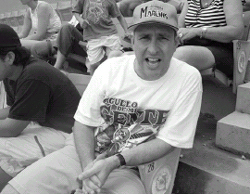
Father Alvarez, a “sports junkie,” takes in Marlins games whenever he can.
Priestly stereotype that should be discarded:
“That a priest is a certain way. The best thing we bring to the priesthood is who we are, and we’re all so different.”
Most difficult aspect of being a priest:
“Shattering some of these very limited notions of what a priest is.”
On the “Drama and Ministry” course he devised and teaches to seminarians:
“Drama and ministry are both centered on conflict. By studying drama, we become more attuned to the conflicts that we address in ministry.”
What he does on his days off:
“I’m a huge sports fan, so on my days off, if the Marlins are playing, I’m at the stadium.”
Favorite TV series:
“I watch ESPN. … I’m a sports junkie.”
Favorite type of music:
“I’m probably the only Cuban who listens to American folk and blue grass.”
Person he most admires:
“Jesus. I admire Jesus, the way he lived, the fact that he was a regular guy, a people’s man. He found joy and life in the little things and helped people discover that.”
Thing he most fears:
“At the end of my life, not being as giving as I perhaps could have been. But Jesus is very merciful and he can be at peace with that, so I don’t lose too much sleep over it. I’ll bank on his mercy.”
Hobbies:
“Watching sports, music, movies. I love to travel. I love to eat.”
Regrets:
None. “All the ladies come hug me, kiss me, and I send them home with somebody else. How could I have any regrets? I have the best of all worlds.”
Born in Cuba in 1957, Father Corces grew up in Miami and was ordained for the archdiocese in 1988. As vocations director, he is responsible for recruiting and screening candidates to the priesthood. He also helps out at Prince of Peace Church in Miami, teaches lay ministry courses and has been involved with the HIV/AIDS ministry.
When he knew he wanted to be a priest:
"I tried going into the seminary right after high school and it didn't work. I was too young, too immature." Years later, he began questioning his choice again: "During a New Year's Eve party in which I was having the best time, I stopped and looked around and said, is this what I want? And the answer was very clear. No. That is not for me."
Later still, during a visit to the missions in Honduras, he realized his call was to the priesthood:
"Coming in contact with the dirt poor people made me want to make a difference. The priesthood came up as the way to make a difference. Of course, there are other ways. But that was my way, the gift being offered to me."
His description of the ideal priest:
"First of all, a human being filled with love for life and God and deep faith that, in and though that broken humanity, God blesses the world. You have to be filled with life, definitely.":
What he would be doing if he had not become a priest:
"A teacher or a pilot. I love to tach and I love planes."
"I am successful when I know that the person has been touched by the spirit of Christ - when I have facilitated that encounter. You see the fruits. You see the change. Those are moments of sucess."
Greatest disappointment:
"9/11. Disappointment at our own humanity, that we are capable of doing something like that."
Greatest joy:
"9/11. I was so angry in the morning, and by the afternoon, I saw how human beings are capable of the highest, heroic choices."
Person he most admires:
Gandhi. "I think he was an incredible man who was able to free a country without shooting a gun."
Thing he most fears:
"I fear being old, sick and helpless, because I see it every day."
What he did before becoming a priest:
Worked in a bank's accounting department for 7 years: "I hated it."
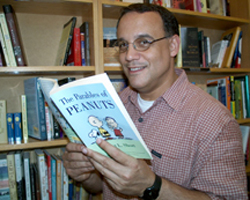
Father Pedro Corces indulges in his favorite pastime: browsing in bookstores & reading.
Most difficult aspect of being a priest:
"Finding myself without answers and therefore dealing with the frustration of being powerless before cerain situations. Having to accept that I do not have all the answers."
What he does on his days off:
Loves going to the movies and spending time in bookstores: "I'm a bookworm. And when the weather is nice I go to the beach. I love the ocean."
His harshest critic:
"Myself and the Gospel."
His greatest accomplishment:
"I am successful when I know that the person has been touched by the spirit of Christ - when I have facilitated that encounter. You see the fruits. You see the change. Those are moments of success."
Born May 6, 1964, in Levittown, New York, his family moved to Jensen Beach when he was 8. He attended public schools and St. Martin de Porres Parish, and was studying at Indian River Community College when he decided to enter the seminary.
Since his ordination, May 11, 1991, he has served as priest-secretary to both Archbishop Emeritus Edward McCarthy and Archbishop John C. Favalora, and as associate pastor at Epiphany Parish in South Miami and Immaculate Conception in Hialeah.
He is currently studying fulltime at Florida International University, working toward a degree in exceptional student education with a specialization in autism.
When he knew he wanted to be a priest:
"I started thinking about it when I was in eighth grade. Throughout high school it was an idea that kept coming back to me. Sometimes yes, sometimes no, but it definitely kept coming back. While there were many things that I could do and do well, this was the one thing where I felt I could give the best I had to give and be the most fulfilled."
What he would be doing if he had not become a priest:
His intended major in college was education. "It's very interesting that, these many years later, the church has come to me and asked me to fulfill a need by studying special education. So it's come full circle. In a sense, I gave that up to enter the seminary and now it has been given back to me."
Greatest disappointment:
"If you turn disappointments over to God, they don't become great. So I don't worry about those."
Greatest joy:
"Sharing with people in the important moments of their lives, the joyful ones as well as the sorrowful ones."
Most difficult aspect of being a priest:
"Being unable to meet the overwhelming needs that are being presented to you. Being unable to be in three places at once and wanting to meet those needs."
Priestly stereotype that should be discarded:
"That priests are supposed to be angels in human form rather than human beings who walk with the community."
"In a sense, I gave that up (a career in education) to enter the seminary and now it has been given back to me."
How others describe him:
"I've been told I have a raucous laugh." When he was at Epiphany, "it was a vocabulary word and the kids were not getting it. So the teacher said, 'Father Michael has a raucous laugh.' And the kids got it."
Life as a university student:
"It's neat not to have any sort of favoritism toward me. Because sometimes priests are treated with favoritism. It's nice to know that the grade I'm getting is because I'm working as hard as everybody else Being at the university has helped me to see the importance of being a person, not just a persona. It's important for priests to be persons with their people. Jesus said, 'I know my sheep and mine know me.' Underline the 'mine know me' part because sometimes we forget that. The sheep also need to know their shepherd."
On dancing:
"When I first got to Immaculate, I had never seen a community that so loved to dance. I never danced. I was terrified of dancing my whole life. But in order to be part of this community, I took salsa lessons. It was exercise. It was fun. And now I can dance with my community. They were all happily shocked. I'm still no good, but at least I'm not afraid anymore."
On the priestly commitment:
"To be a good husband and wife, you have to be desperately in love with your spouse. The priest also must be desperately in love, passionately in love, with God and the priesthood. It is the same commitment. We're called to a spousal relationship with God. It needs to be that deep and that real and that passionate. If it's only about what you do, then it's work. It's just a job, it's not a life. Being a husband or a wife is not only about what you do, but who you are because of your relationship to this other person. For a priest, it has to be the same."
Thing he most fears:
"Losing loving relationships. Becoming so busy that I loose touch with those loving relationships, with families and friends that keep me human, that keep me real."
Person he most admires:
"My father because he was a decent man who worked very hard to provide for his family, to create a loving environment in his home, who was always willing to do things for other people without wanting recognition or thanks."
Born Aug. 9, 1941 in Jamaica Plain, N.Y., he moved to Miami in 1949 and grew up in Holy Family Parish, North Miami. He attended Archbishop Curley High School and entered the seminary during his senior year. Ordained in 1968, he served as the founding director of the archdiocesan Office of Worship from 1978 to 1984. He has spent 24 of his 35 years as a priest at St. Louis Parish in Pinecrest, including the last 21 years as pastor. "I think I'm this close to marrying one of the kids I baptized here." He also serves as dean of the South Dade Deanery.
When he knew he wanted to be a priest:
Probably around the fifth grade: "You'd be serving at Mass and there was just something very special about all that." He would also lock up the church and set out the vestments for the next morning. "The priests that I knew trusted me. I learned how to drive in the church truck when I was 12 years old because Msgr. (Rowan) Rastatter let me drive the truck around the parking lot. He was my hero."
What he would be doing if he had not become a priest:
"I haven't the vaguest idea. There isn't anything else that I ever think about being. I could just as easily be bagging groceries at Publix."
Why he never wanted to be a missionary:
"I wanted to be a priest and Holy Family would do just fine. To this day I get nervous going to Broward County."
What he does on his days off:
"Take a deep breath. I'll go and spend the day with a friend. Go to a movie. Get off by myself and read.
Hobbies:
"I've played at tennis. To say that I was a tennis player would dishonour the sport."
"I learned long ago that I'm not the Messiah. We only had one of those."
Best memory:
"The morning we went up to celebrate Mass with the Holy Father." He was one of the 38 priests studying at the North American College in Rome who gathered in the pope's private chapel on Nov. 30, 1989, at 6:30a.m. When it came time for the homily, the pope simply said, "'Today we let Jesus speak.' And he sat down. We all reflected on the Gospel for seven minutes."
Greatest frustration:
"Not being able to do all the things people would like me to do."
Greatest joy:
"The people who are here with me at St. Louis. I pray to God I never abuse that trust."
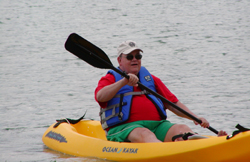
Father Fetscher kayaking on the Great Lakes during a recent vacation.
Most difficult aspect of being a priest:
"When things happen that you can't have any control over and you don't have all the glib answers. Or you can't wave the wand and make it all better. I learned long ago that I'm not the Messiah. We only had one of those."
His description of the ideal priest:
"To be all things to all people. Jesus certainly poured himself out for people. That's the standard by which we measure ourselves."
Favourite type of music:
Peggy Lee, Louis Armstrong, Leonard Bernstein
What he collects:
"Everything" but especially books: "I had this idea that if I owned the book and it sat in the shelf, somehow, by sheer osmosis, whatever was in it would stay in my head."
On his personality:
"You're looking at a guy who voted for Barry Goldwater and George McGovern. Think about that."
Favourite priestly assignment:
"The one I'm in."
Person he most admires:
Auxiliary Bishop Agustin Román: "I'm continually amazed at his capacity for charity, gentleness and kindness. If I could have a tenth of it, I would be a happy man."
Born Oct. 31, 1956, in Santa Clara, Cuba, Msgr. Marin came to the United States with his family - parents and younger sister - at age 4. They settled in Chicago.
He went to medical school in the Dominican Republic and completed his residency at the University of Miami, specializing in investigational cardiology. He was ordained for the Miami Archdiocese in 1989 and later obtained a canon law degree from The Catholic University of America.
He served as chancellor from 1993 - 2003 and, in addition to his work as promoter of justice and judge on the metropolitan tribunal, as well as chaplain of the Catholic Physicians & Dentists Guild.
When he knew he wanted to be a priest:
He felt the call in fifth grade at Our Lady of Mercy Catholic School in Chicago, where he was an altar server. He would have entered the high school seminary had it not been for the advice of the school's new principal who suggested he attend a "prestigious" public high school instead that focused on math and science. "The whole background of my family being in medicine came back again and I went back to medicine. Priesthood was out of the picture for those years."
Vocation moment:
In 1976, his first year of medical school, there was a huge explosion at a sugar mill in the Dominican Republic. "The 400 men who were burned kept asking for a priest. The only priest was away at a mission. It was very clear to me, seeing all of the doctors and the nurses and 123 men dying, that there was more need for priests than there was for doctors." He decided to quit medicine, but again was advised not to by the seminary rector, who told him "the best thing to do was to finish medical school because that would always be in the back of my mind. God would call me later." God did - in 1983 in New Orleans. "I was giving a keynote speech at a cardiologists' convention. These two gentlemen walked up to me and said, 'Are you a priest?' They were Jesuit physicians." They told him: "Your whole empathy for the patient almost speaks of you being a priest already."
On making the final decision:
"I needed to prove to myself that I could be a good physician - New Orleans was that proof. It was the pinnacle of medicine. So next, I needed to prove that I could be a good priest."
"It was very clear to me, seeing all of the doctors and the nurses and 123 men dying, that there was more need for priests than there was for doctors."
Who was most surprised by his vocation:
"Some of my medical colleagues. They didn't understand it. But in the long run they have come asking for help at times and are glad that I'm there for them. The friendships have remained."
Favourite priestly assignment:
Our Lady of Guadalupe: "There's such a great community that is constantly challenging me. I can place many of my gifts there at the service of this community."
Greatest disappointment:
None. He sees them as "challenges, as moments of growth, time to learn. The alternative would be to sit down and cry and I don't do that."
Greatest joy:
"Just being with people at the most important times of their life - the birth of a child, the death of a relative, their wedding day. Their whole life, you're involved with them."
Greatest challenge:
"To realize that you're not going to please everybody. I'm a pleaser. I like to keep people happy. You realize that not everybody is going to be happy."
His harshest critic:
"My mother. She's very truthful."
Hobbies:
He collects coins and stamps and is an avid reader, at least one book a month. "I've had three at a time going." He especially loves reading history books.
Favourite type of music:
He likes all types, from Annie Lenox to Bach. He also has season tickets to the opera.
People he most admires:
His parents, who sacrificed their own futures to give their children a future in a free land. His mother worked nights in order to be with her children during the day. "She would put us to bed and be there when we woke up. We didn't realize she was working all night. It was a great sacrifice that they made. They are always my heroes."
Current difficulties in the church:
"This isn't the worst of times. It isn't the best of times. But we'll get through it and go into another wonderful adventure with God."
Born in El Salvador on Sept. 5, 1974, Father Alfaro was educated by the Marist Brothers there until 11th grade, when he moved to South Florida. He graduated from Miami Beach Senior High in 1992, got a bachelor’s degree in psychology from FIU in 1997 and entered St. John Vianney Seminary in Miami that same year. He went on to St. Vincent de Paul Regional Seminary in Boynton Beach, where he obtained a Master in Divinity, and was ordained for the Archdiocese of Miami on May 10, 2003. He served at St. John Neumann Parish in Miami until he was sent for higher studies in Rome. He obtained a licentiate in Church history from the Pontifical Gregorian University in 2009 and taught at St. Vincent de Paul Seminary until June 2013, when he was appointed administrator of Blessed Trinity.
What he did before becoming a priest:
“During my college years I had a part-time job as a bank teller at then-NationsBank. I was also very involved in the youth group and the youth choir in my home parish (St. Joseph, Miami Beach).”
When he knew he wanted to be a priest:
“I started considering the possibility of becoming a priest when I was around 20 years old.”
Person or event that triggered his vocation:
“I did a retreat that changed my life when I was 16, but I did not consider the priesthood at that time. Then when I was in college, a new priest came to my home parish. He inspired my vocation. Although he never spoke to me about the vocation to the priesthood, he showed me with his example how fulfilling the life of a priest could be. I then began to ask God if he could be calling me to this lifestyle.”
Person/persons most surprised by his vocation:
“Because I was so involved in Church at the time, I think the decision to enter seminary surprised very few people.”
What the seminary did not prepare him for:
“It’s impossible to learn everything in the seminary. It certainly did not prepare me to be a seminary formator something I did for four years.”
‘I greatly admire the example that Pope Francis is giving the whole Church.’
What he would be doing if he had not become a priest:
“Perhaps I’d be a psychologist or a teacher.”
The most difficult aspect of being a priest:
“Having to deal with administration, handbooks, financial concerns, managing staff, paperwork, etc.”
His description of the ideal priest:
“The ideal priest is someone who is a man of deep communion with the Lord. His prayer leads him to action in ministry and vice versa. Someone who makes himself available to the people of God and tries to respond to their needs as he walks the journey of faith together with them.”
A priestly stereotype that he feels should be discarded:
“That a priest is above the rest of the people or better than the rest of humanity.”
What he does on his day off:
“Rest, watch a good movie, read and/or visit my family and friends.”
Favorite movie:
Frank Capra’s “It’s a Wonderful Life.”
Favorite TV series:
“24.”
Father Jose Alfaro, far right, is seen here during a visit to Disney World with his family.
Last book read:
“The Infancy Narratives” by Pope Emeritus Benedict XVI
Favorite type of music:
Country, classical and Christian pop.
Person he most admires:
“I greatly admire the example that Pope Francis is giving the whole Church. He is preaching and teaching not only through words, but especially through his own actions. It’s been thrilling to see him and to listen carefully to all the speeches he gave in Rio de Janeiro during World Youth Day. His simplicity, humility, sincerity and zeal (are) inspiring a lot of people to come back to the faith.”
His greatest disappointment:
“My own flaws and sinfulness.”
His greatest joy:
“Celebrating the sacraments, particularly the Eucharist and reconciliation.”
Thing he most fears:
“To give scandal.”
Regrets:
“None. I could not see my life being any happier or more fulfilled than doing what I’m doing.”
Born Nov. 11, 1960, in Havana, Cuba, Father Alvarez came to Miami with his parents and older sister in 1967. He grew up in St. John Bosco Parish, Little Havana, and entered the seminary at age 36. He was ordained for the Archdiocese of Miami on May 10, 2003. Before joining the seminary staff in September, 2004, he served as associate pastor of St. Brendan Parish in Westchester. He also hosts the Spanish and English language television programs produced by the archdiocese which air on Cable-TAP in Miami-Dade County.
What he did before becoming a priest:
He earned bachelor’s and master’s degrees in theatre and spent a decade as an actor and director,doing theater, television commercials and films: “Blink-and-you’ll-miss-me kind of things.” He then spent 15 years as a teacher and coach at his alma maters, Sts. Peter and Paul School and La Salle High School in Miami.
When he knew he wanted to be a priest:
“When I had matured enough … I dated enough that I could have married. I thought about it a couple of times. But I thought the lifestyle was too restricted. … I always felt that I needed to be freer to engage in ministry. I would have driven my wife nuts.”
What he would be doing if he had not become a priest:
“The same thing I was doing before, teaching and coaching. I loved it. It wasn’t like I became a priest because I was miserable doing what I was doing before. I just felt called to do this.”
Who was most surprised by his vocation:
“Myself. It’s funny, not too many people were surprised. … At one time I had a girlfriend who would say to me, ‘Stop talking to me with that priest’s voice of yours.’”
What the seminary did not prepare him for:
“I haven’t been too surprised by anything I’ve seen in ministry. I spent 10 years in the entertainment industry and worked with coaches. I was ready for anything.”
‘I admire Jesus, the way he lived, the fact that he was a regular guy, a people’s man. He found joy and life in the little things and helped people discover that. ’
Favorite priestly assignment:
“They’re all good. As long as you give me people, I’m happy.”
Greatest joy:
“Hanging out with Jesus; hanging out with people; enjoying the little things of life. That’s what it’s about.”
His description of the ideal priest:
“You need to be a regular guy. … What gives credibility to the faith is not what you do but how you relate to people. Jesus changed history not so much because of what he did but because of the way he related to the people who came to him. He showed them that within every ordinary event, the extraordinary was hidden there. That’s my whole spirituality, finding the extraordinary in the ordinary.”
Father Alvarez, a “sports junkie,” takes in Marlins games whenever he can.
Priestly stereotype that should be discarded:
“That a priest is a certain way. The best thing we bring to the priesthood is who we are, and we’re all so different.”
Most difficult aspect of being a priest:
“Shattering some of these very limited notions of what a priest is.”
On the “Drama and Ministry” course he devised and teaches to seminarians:
“Drama and ministry are both centered on conflict. By studying drama, we become more attuned to the conflicts that we address in ministry.”
What he does on his days off:
“I’m a huge sports fan, so on my days off, if the Marlins are playing, I’m at the stadium.”
Favorite TV series:
“I watch ESPN. … I’m a sports junkie.”
Favorite type of music:
“I’m probably the only Cuban who listens to American folk and blue grass.”
Person he most admires:
“Jesus. I admire Jesus, the way he lived, the fact that he was a regular guy, a people’s man. He found joy and life in the little things and helped people discover that.”
Thing he most fears:
“At the end of my life, not being as giving as I perhaps could have been. But Jesus is very merciful and he can be at peace with that, so I don’t lose too much sleep over it. I’ll bank on his mercy.”
Hobbies:
“Watching sports, music, movies. I love to travel. I love to eat.”
Regrets:
None. “All the ladies come hug me, kiss me, and I send them home with somebody else. How could I have any regrets? I have the best of all worlds.”
Born Jan. 20, 1954, in Burundi, Africa, Father Biriruka entered the seminary of Bujumbura in 1974 and was ordained July 11, 1981, for the Diocese of Ngozi, Burundi. He obtained a degree in theology from the Urbaniana Pontifical University in Rome in 1985 and a licentiate in moral theology from St. Patrick’s College in Maynooth, Ireland, in 1991. He speaks Kirundi, his native tongue, French (one of Burundi’s official languages), English, Spanish, a little Swahili, and is learning Italian. He found refuge in the United States in 1995 after being blacklisted in his homeland for trying to stop the genocide between Tutsi and Hutu. He has served at Our Lady Queen of Heaven in North Lauderdale, Immaculate Conception in Hialeah, St. Maximilian Kolbe in Pembroke Pines, St. Kevin in Miami, and Epiphany in South Miami before being named pastor of Blessed John XXIII in June 2008.
When he knew he wanted to be a priest:
“I must have been either 11 or 12 years old.”
Person or event that triggered his vocation:
“My aunt was instrumental. She spoke to me about it quite a bit. She must have seen something in me. There was also a missionary who after hearing my confession asked me if I would ever consider the priesthood.”
Persons most surprised by his vocation:
“No one. … My mother may have tried to tell me to consider a career in business to help support the family. My father died in 1973, only a year before I entered the seminary. My mother was left caring for my four older sisters and two younger brothers.”
What the seminary did not prepare him for:
“They could have done more to teach us how to run a parish, deal with the finances. I had to learn a lot on my own. Also, they did not prepare us enough on how to deal with social situations. In my case, in Burundi we never discussed in the seminary the problems of the country and how to deal with them as a priest.”
What he would be doing if he had not become a priest:
“Either a businessman or a teacher. I felt a strong calling to teach during my high school years until my call to the priesthood became too strong to ignore.”
"Celibacy is difficult but beautiful."
The most difficult aspect of being a priest:
“Celibacy is difficult but beautiful. Obedience is also a challenge. As priests we pledge our obedience to our bishop. In Africa it was challenging to be obedient because situations change so often.”
His description of the ideal priest:
“He would love God very deeply, love his people. … In loving your people you must live their joys and sufferings. You must be part of it. A good priest must also be well educated and know and teach the faith.”
A priestly stereotype that he feels should be discarded:
“Priests should avoid being put on pedestals. We should be brothers among brothers and sisters. If people saw us that way then maybe they would have a better understanding of the priesthood and be willing to pray more for vocations and their priests.”
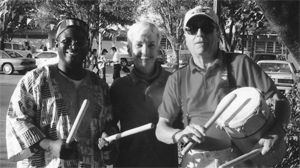
Dressed in traditional African garb, Father Biriruka poses with former parishioners during an event at St. Kevin Parish a few years ago.
Favorite movie:
“I don’t really watch movies, but I would like anything that has to do with Padre Pio or Blessed John XXIII. Occasionally I enjoy a good martial arts movie … as long as it isn’t too violent.”
Favorite TV series:
“I like the news. I watch CNN or BBC. I enjoy hearing about politics and then looking at it from the point of view of theology.”
Favorite type of music:
Gregorian chant.
Person he most admires:
“John Paul II because of how he loved the people, how he taught us, how he dealt with problems and how he opened the doors of Jesus to the world.”
His greatest disappointment:
“In my country, there have been horrible massacres and genocides as in neighboring Rwanda. My greatest disappointment has been not being able to stop them. I have tried. I have written letters, made phone calls to so many people both in the United States government and abroad and yet nothing has happened to stop these senseless killings.”
His greatest joy:
“Serving the people of God in both good and bad times.”
His greatest accomplishment:
“I was able to successfully build this church (Blessed John XXIII in Miramar) and I think I have also earned partial credit, at least, for stopping the persecution of the Church in Burundi. I did that by speaking the truth, being vocal and writing letters.”
Thing he most fears:
“I don’t have fears; I consider them adventures.”
Regrets:
“I have had struggles but I have no regrets.”
Born April 12, 1951 in Miranda, a city in Burgos, Spain, he came to Miami in 1978 on a business venture: representing 40 Spanish publishers seeking to sell bilingual textbooks in the U.S. market.
While living in St. Francis de Sales Parish on Miami Beach, he rekindled his vocation and was ordained for the Archdiocese of Miami on May 14, 1983.Since then, in addition to parish assignments, he has served in the vocations office, as archdiocesan director of youth ministry and as founding director of Radio Paz/Peace/Ke Poze.His journey to the priesthood:
He entered the seminary in Madrid, Spain, at 17, and left at 21. "It was the early 1970s. We were revolutionaries. We went to live in the poor neighbourhoods of Madrid, in groups of five. (We) decided that we had to study theology among the people." Eventually, he left theological studies altogether. "I had a crisis of faith. I wanted to discover what it was to live life. I wanted to prove that I could be successful in business and be a normal person."
What he did before becoming a priest:
He started his own business, transporting and delivering newspapers. Before that, in order to support himself as an "in-the-world" seminarian, he worked summers as a bellboy and waiter in Geneva, Switzerland. He also briefly drove a cab. "The tourists would get mad at me because I didn't know the streets of Madrid, and they thought I was cheating them."
A knock on the door:
By age 27, he had built a successful business, owned a large house in Madrid and "lived really well." One night, while he was getting ready to throw a party, an elderly couple knocked on his door, suitcases in hand. They needed a place to stay. He tried to shut the door on them "but it wouldn't close. It was like something was stuck. I remembered the Gospel passage, 'Whatever you do to the least of my brothers' I thought of my parents in the same situation." He relented, but warned the couple that it was only for one night. They stayed with him for two years. "I wanted to know nothing about God. When they came to my house and knocked on my door, they gave me back my vocation."
"I had a crisis of faith.I wanted to prove that I could be successful in business and be a normal person."
Why he ultimately became a priest:
"I found out that money didn't bring me happiness. I was looking for something that would give meaning to my life. When I entered the seminary the first time, I thought I was missing something, and I didn't want to be a frustrated priest."
Being one with the people:
At his first assignment, the predominantly Cuban Sts. Peter and Paul Parish in Miami, he strived to fit in. "I would invite myself to eat in (parishioners') homes," telling them that he loved "peccadillo" and black beans. After the first two weeks of eating that every night, he got up on the pulpit again and said, "I would like to change the menu."
As a young seminarian, Federico Capdepon helped Cuban refugees in Madrid. He also played guitar in a musical group he dubbed, "Los Brothers." The six seminarians would go around the countryside performing at dances for youth groups. "We only knew four songs."
Who was most surprised by his vocation:
"My father wasn't too thrilled. He wanted me to be an architect. Every time my mother thought about it, she would start to cry because she thought they were going to send me to Africa." Even after he came to Miami, "my mother thought I was converting Indians here in Florida."
Greatest joy:
Serving as a link between the earth-bound, materialistic world and the transcendent, spiritual world. "The people see in (priests) a font of joy, of hope, of spirituality, of the possibility of a different world than the one in which we live."
Most difficult aspect of being a priest:
"Not being able to resolve all the problems. We are asked to do a lot and we are not prepared for it. We are asked to be social workers, counsellors, administrators, great preachers, liturgists. Sometimes you just have to say, 'I don't know' and 'I can't do it.'"
His description of the ideal priest:
"A priest has to be a spiritual man, but not pie in the sky. He has to be happy, and able to convey that joy to people. He has to be capable of laughing with people when they need to laugh and crying with people when they need to cry. Basically, he has to like people."
Priestly stereotype that should be discarded:
"The stuck-up, formal priests who have to be treated differently, who are not part of the people, who are unapproachable."
Favourite type of music:
American country music. He also collects folkloric music from different countries.
Person he most admires:
"Anyone who leaves behind their way of life to do something extraordinary for others."
Born May 6, 1964, in Levittown, New York, his family moved to Jensen Beach when he was 8. He attended public schools and St. Martin de Porres Parish, and was studying at Indian River Community College when he decided to enter the seminary. Since his ordination, May 11, 1991, he has served as priest-secretary to both Archbishop Emeritus Edward McCarthy and Archbishop John C. Favalora, and as associate pastor at Epiphany Parish in South Miami and Immaculate Conception in Hialeah. He is currently studying fulltime at Florida International University, working toward a degree in exceptional student education with a specialization in autism.
When he knew he wanted to be a priest:
"I started thinking about it when I was in eighth grade. Throughout high school it was an idea that kept coming back to me. Sometimes yes, sometimes no, but it definitely kept coming back. ... While there were many things that I could do and do well, this was the one thing where I felt I could give the best I had to give and be the most fulfilled."
What he would be doing if he had not become a priest:
His intended major in college was education. "It's very interesting that, these many years later, the church has come to me and asked me to fulfill a need by studying special education. So it's come full circle. In a sense, I gave that up to enter the seminary and now it has been given back to me."
Greatest disappointment:
"If you turn disappointments over to God, they don't become great. So I don't worry about those."
Greatest joy:
"Sharing with people in the important moments of their lives, the joyful ones as well as the sorrowful ones."
Most difficult aspect of being a priest:
"Being unable to meet the overwhelming needs that are being presented to you. Being unable to be in three places at once and wanting to meet those needs."
Priestly stereotype that should be discarded:
"That priests are supposed to be angels in human form rather than human beings who walk with the community."
"In a sense, I gave that up (a career in education) to enter the seminary and now it has been given back to me."
How others describe him:
"I've been told I have a raucous laugh." When he was at Epiphany, "it was a vocabulary word and the kids were not getting it. So the teacher said, 'Father Michael has a raucous laugh.' And the kids got it."
Life as a university student:
"It's neat not to have any sort of favoritism toward me. Because sometimes priests are treated with favoritism. It's nice to know that the grade I'm getting is because I'm working as hard as everybody else. ... Being at the university has helped me to see the importance of being a person, not just a persona. It's important for priests to be persons with their people. Jesus said, 'I know my sheep and mine know me.' Underline the 'mine know me' part because sometimes we forget that. The sheep also need to know their shepherd."
On dancing:
"When I first got to Immaculate, I had never seen a community that so loved to dance. I never danced. I was terrified of dancing my whole life. But in order to be part of this community, I took salsa lessons. It was exercise. It was fun. And now I can dance with my community. They were all happily shocked. I'm still no good, but at least I'm not afraid anymore."
On the priestly commitment:
"To be a good husband and wife, you have to be desperately in love with your spouse. The priest also must be desperately in love, passionately in love, with God and the priesthood. It is the same commitment. We're called to a spousal relationship with God. It needs to be that deep and that real and that passionate. If it's only about what you do, then it's work. It's just a job, it's not a life. Being a husband or a wife is not only about what you do, but who you are because of your relationship to this other person. For a priest, it has to be the same."
Thing he most fears:
"Losing loving relationships. Becoming so busy that I loose touch with those loving relationships, with families and friends that keep me human, that keep me real."
Person he most admires:
"My father because he was a decent man who worked very hard to provide for his family, to create a loving environment in his home, who was always willing to do things for other people without wanting recognition or thanks."
Born Jan. 21, 1954, in Moron, Cuba, Msgr. Castañeda came to South Florida with his family and graduated from Miami Springs Senior High. He attended Miami Dade College and Florida International University, graduating with a bachelor's degree in elementary education and a minor in special education. In 1982, he entered St. John Vianney College Seminary in Miami and continued his studies for the priesthood at St. Vincent de Paul Regional Seminary in Boynton Beach. He was ordained May 16, 1987, for the Archdiocese of Miami. Among his assignments since then, he has served as pastor of Our Lady of Perpetual Help Parish in Carol City and rector of the National Shrine of Our Lady of Charity in Miami. He became pastor of St. John the Apostle in 2010 and also serves as director of Opus Caritatis, a ministry to the homeless, the elderly and people with substance abuse problems.
What he did before becoming a priest:
"I began working when I was 15, went to college and became an elementary school teacher for the public school system in Miami-Dade County."
When he knew he wanted to be a priest:
"At age 19 I thought of becoming a Franciscan brother. The call to become a priest was not in the beginning, it developed slowly under spiritual guidance. I didn't begin the seminary until I was 28 years old."
Person or event that triggered his vocation:
"After I read the life of St. Thomas de Celano (one of the first followers of St. Francis of Assisi) and reading about the radical decision to leave everything behind and follow the Lord. Being involved in parish ministry fueled my desire to serve the Church."
Person most surprised by his vocation:
"My family at first because they didn't understand; also the principal at the school where I taught. I remember she said, 'I have goose bumps,' when I told her I was going into religious life."
What the seminary did not prepare him for:
"I would have benefited from learning more about the fundamentals of the biblical languages and Latin since we are committed to read, study, preach and teach the sacred Scripture as part of our way of life."
'I do thank God for calling me and using me as his instrument in spite of my unworthiness.'
What he would be doing if he had not become a priest:
"Teaching elementary school and special education. I was very happy doing that!"
Favorite priestly assignment:
"Serving the poor in the inner city and serving the Virgin Mary."
The most difficult aspect of being a priest:
"This question reminds me of John 15:20: 'No slave is greater than his master, if they persecute me they will also persecute you.' The hatred and persecution that Jesus suffered is also our own suffering as priests."
A priestly stereotype that he feels should be discarded:
"People think that in order for a priest to be truly happy he needs to be married, and that simply isn't true."
A 3-year-old Msgr. Oscar Castañeda is pictured here dressed as a cowboy in his native Moron, Cuba.
Favorite movie:
"The Mission."
Favorite TV series:
"When I have a little bit of time I like to watch the show on A&E 'Intervention.' It is about a method or strategy used to help drug addicts recognize their problem and begin the process of recovery."
Last book read:
"Jesus and the Jewish Roots of the Eucharist" by Brant Pitre.
Favorite type of music:
"I like music in general but my favorite is classical guitar and Bach's organ concertos."
What he collects?
"Nothing in particular, but throughout the years I have kept various editions and translations of the Bible as my own way of interest in sacred Scripture."
Person he most admires:
Blessed Teresa of Kolkata. "I admire her convictions, her courage and her poverty."
His greatest disappointment:
"When I see people abandon the practice of the sacraments or when marriages break and families are broken apart."
His greatest joy:
"To celebrate the Eucharist with my parents on their 60th wedding anniversary (which took place Sept. 10 of this year.) It is a joy and a special grace for my family."
His greatest accomplishment:
"I normally don't look at my life from that perspective, but I do thank God for calling me and using me as his instrument in spite of my unworthiness."
Thing he most fears:
"I try to live without fear because it tends to paralyze some aspects of my life. My apprehension is to not want to contradict myself and the ministry/ mission that I am called to."
Born Aug. 1, 1953, in Georgetown, British Guiana (now Guyana), Father Chan-A-Sue’s name is actually an anagram. His great-grandfather was named Asue Chen, but when he immigrated to Guyana, he rendered it Chan-A-Sue. Father Chan-A-Sue first went into an accounting career. He earned a diploma from Liverpool Polytechnic in Liverpool, England, then joined the Institute of Chartered Accountants in England and Wales. He worked for auditing companies in London, Georgetown and Miami before answering the call to the priesthood. He earned a degree in philosophy at St. John Vianney College Seminary in Miami, and a master’s degree in divinity at St. Vincent de Paul Regional Seminary in Boynton Beach. He was ordained for the Archdiocese of Miami on May 13, 2000. Before coming to St. Bartholomew in October 2010, Father Chan-A-Sue served at St. Maurice in Dania Beach, Holy Family in North Miami, Blessed Trinity in Miami Springs and St. Andrew in Coral Springs.
Why did you leave a secular career to become a priest?
“When I went to college, I volunteered to lead rosary at lunch. A priest told my mother I should be a priest. I thought that was strange. In Miami, I got involved at St. Agatha and became friends with Father (now Bishop Felipe) Estevez. People kept saying I should become a priest. I decided I’d go to seminary; if I didn’t like it, I’d leave. But when I got there, it just felt right.”
Person/persons most surprised by your vocation:
“My family. My mother asked if I had to do it. I partied a lot. I wasn’t wild and crazy, but I danced a lot. I had a fun-loving life.”
Did the priesthood make you give up fun?
“I have fun in different ways. I like lively Masses. I’m always bobbing with the music.”
‘ I like lively Masses. I’m always bobbing with the music.’
Favorite priestly assignment:
“Everywhere. The culture is so egoistic that if we’re unhappy, (we think) it’s because of the people around us. Happiness comes from making the best of the surroundings.”
How do you like to spend time off ?
“Sometimes I go with friends to movies or dinner. For restaurants, I always like to try something new. And I like gardening.”
“‘Lincoln.’” He said, ‘Your compass may be true north, but you may have to go there by an indirect way.’ The lesson was that to get to a goal, you have to compromise.”
Last book read:
“‘The Infancy Narratives of Jesus of Nazareth,’ by Pope Benedict XVI. He comes with insight, speculating into the minds of the Gospel characters.”
Other interests:
Football. The Hurricanes and the Dolphins. “I like to go to the games at Sun Life Stadium just down the road.”
Person you most admire:
Person you most admire: “One is Nelson Mandela, for how he brought South Africa from the brink of civil war.”
Your most memorable spiritual experience:
“My ordination. I was tired because I’d been doing a lot of work. When they put me on the floor, I was afraid I’d fall asleep. But just after Archbishop (Emeritus John C.) Favalora anointed my hands, I felt a peace come over me.”
Father Chan-A-Sue is pictured here in Kew Gardens, London, in wintertime, around 1980.
Something most people don’t know about you:
“I always look at the theological aspects of movies. ‘Snow White’ is about power and innocence. The mirror sees the soul. The reflection is not the physical but the inner (self). And a kiss brings Snow White back to life. Love conquers death.”
Your harshest critic:
“In every parish, 10 percent are going to love you because you’re the priest; 10 percent won’t like you because you remind them of someone they don’t like; 40 percent will warm up to you; and the other 40 percent are just fulfilling their Sunday obligation. That’s the group you need to educate to become more active.”
Motto, or favorite Scripture verse:
St. Augustine: “Christ has no body on earth but yours, no hands on earth but your hands, yours are the eyes through which he looks with compassion on the world, yours are the feet with which he chooses to go about doing good, for as he is the head, so you are the members, and we are all one in Christ Jesus.”
Born Feb. 14, 1961, in Limbé, Haiti, Father Charles studied to become an electrician and interior designer after graduating from high school in his homeland. But he always felt called to the priesthood. After studying almost three years at Iteso, the Jesuit university in Guadalajara, Mexico where he became fluent in Spanish), he entered St. John Vianney College Seminary in Miami in 1992, and was ordained for the archdiocese on May 8, 1999.
He served at St. Mary Cathedral and Sacred Heart Parish in Homestead before being appointed administrator of Divine Mercy Mission in Fort Lauderdale in December 2004.
The community has about 1,600 families, all of them of Haitian origin.
When he knew he wanted to be a priest:
When he was between 4 and 6 years old, he was impressed by the “extreme kindness” of Father Joseph Lepevedic, a priest who was very close to his family. “He gave the last rites to my grandmother and when he gave her the last rites he said, ‘Bye, and I will see you in heaven.’ A couple of days after my grandmother died, he died. … That is when I said I want to be somebody like that when I grow up.”
What he did before becoming a priest:
“I made more money at interior design so that is what I did after high school.”
Who was most surprised by his vocation:
“Nobody really. I ran into a friend that I have not seen in about five years, and she told me, ‘Everybody always knew that you wanted to be a priest.”
Current responsibilities:
“Because this is a community that needs to be built up (physically and spiritually), I am involved with everything. I scrape, I mop, I do educational things.”
What he does on his days off:
“I don’t have any. If I have spare time, I do garden work around the church.”
Favorite movie:
“Quo Vadis” (1951)
Vocation moment:
“My whole life I have been very close to the church. Because of my situation with my family (I had) to postpone going to the seminary to become a priest. But (the idea) was always there.”
"Somebody who has his feet on the ground; being yourself and knowing yourself."
What he would be doing if he had not become a priest:
“A design consultant, a large-scale operation that would deal with all phases (of design).”
Favorite priestly assignment:
“It is difficult to choose just one” but first on the list is the migrant ministry in Virginia, where he worked when he was a seminarian. “You had to be there to defend the people when they were being mistreated.”
Greatest disappointment:
“The outlook you get in the seminary is completely different from what comes outside. Life outside is a big adjustment.”
Because gardening is one of his hobbies, Father Robés Charles personally tends the garden at his parish, Divine Mercy Mission in Fort Lauderdale.
Priestly stereotype that should be discarded:
“Thinking that a priest is a perfect man of the world; that they have to be serious men, always wearing black and white. They should be thought of as simple people.”
Favorite type of music:
“Wow! It is so large. I love music, I love singing. The only music I really don’t like is blues.”
What he collects:
Manger scenes, different types of currency and stamps.
Person he most admires:
“My dad, Jolius Charles. He taught me that nothing is impossible.”
Thing he most fears:
People who put others down for no reason: “I don’t really fear them. I just don’t like to be around them.”
The son of a Cuban mother and Italian father, Father Alfred Cioffi was born in Havana, Cuba, Nov. 5, 1952, the older of two brothers. The family left Cuba in 1960 and lived in New Orleans and New York before moving to various countries in Central America. (His father worked for the airline Alitalia.) After high school, the young man came to Miami to study marine biology. In 1973, he received his undergraduate degree in biology from Florida International University but was not accepted for postgraduate work at the University of Miami's Rosenstiel School of Marine and Atmospheric Science.
After working at a fish farm, taking time off to care for his ailing mother and teaching at Miami's St. Brendan High School, he entered the seminary in 1980 and was ordained for the archdiocese on May 11, 1985. Father Cioffi served at Epiphany Parish in South Miami before being sent to Rome to obtain a doctorate in moral theology.
Upon his return, he taught at St. Vincent de Paul Seminary in Boynton Beach and served five years as pastor of St. Kevin Parish in Miami before being sent to Purdue University in Indiana to obtain a doctorate in genetics. Because of Father Cioffi's expertise in this controversial field, the Archdiocese of Miami has "lent" him to the church at large.
Titles of his doctoral dissertations:
Moral theology: "The Fetus as Medical Patient: Moral Dilemmas in Prenatal Diagnosis From the Catholic Perspective." Genetics: "The Relationship Between the Structure and the Function of Chromosomes."
What he did before becoming a priest:
After graduating from FIU, he got a job taking care of tropical aquarium fish at a fish farm on Sunset Drive in Miami. "It was a lot of fun. I would take care of the fish all day. The weekends I would be sailing and diving and dating and dancing – and I was getting paid for it."
What he would be doing if he had not become a priest:
Marine biologist.
"My best recommendation for TV is to shoot it before you throw it out the window."
Vocation moment:
"I love nature. Through nature, I had a deeper relationship with God." As a teacher, he also "wanted to reach the teenagers at a deeper level, a more spiritual level; especially to try to help them not commit some of the mistakes that I had made when I was a teenager." Finally, taking care of his bedridden mother for more than a year "brought forth a generosity in my life." Until then, "I would have said 'I'll be a nun before I become a priest.' Those were the chances."
Celibacy:
"That was a big sacrifice, and it is daily," although it has a practical advantage: "just being available for the people."
Favorite sacrament:
Confession, "because I've had to use it a lot. But seriously, to think that people, total strangers, come to us with their conscience in their hands. They tell us things they don't tell their spouse. It's a very privileged moment that we have."
What he does for fun:
Scuba diving and sailing.
Favorite movies:
"It's a Wonderful Life" and "The Passion of the Christ."
Greatest disappointment:
"The church abuse scandal."
Favorite TV series:
"My best recommendation for TV is to shoot it before you throw it out the window. The happiest moment of my life was when I gave up TV. I'm addicted to TV, you see, so when I turn it on I can't turn it off."
Regrets:
"All the sins of my life: being too wild, too young."
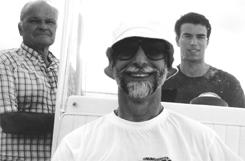
At home on the water: Would-be marine biologist Father Alfred Cioffi, center, during a diving trip with cousin-inlaw, Richard Jung, and his son, Ricky.
Wild days:
"I started smoking at 11." As a teenager in Central America, he and his friends would compete to see who could find a good wedding to crash and then be the first to get drunk. "It's by sheer miracle that I'm alive. … I have been the cause of my parents' sanctification."
Thing he most fears:
"That the scandal is not over."
Greatest joy:
Teaching.
Greatest accomplishment:
"Convincing a mother not to have an abortion."
What he collects:
Not much anymore, but "I used to collect coins, stamps, plants, animals, women, fossils. You name it."
Born in Cuba in 1957, Father Corces grew up in Miami and was ordained for the archdiocese in 1988. As vocations director, he is responsible for recruiting and screening candidates to the priesthood. He also helps out at Prince of Peace Church in Miami, teaches lay ministry courses and has been involved with the HIV/AIDS ministry.
When he knew he wanted to be a priest:
"I tried going into the seminary right after high school and it didn't work.
I was too young, too immature." Years later, he began questioning his choice again: "During a New Year's Eve party in which I was having the best time,
I stopped and looked around and said, is this what
I want? And the answer was very clear. No. That is not for me."
Later still, during a visit to the missions in Honduras, he realized his call was to the priesthood:
"Coming in contact with the dirt poor people made me want to make a difference. The priesthood came up as the way to make a difference. Of course, there are other ways. But that was my way, the gift being offered to me."
His description of the ideal priest:
"First of all, a human being filled with love for life and God and deep faith that, in and though that broken humanity, God blesses the world. You have to be filled with life, definitely."
What he would be doing if he had not become a priest:
"A teacher or a pilot. I love to tach and I love planes."
"I am successful when I know that the person has been touched by the spirit of Christ - when I have facilitated that encounter. You see the fruits. You see the change. Those are moments of sucess."
Greatest disappointment:
"9/11. Disappointment at our own humanity, that we are capable of doing something like that."
Greatest joy:
"9/11. I was so angry in the morning, and by the afternoon, I saw how human beings are capable of the highest, heroic choices."
Person he most admires:
Gandhi. "I think he was an incredible man who was able to free a country without shooting a gun."
Thing he most fears:
"I fear being old, sick and helpless, because I see it every day."
What he did before becoming a priest:
Worked in a bank's accounting department for 7 years: "I hated it."

Father Pedro Corces indulges in his favorite pastime: browsing in bookstores & reading.
Most difficult aspect of being a priest:
"Finding myself without answers and therefore dealing with the frustration of being powerless before cerain situations. Having to accept that I do not have all the answers."
What he does on his days off:
Loves going to the movies and spending time in bookstores: "I'm a bookworm. And when the weather is nice I go to the beach. I love the ocean."
His harshest critic:
"Myself and the Gospel."
His greatest accomplishment:
"I am successful when I know that the person has been touched by the spirit of Christ - when I have facilitated that encounter. You see the fruits. You see the change. Those are moments of success."
The oldest of three children, Father Davis was born in Hamilton, Ohio, Sept. 16, 1963. He entered the Pontifical College Josephinum in Columbus, Ohio, in 1981, studying for the Archdiocese of Cincinnati. A summer doing evangelization work in Mexico proved “dramatically impactful” and he decided to move to a “multilingual, multicultural part of the church in America” in order to do “cross-cultural ministry.”
The fact that his grandparents lived in Dania Beach and his parents had a connection with Archbishop Edward McCarthy - his brother was their pastor - made Miami a logical choice. He moved here in 1985, spent a year studying theology at the North American College in Rome, then returned to St. Vincent de Paul Regional Seminary in Boynton Beach. He was ordained for the archdiocese in May 1990 and has been assigned to Archbishop Carroll High School since 2000. He also has helped out on weekends at Our Lady of Lourdes Parish in Miami since 1992.
Vocation moment:
An altar server since fourth grade, he attended a high school with a “very vibrant Catholic atmosphere.”
One day, the librarian, a nun, asked him what he wanted to do with his life. His reply, “I'll probably be a teacher.” Her reply, “You're going to be a priest. I am going to pray for you every day so that you'll be a priest.” Another time, he was playing golf with the priest who was principal of the high school who told him, “You just might have what it takes to be a priest.” He gave up a full scholarship to the University of Dayton to enter the seminary at 17. “I went in willing to give it a try, one year at a time.” By senior year, “It was obvious this is what I wanted to do.”
Who was most surprised by his vocation:
“My father: He was a nonpracticing Catholic during all my growing up years.” After Father Davis was ordained, “he started going to church and is now a daily communicant.”
"Sometimes I feel like Obi Wan or Luke Skywalker with the light saber, battling the forces of evil."
What he would be doing if he had not become a priest:
“I wanted to be a dentist, an astronaut for NASA, a pilot for Delta Airlines.” He also could have followed in his father's and grandfather's footsteps - both of them were local golf professionals - and joined the PGA.
Greatest disappointment:
“I have not been able to be directly responsible for someone going into the seminary” even though he has worked hard at Archbishop Carroll High School to create “an environment where vocations are possible.”
Hobbies:
“I do love to travel. I've been to all 50 states and like to go to other countries. I find that a spiritual experience, to discover God in new places.”
Favorite movie:
“I'm not a movie buff. I love “Star Wars” though. I have all the DVDs.”
His biggest challenge:
“To maintain the spiritual disposition of the priesthood in an otherwise secular job description. Most of what I do (as president and principal of a high school) does not require me to be a priest.”
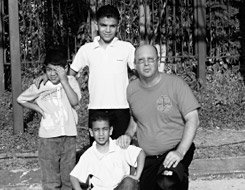
Father Davis poses with Palestinian boys in Jericho during a trip to the Holy Land in June 2006. “What did Jesus look like when he was a little boy? I wanted to have a sense of this.”
Most difficult aspect of being a priest:
“The Good Friday dimension of priesthood is heavy. Being on the front line and fighting the good fight on behalf of the church and furthering its mission.
This is not Father Davis' personal agenda. This is the agenda of Christ and the church.We're constantly battling a lot of dark forces of evil and brokenness. Sometimes I feel like Obi Wan or Luke Skywalker with the light saber, battling the forces of evil.”
On celibacy:
“Good things are worth sacrificing for. There are causes that lead ordinary people to do extraordinary things.
If heaven is the goal, then celibacy for the kingdom makes sense.”
His description of the ideal priest:
“There is none. There were many different talents, temperaments and spiritual gifts among the apostles and they were all close to the Lord. I see ideal priests on every different front.”
His harshest critic:
“Myself. I demand hard work, integrity, professionalism and excellence of myself.”
Thing he most fears:
“Being separated from the Lord. Not being with Christ. That would be a frightful and hellacious destiny.”
Born in Illinois in 1954, he grew up in Hialeah, entered the seminary at 15 and was ordained for the Archdiocese of Miami in 1983. He is founding pastor of two-year-old St. Katharine Drexel Parish in Weston, a growing community of more than 600 families, about 60 percent Hispanics from various countries in South America. Father Edwards learned to speak Spanish by "hanging out with the Cubans in Hialeah." He also taught himself Slavic during summer visits to his mother's family in Slovakia. Diagnosed with a brain tumor in 2005, Father Edwards died April 22, 2006.
His description of the ideal priest:
"Someone who prays and knows how to teach others to do that. Also, someone who is able to help people make the connection between God's word and their life."
Greatest joy:
"It's a repeat experience. When somebody comes and is able to express to me that my ministry has made a difference and enabled them to connect with God."
Priestly stereotype that should be discarded:
"That the priest has a better or more direct connection with God than lay people do."
Times he has failed as a priest:
"When I spoke too quickly, too harshly. Mostly cases of putting my foot in my mouth. Depending on the circumstances, you don't always get a second chance."
What the seminary did not prepare him for:
"The seminary gives you a foundation of theological knowledge. But the priesthood is mostly on-the-job training."
" It's a repeat experience. When somebody comes and is able to express to me that my ministry has made a difference and enabled them to connect with God."
Person, other than Christ, that he most admires:
"The late Msgr. Dominic Barry, my pastor as a kid at Immaculate Conception Parish in Hialeah. He was the epitome of a good pastor, an excellent image of what a good shepherd should be."
Thing he most fears:
"Nothing. We're in God's hands. God holds us and sustains us. There's no place we can go outside of God's providence. So I don't know that there's anything I fear."
What he does on his days off:
"I sleep late. I either go to the movies or watch videos. I catch my breath."
Hobbies:
Wrestling and rugby. He used to coach wrestling at Columbus High School and play rugby on the weekends but he cannot do that anymore. "It works on a teacher's schedule. It doesn't work on a parish priest's."
Most watched movie:
"A Few Good Men" - he used it in his religion classes at Columbus.
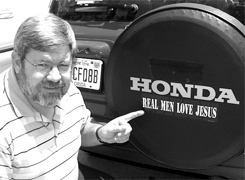
Father Paul Edwards puts his feelings on his bumpersticker.
When he knew he wanted to be a priest:
"I've never consistently wanted to be anything else. Ever since kindergarten, that's all I ever wanted to do and all I ever wanted to be."
Who was most surprised by his vocation:
"Nobody."
Favorite priestly assignment:
Teaching at Columbus High School in Miami, which he did for five years in the mid-1980s.
Greatest disappointment:
"When people get divorced. It's such an awful thing. It's so hurtful to them and to their families. It breaks the community of the church. It's almost never in their best interests. It's the single most painful thing that happens on a day to day basis."
Most difficult aspect of being a priest:
Finding time for a social life with lay people: "The time that most people are available is when I'm not. Even family celebrations such as Christmas or my mom's birthday inevitably have to be tailored around my schedule."
What lay people teach him:
"Not to take myself too seriously."
Born April 6, 1956 in Guantánamo, Cuba, Father Espino is the third of six brothers and sisters. He came to Miami in 1961 with a sister and older brother (now deceased) as part of the Pedro Pan program, which ultimately spirited more than 14,000 children out of Cuba. Father Espino lived with relatives in Brooklyn, N.Y., and Pennsylvania before being reunited with his parents on Valentine’s Day, 1966. That’s when I met my littlest sister, who was born two years after I left Cuba. The family moved near St. Benedict Parish in Hialeah, where he attended public schools. He entered the seminary in 1976 and was ordained a priest for the Archdiocese of Miami in 1983.
He has served at Corpus Christi in Miami, Sacred Heart in Homestead, St. Ann in Naranja, St. Martin de Porres in Leisure City, Holy Family in North Miami and as archdiocesan director of Encuentros Juveniles and Youth Ministry. From 1999 to 2004, he returned to Guantánamo, Cuba, to work as a missionary. In addition to his duties at Holy Rosary, he currently serves as archdiocesan liaison to Caritas Cuba.
What he did before becoming a priest:
He worked part-time and during the summer delivering newspapers, cleaning up in a pizza parlor, pumping gas, bagging groceries and making deliveries.
When he knew he wanted to be a priest:
About a year-and-a-half after graduating from high school, while studying pre-med at Miami Dade College. "I had a conversion experience.I saw the need for priests."
What he would be doing if he had not become a priest:
"I always wanted to be a doctor or in medicine." He still keeps up with topics in bioethics.
His Greatest joy:
"Being able to be present to people in moments of need.You can make a difference in people’s lives."
Most difficult aspect of being a priest:
"Being open to the person that you have before you, being non-judgmental. We have a tendency to judge and to solve and give the correct answer right away. We just have to listen and walk with people."
His description of the ideal priest:
"There’s no such thing as an ideal priest, in a sense.
The ideal priest is the man who is able to be comfortable with himself, transparent before God and others, and be there for others."
"I turn out much better than I should have."
A priestly stereotype that should be discarded:
"That priests are know-it-alls and solve-it-alls. Unfortunately, sometimes priests believe that."
His harshest critic:
"Myself."
Who was most surprised by his vocation:
"My brothers and sisters - they know me. You’re never a prophet in your own home." One girlfriend told him his decision was "a waste of brains."
What the seminary did not prepare him for:
"The burden of the bills and the building fund and this whole reality that takes energy away from pastoral work."
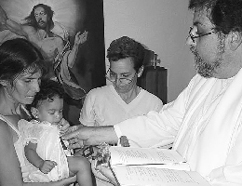
Father José Espino spent five years as a missionary in his native Guantánamo, working mostly with people who were uncharted. Here, he baptizes a young child.
What he collects:
Postcards from Guantánamo: "I discovered eBay."
Person he most admires:
For his example of perseverance: Charles de Foucauld, "a strange priest who founded a community that nobody joined." Today, that would be the Little Brothers of Jesus Caritas.De Foucauld is also the inspiration behind a priestly fraternity, Jesus Caritas, to which Father Espino belongs.
Thing he most fears:
"Not responding to God’s will, and not con-fronting my fears."
Thing he is grateful for:
"God’s grace working. I turned out much better than I should have."
Hobbies:
Cooking: "In Cuba I cooked for myself for 5 years. My grandfather used to cook and my dad cooked. It’s a way of relaxing."
On going to Cuba:
When he arrived, the newly-created Diocese of Guantánamo had five priests and two parishes. In five years, it grew to nine parishes and 12 priests and was on the verge of ordaining its first diocesan priest.
"The work of the priest is the work of the priest wherever you go. You build up community."
Bishop Estévez was born Feb. 5, 1946, in Havana. "The liturgical calendar used then had as the saint of the day Felipe de Jesus," so that is his given name. He is the second of three children (two boys and a girl) who grew up in the area of Pedro Betancourt, in the province of Matanzas. In July 1961, the future bishop arrived in Miami as one of more than 14,000 unaccompanied children smuggled out of Cuba through the Pedro Pan program. A month later, he was relocated to St. Vincent Villa Orphanage in Fort Wayne, Ind., where he lived while attending Central Catholic High School. His brother joined him six months later, and they were reunited with his parents and sister a year after that. The future bishop attended seminaries in Montreal and was ordained May 30, 1970, in Fort Wayne for his home Diocese of Matanzas.
Having been refused permission to return, he went to Honduras, where he served as a parish priest and member of the faculty in two seminaries. In 1975, he joined the faculty at St. Vincent de Paul Regional Seminary in Boynton Beach. After obtaining a doctorate in theology from the Pontifical Gregorian University in Rome in 1980, he was named president/rector of St. Vincent de Paul, where he remained until 1986. In 1987, he was appointed pastor of St. Agatha Parish in Miami and director of campus ministry at nearby Florida International University. In 2001, he returned to St. Vincent de Paul as dean of spiritual formation, and in November 2003 was appointed auxiliary bishop of Miami. He was appointed bishop of St. Augustine on April 27, 2011, and installed June 1.
When he knew he wanted to be a priest:
"From early on in high school I kept the idea only to myself as an amazing dream."
Person or event that triggered his vocation:
"I was very blessed as an adolescent to know 'Padre Aleido,' a very zealous and holy priest. One day he took my hands and said, 'These hands could consecrate the body of Christ.' I remained in shock and bewildered, not really understanding his words — it was a very sacred moment. Undoubtedly the seeds were then sown." That priest was Miami's retired Auxiliary Bishop Agustín Román, who has remained his friend and mentor for more than 40 years.
Persons most surprised by his vocation:
"My father. When I broke the news he felt let down, as I would feel if a son of mine would join the Hare Krishna. Within a year I could feel he was happy over the idea of becoming the father of a priest, an idea he had never considered."
What the seminary did not prepare him for:
"I was trained immediately after the Council of Vatican II. It certainly did not prepare me to deal with the very subtle crisis that came simultaneously with the great work of renewal of the Holy Spirit. I have a great gratitude for the great pontificate of John Paul II. His courageous leadership brought clarity and a vision which the whole Church needed at the end of the '70s."
' A pastor of a parish (is) the best job in the Catholic Church.'
What he would be doing if he had not become a priest:
"Signs point to being an educator, a university professor perhaps; also I would have chosen to contribute in the field of international development and world peace."
Favorite priestly assignment:
"A pastor of a parish, the best job in the Catholic Church."
Most difficult aspect of being a priest:
"To live immersed in a living paradox or in an immense gap: on one side being a channel of God's mystery, on the other side at the same time being a very limited fragile individual who is also a sinner. … St. Paul expressed it perfectly: 'We carry the treasure in earthen vessels that the all-surpassing power may be of God and not from us' (2 Cor 4:7)."
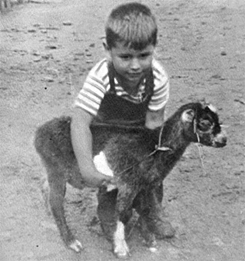
The future Bishop Estévez is shown here as a 4-year-old, playing with a goat in his native Matanzas, Cuba.
Most rewarding aspect of being a priest:
"The celebration of the Eucharist."
His description of the ideal priest:
"The ideal priest is really the holy, totally self-giving priest. The example is John Paul II — hard to match."
Hobbies:
He loves music, long walks during which he prays the rosary, tennis and baseball. His favorite team is the Florida Marlins.
What he does on his day off:
"I usually do personal reading and correspondence; usually see a movie; have a beer with a friend, a couple of friends or family. It's a day in which I take care more of my personal items."
Last movie watched:
"Poetry" (a South Korean film).
His favorite book:
"I love to read theology."
His greatest joy:
"Seeing with my own eyes the growth that Christ makes possible in people."
His greatest fear:
"I fear attacks, to be attacked, misunderstood; when your integrity is challenged or when your intentions are not well understood."
His greatest disappointment:
"My lack of holiness."
Person he most admires:
"St. John the Evangelist — the breadth of his writing, the breadth of his understanding of the event Jesus is truly overwhelming."
Priestly stereotype that he thinks should be discarded:
"That we are unhappy. Recent statistics point out that more than 94 percent, 95 percent of priests are happy and satisfied in what they do."
Born Dec. 30, 1928, in Galway, Ireland, Msgr. Fogarty is the second youngest of seven children. He attended seminaries in Ireland, was ordained June 2, 1957, and was recruited for the Diocese of St. Augustine, which then covered all of Florida, by the late Archbishop Joseph Hurley. In addition to his duties as pastor and dean, Msgr. Fogarty is chairman of the board of trustees of the archdiocesan Pension Plan and a member of the board of trustees of the archdiocesan Health Plan. Among his assignments during the past 46 years in south Florida: founding pastor of St. Bartholomew Parish, Miramar; archdiocesan chancellor (1972-78) and vicar general; pastor of St. Rose of Lima Church in Miami Shores (1971-91).
What he does on his days off:
He plays golf year-round with three pastor friends: "The Tuesday game is almost sacrosanct."
When he knew he wanted to be a priest:
"In my fourth year of high school." His father wanted him to follow in his footsteps and be a teacher. "I squandered the money he sent me to apply for admission to teachers' training college."
What he would be doing if he had not become a priest:
An attorney or an engineer - his debate club experience would have been useful in a career in law and his love of math would have served him well as an engineer.
Favourite movie:
"The Paper Chase"
Favourite TV program:
"The O'Reilly Factor"
What the seminary did not prepare him for:
"The challenges regarding finances in parish administration, such as budgeting, fundraising and stewardship. You have to find your own way through that."
Favourite priestly assignment:
Recruiting seminarians from Ireland for the Diocese of Miami during the 1960s: "Every September it was a battle. About 20 to 30 diocese were vying to recruit seminarians." Among those he recruited: Father Peter Lambert (pastor, St. Clement, Pompano);, Father Gabriel O'Reilly (Pastor, St. David, Davie); Father Edmond Prendergast (Pastor, St. Bonaventure, Davie); Father Michael Quilligan (Pastor, Annunciation, Hollywood); the Dalton brothers, Father Brendan (Pastor, St. Bernadette, Hollywood) and Father Bryan (Pastor, St. Ambrose, Deerfield Beach); Father James Murphy (Pastor, Our Lady of the Lakes, Miami Lakes); Father Timothy Hannon, (Pastor, St. Anthony, Fort Lauderdale).
"I fear retirement. I don't know what I'd do."
Most difficult aspect of being a priest:
"Being chained to a desk & enmeshed in administration."
His description of the ideal priest:
"One who is engrossed in apostolic work founded on a prayer life to which one devotes sufficient time. One's energy flows from an adequate prayer life."
Priestly stereotype that should be discarded:
"The expectation or concept that priests deserve special treatment or privileges in the ordinary affairs of life."
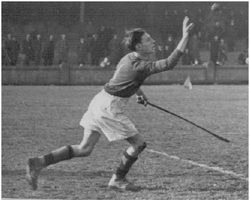
Before becoming a priest, Msgr. Fogarty (above) was a nationally-recognized hurling goalkeeper. Hurling is an ancient Irish sport, a cross between lacrosse and field hockey played with sticks called hurleys and balls known as sliotars. This photo was taken at the all-Ireland colleges semi-final in 1946. Although Msgr. Fogarty's side lost, the national newspaper praised his stellar goalkeeping.
His harshest critic:
"I am my harshest critic when I allow myself to become enmeshed in the trivia of pastoral life at the expense of the more essential dimensions of parish ministry."
His greatest accomplishment:
Helping to steer the Pension Plan for archdiocesan employees to its present stable position as one of the better diocesan retirement plans in the nation; recruiting a large number of priests in Ireland for the Diocese of Miami.
Last book read:
"A People Adrift" by Peter Steinfels. "It's about the crisis of the Roman Catholic Church in America. It's well-written and stimulates thought, even though one does not necessarily agree with many of the author's conclusions."
Favourite type of music:
Classical music - 1360 AM.
Person he most admires:
Pope Paul VI for trying to keep the church together after Vatican II; and William Bennett, secretary of education during the Reagan administration and author of 14 books. Despite admitting to a gambling problem last year, Bennett is "perhaps the greatest secretary of education we've ever had."
Thing he most fears:
"I fear retirement. I don't know what I'd do on a Monday morning if I had to face a week with nothing specific to do."
Born Dec. 7, 1956, in Sacramento, Calif., Father Grady is the third of five brothers (the youngest is deceased). His father served in the Air Force and the family moved often. Father Grady entered the seminary for his then home Diocese of Providence, R.I., right after high school. He obtained a bachelor’s degree in political science and philosophy from Providence College, studied a year at the Catholic University of Louvain, Belgium, and nearly two years at the Catholic University of America in Washington, D.C., before leaving the seminary. In order to support himself, he got a job as a desk clerk at a hotel in the nation’s capital and “kept getting promoted” until becoming regional director of marketing for a national chain, a position which ultimately brought him to South Florida. In 1991, he returned to the seminary, entering St. Vincent de Paul in Boynton Beach. He was ordained for the Archdiocese of Miami on May 14, 1994, and has served as associate pastor at St. Gregory in Plantation and Nativity in Hollywood, as well as teacher and assistant principal at St. Thomas Aquinas High School in Fort Lauderdale. He was named administrator of St. Jerome in June 2011.
When he knew he wanted to be a priest:
At age 18, and then again at 34: “Every couple of years I would have the urge to go back but I would say, no, I’m enjoying my life.” Finally, while working at a hotel in Florida, a Jewish lady who knew nothing of his background said to him, “Have you ever thought of becoming a priest?” A year later, “I made a deal with God. I’ll call (the seminary). They’ll tell me I’m too old. And then you’ve got to leave me alone.” It didn’t work out that way: “If God wants you, God gets you.”
What he would be doing if he had not become a priest:
“I would be doing hotel management, which I loved.”
What he does on his days off:
“I like to be able to sleep late in the morning and go out to dinner or lunch with friends.”
Favorite TV series:
“The Daily Show with Jon Stewart”
‘If God wants you, God gets you.’
Favorite priestly assignment:
“I love the parish because it’s varied. I’ve had it where I’m burying somebody in the morning and marrying somebody in the afternoon … In parishes, people let you into their lives at the most difficult and joyous moments. And this is a great gift of being a priest.”
Greatest disappointment:
“That there is still war in the world. I’m a big advocate of peace. I just see absolutely no sense to the violence.”
Greatest joy:
“My family.”
Most difficult aspect of being a priest:
“It seems there are not enough hours in the day to do everything. And those are the days you’re going to get these sick calls and have to go to the hospital. That’s when I remember the saying, ‘If you want to make God laugh, make a plan.’”
His description of the ideal priest:
“A man of prayer, a man with a sense of humor, and a man who can recognize Christ in everyone.”
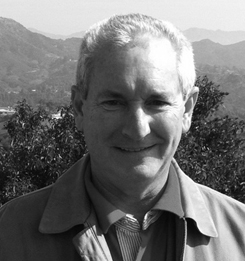
Father Michael Grady traveled to Hollywood, Calif., in March 2011 to preside at the wedding of a former student.
Priestly stereotype that should be discarded:
“Ascribing any super human attributes to a mortal man is not really a good strategy. Priests are human like everybody else.”
What the seminary did not prepare him for:
“They can’t really prepare you for diocesan priesthood because their training is structured as if you were entering a religious community prayer together, etc. Your schedules are so busy (as a diocesan priest) that to try to plan morning and evening prayer together every day, that’s not reasonable.”
Favorite type of music:
Classic Motown: The Supremes, Temptations, Four Tops
Person he most admires:
“My grandmother … an incredible woman. She was a tiny little thing, lived to be 96 years old and she just had this wisdom.” Hers was the first family funeral he celebrated as a priest.
Thing he most fears:
“Spiders I’m allergic to them.”
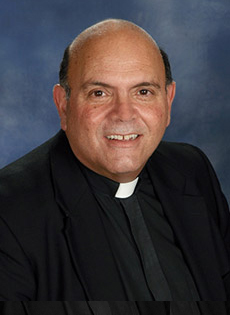
Born Oct. 13, 1950 in Cuba, he came to the U.S. with his family at age 11, graduated from Hialeah High School and served in the U.S. Army. He entered the seminary at age 40, after 13 years as a criminal defense attorney, and was ordained for the Archdiocese of Miami in 1996. In addition to his duties as pastor, he also serves as a judge in the Metropolitan Tribunal and supervising principal of St. Brendan High School.
On his delayed vocation:
“For the longest of time I resisted his calling. One day I said, why am I fighting? I thought money would make me happy. I thought fame would make me happy. I thought power would make me happy. When I chose not to be rich to become a priest, I became the happiest… Finally I was doing God’s will and not mine.”
Who was most surprised by his vocation:
“The one person in my family who was not surprised was my dad. He said, ‘I kind of expected it 20 years ago. What took you so long?’”
On being an attorney:
“I love the law. Having been a lawyer has helped me be a more effective priest, because I can get my thoughts across to people.”
On choosing criminal law:
“I like jury trials. I have to be with people. I just get energized by people.”
On becoming a canon lawyer:
“I thought that I was done with the law… I’m convinced God has an enormous sense of humor.”
On celibacy:
All the years he was a lawyer, he knew God was calling him to the priesthood. So he attended Mass daily and led a celibate life. “If you do not have the grace to live (celibacy) beforehand, then you should have the humility to decline.”
"When I chose not to be rich to become a priest, I became the happiest… “
On temptation:
“Just because we’re priests doesn’t mean we’re above it all.” He goes to confession at least twice a month, preferably once a week: “It is not because I’m in grave sin. It is because I wish to avoid sin.”
On obedience:
“I knew obedience was going to give me a lot of headaches, because I had been on my own so many years.” So before entering the seminary, “I sold my Mercedes. All of my properties I placed in trust for the benefit of my parents. I would allow only $50 a month for my personal expenses.… I had to physically tell myself, you have to enter this discipline.”
Priestly stereotype that should be discarded:
“We are not walking about in clouds or sitting on high pedestals. My connection with God is no different than the people I serve. In fact, I know that their connection is a better connection. Mine has static.”
Artist’s sketches hanging in the rectory of St. Brendan show Father Heria as a criminal defense attorney during a high-profile drug case in Chicago.
Most frustrating part of priestly ministry:
“The administrative part…. If we are not careful we can lose our sense of spirituality.”
Local hero:
Father Pedro Luis Perez, pastor of San Lazaro Parish in Hialeah, whom he has known since age 12: “I pray that through my years of priesthood I can always be as consistent and as transparent as he has been.”
Hobbies:
“I’m a baseball fanatic. I’m a boxing fanatic. I believe De La Hoya was robbed.”
Greatest fear:
Failure.
Regrets:
“In the beginning of my seminary life I thought that I had waited too long. As I look back I realize there’s no reason to regret. Because God has used it all.”
On the role of a priest:
“Sometimes, when people come to see a priest, they want our prayers. They also want to see the human aspect of a priest. They don’t ask for much: a kind word here and there, a supportive hand, and lots of prayer.”
Born Dec. 22, 1966, in San Juan, Puerto Rico, Father Hernandez considers himself a "Cuban-Rican" because he grew up on the island but his parents and grandparents are from Cuba. The middle of five children - two older brothers, two younger sisters - he studied in Passionist schools before entering the seminary in Miami in 1987. Ordained in 1994, he served at Epiphany Parish in South Miami and Sts. Peter and Paul, Miami before becoming the first Hispanic pastor of the historic St. Mary Star of the Sea Parish in 2002. It is the third oldest parish in Florida.
On studying for the priesthood:
"When I was a kid I was not much attracted to studies. I said to the Lord when I graduated from high school, the shorter the career, the better. Like always, the Lord has a good sense of humor. So he said, 'Oh, yeah, you're going to study eight years for the priesthood.'"
Why the priesthood:
"I wanted to serve people. Really, the life of the priest did not interest me. What attracted me was the service that the priest does for the community."
Seminary life:
"It was my first time away from home and I was learning English. God wanted me to stay, because it was a terrible year, difficult to adjust."
Good advice from a fellow priest:
"You cannot live better than your parishioners." - Father Juan Lopez, pastor, Sts. Peter and Paul Parish, Miami.
What he does on his days off:
"I go to Miami and eat with friends.
Favorite TV series:
"Friends" (he has a collection of episodes) and "The Golden Girls": "I learned English watching 'Golden Girls.'"
How he makes decisions:
"I always go to the tabernacle and pray to the Lord."
What he would be doing if he had not become a priest:
"I probably would have finished accounting and be in business - maybe selling, like my father."
Greatest frustration:
"Some of our regulations are a little strict for our people. But it's part of our faith. It's part of our tradition. And you have to follow them."
"I don't want someone to leave the Church because of me."
Difficult moment:
During the height of the priestly sexual abuse crisis in 2002: "Do I need to be in this? I can be an active parishioner like my father is. I don't need to be labeled as one of them."
Most difficult aspect of being a priest:
"To always make sure that what you do, you do it right ... I don't want someone to leave the church because of me."
Favorite type of music:
For listening: Soft Spanish melodies by artists such as José Luis Perales; for dancing: "If there's salsa or merengue I will dance, because the music gets into me."
Collections:
He owns 60 Nativity sets. "I love Christmas time and I love nativities. I'm the one who sets up the nativity at my church."
Father Hernandez, who describes himself as "a social person," celebrates his birthday with former parishioners from Sts. Peter and Paul Parish in Miami, Luis Acosta and his wife, Kirsy. He celebrated their wedding and baptized their children.
Hobbies:
"Eating - you can see that. ... For three years I used to cook on Sundays in the major seminary. I don't have time now." He also likes antique shops. "I just look. I don't have the money to buy."
Persons he most admires:
"My parents and grandparents - they were people who were not rich but they were so centered in what they had to do in life that they gave me a model to follow."
Biggest fear:
"Not death, but suffering a long illness, a heart problem, or cancer. As a priest, you don't have anyone. ... If that happens to me, who's going to take care of me?"
Upcoming challenge:
"My heart is calling me to do it - start a mission church in Stock Island. There are a lot of Hispanic and Haitian people over there. Even though they come to the big church, they don't feel part of the big church. I feel the responsibility and the need - if they can't come to me, I have to go to them."
Born Oct. 6, 1952, in Washington, D.C., Father Hogan is the second of three children. His family moved to Florida in 1965 and became active in Holy Rosary Parish in Perrine. He entered St. John Vianney Seminary as a ninth-grader in 1966 and was ordained a priest for the Miami Archdiocese in 1980.
After serving at St. Ignatius Loyola in Palm Beach Gardens and teaching at the minor seminary, he was sent to Rome, where he obtained his doctorate in liturgy. In addition to his archdiocesan duties, Father Hogan serves as North American director of the Patrons of the Arts of the Vatican Museums, a group dedicated to preserving the artistic and historical treasures of the Vatican.
His early entrance into the seminary:
"I’m one of the last lifers." His first day of school in 1966 there were 36 in the class. "I was the only one out of the class to be ordained."
When he knew he wanted to be a priest:
"It first hit me when I was 10 or 11, when I started serving Mass." He played at Mass at home, wearing a Superman cape for robes and using nickel-size candy wafers as Communion. "It was a way of imitating what you saw at Mass. There was a majesty and a beauty (there)." Then he went to an ordination at St. Mary Cathedral and "I was just blown away by the dedication that I saw."
What he would be doing if he had not become a priest:
An architect or someone involved in politics. "Both work on building the physical and also building a better life for people, a better community."
What he did before becoming a priest:
At age 12, he played the organ at weekend Masses at Christ the King and Holy Rosary in Perrine. He left the seminary for a while and worked as a salesman in the commissary of an Air Force base, but he was not really good at it. "I always would tell people, this is a good deal or a bad deal."
"Once the priest thinks he’s better than the people, that’s the beginning of the destruction of his vocation."
What he does on his days off:
"I love going out to dinner with priest friends. Anything where you can relax and enjoy being with people who understand what your daily life is about."
Favorite TV series:
"I’m a newsaholic. I watch a lot of (talk shows) until my blood pressure goes up. That’s the political side of me."
Greatest joy:
"Celebrating the Eucharist."
His description of the ideal priest:
"Christ is the ideal priest. All we can attempt to do is be the alter Christi, try to be like Christ."
Priestly stereotype that should be discarded:
"That priests really are not in touch with what happens in the everyday life of people in the parish. When you wake up at 6 o’clock to open the church doors and 20 people start coming to you to talk about what’s going on in their lives, you sort of know what’s going on."
Young Terence Hogan playing the piano at home. At age 12, he played the organ at weekend Masses at Christ the King and Holy Rosary in Perrine.
Words of wisdom:
"Once the priest thinks he’s better than the people, that’s the beginning of the destruction of his vocation."
Who was most surprised by his vocation:
"Oftentimes, I am."
Person he most admires:
Mother Teresa and St. Francis of Assisi: "The grace that she shared with others is just a constant opportunity for meditation on how we really are called to be." His story parallels Mother Teresa’s: "That constant love for those who have nothing, and yet done joyously."
Thing he most fears:
"I feel that we as a society are too rapidly losing respect for the individual as a human being and as a spiritual person. Once the ego becomes God in our life, then we are doomed to our orig-inal sin. How often do we as individuals think we know everything?"
His job with the Patrons of the Arts:
"One of the best parts of the Patrons job is that I often have the Vatican Museums or the Sistine Chapel all to myself."
Born May 10, 1943 in Butte, Mont.,Father Holoubek moved to Clewiston, Fla.,with his parents and sister when he wasfour months old. He attended local publicschools, then studied one year at theUniversity of Florida before entering theseminary. He was a member of the secondclass to graduate from St. Vincent de PaulSeminary in Boynton Beach and wasordained to the priesthood May 24, 1969,for the Archdiocese of Miami. He hasserved at St. Juliana in West Palm Beach,as chaplain of the Civil Air Patrol in PalmBeach, as associate pastor at St. John theBaptist in Fort Lauderdale and St. Colemanin Pompano Beach, and as pastor at St.Lawrence in North Miami Beach. Hebecame pastor of St. Maurice in 2000 and also serves as chaplain of the Hollywood Fire Department.
What he did before becoming a priest:
He worked at an A&P grocery store as a bagger,stocker and checker, even mopping floors onoccasion. He also helped his dad mow lawns andwas a caddy at a golf course. One summer heworked as a security guard at United States SugarCorporation - seven days a week, from midnightto 7 a.m., swatting mosquitoes and punching aclock when he made rounds every half-hour.
When he knew he wanted to be a priest:
“If anything I was sure I didn’t want to be a priestwhen I was in high school. I had a misconceptionthat it would be a very boring life, that the semi-nary would be the most boring place in the world.My vocation wasn’t a sudden revelation; it hap-pened sometime during my time in the seminary. I grew into (the idea of becoming a priest). Someof the most wonderful people I have met in mylife were at the seminary.”
What he would be doing if he had not become a priest:
Teaching.
Who was most surprised by his vocation:
“Myself. I really didn’t think I was going to lastmore than a couple of months in the seminary.”
"Life is difficult; it is the wiseperson who can embrace that truth."
Current responsibilities:
In addition to his duties as pastor, he is responsi-ble for St. Maurice’s religious education programand oversees 43 active ministries at the parish.Along with volunteers of the parish’s “WreckingCrew,” he helps mow lawns, pick up trash, trimweeds and clean bathrooms on Fridays andSaturdays. “There are so many different dimen-sions to (being a priest). You have to specializein so many different things.”
What he does on his days off:
“I visit friends and enjoy their company. I usedto play golf and tennis but had to give up thosesports because of weakness in my arms.”
Favorite movie:
“Midnight Cowboy.” “I like the story. It’s abouttwo very struggling people making their way inlife, how they help one another. They have thisdignity about them.”
His description of the ideal priest:
“Somebody who is very pastoral, very kind and agreat preacher, and someone who relates wellwith people.”
Priestly stereotype that should be discarded:
“Some people believe that priests are more holythan lay people. I don’t think priests are moreholy than anybody else.
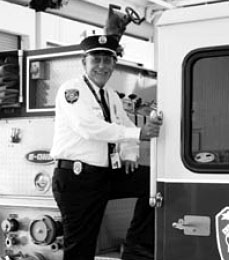
Father Holoubek serves as chaplain of the Hollywood FireDepartment.
Last book read:
“The Road Less Traveled” by Scott Peck. “Life isdifficult; it is the wise person who can embracethat truth.”
Favorite type of music:
“New Age” and rhythm and blues."
What he collects:
University of Florida Gator memorabilia, includ-ing, but not limited to, sandals; Emmett Kellyclowns and gargoyles; reproductions of VincentVan Gogh paintings.
Thing he most fears:
"I feel that we as a society are too rapidly losing respect for the individual as a human being and as a spiritual person. Once the ego becomes God in our life, then we are doomed to our orig-inal sin. How often do we as individuals think we know everything?"
Persons he most admires:
Blessed Mother Teresa of Calcutta and DaveRobinson, director of Pax Christi, USA. “I caredeeply about peace and justice. We have a great hunger program here. There are peoplewho do care.”
Thing he most fears:
Declining health, or a medical condition that would make him retire early.
Born May 27, 1942 in Suffern, N.Y., Father Hoyer has four brothers and two sisters. His father is 95 years old; his mother died three years ago at 88. His family operates an ice cream store in upstate New York that has remained in business at the same location for 53 years. He attended Catholic elementary school and public high school, and earned degrees from the Catholic University of America and St. Vincent de Paul Regional Seminary in Boynton Beach. He was ordained for the Archdiocese of Miami on May 24, 1980 and served at St. Helen, Fort Lauderdale and St. Rose of Lima, Miami Shores before becoming pastor of Our Lady Queen of Martyrs in 1989.
What he did before becoming a priest:
He was a disc jockey on a college radio station and during afternoon drive time on a “real” station, WETZ-AM in upstate New York. “That’s where the name ‘Happy Hoyer’ comes from. Someone said I was the happiest person they had ever met and the name stuck.”
Vocation moment:
Father Hoyer was taught by the Marist brothers in elementary school. “We had lots of interaction with priests of the parish and school.The nuns, priests and brothers looked for and prayed for vocations. Vocations were positively presented, and they were looked upon favorably in the home. Being a priest is never dull, always challenging and never boring. Where else could I have more fun?”
What he does on his days off:
“I try to catch up with work.” He also enjoys traveling, and has visited Europe and Greece, as well as Fatima and Lourdes.
Favorite type of music:
Disco
Favorite TV show:
“The Amazing Race.” “It’s nice to see places you’ve been to and you want to go to.”
Favorite movie:
“The Good, The Bad and The Ugly” starring Clint Eastwood. Although he enjoys movies, he reads the reviews before deciding which ones to see. “The bad language and the violence (of today’s movies) are real turn-offs.”
What the seminary did not prepare him for:
The financial rules, regulations and legal aspects of running a parish. He remembers taking a management course in the seminary and having a good comprehension of what was being taught because of his exposure to the “business world” - his family’s ice cream store, where he learned about payroll taxes, accounting and sales taxes. His father read The Wall Street Journal every day.
Favorite aspect of ministry:
Celebrating Mass with the children. “They are eager to listen and learn. The kids are good here.”
Most difficult aspect of being a priest:
Trying to be all things to all people and trying to satisfy everyone. “It’s very hard, you just have to prioritize. Pray and hope you make the best decisions.”
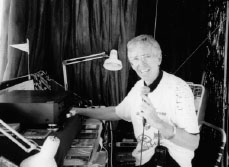
Father Hoyer got his nickname “Happy” when he worked as a disc jockey at a radio station in New York. He still pulls DJ duty at his parish when the occasion requires it.
Harshest critic:
“Myself. I like things that are well-planned and executed perfectly.”
Greatest accomplishment:
Building up strong communities of faith: “That’s what I’m working towards.”
Last book read:
“Tuesdays with Morrie” and “The Five People You Meet in Heaven,” both by Mitch Albom; and “The Purpose Driven Life” by Rick Warren.
Priestly stereotype that should be discarded:
“The priest is aloof and lives in an ivory tower, disconnected from people.”
Persons he most admires:
Nancy Grace of CNN and Court TV. “She was a prosecutor. She does her research and takes a stand. She’s a very good victim’s advocate.”
Thing he most fears:
Having enough money to keep Our Lady Queen of Martyrs School viable.
‘Happy Hoyer’ Street:
In November 1997, the city of Fort Lauderdale named S.W. 11 Court, in front of Our Lady Queen of Martyrs, “Happy Hoyer Street.” Parishioners had lobbied officials for months to rename the street after their beloved pastor. He knew nothing of their efforts. “They told me they usually named streets after dead people. I was very happy to have it named after me when I’m alive. Sometimes I fear what they (parishioners) do behind my back!”
Born Sept. 22, 1958, in Havana, Father Isern moved to Venezuela with his family at the age of 5. When he was 9, they moved to Miami where he attended public elementary school and a private high school, Champagnat. (He still celebrates the school's graduation Mass each year.)
He studied marketing and international business at Miami Dade College and Florida International University, and worked for a bank until “a gradual search for answers” led him to the priesthood. He was ordained for the Archdiocese of Miami on April 16, 1993, and has been at Our Lady of Lourdes since June 2002, taking over as pastor in March 2003.
What he did before becoming a priest:
He worked for First National Bank in the marketing department, promoting one of the first ATMs. “They were called Quick 'n' Easy back then.”
When he knew he wanted to be a priest:
“I was looking for answers and I knew the Lord had them. I wasn't too happy where I was in my life and I definitely couldn't see myself promoting ATMs for the rest of my life.” Toward the end of his studies at FIU, “I would go to the Blessed Sacrament late at night. However, there really weren't any churches nearby that were open late, so I would stand outside the windows of the old church of St. Brendan, now the parish hall, and all I could see was the red glow from the sacramental candle. I would be there for a long while, looking for the answers I knew he had for me.”
After a while, he realized that St. John Vianney Seminary was right next door and did have late-night adoration. “So I drove up and walked in like I owned the place, and I wasn't leaving until I got some answers. I did that for a while before the rector was notified that I was doing this, and I wasn't even a seminarian.”
Over time, he discovered his call to be “with (Christ) and in him.”
" The reality is that you gain even more than you could ever sacrifice. The Lord gives so much. "
What he would be doing if he had not become a priest:
“Probably still marketing and promoting those ATMs.”
What he does on his days off:
“I own a little 25-foot sailboat, so I enjoy sailing. I get out there on the ocean. I really cherish it.”
Favorite TV series:
“I don't usually get to watch the programs when they're on, but I record them and watch them later. I enjoy political commentary shows.”
Greatest accomplishment:
“Realizing that it's not about my greatest accomplishment, but in helping others accomplish; accomplishing things together and growing in Christ.”
A five-year-old Father Fernando Isern is pictured here swimming in 1963. He still loves the water and enjoys sailing on his days off.
His ideal priest:
Pope John Paul II.
Most difficult aspect of being a priest:
“The multiple demands of being a pastor can be trying.”
His harshest critic:
“My friends keep me honest. That is a blessing. They keep my feet on the ground whenever they come off.”
Priestly stereotype that should be discarded:
“That one gives up so much when you become a priest. The reality is that you gain even more than you could ever sacrifice. You don't have to stop doing what you love. And if you're away from your family, you gain an immense family in the Church. The Lord gives so much.”
Thing he most fears:
“My computer crashing - it keeps blue-screening.”
Born Oct. 18, 1967, in Jean-Rabel, Haiti, Father Jean-Mary is the fifth of seven brothers and sisters. His father was a farmer who wanted him to study agronomy, but he was interested in law as a way of fighting the injustice he witnessed in Haiti. He finally settled on accounting “because it was something practical and less burdensome. But it was not my vocation.” He entered St. John Vianney College Seminary in 1992 and was ordained for the archdiocese in May 2001.
He now leads a mission church with more than 2,000 registered families, where more than 4,000 people come to Mass each Sunday.
When he knew he wanted to be a priest:
At age 7, he was inspired by the example of his parish priest, Father Jean-Marie Vincent, who was murdered in Haiti in 1994. “He was a very down-to-earth priest” who played soccer with the kids, brought bands to the town and helped the peasants. “To me that was the perfect image of a priest who established a balance between the spiritual and the temporal.” He did not think about the priesthood again until age 19. “I was in search of meaning in my life. That’s when I began to discern a vocation.” He spoke to a priest in his hometown who gave him two books to read on the lives of Blessed Charles De Foucauld and St. Louis de Montfort. “I think that was the wake-up call in my life. After reading those two books, I felt that God was calling me.”
What he did before becoming a priest:
“I worked one year as an accountant for a French organization.”
Coming to Florida:
He entered the Montfort Fathers in 1989 and was sent to their novitiate in France, but realized he did not want to become a religious priest. While visiting family in south Florida in 1991, he met people who told him, “We need priests here. Why should you go back to Haiti?” He met Father Thomas Wenski (now bishop of Orlando) and spent the summer at Notre Dame d’Haiti, working alongside another young Haitian (now Father Robés Charles of Divine Mercy Haitian Mission in Fort Lauderdale). That’s when he decided, “The Holy Spirit knows what he’s doing. I’m going to let myself be carried by the winds of the Holy Spirit.”
"I believe that God is on my side wherever I go."
On language:
He spoke neither English nor Spanish when he entered St. John Vianney Seminary. He now speaks English and Spanish in addition to French and Creole, and is trying to learn Ibo, a Nigerian language. “The role of the church is to preach integration, not isolation or assimilation. … The more languages you know, the more world is open to you.”
What he does on his days off:
Visits his sister in Fort Lauderdale, who is a single mother of three. “I play a father role in the lives of my nephews.”
Greatest joy:
“Being a priest and being a servant of God and of his people. I think that is the greatest blessing in my life.”
Soccer enthusiast Father Reginald Jean-Mary cheers on Notre Dame d’Haiti’s team during the archdiocesan jubilee year soccer tournament held among Haitian parishes earlier this year.
Favorite movie:
“Contact” with Jodie Foster
Greatest disappointment:
“To see that we are still in that mess in Haiti.”
Most difficult aspect of being a priest:
“People have a lot of expectations of you. People see you in such a high standard. And you know your limitations as a human being.”
His description of the ideal priest:
“A servant; a man who is inside what he is on the outside; a man who is on the outside what he is on the inside.”
Priestly stereotype that should be discarded:
A Haitian stereotype: “That priests have money” because Haiti is a missionary country and the church provides everything to the people.
Favorite type of music:
Compas, Haitian dance music. “I enjoy singing.”
Hobbies:
Playing soccer, watching movies and reading. “On my day off I will go to Barnes & Noble for at least two hours.”
Person he most admires:
The late Brazilian bishop, Dom Helder Camara, and Bishop Frantz Colimon of the Diocese of Port-de-Paix, Haiti.
Thing he most fears:
“Nothing. I have no fear. I believe that God is on my side wherever I go.”
Born Feb. 10, 1972, in Cap-Haitien, Haiti, Father Jeanty came to the U.S. in April 1990 to join his parents, who were already living in Pompano Beach. He began studying accounting at Broward Community College while working full time, but entered the seminary in August 1996. He was ordained for the archdiocese on May 15, 2004, and served as associate pastor at St. Bartholomew Parish in Miramar until 2006, when he went to Rome to study canon law. He was named archdiocesan chancellor for canonical affairs in September 2010, and also serves as a judge in the Metropolitan Tribunal and pastor of St. Philip Neri Parish in Miami Gardens.
When he knew he wanted to be a priest:
"It was only after I came here. I was doing everything else — pursuing a career, I had a girlfriend, I was involved in youth ministry and church. … There was a void in my heart calling me, as if this wasn’t enough.” The climax of his discernment came, by “God-incidence,” on the same date he would later be ordained a priest, May 15: “Jesus appeared to me in a dream. He said, ‘Chanel, come to me.’ I woke up from the dream; never slept the rest of the night. I called up the vocations director that morning and said, ‘I’m entering the seminary"
Person or event that triggered his vocation:
"It’s all a mystery to me. The seed was planted in my heart."
What he would be doing if he had not become a priest:
"Probably a college professor, teaching philosophy or something that has to do with humanity, with the arts. I love philosophy."
What the seminary did not prepare him for:
"There’s no way that I would imagine that I would end up being the chancellor of the archdiocese. The seminary doesn’t prepare you for that."
Most difficult aspect of being a priest:
"To stand in the threshold of being the very incarnation of God is so mind-boggling. Hopefully you know your limitation."
"To stand in the threshold of being the very incarnation of God is so mind-boggling."
His description of the ideal priest:
"To be able to satisfy the hunger that everyone has for the infinite, the divine, for God. That’s where I come in."
Priestly stereotype that should be discarded:
"I know people expect a priest to be a role model and a great human being. That’s as it should be. But we’re certainly not supermen. All of us have to struggle with our limitations."
What he does on his day off:
"He likes to go to the beach. “I simply enjoy the outdoors, read a good book."
What he does on his day off:
Favorite movie:
"Kingdom of Heaven,” “Gladiator,” “Avatar” and other epic-type movies whose message is, “What good would it be for a man to live in this world and not make it a better world?"
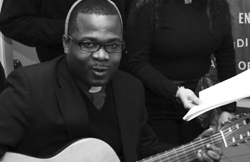
Father Jeanty, seen here during a Pastoral Center Christmas party, taught himself to play the guitar while in the seminary. Eventually, he bought an acoustic guitar for $1,200. “It’s still my companion. It was a great investment.
Favorite TV series:
"I don’t have time."
Favorite book:
"The Road Less Traveled" by M. Scott Peck
Favorite type of music:
"As long as it sounds good, that’s me. Give me a good sound, a good lyric and I love it already"
Person he most admires:
"My mother. She wouldn’t expect from me anymore than what she knows I can do. But she accepts me even when I don’t do what she knows I’m capable of. If I could live up to her, I would wake up a better man every day."
His greatest disappointment:
"To not have made the best of the opportunities I have had as a person."
His greatest joy:
"Whenever I say ‘yes’ to a call to serve, it’s going to be the place of (my) greatest joy."
His harshest critic:
“"People who aren’t as easygoing as I am. I drive them nuts. They say I’m too relaxed, too peaceful. I’m always keeping my cool"
Regrets:
"None. The stupid things that I’ve done have brought me to be the person that I am now and helped me to see a different perspective, to be a better human being for others"
Born Oct. 31, 1956, in Santa Clara, Cuba, Msgr. Marin came to the United States with his family - parents and younger sister - at age 4. They settled in Chicago. He went to medical school in the Dominican Republic and completed his residency at the University of Miami, specializing in investigational cardiology. He was ordained for the Miami Archdiocese in 1989 and later obtained a canon law degree from The Catholic University of America. He served as chancellor from 1993 - 2003 and, in addition to his work as promoter of justice and judge on the metropolitan tribunal, as well as chaplain of the Catholic Physicians & Dentists Guild. Msgr. Marín died Dec. 28, 2018.
When he knew he wanted to be a priest:
He felt the call in fifth grade at Our Lady of Mercy Catholic School in Chicago, where he was an altar server. He would have entered the high school seminary had it not been for the advice of the school's new principal who suggested he attend a "prestigious" public high school instead that focused on math and science. "The whole background of my family being in medicine came back again and I went back to medicine. Priesthood was out of the picture for those years."
Vocation moment:
In 1976, his first year of medical school, there was a huge explosion at a sugar mill in the Dominican Republic. "The 400 men who were burned kept asking for a priest. The only priest was away at a mission. It was very clear to me, seeing all of the doctors and the nurses and 123 men dying, that there was more need for priests than there was for doctors." He decided to quit medicine, but again was advised not to by the seminary rector, who told him "the best thing to do was to finish medical school because that would always be in the back of my mind. God would call me later." God did - in 1983 in New Orleans. "I was giving a keynote speech at a cardiologists' convention. These two gentlemen walked up to me and said, 'Are you a priest?' They were Jesuit physicians." They told him: "Your whole empathy for the patient almost speaks of you being a priest already."
On making the final decision:
"I needed to prove to myself that I could be a good physician - New Orleans was that proof. It was the pinnacle of medicine. So next, I needed to prove that I could be a good priest."
"It was very clear to me, seeing all of the doctors and the nurses and 123 men dying, that there was more need for priests than there was for doctors."
Who was most surprised by his vocation:
"Some of my medical colleagues. They didn't understand it. But in the long run they have come asking for help at times and are glad that I'm there for them. The friendships have remained."
Favorite priestly assignment:
Our Lady of Guadalupe: "There's such a great community that is constantly challenging me. I can place many of my gifts there at the service of this community."
Greatest disappointment:
None. He sees them as "challenges, as moments of growth, time to learn. The alternative would be to sit down and cry and I don't do that."
Greatest joy:
"Just being with people at the most important times of their life - the birth of a child, the death of a relative, their wedding day. Their whole life, you're involved with them."
Greatest challenge:
"To realize that you're not going to please everybody. I'm a pleaser. I like to keep people happy. You realize that not everybody is going to be happy."
His harshest critic:
"My mother. She's very truthful."
Hobbies:
He collects coins and stamps and is an avid reader, at least one book a month. "I've had three at a time going." He especially loves reading history books.
Favourite type of music:
He likes all types, from Annie Lenox to Bach. He also has season tickets to the opera.
People he most admires:
His parents, who sacrificed their own futures to give their children a future in a free land. His mother worked nights in order to be with her children during the day. "She would put us to bed and be there when we woke up. We didn't realize she was working all night... It was a great sacrifice that they made. They are always my heroes."
Current difficulties in the church:
"This isn't the worst of times. It isn't the best of times. But we'll get through it and go into another wonderful adventure with God."
Father Marino was born July 27, 1967, in Flushing, N.Y. His family later moved to South Florida, and in 1985 he graduated from Chaminade College Preparatory (now Chaminade-Madonna College Preparatory) in Hollywood. After his freshman year at The Catholic University of America in Washington, D.C., he was accepted as a seminarian for the Archdiocese of Miami. He studied at St. John Vianney College Seminary in Miami and St. Vincent de Paul Regional Seminary in Boynton Beach, and was ordained April 16, 1993.
He has served as pastor of St. Michael since July 2008, and before that was pastor of Visitation Parish in North Miami. In addition, he serves as adjunct spiritual director at St. John Vianney; spiritual director of the Italian Apostolate; chaplain of the Knights of St. Gregory and St. Sylvester; and presbyteral council representative for the East Dade Deanery. He also is a member of the international movement Communion and Liberation, and serves as the priest responsible for member priests in the U.S.
What he did before becoming a priest:
“My parents owned a fish market in Pembroke Pines and both my brother Joseph and I worked there when we were younger.”
When he knew he wanted to be a priest:
“I would say, the age of reason, 7.”
Person or event that triggered his vocation:
“By the time I had my first Communion, I knew I wanted to do what the priest did. I wanted to stand at the altar and make Jesus present. My vocation stems from the liturgy of the Church.”
What he would be doing if he had not become a priest:
“Probably work in the food industry, in some aspect of the seafood business. “Before I became pastor of Visitation Parish I was the fine dining food critic for the Miami Herald Broward edition for three years, from 2000 to 2003, and that was a lot of fun.”
The most difficult aspect of being a priest:
“Not living up to people's expectations, even though sometimes their expectations are unreasonable.”
His description of the ideal priest:
“A man who is faithful to Christ, the Church and the liturgy.”
‘My own human failure is my disappointment …’
A priestly stereotype that he feels should be discarded:
“I don't believe there are any, especially in this archdiocese, because we are all so diverse with such a variety of style.”
What he does on his day off:
“I like to cook, I like to fish (shallow water reef fishing), but mainly I like to relax at the parish.”
Favorite movie:
“The “Godfather” trilogy: “Yes, even Godfather III!””
Favorite TV series:
“House” and “No Reservations” with Anthony Bourdain.”
Last book read:
“I just re-read, 'The Leopard' by Giuseppe di Lampedusa and the biography 'John Adams' written by David McCullough.”
Favorite type of music:
"I enjoy music; I like having either classical or opera playing in the background. I have an appreciation for the human voice.”
Father Marino is pictured here with his mother, Marie, and his brother Joseph, whom he calls “a great blessing in my life.”
What he collects?
Liturgical vestments and vessels (chalices)
Person he most admires:
"Many people (and) no one person in particular. I have spiritual fathers that I model my life as a priest after: Pope John Paul II; Msgr. Luigi Giussani, founder of Communion and Liberation; Archbishop Fulton Sheen; and Cardinal Joseph Ratzinger before and after becoming Pope Benedict XVI. As a high school student, I received the book 'Introduction to Christianity,' written by Cardinal Ratzinger, and although I didn't understand it I knew that it was important for my life. I have never put that book down since."
His greatest disappointment:
“I would say to not communicate God's love and truth as I should. My own human failure is my disappointment, my lack of charity and mercy.”
His greatest joy:
“I have lots. The fact that I wake up in the morning, that people feel welcomed at my parish, being the person that can see the good in others are all joys. My brother Joseph is a great blessing in my life.”
His greatest accomplishment:
“I am only doing what I am supposed to do. … I may do it poorly, but I am still doing it.”
His harshest critic:
“Myself. However, my mom is my greatest champion.”
Thing he most fears:
“Allowing my human failures to overwhelm me, to disappoint people or let them down.”
Regrets:
“When I fail to show charity and mercy, sometimes on a daily basis.”
Born Dec. 5, 1962, in North Miami, Father McCormick is the fifth of eight children born to a Quaker mom and Presbyterian dad who converted to Catholicism in 1966. "They said they converted because they were tired of being called sex maniacs in the Protestant church." He grew up in St. Bartholomew Parish, Miramar, and graduated from Cooper City High School in 1981. His involvement in young adult groups led to his appointment as a "wisdom person" for the archdiocesan synod, 1985-1988. He was ordained in May 11, 1996, and served at St. Louis Parish, Pinecrest; and St. Andrew, Coral Springs; before being named pastor of St. Maximilian Kolbe in March 2002.
What did you do before becoming a priest?
He worked at a Sony manufacturing plant. "We built mixing consoles for recording studios. … It was very tedious work. But I did it for eight years. It enabled me to get involved in a lot of ministries. I worked my eight hours and then went to churches."
When did you know you wanted to be a priest?
"Almost immediately after high school, because I just loved what I was doing for the church. … I just wanted to make a difference for God. To be honest, I didn't think that because of my disability, the seminary would give me one look."
Why didn't you continue being a lay person?
"As a lay person, I had been involved in as many things as I could probably be involved in. But it just seemed that God was calling me to something beyond that. I'm very glad I followed up on that because I've been very happy as a priest. I mean, you can only say you're a young adult for how long?"
What would you be doing if you had not become a priest?
"I really thought at different points that I was going to become a youth minister or a young adult minister. (The church) is such a part of my life, I can't imagine my life being not part of that."
What is your disability?
He has cerebral palsy. "It's probably because I was so premature. I was born in the sixth month, which, in 1962, it's quite amazing that I survived."
What is people's reaction to your disability?
"The first two weeks I'm in a parish, people are just so terrified I'm going to fall crashing to the ground.… It's how the Lord made me. I was born with this. I've always had to go through life knowing that there were certain limitations."
"I just wanted to make a difference for God."
What do you do on your days off?
"I read my comics. I do a lot of things that most people do on the weekend, such as go to the dentist, get my hair cut, go to the bank."
What is your favorite movie?
"Godspell" – "I memorized that entire album when I was 9 years old. I put it on and I still enjoy it."
What is the most difficult aspect of being a priest?
"Situations where you have to be in two places at once, and unfortunately, you can't do that … I've had the beeper go off when I'm doing weddings or at the cemetery. … People don't need a priest according to your schedule. They need one according to theirs.Unfortunately, you can't be two places at once."
What is your greatest disappointment?
"That probably falls under my greatest challenge – the times that I'm not able to be there for someone."
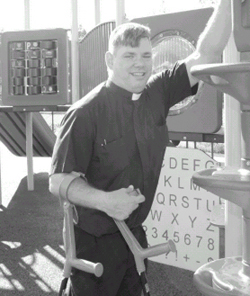
Father Jeff McCormick, a comic-book hobbyist, poses in the playground of St. Maximilian Kolbe's new education center.
What is your greatest joy?
"Preaching. That and hearing somebody's confession who's been away for a long time. To know you've made such a substantial difference in someone's life just by being there."
What is your description of the ideal priest?
"Somebody who prays. Somebody who's present.Somebody who proclaims."
Priestly stereotype that should be discarded?
"I don't play golf."
Who was most surprised by your vocation?
Some of his friends, who told him: "'Priests aren't supposed to be funny. You can't be a priest. You laugh too much.' Of course, it's been my experience that priests have the best sense of humor."
What is your favorite type of music?
Contemporary Christian music, 88.1 WAY FM: "I turn it off when they start to preach because I can't deal with their theology."
What do you collect?
Comic books: "I've been reading comic books since I was 10." His favorites: Avengers, X-Men, Justice League.
Who do you most admire?
Miami Auxiliary Bishop Agustín Román "because he breathes and lives his ordination."
What do you fear the most?
"That people will see our faith as irrelevant, because the Catholic faith has been under such heavy attack. It's hard to see our faith so heavily ridiculed."
Born Oct. 10, 1933, in Ennis, County Clare, Ireland, Msgr. McDonnell is the eldest of five children. He was ordained June 16, 1957, for the then-Miami Diocese. Among his many assignments during the past 47 years, he has served as supervising principal of St. Thomas Aquinas High School in Fort Lauderdale, Immaculata-La Salle High School in Miami and Mary Immaculate High School in Key West. He also served as pastor of St. Jerome in Fort Lauderdale; St. Mary Star of the Sea in Key West; and St. Clement in Fort Lauderdale. His last assignment was as pastor of St. Sebastian Church, Fort Lauderdale. He died Nov. 27, 2006.
What he does on his days off:
"I don't have many days off, but when I do I like to read and shop. I like to go to Disney and the Keys. I played golf for 37 years, but I haven't played since 1992. I had a 10 handicap 30 years ago. Although I never played at Pebble Beach, I had lunch there last summer."
Favourite movie:
"A Man For All Seasons" - "I admire St. Thomas More."
Favourite TV program:
Old movies on AMC (American Movie Classics)
Who was most surprised by his vocation:
"My father and my friends and the guys I hung out with ... I went to the seminary right out of the blue. I didn't tell anyone. My father told me that if I ever wanted to come home, I'd be welcome with open arms."
What he would be doing if he had not become a priest:
"I have no idea ... I probably would have gone on to the university. I would like to have been a doctor, but taking a look at what they had to go through, I don't think I would have made it."
Favourite priestly assignment:
Starting a new parish, St. Cecilia in Fort Myers: "Many priests don't get an opportunity to do that."
"The older I get the more I admire the old priests for their faithfulness, by the grace of God."
Greatest disappointment:
"Every time I was transferred."
Greatest joy:
Celebrating the Eucharist & administering the sacraments.
Most difficult aspect of being a priest:
"Making sure you have enough money to pay the bills. Administration, when you're in it, it's hard to let go of it."
"I don't want someone to leave the church because of me."
His description of the ideal priest:
"Many times we forget that priests are human beings. I don't have an idea of what an ideal priest is. You have to face the aspect that not everyone will like you. I suppose a man who serves the people and in the process keeps his sanity."
Msgr. Patrick McDonnell is no longer able to play golf but still managed to have lunch at Pebble Beach last summer.
His harshest critic:
"Me. I have difficulty managing my time. I went to a retreat where I heard that we minister to our interruptions. One of my problems is that I can't say, 'No.'"
What the seminary did not prepare him for:
"Learning on the job, how to handle emergency calls in the night. In my first assignment I was blessed by a good pastor, (the late) Msgr. John O'Dowd in South Miami. I had a bunch of real great priests who taught me early on."
Greatest accomplishment:
"Surviving. The older I get the more I admire the old priests for the faithfulness, by the grace of God."
Last book read:
"Bleachers" by John Grisham. He is currently reading "Ashes to Ashes."
Favorite music:
Golden oldies, "Little Things Mean a Lot."
Person he most admires:
Pope John Paul II and Jimmy Carter. "Carter's attitude towards his presidency was great - his value system and what he's done since he left the job, traveling the world promoting peace, and his work with Habitat for Humanity. I would like to see his place in Atlanta (The Jimmy Carter Library and Museum). I'd also like to read allof his books."
Thing he most fears:
"I don't have a fear of incapacitation. I'm working on being physically incapacitated. I understand what they mean when they say, 'physically challenged.' I'm all the time figuring out how I'm going to do something."
Born June 22, 1969, in León, Nicaragua, Father Paguaga is the oldest of four children. He arrived in the United States Dec. 1, 1989, after a one-month, $2,000 journey from Guatemala. He worked in the construction industry, at fast-food restaurants and washing dishes before entering the seminary in 1991. He was ordained a priest for the Miami Archdiocese in May 2000, and served at Our Lady of the Lakes in Miami Lakes before being assigned to Little Flower last summer.
Why he came to the United States:
"To come, work, save, help my family and go back after six or seven years." His father had died in 1984, and the family had moved to Guatemala, partly due to the political troubles in Nicaragua. The family's pharmacy had been looted; their grandfather had been kidnapped.
What he did before becoming a priest:
He was one of the first cooks at the McDonald's on S.W. 87th Avenue and 24th Street in Miami. He also worked at Burger King and as a busboy at the Radisson Hotel. At one point, he held three jobs simultaneously. "I'm very proud of it. If you want to work, you will find work. If you want to get ahead, you can get ahead."
When he knew he wanted to be a priest:
He first asked his mother for permission to enter the seminary at 6. At 14, he attended a charismatic retreat for young people. "I remember saying, 'This is what I really want to be.'" His father's response: "Over my dead body." He tried to enter the seminary in Guatemala but his mother asked him to wait. After coming to Miami, "I knew I didn't want to stay (in the United States) to make money but to serve the people. I saw the need here. An immigrant can best understand an immigrant."
"It's almost like God brought me here..."
What he does on his days off:
"I like to go to the beach. I like to go to the gym. I spend a lot of time working in the garden. It puts my mind at ease."
Favorite movie:
"The Lion King."
Favorite TV series:
"The Golden Girls", "Touched by an Angel" and the Discovery Channel.
God's plan:
"It's almost like God brought me here and opened the doors because in less than two years I was in the seminary. It couldn't have been more clear that God wanted me to be here."
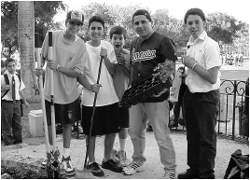
Gardening enthusiast Father Paguaga with some student helpers from St. Teresa School in Coral Gables.
Favorite type of music:
Country music, 99.9 KISS FM
What he would be doing if he had not become a priest:
He was studying civil engineering at the University of Guatemala. "The thing is, I don't see myself doing something else other than being a priest. This is what I love. Sometimes I feel guilty that I get paid for what I do."
Priestly stereotype that should be discarded:
"Sometimes people don't see us as human beings with the same needs and feelings as others. We come from a family. We sat for many years in the pews where people sit and listened to the liturgy. We're real. We weren't born wearing vestments."
Most difficult aspect of being a priest:
Transfers: "You get to love your people, you devote yourself to them, and then you have to move."
Greatest disappointment:
"That my father didn't see me ordained because, actually, he would have been extremely happy with me. My father was never able to see his son fully realized as the man he wanted to be.
Person he most admires:
"My mother - her faith and trust in God, her simplicity, her sense of humor. She has never complained to God or anybody else for all the things that she has been through in her life."
Born in Haiti in 1954, he speaks fluent English and Spanish. In May, 1988, he became the first Haitian priest to be ordained for the archdiocese. In addition to his duties as pastor, he directs the Society for the Propagation of the Faith for the archdiocese.
His description of the ideal priest:
“Being a priest is the ideal. It’s not so much what you are supposed to do. It’s what you are supposed to be. You can bring this ideal about in your personal life and in the life of others.”
Priestly stereotype that should be discarded:
“That priests are unhappy and our life is a sacrifice and misery. That’s not true. I have so much fun being a priest it’s just incredible.”
What he did before becoming a priest:
While studying for his master’s degree, he used to support himself by playing the organ in churches in Toronto. “Italian churches – can you imagine?”
Favorite book:
“Don Quixote” by Cervantes: “His ability to see what a lot of people couldn’t see. To feel what a lot of people couldn’t feel. To be able to search and find goodness where a lot of people would not be able to find it. I think we need to do that also to believe in a human being so much that finally that person, seeing how much you believe in her, begins to believe in herself.”
Person he most admires, other than Christ:
“My 95-year-old father, a man of faith, of conviction, who cares deeply for the people and who would share the shirt off his back with anybody in need.”
" I discovered in the priesthood that you can do a lot of good. You can be a sign. "
When he knew he wanted to be a priest:
He thought about it after his first Communion. In high school, he considered becoming a musician or a doctor but the idea of the priesthood stayed with him. “My father and mother always prayed for vocations. They always ended their prayer with, ‘if it’s the will of God that a vocation should come out of the family, may the will of God be done.’ I don’t think they were thinking about me. When I began really to think about the priesthood, my father’s prayer became my prayer, basically: Lord, if it is your will that I become a priest, guide me, and may your will be done.”
Who was most surprised by his vocation:
His father, who jokes that he used to believe All Saints Day was the feast for deceased priests and religious until his son became a priest. “Now he knows better. But since I became a priest, I can never get him to call me by my name. He calls me ‘father.’”
Greatest joy:
“I have a lot of them. I discovered in the priesthood that you can do a lot of good. You can be a sign.”
Greatest disappointment:
Haiti
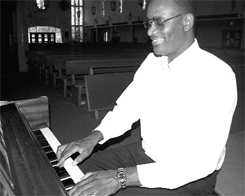
At one point, Fr. Pierre thought he might pursue a career in music. Today, he plays the piano for relaxation.
Most difficult aspect of being a priest:
“It can be crazy sometimes,” such as a recent Saturday when he presided at the funeral of a 20-year-old and a couple of hours later witnessed the marriage of two young people. “One minute I was terribly sad. The next hour I was smiling. Isn’t that crazy? You pass from one type of sad feeling to a joyful and happy moment If you are not well balanced, that’s going to take a toll on you.”
His biggest challenge:
“Challenges are also opportunities.” When he was named pastor of St. James, the school was on the verge of closing and parish buildings were run-down. He figured, “It cannot get any worse. Anything I do will be fine. I started working with my hands, cleaning. As the people saw me working, they joined me.”
Thing he most fears:
“The degradation I have seen around the world. We are becoming more and more insensitive to the plight of the poor, like somebody watching TV with a remote control. If we get to something unpleasant we just turn it off and tune out. It is very sad to see.”
Born in 1955 in the state of Kerala, India, Father Puthusseril was ordained for the Diocese of Krishnagar, India, on Oct. 6, 1979. While studying for his canon law degree in Rome, he made friends with some priests from the northern United States, whom he visited a few summers.
That is how he found out about Florida, where there was “great weather, similar to what we have back in Kerala, India.” He came to Miami in 1990 and was incardinated (made a part of the archdiocese) in 1995. Along with parish work, he has served as archdiocesan coordinator for high-tech, and a judge and defender of the bond in the Metropolitan Tribunal. Since July 2002, he has been pastor of St. Andrew Parish in Coral Springs.
What he did before becoming a priest:
“I was studying. I am not a 'late vocation.”
When he knew he wanted to be a priest:
“From an early age, probably around 8 or 9. But that was not a definite. When I became a teenager, I was not 100 percent sure if that was the way I wanted to go. I had some questions and wavering moments, but then, finally, it worked out this way.”
Person or event that triggered his vocation:
“No one, really, but there were people who wanted me to leave my vocation. … My father died when I was 21 and in our culture, the oldest son takes on the family responsibilities. So, when my father died, I was still in the seminary and some members of my family told me, 'It's time to leave the seminary, come home and take care of the family.”
What he would be doing if he had not become a priest:
“I would have taken electronic engineering. Electronics was my hobby. I loved building my own little gadgets.”
What the seminary did not prepare him for:
The business aspect of the Church, administration and finances. “And I don't blame them, because that is not a business school. … You learn things at the parish. That happens in any profession. I don't look at it as a negative.”
‘Electronics was my hobby. I loved building my own little gadgets’
The most difficult aspect of being a priest:
“Trying to please everybody. It's almost impossible.”
His description of the ideal priest:
“The ideal priest is, naturally, Jesus Christ. Can we imitate Jesus Christ 100 percent? We are human beings; we try the best we can.”
On compassion and the law:
“It is always a juggling act trying to be compassionate, understanding, loving, caring and yet to fulfill the requirements of the laws of the Church. Being a canonist, it makes it more difficult because I know the law.”
A priestly stereotype that should be discarded:
That priests have no faults or failures. “Priests are human beings.…They make mistakes.…I don't mean that priests should not be holy; they should be. But we do not always reach the ideal.”
What he does on his day off:
“I wear a different set of clothes and I work in my office during the morning, trying to catch up on all the things that I need to do, and all the paperwork. But in the afternoon, I try to relax a bit and go out for dinner.”
Father Puthusseril is shown here tinkering with an amplifier in the auditorium of the papal seminary in Pune, India, in the late 1970s. He still loves tinkering with electronics and computers.
Favorite movie:
“Life is Beautiful"
Favorite TV series:
“What is TV? I have no time for TV!”
Last book read:
“The Case for Christ” by Lee Strobel, an investigative journalist and agnostic who became a believer.”
Favorite type of music:
“I mostly listen to spirituals in my mother tongue.”
Person he most admires:
“I do admire my mother greatly because of the struggles she had to go through: being a single mother raising seven children on her own; two or three of us were of age, but the others were still young.”
His greatest joy:
“I find great joy in celebrating the sacraments, in ministering to people.”
Thing he most fears:
“I really don't want to die without the sacraments.”
Regrets:
“I don't really have any. … If you ask me if I would be a priest all over again, I would say 'yes!' even with all the challenges that are out there today.”
Born June 1, 1951, in Havana, Father Rivero left there with his family at age 9, moving to his great-grandmother's house in Barcelona, Spain. Three years later, the family moved to his grandfather's cattle ranch in central Florida, where he learned to drive a tractor and prepare the land for pasture. A year later, the family settled in Miami's Coconut Grove section, where Father Rivero attended Mass and served as an altar boy at St. Hugh.
He was ordained May 15, 1982, for the Archdiocese of Miami and served at Immaculate Conception in Hialeah, Corpus Christi in Wynwood, the National Shrine of Our Lady of Charity in Miami, and as pastor of Holy Family in North Miami from 1999 to 2004. From 1992 to 2006, he served as director of the respect life ministry. In 2004, he was named pastor of St. Raymond and still serves as spiritual director of respect life.
When he knew he wanted to be a priest:
When he left Cuba at the age of 9: “I wasn't sure, so I procrastinated.”
Vocation moment:
In his last year of college at Miami-Dade, he joined a charismatic prayer group: “I really experienced there a new awareness of the Lord and his love and his purposes for us. I had the peace in my heart to make the decision to go into the seminary.”
What he would be doing if he had not become a priest:
“Taking care of the environment.” Before becoming a priest, “I was concerned that we were wrecking our planet. I wanted to do something about it. But then through the prayer group I realized that the root of the problem is that we have drifted away from God. I became aware of Christ's lordship and his calling for us to be a new creation.”
His Navy experience:
After high school, “I was about to be drafted. I had a very low number,” so he simply signed up and put in his four years. “I was never on a ship. I was always in construction work.” After the Navy, he began studying chemical engineering at Miami-Dade College and was accepted to the University of Florida but did not attend. “That's when I decided to change and go into the seminary.”
" The measure of how well the parish is doing is how many people are confessing, because we are all sinners. "
Judging success:
“The measure of how well the parish is doing is how many people are confessing, because we are all sinners.”
What he does on his days off:
“I don't have a day off. I enjoy what I do so much that I don't see my time as being on the job or off the job. I'm just a priest every day.”
Web site:
A Web site he developed 13 years ago www.corazones.org - now has 1 million unique visitors each month, making it one of the top 12,000 of all the Web sites in the world. “I saw right away that this was the wave of the future.”
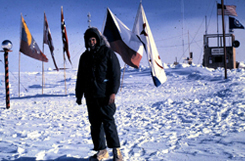
After high school, Father Jordi Rivero joined the U.S. Navy. His assignment with the Seabees took him to the South Pole. “I was the first Cuban-born person in the South Pole.”
His description of the ideal priest:
“A saint.”
Priestly stereotype that should be discarded:
“That it is a profession or it's a job, or that the people are customers of a franchise or a social club, so then you can demand or expect services without understanding that we are called to be a body where we're all responsible for each other. The laypeople are as much the Church as the priests, and we all have to be a family.”
Travel:
“Once a year I try to go on a pilgrimage. That is my vacation.”
Person he most admires:
“John Paul II and Benedict XVI - I really love them as fathers. At the local level, I really admire tremendously Bishop (Agustín) Román. Having lived with him, (I know) the man is a saint.”
Hobbies:
“If you consider the Web site a hobby. I love to advance the kingdom of God and use whatever resources I have to do it.”
Regrets:
“I have never had any doubt whatsoever of this vocation. Never. This is who I am.”
Msgr. Schwanger was born April 25, 1960, in Harrisburg, Pa. He graduated from Middletown Area High School there, then followed his father to Florida, where he graduated from the University of Florida in 1982. He went to the University of Florida Law School, obtaining his law degree in 1984. That same year, he entered the seminary, completing his studies at St. Vincent de Paul Regional Seminary in Boynton Beach. He was ordained for the Archdiocese of Miami on May 12, 1990. In addition to his duties at Our Lady of Lourdes, he serves as adjutant judicial vicar of the archdiocesan Tribunal, promoter of justice for the archdiocese, president of Archbishop Coleman Carroll High School in Miami, chairman of the permanent diaconate advisory board and judge for the Tribunal of Nassau, Bahamas.
What he did before becoming a priest:
"I went to school. I worked for the University of Florida as an attorney. I also worked for Reisman & Brynn, a law firm that is no longer in existence, and I handled immigration matters for the Archdiocese of Miami."
Person most surprised by his vocation:
"My friends because they thought I could do good things as a lawyer. They did not see a need for me to be a priest. It seemed radical to them at the time. They are still my friends."
What the seminary did not prepare him for:
"Nothing prepares you for everything. The seminary gave me the tools I needed."
What he would be doing if he had not become a priest:
"I would probably be an attorney, working in legal aid or government work."
Favorite priestly assignment:
"Being the pastor of Our Lady of Lourdes. It is the universal Church in miniature. There are so many cultures. It is such an active community. There are always more things to respond to and develop. I never wake up bored. And the spirit of our community is extraordinarily positive."
The most difficult aspect of being a priest:
"It is seeing the suffering for those who do not respond to Christ. It is knowing that if they gave their life to Christ, it would change their lives. I know the stories of people intimately, and the desperation, hurt and struggle people face. If they would give their life to Christ and believe, it would change everything."
'If (people) would give their life to Christ and believe, it would change everything.'
His description of the ideal priest:
"He loves God and loves his people."
A priestly stereotype that he feels should be discarded:
"The thing about stereotypes is that they are partial truths. They are incomplete. Priests are as different as there are people in the world. People need to realize that."
What he does on his day off:
"I walk. If I have the whole day off, I walk a 15-mile circuit. I have walked El Camino de Santiago three times, and I have been on it a total of eight times. I also visit friends."
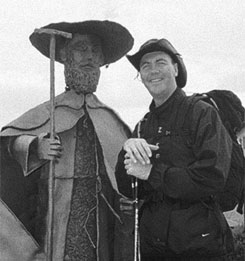
Msgr. Kenneth Schwanger is shown here on one of his pilgrimages through El Camino de Santiago (The Way of St. James) in Spain. He has walked the ancient pilgrim road in its entirety three times and been on some part of it a total of eight times.
Favorite movie:
"'The Lion in Winter' because of its artful use of the English language in the dialog. The recent movie I have seen is 'The Way,' written and directed by Emilio Estevez and starring his father, Martin Sheen. I really enjoyed the movie. It is a good portrayal of the human stories that get intertwined and grow along the Way of St. James and the cinematography is great. It is more challenging physically than the movie lets on. It helped me relive my experiences and remember the people I have met over those years."
Favorite TV series:
"Gator football."
Last book read:
"El Sueño del Celta. The Celtic Dream."
Favorite type of music:
Classical
Person he most admires:
"My mom and dad. They were good souls and normal people."
His greatest disappointment:
"There is not enough time to do all that I want to do and experience it all."
His greatest joy:
"A Mass where everyone is connected and you feel the Spirit."
His greatest accomplishment:
"Being an authentic person."
Thing he most fears:
"I don't know that person and I would rather not."
Born July 16, 1941, on a farm in County Cork, Ireland, Father Singleton aspired to the priesthood from seeing priests who visited from many nations. He studied at St. Patrick's Seminary in Thurles, County Tipperary, was ordained in September 1965, and set off for South Florida. He was assigned first to St. Helen in Vero Beach, where he acquired a heart for agricultural workers and the underprivileged.
That orientation would later guide his work at Sacred Heart in Homestead, San Isidro in Pompano Beach, the Pompano Beach Labor Camp and Our Lady of Guadalupe in Immokalee. While in Immokalee, he recognized he had an alcohol addiction and sought professional counseling.That led him to learn how to help others out of substance abuse. He studied the subject at Johns Hopkins University in Baltimore, then St. Mary's University in San Antonio. On returning to South Florida, he worked at Palm Beach Institute, became clinical director of Anon Anew in Boca Raton and eventually executive director of the Hanley-Hazelden Center, West Palm Beach. He later served at St. Joan of Arc in Boca Raton and most recently at St. Anthony, from where he retired July 1, 2014. [Father Singleton died in Ireland Nov. 24, 2023.]
How his work with migrants influenced his ministry:
"With migrants, you come to realize what is really significant in your life. The day-to-day story about the migrants was survival — for rent, for food. They always gravitated to the Church. We also had to become their advocates for the state. All that opens you up to what it means to survive and be a human being. And how you're aided by the spiritual."
How alcohol addiction affected his ministry:
"It informs your whole life. I got into AA (Alcoholics Anonymous) and it gave me a whole new understanding of my vulnerability, and how you're not an island unto yourself. And (it provided) a new understanding of God the Father. Prior to that, it was 'Do you believe that God loves you?' But through AA, I experienced it. That influenced my relationship with God, and how I related to others."
What the seminary did not prepare him for:
"The professors had been educated in Rome, so through no fault of their own, they had no idea of the American Church and not much understanding what was going on in American society."
' You get the sense that (Pope Francis) knows how to run a parish.'
Culture shock on coming to U.S.:
"A big cultural shock. Suddenly, you're out here and totally free, and trying to manage your freedom in a responsible way. And how the people viewed Church and priests was very different. … You never saw a priest (in Ireland) except at Mass, and people stayed at a distance. Here, people saw the priest as approachable. They'd invite you to their house."
Hardest part of being a priest:
"Trying to be as available as possible, and trying to be all things to all people. That can eat you up over time. You hope you have enough spiritual life to sustain you."
Biggest challenge facing the Church today:
"To become relevant, to help people make sense of the Gospel message in their daily lives. That gets beyond a lot of the regulations and laws that some people can get caught up in."
Favorite vacation spot:
"Back home in Ireland, on the home farm. And I play a lot of golf, if weather permits. I tell people that overnight, I become the laziest person in the world."
Favorite TV series:
"I watch the news and golf and ESPN. I follow the Dolphins."
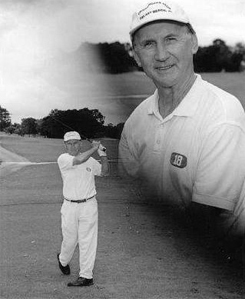
Father Jerry Singleton is seen here at the PGA National Charity Golf Tournament in 1990.
Favorite type of music:
"I like Irish music and light classical music, and some country-western. It's like Irish ballads."
Person he most admires:
"Pope Francis. He's the first one that I'm aware of who has a sense of the pastoral. Francis' sermons are very down to earth. You get the sense that he knows how to run a parish."
Something most people don't know about him:
"There are times I seem to be vain. I take maybe too much pride in accomplishments."
Regrets:
"Maybe one would be that I didn't go into recovery from alcohol sooner. I could have saved myself and others a lot of pain if I'd done it even three or four years earlier."
Advice for others considering the priesthood:
"Learn to serve people. Forget about fancy vestments and vessels. Put into your head that you're going to serve."
Born Jan. 24, 1947, in Havana, Father Sosa arrived in Miami Oct. 27, 1961, one of the 14,000 unaccompanied minors brought to the U.S. through Operation Pedro Pan. He spent time at the Matecumbe and Kendall camps before moving into St. Raphael Hall, where the chaplain was Msgr. Bryan O. Walsh, one of the architects of Pedro Pan. Father Sosa completed his last two years of high school at St. John Vianney Seminary in Miami, went on to St. Vincent de Paul Regional Seminary in Boynton Beach, and was ordained May 20, 1972, one of the first Cuban priests to be ordained for the Archdiocese of Miami. Until his appointment to St. Joseph this fall, he served as pastor of St. Catherine of Siena in Kendall for 19 years, and before that was pastor of St. James in North Miami. He is a published author and composer.
In addition to his duties at St. Joseph, he serves as president of the Instituto Nacional Hispano de Liturgia Inc., as consultor to the U.S. bishops' Committee on Divine Worship, as member of the archdiocesan Vocations Board, and as adjunct professor of liturgy and popular piety at his alma mater, St. Vincent de Paul Regional Seminary.
What he did before becoming a priest:
“I worked summers in various places while I was at the seminary. I entered the seminary when I was 15 years old. I have worked in libraries, banks and even in maintenance for a while during those summers.”
When he knew he wanted to be a priest:
“I always had an inclination toward the religious life. For a while I wanted to be a (Marist) brother, like those who taught me in school in Cuba. Later on, after I arrived in the Pedro Pan program and stayed in Miami, I decided to join the seminary, for which Msgr. Bryan O. Walsh was very happy.”
Person or event that triggered his vocation:
“Brother Modesto from the Marist School in Cuba and Msgr. Bryan O. Walsh.”
Person most surprised by his vocation:
“My parents and some of my schoolmates and friends.” In fact, he told his parents by phone about his plans, as they were still in Cuba. They suggested he wait until they arrived in the U.S., but that did not happen until 1967. By that time, he was halfway through his seminary years.
His experience in the seminary:
“That’s where I learned that I could sing, that I could write, and Latin and Greek.” When he attended the seminary, only 10 of 200 seminarians were Spanish-speaking. He spent four years at St. John Vianney - the last two years of high school and two years of college - and six more at St. Vincent de Paul. “I used to wake up and say, ‘I’ll never make it.’ Now, nearly 40 years have passed.”
What he would be doing if he had not become a priest:
“I would probably be a teacher. I love to teach and even if I am tired, still draw much nourishment from teaching a group or a class. Also, counseling and spiritual direction - I love that.”
'I love to teach and even if I am tired, still draw much nourishment from teaching a group…'
The most difficult aspect of being a priest:
“For me, as a pastor, knowing that I have to fire an employee, and the funeral of a child.”
His description of the ideal priest:
“A man who can balance prayer, teaching and administration in such a way that his life reflects the values of priesthood with peaceful serenity; a man who sees Christ in others and others see beyond his frailties the Christ that lives in him.”
A priestly stereotype that should be discarded:
“A ‘climber,’ someone who thinks he can ‘feel’ better because he is recognized with titles or positions; someone who displays more clericalism than pastoral outreach.”
Hobbies:
“I was a tennis player in the seminary. I still play it and I love to watch it on TV.”
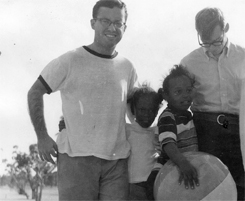
Shown here is a young Father Juan Sosa helping out at a summer camp for children during his time in the seminary.
What he does on his day off:
“Rest, sleep, go to the movies or to the theater, share a meal with good friends.”
Favorite movie:
He has many - “Forrest Gump,” “Casablanca,” “All About Eve,” “The Lives of Others”: “Movies that display opportunities for redemptive love and express it in some form of a turning point.”
Last book read:
Dean Koontz novels
Favorite type of music:
Classical
What he collects:
“Too many gadgets, gifts that I received from people, mostly paintings and icons.”
Person he most admires:
“St. Paul and St. Damian of Molokai, for their perseverance as shepherds in the midst of a most difficult situation; opposed and rejected by their own and others and yet faithful to their priestly commitment.”
His greatest disappointment:
“Anyone who leaves the Church without discernment and personal prayer.”
His greatest joy:
“Sunday and weekly Mass; receiving new members into the Church at the Easter Vigil.”
His greatest accomplishment:
“Books and articles I have written over the years; music I have composed; the satisfaction of writing and composing for others.”
His harshest critic:
“Myself.”
Thing he most fears:
“Not being able to shepherd to people in their life’s journey.”
Born April 8, 1957 in New Jersey, he moved to Florida with his family around 1970, settling in St. Vincent Parish in Margate, where his parents still live. He was ordained in 1983 and served for 10 years as director of Catholic Charities' child welfare division. He has a master's degree in social work and is nationally certified as a social work manager and pastoral counsellor. He still serves as a state policy leader for the Child Welfare League of America.
When he knew he wanted to be a priest:
During his first year of business and pre-law studies at Stetson University, while attending a retreat: "It was as if a voice was saying to me, 'Be a priest, be a priest.' It was quite audible to me. It was just a very strong urge or message. Finally, I believe I actually said it out loud. I said, 'All right, damn it, I'll do it' ... That I am a priest, that I responded to that call, is one of the things that proves to me there is a God... Why would I have thought of it? Why would I do such a thing?"
Hobbies:
He is a runner (five miles about three times a week) and plays trumpet.
Favourite TV series:
"The West Wing": "It's probably the most accurate program you're going to see when it comes to the freneticism of government."
What he would be doing if he had not become a priest:
Definitely a lawyer, "possibly elected office." His father had been a city councilman and police commissioner in New Jersey.
Happiest times as a priest:
His ministry from 1984-1988 at St. Mary Cathedral in Miami, because of what he learned from the late Msgr. Gerard LaCerra's leadership, the bonds of camaraderie among the staff and the generosity of the parishioners. "We didn't have hot water in the winter. We didn't have air conditioning in summer. We used to fight the roaches for breakfast in the morning."
"The Gospel is not a bunch of words in the pulpit. It has to be brought into action"
Role of priests and laity:
"The clerics are in charge of running the business of the church. But the laity are in charge of running the business of the world."
His 10 years in child welfare:
"God has a weird sense of humour. He called me to be celibate and made me the father of hundreds of kids a year." The job entailed dealing with abused and neglected children and their parents: "We were the God committee. Because we had to decide very often who was going to be a family and who was not going to be a family... We were asked to play God."
His involvement in the community:
Despite running a one-priest parish, he serves on the board of the Urban League of Broward County, on the ethics committee at Plantation General Hospital and the coordination committee for Broward County's Million Meals organization. "The Gospel is not just a bunch of words in the pulpit. It has to be brought into action."
Greatest Joy:
"The best time of my week is the Sunday liturgy. Everything else makes no sense without the liturgy."
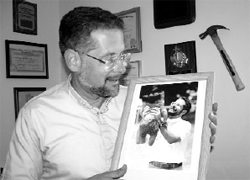
Father Tywoniak treasures this 1993 how to of himself with one of the special needs children he helped find a home for when he was director of Catholic Charities' child welfare division. "Adoption isn't about finding children for childless couples. It's about finding parents for a family-less child."
Most difficult aspect of being a priest:
"Dealing with the drain of being on duty 24 hours a day. You never stop being a priest."
Regrets:
"There have been periods in my life when I've questioned. I've looked back and felt the angst of what if I had married and had kids? After a long day, to come home and have my beautiful wife waiting for me with dinner. And then I think, get real! Because that's just a fantasy, too."
Thing he most fears:
"I've faced death on many occasions during my ministry." The worst moment perhaps was weathering Hurricane Andrew at St. Anne's Residence and Nursing Center in south Miami-Dade. "You can't watch a building fall apart around you and not think you're going to die." He had often wondered how he would react to death, and thought of the martyrs. When it hit him that he might die that day, "a great sense of peace came over me. Then I went back to doing what needed to be done."
Born Aug. 14, 1947, in Indianapolis, he moved to Miami with his family “in 1955 BC — before Cubans,” as he puts it. After graduating from St. Rose of Lima in Miami Shores, he attended high school and college at St. John Vianney Seminary in Miami and completed his studies for the priesthood at St. Vincent de Paul Regional Seminary in Boynton Beach. He was ordained for the Archdiocese of Miami on May 12, 1973.
Among his assignments, he has served as director of religious education for the archdiocese, pastor of St. John the Apostle in Hialeah, and chairman of the archdiocesan Art and Architecture Committee. He has been pastor of St. Bartholomew since 1986 and also serves as president of Msgr. Edward Pace High School in Miami Gardens.
On south Florida’s diversity:
“I remember (when) there were no Cubans in Miami. … I remember there was one Spanish speaking kid in my class when I was in grade school, St. Rose of Lima, and he was from Nicaragua.” Today, in Miramar alone, there are people from everywhere in the Caribbean, South America and Central America. “We have a recognizable Filipino community and a significant Nigerian community. South Florida has completely transformed into an international community. I’ve been here since 1955 and I’ve learned two extra languages (Spanish and French), and I haven’t moved.”
What he did before becoming a priest:
“Student. This is not a second career.”
What triggered his vocation:
“Probably my family. I was raised in a family of practicing Catholics. My parents were music teachers and involved in music ministry in different churches. I always kind of grew up very close to the Church and involved in it.”
What he would be doing if he had not become a priest:
“Maybe some social work program or teaching.”
Favorite priestly assignment:
“Where I am right now. … Father David Russell told me years ago, ‘The best job in the Church is being pastor of a parish.’ And it’s true.”
‘I’ve been here since 1955 and I’ve learned two extra languages (Spanish and French), and I haven’t moved.’
View of the priesthood:
“I’m happy, very happy being a priest, very happy with the choice I’ve made. I would make it again.”
Most difficult aspect of being a priest:
“Leadership through sharing vision, not by simply trying to give orders. It’s getting people motivated and directed, whether it’s in terms of spirituality or stewardship.”
His description of the ideal priest:
“Someone who is pastorally sensitive, a good liturgist and preacher, and a good administrator.”
A priestly stereotype that he feels should be discarded:
“That it’s the priest’s Church and the people are helping him run it. … We need priests; there’s no question there. But everybody has responsibilities. That’s the big thing about stewardship: We’re all in this together. It’s not my Church; it’s our Church, and we must find out the different gifts that everybody has, as well as the different responsibilities we can all fulfill.”
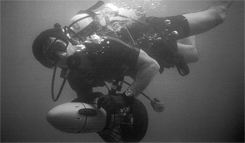
Scuba diving is among Father Vuturo’s favorite sports. He obtained his license in December 1998. “It’s like going to a different part of the world that most people don’t get to see.”
What he does on his day off:
“My father still lives in the area and I spend time with him.” He also likes to scuba dive and play racquetball.
Favorite TV series:
“I enjoy the ‘CSIs,’ any variety of them.”
Last book read:
“A Marginal Jew,” by John P. Meier, and “The Gods of War,” a novel about Julius Caesar, the fourth and final in Conn Iggulden’s “Emperor” series.
Person he most admires:
“My father because of his relationship with me; the example he showed loving and taking care of my mother, who died in 2003; supporting his children; and his ongoing relationship with his adult sons.”
His greatest disappointment:
“Narrow-mindedness in people, whether it’s in political or Church leaders or people in general. Sometimes narrow-mindedness is reflected in prejudices, in racism.”
His greatest accomplishment:
“Becoming pretty good at the sensitivity to ethnic differences, and blending the multiple layers of languages and cultures in our community.”
Regrets:
“The times when I might have hurt people, when I should have been more sensitive and I wasn’t.”
Born April 11, 1949, in Cleveland, Father Tom, as his parishioners typically call him, has a brother and a sister: Ronald Wisniewski and Anne Washburn. Their parents, Henry and Sophie Ann, were both purebred Polish: Their own parents immigrated from Poland in their youth. Eventually his parents bought a farm in North Bloomfield, Ohio, where they lived for 26 years until their deaths. Thomas moved to Florida in 1972 at the request of Msgr. William Dever, who was vocations director for the Archdiocese of Miami at the time. Except for kindergarten, Father Tom was educated wholly in the Catholic school system. A thoughtful student, he earned a degree in philosophy at St. Charles Borromeo High School and College in Wyckliffe, Ohio, then got a master’s degree in theology at St. Vincent de Paul Regional Seminary in Boynton Beach. On May 15, 1976, he was among the last priests ordained by the late Archbishop Coleman F. Carroll, Miami’s first archbishop. Before founding Mary Help of Christians in 1989, he served five years at St. Bernard Parish in Sunrise and eight at St. Anthony in Fort Lauderdale.
When he knew he wanted to be a priest:
“As far back as I can remember, I wanted to be either a priest or a spaceman. Weird combination, I know. Being a priest was probably more realistic. And when I was in first or second grade, Father Hugh Gallagher, the pastor at St. Monica (in Cleveland) said, ‘He’s going to be a priest some day.’”
What he would be doing if he had not become a priest:
“I probably would have gone into some branch of science and taught somewhere. I’m not sure, because once I’d selected the priesthood, I didn’t think of anything else.”
You took a master’s in theology, an academic degree, rather than a master’s in divinity, a ministry degree. Why?
“I have an inclination to be more academic and esoteric.”
Does that affect your ministry today?
“Yeah, I have a tendency to say things that I think are very connected, but they’re not to most people. One Sunday, I gave a homily and said, ‘Think of sin as a black hole. It sits out there eating and destroying.’ People just looked at me like ‘What are you talking about?’”
‘I have an inclination to be more academic and esoteric.’
The hardest part of being a priest:
“Listening to complaints. I try to be patient.”
What he does on his day off:
“I sometimes get away for a couple of days. I go to Cleveland to visit my brother and sister, but I hate traveling. I may also go to Mount Dora to do antique shopping.”
Hobbies:
“I like painting miniatures, especially from ‘Star Trek’ and ‘The Lord of the Rings.’ And I still have a collection of phasers (weapons from ‘Star Trek’) at the house.”
Favorite movie:
“One is ‘The Lord of the Rings.’ I’ve been a fan of (J.R.R.) Tolkien since the books became available in high school. Another favorite film is ‘The Haunting,’ the black-and-white version with Claire Bloom. It’s scary without being gory. A third is the most recent ‘Star Trek.’ They remade the ‘Star Trek’ universe.”
Last book read:
“Information and the Nature of Reality: From Physics to Metaphysics”: “It was on how information can become reality. And how it relates to our faith in God.”
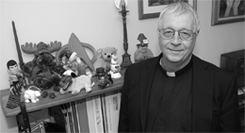
Father Thomas Wisniewski shows a whimsical, tongue-incheek side with a shelf of knickknacks in his office. Among the items are a wooden Starfleet insignia, a stuffed dog with a T-Rex face, Mr. Spock wearing a striped tie, and Gollum from “The Lord of the Rings” in a gnomish hat and tiny white beard.
Favorite type of music:
“New Age. It’s a free-flowing style, with instruments. I listen on Hearts of Space, a public radio station.”
One person in history he would like to meet:
“Outside of Jesus, it would be Peter. He was a stubborn idiot. I can be one at times. With all his failings and shortfalls, he still followed the Lord.”
If he could ask God one question, it would be:
“‘Why me?’ He would probably say, ‘Why not?’”
His most memorable spiritual experience:
“My ordination. I remember the feeling of awe as eachpriest came by, laid hands on my head, and asked God to be with me. I felt great joy and great peace.”
His greatest joy:
“It will always be to celebrate Mass. That’s what we’re ordained to do: to give the life of Christ to the community.”
Something most people don’t know about him:
“I swim every day. It’s one thing I enjoy. I don’t like team sports.”
Thing he most fears:
“Disagreement. I hate conflict.”
What he would like most to be remembered for:
“Being a good priest. Holy. God-like. Not necessarily serious” (smile).
The son of a Cuban mother and Italian father, Father Alfred Cioffi was born in Havana, Cuba, Nov. 5, 1952, the older of two brothers. The family left Cuba in 1960 and lived in New Orleans and New York before moving to various countries in Central America. (His father worked for the airline Alitalia.) After high school, the young man came to Miami to study marine biology. In 1973, he received his undergraduate degree in biology from Florida International University but was not accepted for postgraduate work at the University of Miami's Rosenstiel School of Marine and Atmospheric Science.
After working at a fish farm, taking time off to care for his ailing mother and teaching at Miami's St. Brendan High School, he entered the seminary in 1980 and was ordained for the archdiocese on May 11, 1985. Father Cioffi served at Epiphany Parish in South Miami before being sent to Rome to obtain a doctorate in moral theology.
Upon his return, he taught at St. Vincent de Paul Seminary in Boynton Beach and served five years as pastor of St. Kevin Parish in Miami before being sent to Purdue University in Indiana to obtain a doctorate in genetics. Because of Father Cioffi's expertise in this controversial field, the Archdiocese of Miami has "lent" him to the church at large.
Titles of his doctoral dissertations:
Moral theology: "The Fetus as Medical Patient: Moral Dilemmas in Prenatal Diagnosis From the Catholic Perspective." Genetics: "The Relationship Between the Structure and the Function of Chromosomes."
What he did before becoming a priest:
After graduating from FIU, he got a job taking care of tropical aquarium fish at a fish farm on Sunset Drive in Miami. "It was a lot of fun. I would take care of the fish all day. The weekends I would be sailing and diving and dating and dancing – and I was getting paid for it."
What he would be doing if he had not become a priest:
Marine biologist.
"My best recommendation for TV is to shoot it before you throw it out the window."
Vocation moment:
"I love nature. Through nature, I had a deeper relationship with God." As a teacher, he also "wanted to reach the teenagers at a deeper level, a more spiritual level; especially to try to help them not commit some of the mistakes that I had made when I was a teenager." Finally, taking care of his bedridden mother for more than a year "brought forth a generosity in my life." Until then, "I would have said 'I'll be a nun before I become a priest.' Those were the chances."
Celibacy:
"That was a big sacrifice, and it is daily," although it has a practical advantage: "just being available for the people."
Favorite sacrament:
Confession, "because I've had to use it a lot. But seriously, to think that people, total strangers, come to us with their conscience in their hands. They tell us things they don't tell their spouse. It's a very privileged moment that we have."
What he does for fun:
Scuba diving and sailing.
Favorite movies:
"It's a Wonderful Life" and "The Passion of the Christ."
Greatest disappointment:
"The church abuse scandal."
Favorite TV series:
"My best recommendation for TV is to shoot it before you throw it out the window. The happiest moment of my life was when I gave up TV. I'm addicted to TV, you see, so when I turn it on I can't turn it off."
Regrets:
"All the sins of my life: being too wild, too young."
At home on the water: Would-be marine biologist Father Alfred Cioffi, center, during a diving trip with cousin-inlaw, Richard Jung, and his son, Ricky.
Wild days:
"I started smoking at 11." As a teenager in Central America, he and his friends would compete to see who could find a good wedding to crash and then be the first to get drunk. "It's by sheer miracle that I'm alive. … I have been the cause of my parents' sanctification."
Thing he most fears:
"That the scandal is not over."
Greatest joy:
Teaching.
Greatest accomplishment:
"Convincing a mother not to have an abortion."
What he collects:
Not much anymore, but "I used to collect coins, stamps, plants, animals, women, fossils. You name it."
Born Jan. 6, 1953, in Santurce, Puerto Rico, Father Acevedo attended school there but studied for the priesthood at St. John Vianney Seminary in Miami and St. Vincent de Paul Seminary in Boynton Beach.
He was ordained for the Archdiocese of Miami on May 8, 1999, and served at St. Mark Parish in Southwest Ranches, Immaculate Conception in Hialeah and St. Louis in Pinecrest. In 2005, he was named administrator, and then pastor, of Mother of Our Redeemer Parish in northwestern Miami-Dade County.
What he did before becoming a priest:
“Many things, but the last two careers were flight attendant for Eastern Airlines for 10 years, and just before it went on strike I began studying cardiovascular technology. I was a cardiovascular technologist for three or four years.”
When he knew he wanted to be a priest:
At the age of 6, when he watched a movie about the life of St. Francis of Assisi.
Person or event that triggered his vocation:
When he was much older, the death of a friend. “His faith in God was so evident that at the moment of his death, I started wanting what he had – a personal relationship with God. As I began my journey to finding God … the desire to be a priest returned, so I had to act on it. Thank God I did!”
What the seminary did not prepare him for:
“If I had to pick one, I’d say administration. The rest has been an ‘on-the-job training’; it prepares you to learn on the job. The seminary did help me to become a better person and to listen to God, to trust his will and follow his lead.”
What he would be doing if he had not become a priest:
“I would be a cardiovascular technologist or be in a profession where I have to serve the public. All my life I’ve been geared toward people.”
" I have come to understand that everything that I have done in my life has brought me to where I am now. "
Favorite priestly duty:
“As a priest, what I enjoy the most, besides celebrating the Eucharist, is funerals. It is a moment when you bring hope, comfort and healing to the person who mourns the loss of a loved one. Sometimes it even triggers a conversion in members of the family.”
Most difficult aspect of being a priest:
“Accepting and loving everyone just as Jesus does.”
His description of the ideal priest:
“One who is down-to-earth, who recognizes his brokenness and offers it to God; one who is as loving and merciful to (God’s) people as he is able to be, with the grace of God.”
A priestly stereotype that should be discarded:
“That we are perfect and should never make a mistake.”
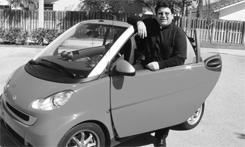
About a year ago, Father Jaime Acevedo switched to driving a Smart Car convertible. He says he has no regrets. It is a lot easier to get around in traffic, and its savings on fuel are great on the pocketbook and the environment.
What he does on his days off:
“Read a book. I may go out to lunch with friends, but mostly I stay home and rest.”
Favorite TV series:
“‘Battlestar Galactica’: I never watched it while it was being broadcast, but I’ve been watching it on DVD whenever I get a chance. It’s better than the one from the ’70s.”
Last book read:
“Come Be My Light: The Private Writings of the Saint of Calcutta.”
Favorite type of music:
“My music taste is kind of eclectic; it depends on the mood. I like classical, especially piano concertos, jazz, movie soundtracks, R & B.”
What he collects:
“Many things, but mainly icons – and monkeys.”
Person he most admires:
“My parents, a great example of what true love and good marriage should be.”
His greatest disappointment:
“Maybe giving so much heartache to my folks because of my aversion to anything that had to do with studies. I was a lousy student!”
His greatest joy:
“Being who I am, a priest!”
Thing he most fears:
“Fear itself. It can paralyze you and prevent you from doing the will of God.”
Regrets:
“None. I have come to understand that everything that I have done in my life has brought me to where I am now. And God has been with me all the time.”
Born April 8, 1957 in New Jersey, he moved to Florida with his family around 1970, settling in St. Vincent Parish in Margate, where his parents still live. He was ordained in 1983 and served for 10 years as director of Catholic Charities' child welfare division. He has a master's degree in social work and is nationally certified as a social work manager and pastoral counsellor. He still serves as a state policy leader for the Child Welfare League of America.
When he knew he wanted to be a priest:
During his first year of business and pre-law studies at Stetson University, while attending a retreat: "It was as if a voice was saying to me, 'Be a priest, be a priest.' It was quite audible to me. It was just a very strong urge or message. Finally, I believe I actually said it out loud. I said, 'All right, damn it, I'll do it' That I am a priest, that I responded to that call, is one of the things that proves to me there is a God. Why would I have thought of it? Why would I do such a thing?"
Hobbies:
He is a runner (five miles about three times a week) and plays trumpet.
Favourite TV series:
"The West Wing": "It's probably the most accurate program you're going to see when it comes to the freneticism of government."
What he would be doing if he had not become a priest:
Definitely a lawyer, "possibly elected office." His father had been a city councilman and police commissioner in New Jersey.
Happiest times as a priest:
His ministry from 1984-1988 at St. Mary Cathedral in Miami, because of what he learned from the late Msgr. Gerard LaCerra's leadership, the bonds of camaraderie among the staff and the generosity of the parishioners. "We didn't have hot water in the winter. We didn't have air conditioning in summer. We used to fight the roaches for breakfast in the morning."
"The Gospel is not a bunch of words in the pulpit. It has to be brought into action"
Role of priests and laity:
"The clerics are in charge of running the business of the church. But the laity are in charge of running the business of the world."
His 10 years in child welfare:
"God has a weird sense of humour. He called me to be celibate and made me the father of hundreds of kids a year." The job entailed dealing with abused and neglected children and their parents: "We were the God committee. Because we had to decide very often who was going to be a family and who was not going to be a family. We were asked to play God."
His involvement in the community:
Despite running a one-priest parish, he serves on the board of the Urban League of Broward County, on the ethics committee at Plantation General Hospital and the coordination committee for Broward County's Million Meals organization. "The Gospel is not just a bunch of words in the pulpit. It has to be brought into action."
Greatest Joy:
"The best time of my week is the Sunday liturgy. Everything else makes no sense without the liturgy."
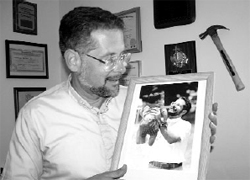
Father Tywoniak treasures this 1993 how to of himself with one of the special needs children he helped find a home for when he was director of Catholic Charities' child welfare division. "Adoption isn't about finding children for childless couples. It's about finding parents for a family-less child."
Most difficult aspect of being a priest:
"Dealing with the drain of being on duty 24 hours a day. You never stop being a priest."
Regrets:
"There have been periods in my life when I've questioned. I've looked back and felt the angst of what if I had married and had kids? After a long day, to come home and have my beautiful wife waiting for me with dinner. And then I think, get real! Because that's just a fantasy, too."
Thing he most fears:
"I've faced death on many occasions during my ministry." The worst moment perhaps was weathering Hurricane Andrew at St. Anne's Residence and Nursing Center in south Miami-Dade. "You can't watch a building fall apart around you and not think you're going to die." He had often wondered how he would react to death, and thought of the martyrs. When it hit him that he might die that day, "a great sense of peace came over me. Then I went back to doing what needed to be done."
Born Jan. 21, 1953, in Havana, Cuba, Father García is an only child. He started elementary school in Cuba but completed it in Spain, where he had emigrated with his parents. He left Spain to move in with relatives in Kansas, where he attended college. He finished his studies at Florida International University, obtaining a degree in accounting. He entered the seminary at age 39 and was ordained for the Archdiocese of Miami on May 10, 1997. In addition to being pastor of St. Cecilia, he serves as spiritual director of Movimiento Familiar Cristiano (Christian Family Movement).
What he did before becoming a priest:
He worked for 16 years as an accountant at Florida Power and Light.
When he knew he wanted to be a priest:
“I always knew it, since I was 9 years old. I can’t say the specific date. The desire just kept growing within me.”
What he would be doing if he had not become a priest:
“Accounting, which I actually have to keep doing because I do the bookkeeping for the parish.”
Who was most surprised by his vocation:
“Nobody. Everybody more or less knew it, and they would tell me.”
What the seminary did not prepare him for:
“The administrative aspects (of the priesthood) but thank God I already had that.”
His current responsibilities:
“Everything involved in running a parish: Painting walls, changing lightbulbs, seeing people, keeping the books.”
" My greatest joy was when I was ordained. "
What he does on his days off:
“See friends, visit the mall, sometimes I go to the movies. Instead of being a day ‘off’ it’s a day ‘on’ because I leave everything for that day.”
Greatest joy:
“My ordination.”
Regrets:
“That I didn’t answer God’s call earlier.”
Favorite TV program:
“I don’t watch much television, but sometimes I watch A Mano Limpia (a local Spanishlanguage talk show) with Oscar Haza.”
Favorite movie:
“Marcelino Pan y Vino – it was the first storybook that I read.”
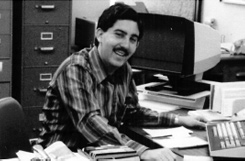
Father Luis Garcia worked as an accountant for Florida Power and Light before becoming a priest.
Favorite type of music:
Old Cuban music, music from Spain and classical music.
Last book read:
Vida y Misterio de Jesús de Nazaret (Life and Mystery of Jesus of Nazareth) by José Luis Martín Descalzo.
Most memorable priestly assignment:
When he was assigned as parochial vicar at St. Maximilian Kolbe in Pembroke Pines. “I spent two years there with Father James Vitucci. He was the best example of priesthood for me – a good friend, a colleague, a good son, a good priest. I was privileged to share the last years of his life. I heard his last confession and laid him to rest.”
His description of the ideal priest:
Father James Vitucci.
Most difficult aspect of the priesthood:
“Trying to keep everybody happy.”
Person he most admires:
“My mother because she was a good woman, a good mother and wife, an example of piety, love and sacrifice for me.”
His greatest fear:
“Not to be able to return to a free Cuba. It was something my parents longed for and they died without being able to go back.”
His biggest critic:
“I’m sure I have many, but I would say it would have to be me.”
The son of Colombian parents, Father Bohórquez was born in Argentina on Oct. 25, 1972. He lived in Venezuela and Colombia before coming to the United States in 1988. He graduated from McArthur High School in Hollywood in 1990, and entered St. John Vianney College Seminary in Miami six years later.
He was ordained a priest for the Archdiocese of Miami in May, 2001. His mother died 24 days after his ordination. He has a sister who lives in Colombia and a brother who lives in Boston. His father lives in Miami. Before going to St. Jerome, he served at Epiphany Parish in South Miami.
What he did before becoming a priest:
He worked in many different trades, from cleaning offices to delivering pizzas to stripping and waxing floors to telemarketing (where he lasted only one day).
What he does on his days off:
“I make it a point to always visit my father: I try to at least eat one meal with him on my day off.”
Favorite movie:
“Contact” starring Jodie Foster
Favorite TV series:
“The Cosby Show” and “Home Improvement”
"I see how God transforms and that thrill is more awesome than anything else in this life."
When he knew he wanted to be a priest:
He never really considered the priesthood seriously until a year or so before he entered the seminary, but he sees now “that was the end of a well-planned-by-God journey.” His family had always been very connected to the church and as a child he sometimes dreamed of preaching the word of God. At 18, he began to pray, “If it is your will that I become a priest, just show me. The answer was so obvious, so in my face, that I could not recognize it.” Finally, a good friend advised him to try it, reminding him that going into the seminary did not mean he would have to stay. When he first got there, he would wake up in the morning and ask himself, “What have I gotten myself into? But the initial fears and cautions became joyful assurance as the years passed.”
What he would be doing if he had not become a priest:
At first he thought of becoming a veterinarian, then an aerospace engineer, later a pilot.
Greatest disappointment:
“There is so much hurt in my heart when, instead of being a ‘bridge’ (to the divine), I have been in the way I relate to people, when I have been unfaithful to the call in my ministry or in the living of my Christianity a ‘rock of stumble’ for people’s faith.”
Greatest joy:
“When I see the word of God and his grace working with all the force of his mercy, power and majesty in the lives of people who have the courage to receive it.I see how God transforms and that thrill is more awesome than anything else in this life.”
Most difficult aspect of being a priest:
“The frustration I experience continuously is my incapacity to transmit my experience of faith. I see that the message of the Gospel cannot be explained or described. I have come to realize that the only way to share this Good News is to let God burn me and, as I am being consumed by that fire, allow the light of Christ to shine then, get out of his way. Letting God come through is my challenge, and many times, my frustration.”
Image of the ideal priest:
“A candle: As the priest allows God’s fire to consume him, that makes it possible for him to illuminate with the light of Christ. But that light will not shine if he is not willing to let the Gospel burn him and consume him little by little.”
Priestly stereotype that should be discarded:
“The priest as a mere professional if the ministry is not embedded to my person, it is no priestly ministry at all.”
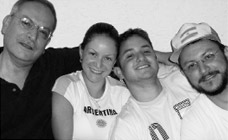
Father Bohorquez, far right, with his father, Francisco, his sister, María Carolina and his brother, José Luis. Although all three are wearing T-shirts that say Argentina, Father Bohorquez is the only one who was born there. His sister was born in Bogotá, Colombia, and his brother in Valencia, Venezuela.
Who was most surprised by his vocation:
“Me I dreamt of serving the Lord as a married man with children. The Lord showed me in more and more powerful and evident ways that the way towards holiness and thus, happiness that he had chosen for me was the priesthood.”
Favorite type of music:
All types at different times: jazz, salsa, Colombian folkloric music, classical, Christian pop, merengue, Catholic and Protestant- Christian hymnody, liturgical, Gregorian.
Person he most admires:
“My mother, who is deceased and planted so many seeds of eternal life in my own life, and my father, who continues to give me a powerful example of integrity, love for life, and unshakable faith in the midst of trials. Also, the three saints which the Lord has given me as continuous sources of spiritual inspiration: St. Teresa of Avila, St. John of the Cross, and St. Therese the Little Flower. Pope John Paul II is also in the bunch.”
Thing he most fears:
“To go astray from the will of God”
Zirilli was born in Melbourne, Fla., on April 26, 1971, the older of two boys. He graduated from the University of Florida in 1993 with a bachelor’s degree in accounting and later obtained a master’s in the field from the University of North Florida. For eight years, he worked as a certified public accountant in private practice in the Key Largo area. In 2002, he sold his firm and entered St. John Vianney College Seminary in Miami, where he completed the pre-theology program before entering St. Vincent de Paul Regional Seminary in Boynton Beach.
He was ordained for the Archdiocese of Miami on May 10, 2008. He was assigned to St. Louis Parish in Pinecrest before being named vocations director in September 2010.
When he knew he wanted to be a priest:
“When I was about 22 the thought came to me while sitting at Mass one day. I was looking at the priest celebrate Mass and knew in that moment God was calling me to it. It was a powerful, beautiful, frightening moment. Before that moment I had an inkling, so I began to find out more about my faith on my own. I read the Bible one chapter at a time, every night. It took a few years to finish.”
Person most surprised by his vocation:
“Me. I had always seen myself as a businessman with a wife and kids but the call (to priesthood) just couldn’t be ignored.”
Seminary life:
“From the first day in the seminary I knew I had made the right decision. I felt as if God was telling me, ‘I want you to be happy and if you follow me you’ll be more happy than doing anything else.”
Favorite priestly assignment:
“I have only had two, so far, and both assignments have been very different. As a parish priest I liked being involved in the day-to-day life at the parish and with the parish community; you get to develop solid relationships. I was always very moved by the example of faith. As vocations director I get to talk about the priesthood and how much I love it. I get to meet lots of people and travel to different parishes every weekend. I get to know both the pastors and the parish community.”
'(I) serve God, but I am not God.'
The most difficult aspect of being a priest:
“(I) serve God, but I am not God. I pray I bring God’s comfort and love to people, but wish I could help everyone. It is difficult to see human suffering. I pray I bring hope and Christ to people; I’m in the business of hope.”
His description of the ideal priest:
“Must have a solid relationship with Christ, be happy, approachable, friendly, humorous and can articulate the faith to people yearning to hear it. Must have a beautiful heart and love God and have an incredible grasp of Scripture.”
A priestly stereotype that he feels should be discarded:
“A lot of people think or view the priesthood as being a life without success or that it is a wasted or unhappy life. That tends to be a barrier to consider vocations. However, priesthood is filled with great happiness, joy and is fulfilling. I am reminded of Mother Teresa when she said, ‘God calls us not to be successful, but to be faithful’.”
Favorite TV series:
“MythBusters”
Last book read:
“Just finished reading the Sherlock Holmes mysteries on my e-reader and I’m now reading ‘The Divine Comedy’ by Dante, ‘Spirit of the Living’ by Pope Benedict XVI and ‘Pride and Prejudice’ by Jane Austen.”
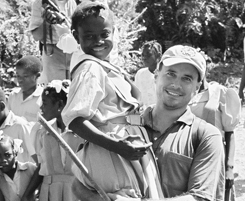
Father David Zirilli is pictured here during an Amor en Accion-sponsored missionary trip to the Diocese of Portde- Paix, Miami’s sister diocese in northwest Haiti. The group consisted of seminarians and parishioners from St. Mary Star of the Sea in Key West who supported the construction of a new school in the village of Dity.
Favorite type of music:
“Love the ’80s, but I can’t pass on a good Gregorian chant. That’s the best.”
Person he most admires:
“St. Joseph because he was and is an ideal role model for Catholic men to be faithful husbands and fathers; he is also a good role model for priests because he was always open and willing to carry out the will of God.”
His greatest disappointment:
“Not responding to the call (vocation) sooner, although that is hard to say. Sometimes things are for the best; no experience is wasted. We learn and grow both from our mistakes and successes.”
His greatest joy:
“When God lets you see the fruit of your ministry. As priests our task is to sow the seeds not necessarily to see the fruits, but when God does allow it, it’s a great joy to know that you have faithfully done your ministry.”
His greatest accomplishment:
“If on my tombstone it reads: ‘Here lies David Zirilli, a holy priest.”