By Archbishop Thomas Wenski - The Archdiocese of Miami
Archbishop Thomas Wenski preached this homily while celebrating Sunday Mass at Our Lady of Guadalupe Church, Doral, Feb. 23, 2020. The Mass preceded his annual Motorcycle Ride to benefit St. Luke Center, an award-winning alcohol and drug rehab facility offering specialized addiction treatment for adults. It is operated by Catholic Charities.
“Love your neighbor as you love yourself” we hear in our first reading from Leviticus. The Lord lays down the law to Moses: No hatred, no revenge, no grudges but love your neighbor as yourself. And Moses coming down from Mount Sinai lays down the law to the chosen people.
In the Gospel – which is a continuation of the Sermon on the Mount which we have been hearing for the past several weeks – Jesus is also laying down the law, a new law to those who would be the new people of God, people of a new covenant, a new testament.
Photographer: ROBERTO AGUIRRE | FC
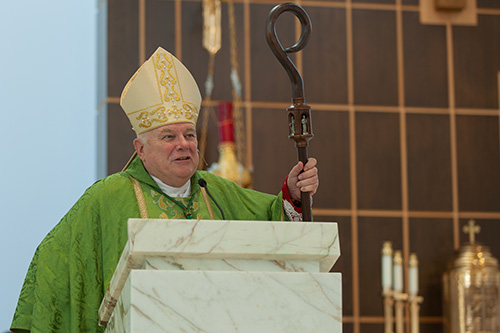
Archbishop Thomas Wenski preaches the homily at the Mass that preceded his annual Motorcycle Ride for St. Luke's Center, Feb. 23, 2020.
In doing so, he does not abolish to old Law and the prophets – but rather he is fulfilling them, bringing them to completeness or perfection. In fact, when Jesus says, “You have heard it said, love your neighbor and hate your enemy…” that “hate your enemy part” is found nowhere in the Bible. The Word of God never says – anywhere – to hate your enemies.
Jesus’ teachings are not for wimps. Love your enemies? Heck, it is hard enough to love our friends. And sometimes, we don’t even love ourselves as we should. Indeed, much of the bad things people do to other people are the result of their not loving themselves.
Think of the hoodlum that mugs an old lady on the street. He’s not doing that because he’s trying to feed his kids. More likely, he does it because he’s trying to feed a habit, a habit that is killing him. He doesn’t love himself very much — which explains his lack of love towards that old lady he mugs.
(Our motorcycle ride today will raise funds to benefit Catholic Charities’ St. Luke Center, a drug rehabilitation facility. Now, I’m not saying the clients there are hoodlums; but they do suffer from addiction.)
People often fall into addictions when they try to self-medicate themselves because of some pain, either physical or psychological, in their lives. Because they self-medicate inappropriately, they don’t really address the pain — and they cause a lot of pain to their loved ones, their families and beyond. Part of the recovery process is to help the one struggling with addiction to recover his sense of self-worth: He (or she) needs to know and to experience that God loves them, that they are not only lovable but loved.
Don’t we at times indulge in any number of self-destructive behaviors – and isn’t that because we don’t love or respect ourselves as we should?
The grudges we nurse, the hatreds we stroke, the revenge we dream about – how much of this lack of love towards our neighbor is a reflection of our own lack of love towards ourselves. As somebody said, “Resentment is like taking poison yourself and then expecting the other person to die.”
Of course, when somebody does something bad to us, it is natural that we don’t feel like forgiving that person, much less do we feel loving towards that person. But forgiveness — and loving — are not mere feelings. To forgive someone is a decision. To love someone is a decision.
Jesus went to the cross freely. He decided to do so — even though he felt anguish, dread and fear. We too — with God’s help — can make decisions independent of our feelings. We do it all the time. I feel like sleeping in; but I got bills to pay and so I decide to get up and go to work. And, maybe later, we feel good about having gone to work because we accomplish something that we were supposed to do.
To forgive might not erase a painful memory; but by forgiving we don’t have to act out of this memory. Forgiveness is freeing. It is liberating. When you say to someone, I’ll never forgive you, you are basically putting that person in control of your life. By forgiving, you free yourself — and by forgiving, even without demanding an apology first, you also decide that you don’t need to control the one who did you wrong. That’s what turning the other cheek means. “An eye for an eye” will just end up in making everybody blind.
But to love your neighbor as you love yourself requires you to love yourself. I’ m not telling you to be egoistical, narcissistic or selfish; but I’m saying that you have to love yourself as made in the image and likeness of God. If you do that, then the Golden Rule makes sense. It’ll mean more than doing unto others before they do unto you. God loves us, he created us and in Jesus Christ, he redeems us– not to love ourselves is to suggest that God doesn’t know what he’s doing.
In the Alleluia verse we sang: “Whoever keeps the word of Christ, the love of God is truly perfected in him.”
Jesus shares with us words of great wisdom — but this is more than human wisdom, it is God’s wisdom. Jesus is the wisdom of God in the flesh. And he gives us his flesh to eat so that we might become what we receive so that “the Love of God be truly perfected” in us.
Our communion in his Body and Blood we receive during the Sacrifice of the Mass is a remedy for our sins and the pains they cause to ourselves and others; it is a sign of God’s love for us and a pledge of the future glory that awaits us.”
Now, even though we are called to love even our enemies, love might not change an enemy; but maybe, it might confuse him. But it won’t necessarily change him. So, Jesus is not telling us to love just as a strategy to get something. This is not about the “art of the deal.” We love not because of what someone might give us in return but because of who we are, who we have become in Christ Jesus, in whose Body and Blood we share. We love because it is the Way of Jesus — and there is no other way to eternal life.