By Florida Catholic staff - Florida Catholic
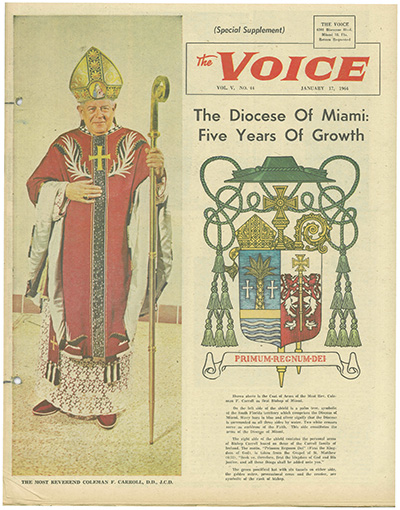
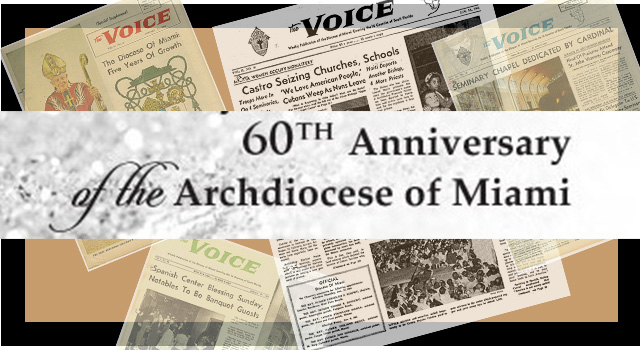
MIAMI | The Archdiocese of Miami is marking its 60th anniversary this year. The diocese was created Aug. 13, 1958 and established when Bishop Coleman Carroll was installed as its first bishop, Oct. 7, 1958.
An anniversary celebration, a “White Gala to Honor the White Collar,” will take place Oct. 20, 2018. Proceeds will go to supporting the work of our two seminaries in forming priests to serve our parishes in the future. More specifics about the gala will be announced in the spring.
In the meantime, the Florida Catholic will be running “This month in archdiocesan history�” segments in its print and online publications throughout the year. For the record, these are highlights, not an exhaustive list of events. Here is the first installment.
January
1960
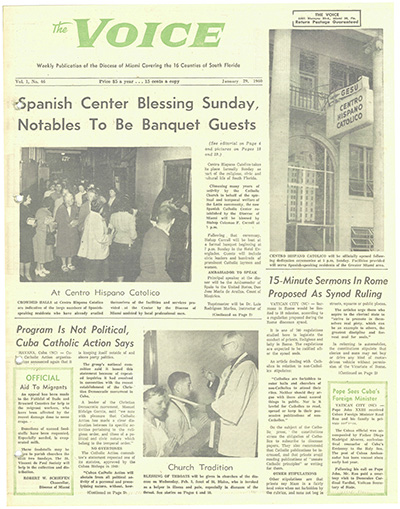
- Jan. 31: Centro Hispano Católico is officially dedicated on the grounds of Gesu Church, to look after “the spiritual and temporal welfare” of the “rapidly increasing Latin colony of South Florida.”
1961
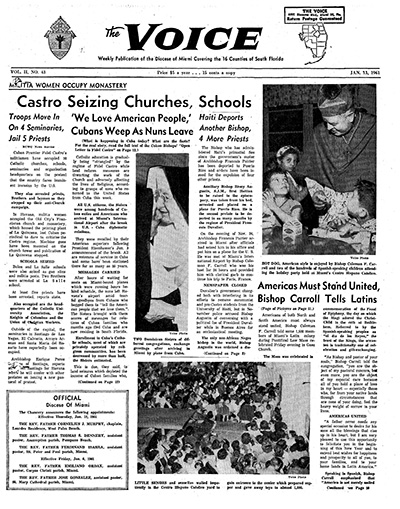
- U.S. citizen Dominican sisters arrive in Miami after being recalled by their superiors following the Jan. 3 break in diplomatic relations with Cuba. On the island, Fidel Castro’s government begins occupying Catholic schools, churches and seminaries, and arresting priests and religious. “Belen and La Salle schools were also seized as gun sites and militia posts,” reports Catholic News Service.
1962
- Bishop Coleman Carroll blesses the new St. Mary Star of the Sea School in Key West, which replaces the St. Joseph School for Boys established in 1881 and torn down to make way for the new building.
1963
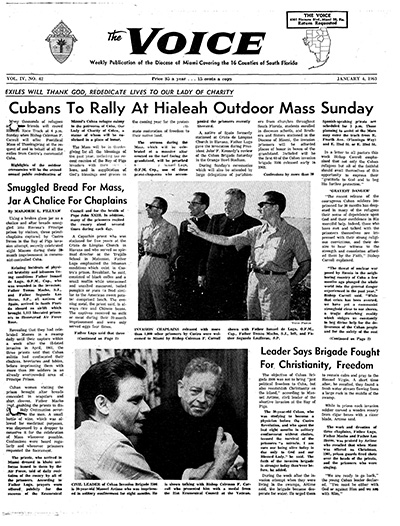
- 20,000 Cuban exiles gather at Hialeah Park for an outdoor Mass where they publicly rededicate themselves and their families to their patroness, Our Lady of Charity.
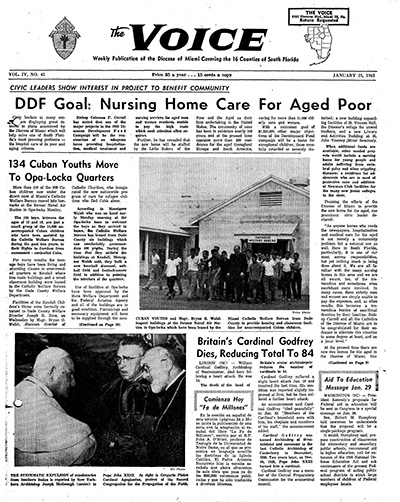
- More than 100 of the 999 Cuban children being cared for by Miami’s Catholic Welfare Bureau (now Catholic Charities) move into the barracks at the former Naval Air Station in Opa-Locka. The 134 boys, ages 13 to 18, are among 14,000 unaccompanied minors brought into the U.S. through the Pedro Pan program.
1966
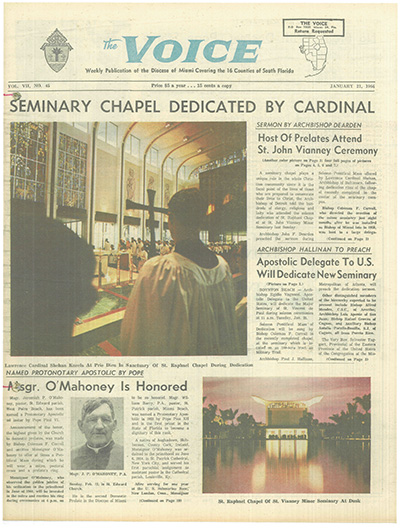
- St. Raphael Chapel is dedicated on the grounds of St. John Vianney College in Miami.
1969
- St. Joseph Residence, a home for able-bodied elderly, is dedicated in Fort Lauderdale.
1972
- Bishop Rene Gracida, a Miami priest, is ordained as the diocese’s second auxiliary bishop. His appointment was announced Dec. 6, 1971.
1978
- Archbishop Edward McCarthy issues the first of his many pastoral letters, this one announcing a Holy Year to coincide with the archdiocese’s 20th anniversary. He calls for “a unique archdiocesan-wide spiritual experience” whereby “the Church of Miami will find a new conversion to living more fully the life of Faith, and Prayer and Love of Christ's Kingdom into which we have been baptized.”
1984
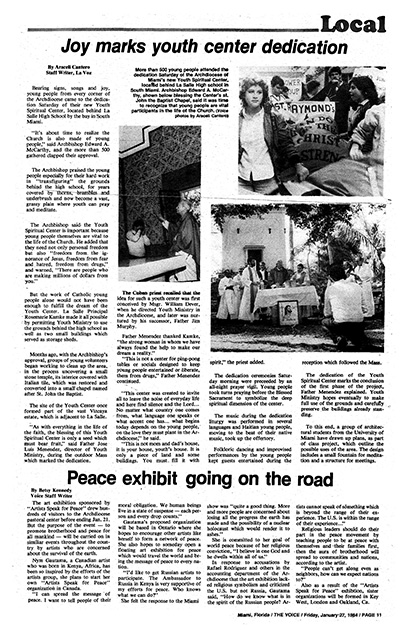
- Archdiocesan Spiritual Center for Youth (now known as the Youth Center) opens on the grounds of Immaculata-La Salle High School, Miami
- Archdiocesan cemeteries dedicate monuments to the millions of unborn children killed by abortion
1986
- A Passionist priest, Father Norbert Dorsey, is appointed auxiliary bishop for the archdiocese.
1989
- On the Martin Luther King holiday, Archbishop Edward McCarthy announces the creation of an Office for Black Catholic Affairs, designed to give the estimated 40,000 black Catholics in South Florida a stronger voice in the Church.
1992
- Auxiliary Bishop Agustin Roman issues a statement urging the prompt release of Mariel detainees “who have served their time and are ready to be integrated into society.” He said that 5,000 of the approximately 10,000 detainees have been released and successfully re-integrated into society.
- Close to 7,000 Haitian refugees being held at the U.S. Naval Base in Guantanamo while U.S. courts decide whether they should be admitted into this country receive a Christmas week visit from Father Thomas Wenski, director of the archdiocese's Haitian Apostolate.
- The archdiocese's Office of Migration and Refugee Services opens a Haitian Service Office to provide legal and social services for newly-arriving Haitian refugees. A newly-created Catholic Emergency Legal Aid for Haitians (which will evolve into Catholic Legal Services) also begins processing asylum applications for Haitians from the U.S. Naval Base in Guantanamo.
1993
- Radio Peace begins broadcasting, offering 13 hours of multilingual Catholic programming � in Spanish from 6 a.m. to 2 p.m., in English from 2 to 6 p.m., and in Creole from 6 to 7 p.m. � on WKAT 1360 AM.
1994
- Msgr. Franklyn M. Casale, a Newark priest with 26 years of experience as a pastor and diocesan administrator, is named president of St. Thomas University, Miami Gardens.
1995
- Jan. 13, 1995: More than 12,000 Catholics gather at the Miami Beach Convention Center to welcome Miami’s third archbishop, John C. Favalora, who had been installed in an official ceremony Dec. 20, 1994, at St. Mary Cathedral.
- Radio Peace, the English-language radio programming of the archdiocese, begins broadcasting on WAXY 790 AM from 3 to 5 p.m. daily and from noon to 1 p.m. Sundays. Spanish and Creole programming continues to air on WKAT 1360 AM.
- Archdiocese of Miami priests and organizations, led by Radio Paz, collect more than 100,000 signatures to present to President Clinton calling for the release of 29,000 Cuban and Haitian refugees from Guantanamo.
1996
- Archbishop Favalora, accompanied by a plane-full of priests and lay people from the archdiocese, travels to St. Petersburg to ordain Bishop Robert N. Lynch, until then a Miami archdiocesan priest, and install him as his successor in the diocese.
1997
- Archbishop Favalora presides at the first ever Migration Week Mass at St. Mary Cathedral, which brings together representatives of nearly a dozen non-Hispanic ethnic groups in the archdiocese. The multilingual, multicultural ceremony coincides with the feast of the Epiphany.
1998
- Jan. 25: Archbishop Favalora leads a group of 152 people � including most of Florida’s bishops and the cardinals of Los Angeles and Detroit � on a one-day pilgrimage to Cuba for Pope John Paul II’s Mass in Havana. The chartered airplane trip was hastily arranged during the first week of January after the archbishop canceled the planned cruise ship to Cuba at the end of December.
2000
- Archbishop Favalora launches a $75 million capital and endowment campaign called “Vision 2000: Sharing God’s Gifts,” to “ensure the future financial stability of our church in South Florida.” In its pre-launch phase, the campaign had already raised $25 million in pledges from several wealthy donors.


Comments from readers