By Tom Tracy - Florida Catholic
Photographer: COURTESY
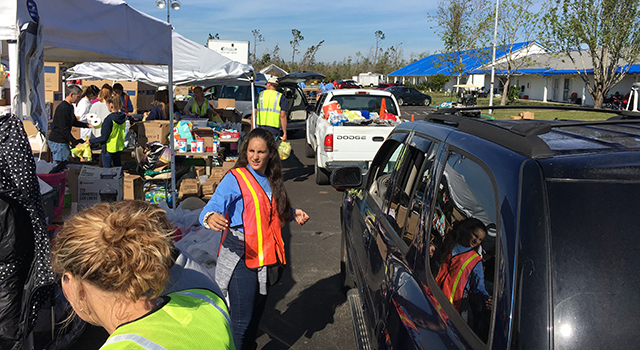
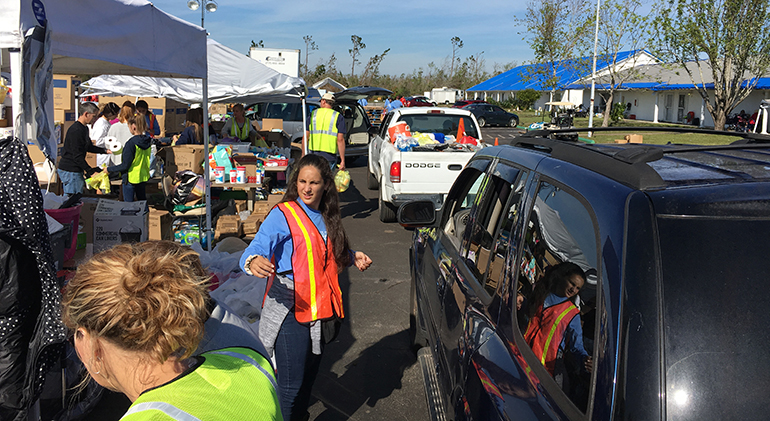
Volunteers from St. Thomas the Apostle Parish in Miami help distribute toilet paper and other necessities at the drive-thru distribution center set up at the heavily damaged St. Dominic Church in Panama City, Nov. 17. “The line of cars would not stop, we could not take a break,” said Catalina Pittier, who went on the trip with her husband and two school-aged daughters.
MIAMI | A mental health professional who just completed a week of engagement with adults and Catholic school children in the hurricane-impacted Florida Panhandle notes how the Christmas season is a mixed blessing for survivors of natural disasters.
“Right now, the holidays are working in two different ways � both as a distraction and an underlying stress factor for parents, both emotionally and financially. But in another way, it is good thing. Kids are looking forward, knowing that Christmas is coming, and it is something else to think about,” said Claudia J. Gomez-Cardona, a licensed mental health counselor who serves as regional director of counseling for Catholic Charities of the Archdiocese of Miami.
Gomez-Cardona and other Catholic Charities mental health counselors spent the first week of December offering therapy and faculty training to areas hard-hit by Hurricane Michael’s near Category-5 strength winds. Michael made landfall Oct. 10 at Mexico Beach, near Panama City on Florida’s Gulf Coast.
The visiting mental health team expected to engage traumatized adults at one of the parishes most impacted by the storm but found they were more useful reaching out to parents, students, faculty and staff at one Catholic elementary school that has absorbed the entire student body of another school forced to close by Hurricane Michael.
Photographer: Anita Ramjit | Catholic Charitie
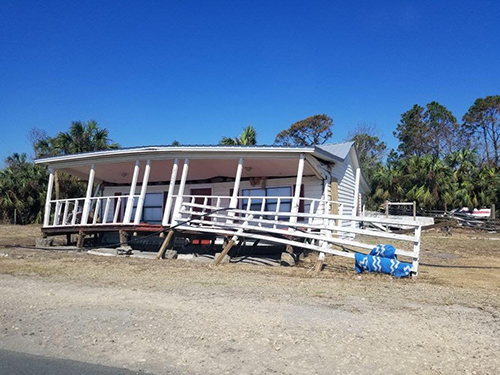
This file photo, taken during an initial assessment tour by Miami's Catholic Charities staff back in October, shows the destruction wreaked by Hurricane Michael in Florida's Panhandle. A group of mental health counselors who returned to the area in early December noted that the Christmas holidays are both a distraction and an underlying stress factor for families, both emotionally and financially.
St. John School in Panama City suffered catastrophic wind and rain damage and is holding classes at nearby St. Bernadette Parish for the foreseeable future. Much of the impacted region remains without power and clean water; the storm’s death toll rose to at least 29 in Florida and a total of 39 across the southern U.S.
Gomez-Cardona said she and her team went from classroom to classroom and began easing into a series of conversations about the hurricane, listening to the youngsters’ stories and encouraging the younger children to simply draw a representation of their feelings and memories of the storm.
“The kids really needed this. It is amazing how they shared their feelings and how scared they were from the hurricane,” Gomez-Cardona said. “We talked about how they are doing now, and you could see some leftover feelings of fear because the community is still so damaged. Life doesn’t feel back to normal at all for them, and kids are very much aware of that with garbage in the streets and downed trees.”
The team met separately with school faculty and staff.
The Christmas and Advent Season, Gomez-Cardona noted, may be a time of joy and good feelings but also cause stressful triggers for displaced families who realize there won’t be a Christmas tree in their own home this year. For others, the season will bring a pleasant distraction for the short term, until their new reality quickly brings them back down to earth in the new year.
Gomez-Cardona said she offered parents and school staff a series of practical measures for natural disaster survivors during the holiday season:
- Start with the spiritual component of Advent and stay focused on what Christmas is truly about. Stay in the present moment, see what you need to do and then do what you can with those things that you control.
- If there is something beyond your control, pray or talk to others about it, do some discernment and try to step back and focus on the things you can be grateful for. Focus on one positive thing each day.
- Even after fostering a sense of gratitude, understand that everyone has problems and life is not perfect. But still make a point to focus on the blessings of good health or one’s children, and then expand on that, write it down, call someone and tell them you are grateful.
- Get out into the community, join activities, be a little more open with people who want to help you or love you. Don't stay isolated.
- Anyone who feels unable to get out of bed each day needs to consider seeing a professional to sort it out, to listen and give advice.
- Some may have feelings of suicide. Be on the lookout for family and friends who may be feeling suicidal.
- Shopping at this time of year can make some people very unhappy and stressed, so try to take one moment at a time.
Gomez-Cardona said other mental health teams from Catholic Charities agencies around Florida have remained in the region to move from group therapy to personalized counseling with students and adults in the Panama City area. Many of the staff from St. John School in Panama City have considerable problems that counselors haven’t had time to address.
“The faculty and administration were so busy they didn’t have time to do individual counseling � that will come later. But we did group presentations about what we observed and what we recommended for the students. You can tell some of them are suffering,” Gomez-Cardona said.
She added that it also was noteworthy to hear the young people, from first to eighth-graders, expressing a lot of gratitude to the emergency responders and post-hurricane workers who are putting things back together in the Panhandle.
“We gave the faculty ideas of red flags to watch out for among the student body: rapidly changed behaviors, reports of nightmares, fear of things not going back to normal,” Gomez-Cardona said. “We advised them to take time during the day to do some student drawing, and to seek out permanent mental health resources from the Panhandle area in terms of agencies there.”
Gabe Tischler, who is working full time on the Hurricane Michael response for the Tallahassee-based Florida Catholic Conference, has noted that Catholic Charities entities in the region have distributed some $6 million in aid, services and donations since the storm. And hardest-hit St. Dominic Parish continues to serve some 2,500 families daily � a project that may continue unabated well into next year.