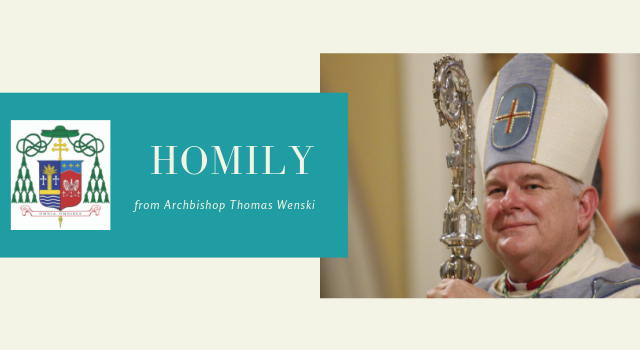
By Archbishop Thomas Wenski - The Archdiocese of Miami
Archbishop Thomas Wenski delivered this reflection at an interfaith Prayer Vigil for Peace held March 29, 2022, in the chapel of St. Anthony at St. Thomas University in Miami Gardens.
Men and women of all ages have longed for peace amid the tragedies and violence that mark human history. Bringing peace is central to the mission of Christ’s disciples. “Shalom” is also a common greeting for Jews, as is “Salaam” for Muslims.
Today, our longing for peace is intensified as we witness the tragedy of the unjust war that Russia is waging in Ukraine. The conflict is at once “far away” and yet close to home. We live in a globalized world – and as Pope Benedict sadly noted: globalization has made us all neighbors, but it has not made us brothers and sisters. And as we see the risks of the escalation of this conflict into a possible World War III, we cannot deny that a just and worthy future for us and our children here will also require a just and worthy future for the people of the Ukraine and their children.
Carl von Clausewitz famously said: “War is simply the continuation of political intercourse with the addition of other means.” But perhaps it is truer to say that “War is the failure of politics.” To quote Pope Francis: “Politics is an essential means of building human community and institutions, but when political life is not seen as a form of service to society as a whole, it can become a means of oppression, marginalization and even destruction.” And to quote him again, “If exercised with basic respect for the life, freedom and dignity of persons, political life can indeed become an outstanding form of charity.”
We pray that charity will conquer hate, that peace will prevail over discord; we pray that politics as a form of service replace politics as a means of oppression or exclusion.
We come together as members of different faiths and religious communities.
Our prayer is not about trying to change God or his mind. It is about changing our minds and our hearts. When we pray, we are like that man in a boat trying to bring it to the dock. He throws out a line, and once secured on a piling, he pulls on the line. The dock doesn’t move, the boat does. And if the water is rough or the winds are blowing strong, then he must pull harder on the line to bring the boat to dock.
Our prayers are about pulling our boat closer to God and his will for us. Thy will be done, we pray, on earth as it is in heaven. His will for us is peace, that we who are made in his image and likeness, live as brothers and sisters.
The bravery of the Ukrainian people struggling for their right to exist as a free people and a sovereign nation inspires us; the solidarity of the Poles who in less than two weeks welcomed almost two million people into their homes edifies us; but the bombing of civilians, the war crimes and the atrocities that we are slowly learning about both frighten us and shame us.
We will only know peace through forgiveness and reconciliation. May God grant us a quick end to the hostilities so that the delicate flower – that is peace – can blossom on Russian and Ukrainian soil.
Soon we Christians will celebrate the Lord’s Resurrection on Easter Sunday. “Peace” was Jesus’ Easter gift to his apostles. “Peace, I leave with you; my peace, I give to you.” May that peace also be his gift to the world this Easter.