By Emily Chaffins -
MIAMI | As approximately one in four U.S. adults struggle with a diagnosable mental disorder in a given year, mental health challenges are a reality for many across South Florida.
For Catholic leaders in the Archdiocese of Miami and beyond, walking alongside community members who are experiencing mental health challenges involves correcting misconceptions about faith and science, addressing cultural stigmas about mental health, and stepping up to the plate to provide quality services to Catholics and non-Catholics alike.
As part of National Recovery Month this September, the Florida Catholic brings into conversation some of the leading Catholic voices promoting mental health in South Florida.
Overcoming stigma
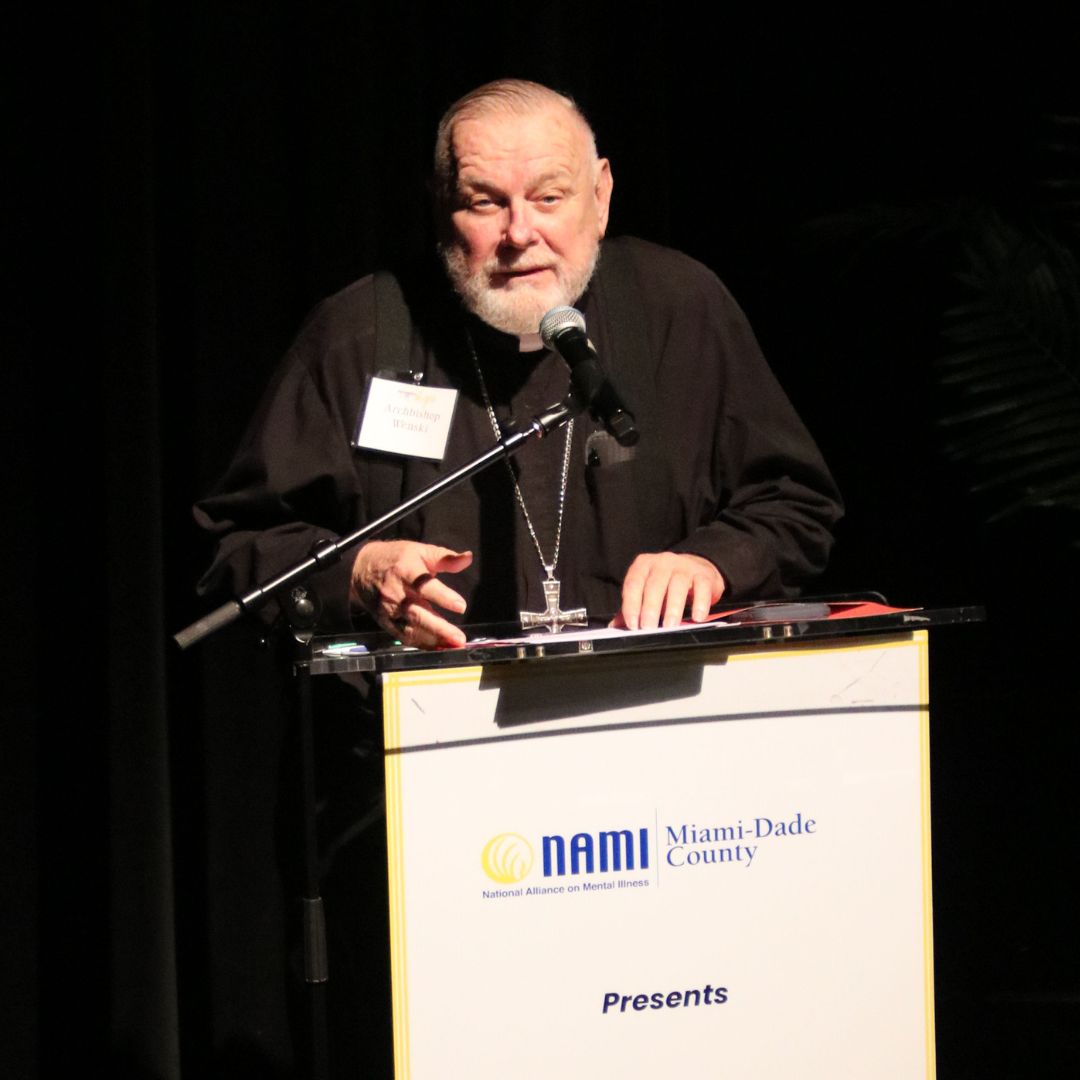
In Archbishop Thomas Wenski’s recent keynote speech – presented at the National Alliance on Mental Illness (NAMI) Miami-Dade County Pathways to Hope Conference – he offered a scenario illustrating the societal challenges facing those with serious mental illness.
Photographer: Emily Chaffins
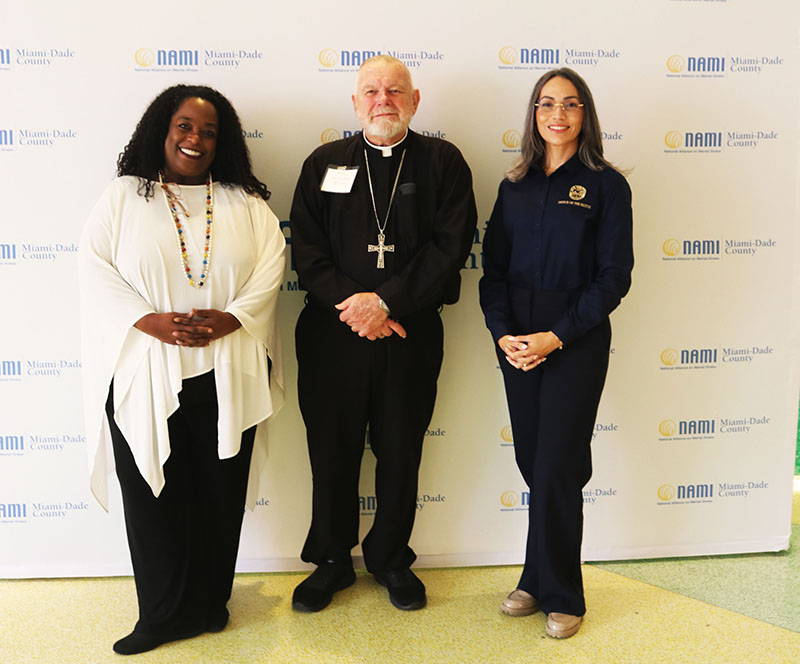
Archbishop Thomas Wenski of Miami, center, presented the keynote speech Aug. 21, 2026, at the Pathways to Hope Conference in Miami. The archbishop is pictured with representatives from Miami-Dade County’s Office of the Mayor Daniella Levine Cava: Michelle Johnson (at left), faith and community leadership manager, and Brenda Lampon, senior advocate for older adults, mental health and disabilities.
“If you are walking down the street and you have a heart attack or are hit by a bus, someone calls 911, the EMTs come and [they] take you to the hospital,” said Archbishop Wenski. “If you have a mental health crisis, someone calls 911 [and] the police come and take you to jail.”
However, the archbishop pointed out that recent improvements have been made in supporting mental health in South Florida. This summer, the Miami-Dade County Commission advanced with funding the Miami Center for Mental Health and Recovery, an undertaking spearheaded by retired Judge Steven Leifman.
Society still has much to learn about caring for those who are experiencing serious mental health challenges. “Mental illness is still associated with shame – and we tend to shun the mentally ill because of that shame and because of our ignorance and fear,” said Archbishop Wenski.
However, he emphasized that the Church has a long history of aid. “From its earliest days, Christianity was reaching out to the poor and marginalized, and the mentally ill have been among them.”
Catholic Charities of the Archdiocese of Miami is one such local Catholic ministry serving those facing mental health and substance abuse issues. This year, the ministry celebrates the 95th anniversary of its founding, which is also when the organization started providing mental health services.
Catholic Charities of Miami offers both telehealth and in-person counseling services as well as alcohol and substance abuse treatment services, all based out of St. Luke’s Center in Miami. Individuals and families, Catholic and non-Catholic alike, are able to participate.
Peter Routsis-Arroyo, chief executive officer of Catholic Charities of Miami, is a licensed mental health clinician. He noted that high housing costs and a difficult job market are common stressors in today’s South Florida community. Many locals seeking Catholic Charities of Miami's mental health services find themselves challenged with anxiety and depression, as in the rest of the country.
While against stereotyping, Routsis-Arroyo noted that culture does sometimes impose mental health stigmas. In South Florida, having a “macho” attitude can cause some men to be reluctant to seek counseling. An additional factor in South Florida is that, while mental health services are widely available in the U.S., this is not always the case in other countries. Routsis-Arroyo has observed that immigrant families are not always aware of the availability of counseling services.
However, Routsis-Arroyo believes that society has come a long way in mental health awareness. “I think we’ve been overcoming over the years the ‘I don’t need counselor because I’m not crazy’ attitude,” he said, while acknowledging this misconception still exists.
“You’re not crazy if you need to talk to someone and you need some help to get yourself back on your feet,” he affirmed.
Sandra Valdes, senior director of behavioral health services at Catholic Charities of Miami, pointed to cultural shifts better integrating those with substance abuse issues into society: from restaurants offering the option of non-alcoholic mocktails, to cruise ships including Friend of Bill meetings for people in recovery.
“They continue to have fellowship and community and support from like-minded individuals,” she said.
Faith and science: it’s about “both/and”
As Archbishop Wenski explained, it’s important to unite both faith and science in mental health treatment.
Photographer: Emily Chaffins
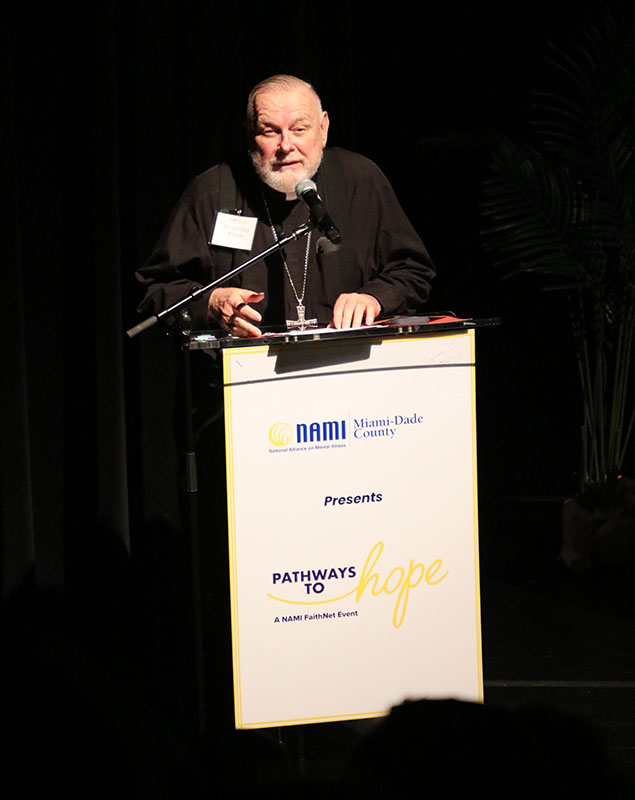
Archbishop Thomas Wenski presents the keynote speech Aug. 21, 2026, at the Pathways to Hope Conference in Miami hosted by NAMI (National Alliance on Mental Illness). Archbishop Wenski discussed the collaboration between medical treatments and faith to promote mental health.
“Catholics do not think mental illness should be solved by prayer rather than by psychiatry. We are a people of both/and!” he emphasized.
Catholic Charities of Miami demonstrates the Church’s commitment to providing up-to-date medical care for those in need of it. “Catholic Charities was the first treatment program in [Dade County] that started the first methadone clinic,” said Valdes.
In the 1970s, methadone became the first pharmacological treatment for heroin addiction. Over time, Catholic Charities of Miami’s medication-assisted treatment has evolved, as they have replaced the use of methadone with other forms of treatment for those with opioid addiction.
Around the early 2000s, Catholic Charities of Miami distinguished themselves by coupling substance abuse services with psychiatric care – a practice not common at the time.
“If you were struggling with symptoms of schizophrenia, they maybe wouldn’t have placed you in a treatment program for substance use; they would have wanted you to focus on just the mental health,” explained Valdes. Instead, Catholic Charities treated both the mental health and the substance use disorder.
Although not all program participants are religious, Valdes has seen how those who do have an interest in faith can find great benefit from incorporating faith into their rehabilitation.
“We did have one individual who started to become very involved at St. Mary Cathedral and who had struggled for years with opioid use,” she said. “Participating in the different groups there really helped him maintain his sobriety. He got divorced while he was here in the program, and he actually reunified with his wife and they had two more children. That definitely is one scenario where the Catholic faith really helped him and changed his life.”
Archbishop Wenski noted that “the Church affirms that mental health struggles are not character defects, willpower failures, or deficits in faith” and also cautioned against assuming that someone’s behavioral disorders are demonic. “The Catechism distinguishes exorcism from psychological illness, noting that medical science should treat illnesses and that experts must rule out medical conditions before considering exorcism.”
Faith communities play an important role in affirming the dignity of community members who are struggling with mental health.
“The mentally ill can be helped today by ‘miracle drugs’ not available a generation or two ago. But the mentally ill also need love, a love that is unconditional positive regard for them, a love that affirms their dignity as made in the image and likeness of God, a love that embraces them as they are, a love that can say to them, ‘I am glad that you are you.’”
The archbishop also pointed out that canonized saints have experienced mental health challenges, too.
St. Oscar Romero, a bishop from El Salvador who was martyred in 1980, was diagnosed with obsessive-compulsive disorder (OCD). St. Therese of Lisieux, a popular French saint known as the “Little Flower,” suffered a mental health crisis as a child. St. Mark Ji Tianxiang, martyred in China in 1900, struggled with lifelong opium addiction.
“I always go back to Matthew 25: ‘Whatsoever you do for the least of my brothers and sisters, you do for me,’” said Routsis-Arroyo. “That includes counseling. Anyone in need of help, they need to be treated with dignity and respect.”
Learn more
- To find out more about Catholic Charities of Miami’s behavioral health and alcohol and substance abuse services, visit their website at https://www.ccadm.org/.
- Spread the word about the United States Conference of Catholic Bishops’ annual Nationwide Novena for Mental Health, prayed from October 10 to October 18.