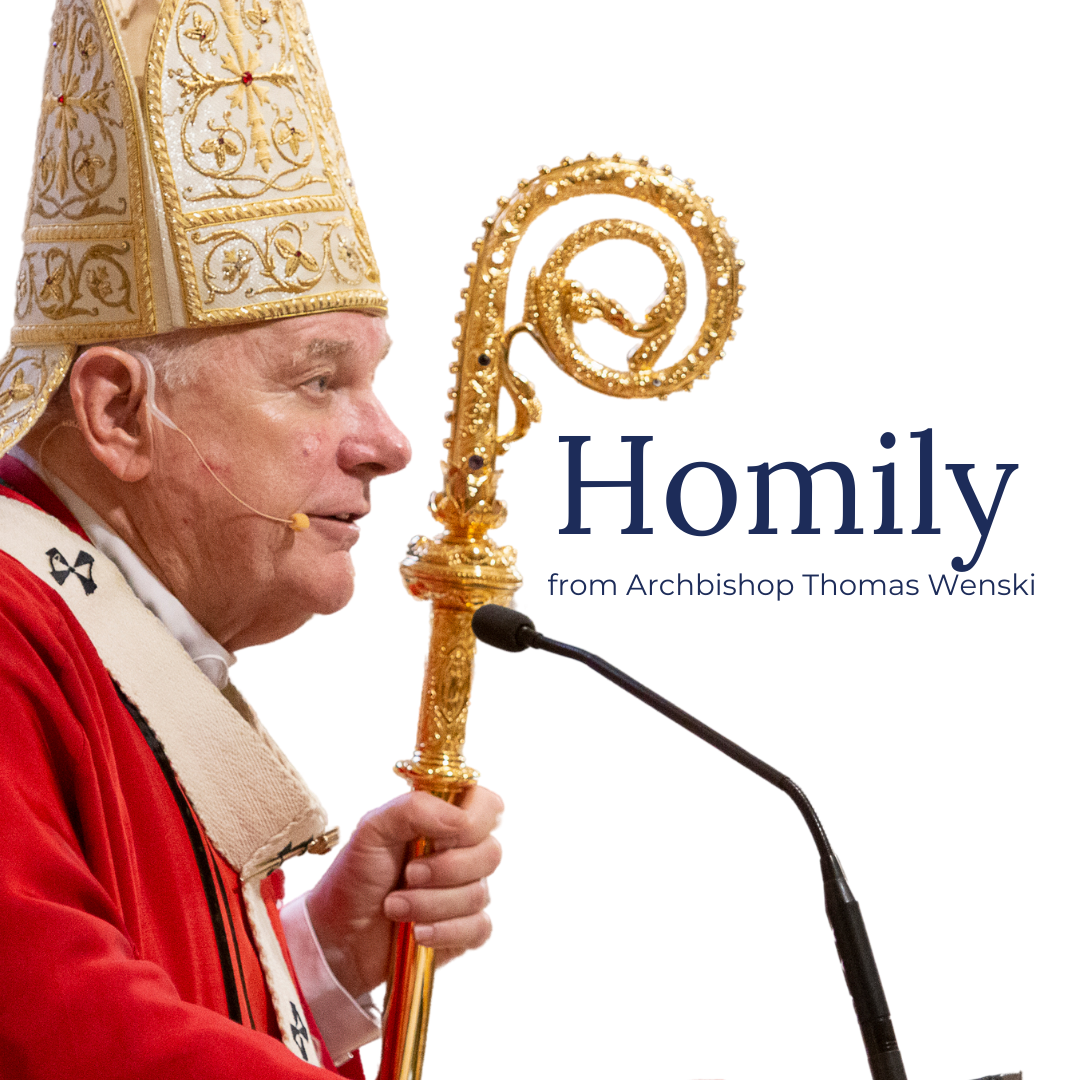
By Archbishop Thomas Wenski - The Archdiocese of Miami
Homily by Archbishop Thomas Wenski at Vigil Mass with the Ladies of Charity at St. John Vianney Seminary. Saturday, Sept 12, 2026.
Today, I welcome the Ladies of Charity and all those related to the Vincentian charism of service to the poor. St. Vincent de Paul was the Mother Teresa of his day. And like Mother Teresa his example continues to inspire us – especially today when a transactional mindset defines much of human relationships – and too often describes how we understand our relationship with God.
It’s the law of the market: everything has a price, every transaction requires an exchange, and balance sheets must match.
“You scratch my back…I’ll scratch yours.
And so, perhaps not aloud, but in our hearts, we often tell ourselves: Yes, I will love him or her, or them but only if they meet my conditions. Yes, I will forgive you, but only if you earn it or make it up to me. Yes, I will serve the poor, but only if they show proper gratitude and live up to my expectations.
But this is not really love – this a transactional contract with a strict ledger of accounts. As I said, “You scratch my back…I’ll scratch yours.”
But Christian charity (agape) shatters this ledger, because charity (agape) is entirely gratuitous, not transactional. It requires no repayment, expects no reward, and does not depend on the worthiness of the recipient.
True charity is modeled on the cross. Christ did not wait for us to apologize or clean up our acts before dying for us; He poured Himself out while we were still sinners. As Saint Paul reminds us, charity "does not seek its own interests" (1 Cor 13:5). Charity (agape) is not a feeling. It is not an emotion, but it is a fierce, deliberate choice to love and forgive as God loves and forgives.
In the first reading, Sirach warns against hugging wrath and anger tight. But he asks us: "Could anyone nourish anger against another and expect healing from the Lord?"
In other words, let go of the ledger. In the gospel, Jesus goes further. Peter asks if he can stop forgiving after seven times. Jesus replies with "seventy-seven times"—charity has no bookkeeping.
So, charity cannot be Conditional: Dependent on how the other person behaves or responds. Rather it must be unconditional, ground in the unchanging love of God, regardless of response.
So, charity does not keep score, remembering past offenses and tracking who owes whom. Rather charity forgives freely.
Charity is not self-serving: in other words, given to feel good, or to gain the esteem of others. It is self-sacrificing, given completely for the ultimate good of the other.
Charity means that the giver does not look on the receive from a position of superiority but with humility the giver sees Christ in the receiver and recognizes their shared poverty.
Saint Vincent de Paul embodied this understanding of charity. He once profoundly reflected that "we must ask the poor to forgive us for the bread that we give them"
He recognized that deep humility is required in true Christian charity because giving material assistance can easily breed paternalism or pride, inadvertently wounding the dignity of the person receiving help. By asking for forgiveness, the giver acknowledges their own unearned abundance and honors the suffering Christ present in the poor.
Saint Paul’s letter to the Romans, today’s second reading, reminds us: "None of us lives for oneself, and no one dies for oneself".
Our lives are interconnected. In the Mystical Body of Christ, your pain is my pain, and my sin impacts your life. When we fail to practice charity, the whole community suffers. Unforgiveness isolates us, but charity restores unity. Paul reminds us that whether we live or die, we belong to the Lord. Because we belong to Him, we must operate by His rules—the rules of total self-giving, humility, and grace.
This shift from transaction to charity, to agape, is exactly what Saint Vincent de Paul meant by his challenging words: "We must ask the poor to forgive us for the bread that we give them."
Saint Vincent understood that a transaction creates an unequal power dynamic. When we give bread to someone who is starving, it is very easy to feel superior, powerful, and righteous. The act of giving can unintentionally humiliate the person receiving it, reminding them of their dependency.
By asking for forgiveness, we destroy the transaction. We confess that the bread we are holding ultimately belongs to God, not to us. We acknowledge that it is only by a stroke of unmerited grace that we are the ones distributing the bread rather than begging for it.
Real charity recognizes a profound spiritual truth: the poor do far more for us than we could ever do for them. We give them perishable bread; they give us an encounter with the living flesh of Jesus Christ.
When we let go of the transactional mindset, we stop counting the cost of our forgiveness and our service. We stop demanding that people "earn" our kindness. Instead, we become conduits of God’s boundless, reckless, and beautiful charity—a love that gives simply because it is the nature of love to give.