By Jose Antonio Varela Vidal -
Photographer: Fundaci�n Ram�n Pan�
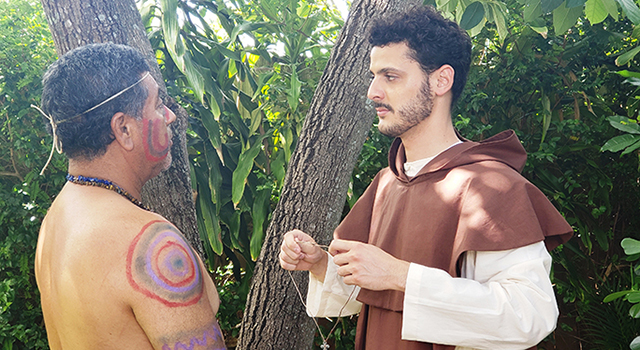
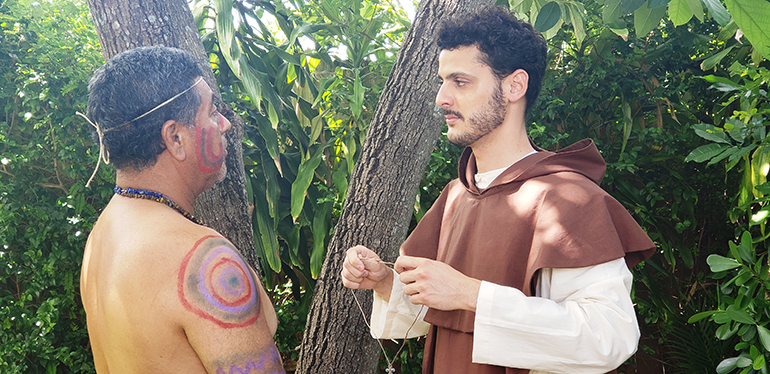
Image from the documentary on Ramón Pané, produced by the Ramón Pané Foundation and available on YouTube.
The story goes that a young monk, a lay brother who belonged to the Hieronymites' monastery in Barcelona, was very impressed by the "evidence" that Christopher Columbus brought to the kings of Spain: six members of the original inhabitants of the far-off lands where the expeditionary navigator made his first journey.
They were Taino Indians, present at that time on the Dominican island of La Isabela, the name Columbus gave to the land he reached at the end of his first journey, and where he erected a cross, a place that is preserved to this day.
It is worth mentioning that these people, together with some samples of the flora and fauna of the future America, were evidence that the explorers had really arrived at a territory overseas. Therefore, this demonstration, together with stories and journals, would serve to boost the pride of the Catholic monarchs and obtain their support for new colonial travels, although this time they would have to bring a stronger reinforcement: the missionaries of the first evangelization.
The young man who observed this scene, and who would be touched in his innermost fibers upon learning that entire communities of people had been found on the journey, was none other than the Spaniard Ramón Pané, who joined Christopher Columbus on his risky second voyage in 1493. Today Pané is recognized as the "first catechist.”
MISSIONARY AD GENTES
His figure was highlighted recently by the premiere of a documentary produced by the Ramon Pané Foundation. In 58 minutes, the video wants to bring us closer to this very important figure in the history of the first evangelization of America, as well as to the current efforts that the Church is making in areas of mission, amid conditions that are not always easy and when enthusiasm is not at its peak.
The video, available on YouTube under the title "Ramón Pané, the First Evangelizer of America," tells the story of Pané's work while showing natural scenes of the first territories that were reached, along with archaeological remains of that feat and historical monuments, such as the current monastery of the Hieronymites in Barcelona — all places to visit on your next trip to Spain or the Dominican Republic. In the latter, you cannot miss a visit to La Vega, where the first Eucharist in America was celebrated in 1494.
The production, which included the participation of the audiovisual production company LUMO and The Jesus Film Project, gathers the contributions of renowned bishops and historians of America and Spain, who highlight Pané's courage, missionary zeal and the prophetic role he played, even when he had to accuse Christopher Columbus of evil practices among the natives.
The video shows that, although Pané was commissioned by Columbus to describe the nature and customs of the site, as the chronicler of the first book written in America, "Report on the Antiquities of the Indians," the admiral wanted to rise above God himself and forbade him to evangelize because this affected his plans for conquest and accumulation of power as viceroy.
However, the work of the man who was also known as "the first lay evangelizer" of the American continent did not stop, and now he is beginning to be recognized for his disposition and service, to which the recently released documentary contributes.
The missionary work of Pané included an approach to the word of God through the prayer of Lectio Divina, for which he is recognized as its father in the newly reached lands, governed by Chief Guaticaba.
Having settled into the environment, and in a clear example of inculturation of the Gospel, he approached the native leader and accompanied him, in his own language, for about two and a half years in a process of integration. After this period, the chief asked for baptism for himself, his family and some members of the Taino people. This would later bring them martyrdom and make them the "first martyrs of America," as declared by the St. John Paul II.
WORK RECOVERED
With plans underway to begin his process of beatification, as reported by Brother Ricardo Grzona, president of the Pané Foundation, the documentary allows us to approach this figure who, because of his youth and his availability as a religious, is a modern example of motivation and missionary zeal.
It is also a remedy for "the lukewarmth, mediocrity and sloth" of many Christians who do not commit themselves in modern society, as stated by Professor Guzmán Carriquiry during the presentation of the video to the press. Carriquiry was secretary of the Pontifical Commission for Latin America for several years.
Also attending the presentation were Cardinal Oscar Rodríguez Maradiaga, archbishop of Tegucigalpa (Honduras); Bishop Julio César Corniel, of Puerto Plata (Dominican Republic); and Father Jaume Aymar, superior of the Monastery of San Jerónimo de Murtra, in Barcelona.
The video can be found on the Pané Foundation’s social networks. The foundation also has been made it available, free of charge, to television stations and other institutions that request it.