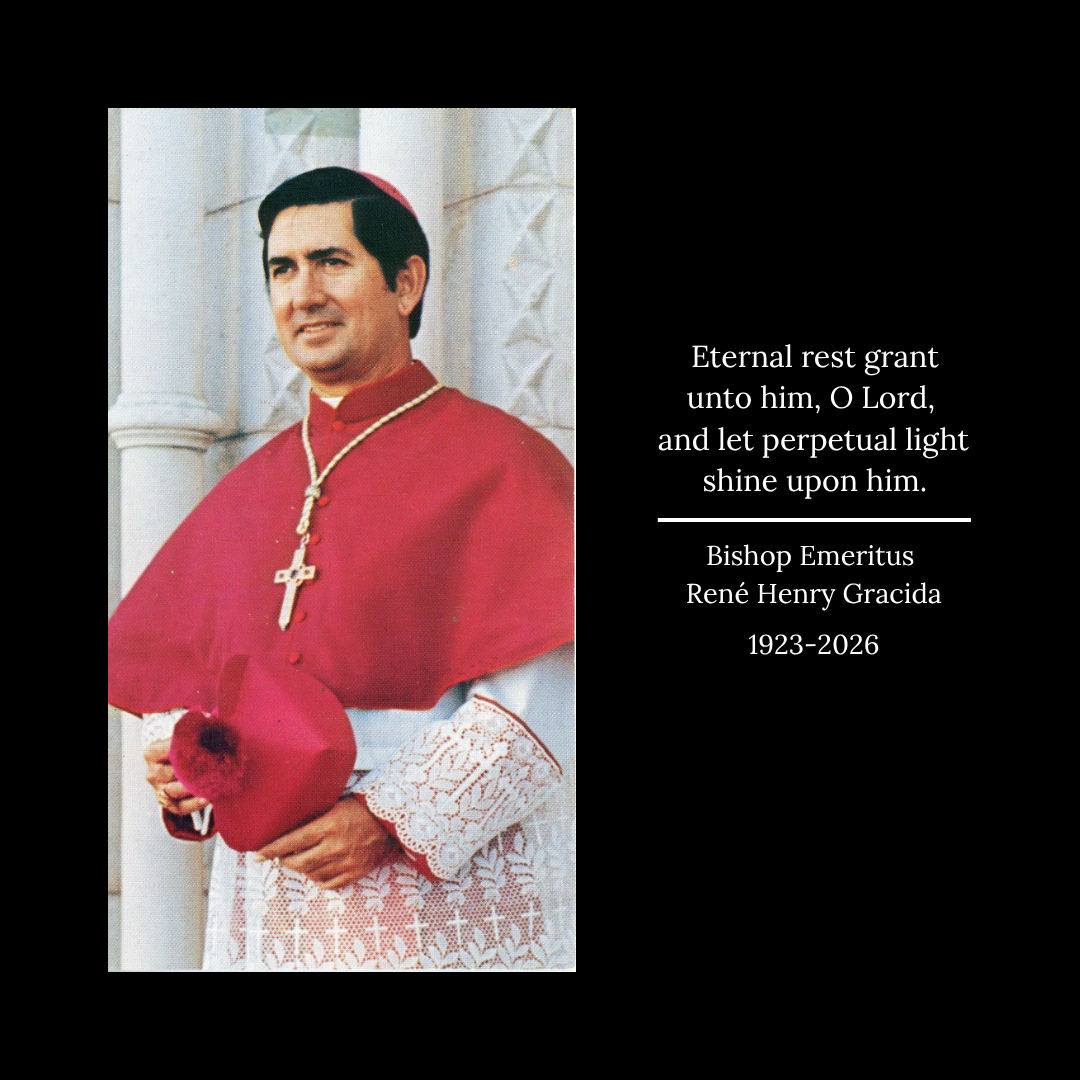
By Andoni Biurrarena - Archdiocese of Miami
MIAMI | Bishop Emeritus René Henry Gracida, who served as auxiliary bishop of the Archdiocese of Miami from 1972 to 1975, passed away peacefully in the early morning hours of May 1, 2026, in Corpus Christi, Texas, at the age of 102. His death was announced by the Diocese of Corpus Christi, Texas.
Bishop Gracida, a World War II veteran, was the oldest Catholic bishop in the United States.
Bishop Gracida, who served as the fifth bishop of the Diocese of Corpus Christi from 1983 to 1997, was widely recognized for his pastoral leadership, commitment to clergy formation, and expansion of diocesan ministries.
In the Archdiocese of Miami, Bishop Gracida played a key role during a formative period in the history of the archdiocese, supporting the rapid growth of the local Church and ministering to a diverse and expanding Catholic population.
A ministry rooted in South Florida
In 1961, Bishop Gracida was incardinated (transferred) from the Benedictine Order to the Archdiocese of Miami. From 1961 until his appointment as auxiliary bishop in 1971, Bishop Gracida served in numerous pastoral and leadership roles across the Archdiocese of Miami, including assignments at Holy Family, St. Coleman, St. Matthew, St. Ambrose, Visitation, Nativity, St. Patrick and St. Kieran parishes. He also served as chancellor, vicar general and acting rector of St. Mary Cathedral.
Appointed auxiliary bishop by Pope Paul VI on Dec. 6, 1971, Bishop Gracida was consecrated Jan. 25, 1972. During his time in South Florida, he worked closely with Archbishop Coleman Carroll and served parishes across the archdiocese.
Known for his practical and hands-on approach to ministry, Bishop Gracida also obtained a pilot’s license, flying small planes to visit parishes throughout the region — a reflection of his commitment to reaching the faithful wherever they were.
A bishop shaped by service
Born in New Orleans, Louisiana, on June 9, 1923, Bishop Gracida developed an early interest in missionary life as a teenager, inspired by the Jesuit martyrs depicted in The Last of the Mohicans by James Fenimore Cooper.
Bishop Gracida was the son of Enrique J. Gracida Carrizosa, a Mexican architect and engineer from Oaxaca, and Mathilde Derbes, a fifth-generation French-American Cajun. His great-uncle served as a vicar general in Mexico.
His path to the priesthood was preceded by military service. Bishop Gracida served with distinction in the U.S. Army Air Corps during World War II from 1943 to 1945. He flew 32 missions as a tail gunner and later as a flight engineer with the 303rd Air Expeditionary Group over Nazi-occupied Europe. He finished his service as a second lieutenant and was decorated with an Air Medal.
During his military service, Bishop Gracida later reflected in a 1983 series of Lenten reflection articles published in Voice newspaper on his struggle to reconcile the concept of a just war with fighting against Nazi aggression and defending his country and the free world.
“But on the other hand, I was not happy about my direct involvement in killing,” Bishop Gracida wrote.
“What elation I may have felt over the Allied victory was soon dissipated by the growing realization that military success purchased at the cost of countless lives had been crowned with political failure, when the leadership of the western world created the Soviet Empire, which now poses an even greater threat to the free world that Hitler ever did”, he wrote.
After the war, Bishop Gracida studied architecture at the University of Houston, earning a bachelor’s degree and working professionally in the field before entering religious life.
In 1951, Bishop Gracida joined the Order of Saint Benedict at Saint Vincent Archabbey in Latrobe, Pennsylvania, taking the name of Jesuit martyr Rene Goupil, who was tortured and martyred by the Iroquois in 1642.
Bishop Gracida professed vows in 1953 and 1956 and was ordained a priest on May 23, 1959. In 1961, Bishop Gracida was incardinated into the Archdiocese of Miami.
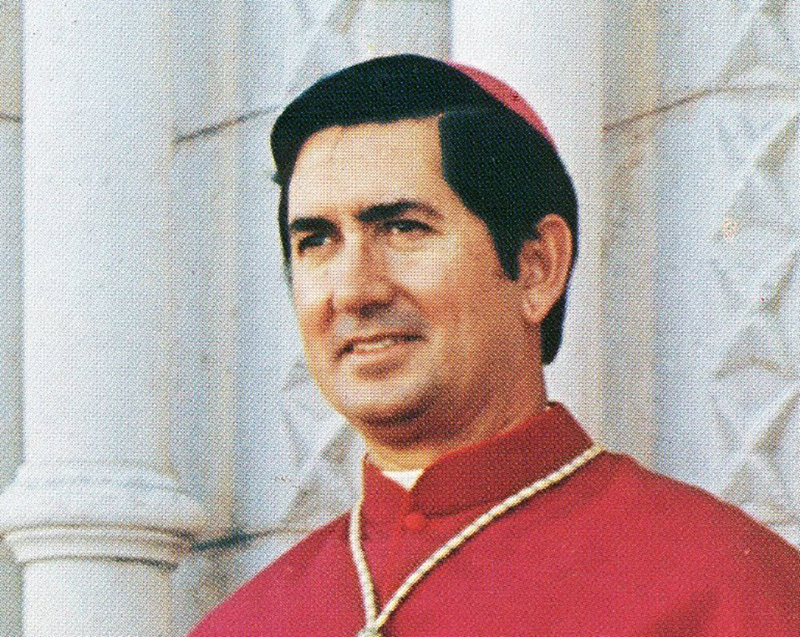
Retired Bishop René H. Gracida of Corpus Christi, Texas, is seen in an undated decades-old photo. Born in 1923 in New Orleans, had led the Corpus Christi Diocese from 1983 until his 1997 retirement. Bishop Gracida died May 1 at age 102. (OSV News photo/courtesy Corpus Christi Diocese)
Leading dioceses across Florida and Texas
In 1975, Pope Paul VI named Bishop Gracida the first bishop of the newly established Diocese of Pensacola-Tallahassee. Three years later, Bishop Gracida received an honorary Doctor of Laws degree from St. Leo College.
The Mass of installation took place at the Pensacola Bay Civic Center on Nov. 6, 1975. Evangelization was his priority during his time as bishop. He instituted and fostered programs and efforts that reached out not only to Catholics, but also to estranged Catholics and the unchurched, particularly through the mass media and through lay groups such as the Legion of Mary.
He launched the deacon program and promoted the growth of priestly vocations. He also oversaw the founding of several parishes during his tenure.
He became well known for piloting his own aircraft to visit parishes and celebrate confirmations across the Panhandle. Bishop Gracida also became a supporter of the nascent cause for the canonization of the Martyrs of La Florida.
For his entire episcopal career, Bishop Gracida advocated for life from “womb to tomb,” defending the unborn, incarcerated and terminally ill. He was also committed to nonviolence and the dignity of minorities.
“Throughout my life I have struggled to be a nonviolent person — nonviolent in thought, word and deed. I have not always succeeded,” Bishop Gracida wrote in the 1983 Lenten reflections in Voice.
“I have been moving toward a total commitment to nonviolence. At the heart of the message of Jesus Christ about nonviolence lies the command that we should forgive one another. There is no other course open to the Christian than practicing a kind of forgiveness which makes violence impossible in thought, word and deed,” he said.
On May 19, 1983, Pope John Paul II appointed Bishop Gracida bishop of Corpus Christi, where he served until his retirement in 1997.
The promotion as bishop of Corpus Christi gave Bishop Gracida mixed emotions. “I have a special love and affinity for the Diocese of Pensacola-Tallahassee and its people. The Catholic people and others of Northwest Florida have given me so much. Leaving will be painful,” he said in a statement announcing his appointment.
During his tenure, Bishop Gracida expanded diocesan communications through radio and television, promoted priestly and lay formation, and established new parishes and missions, particularly in underserved areas such as the colonias of Laredo.
He also supported the development of retreat centers, a youth camp, and the Pastoral Institute for continuing adult education and formation. The Diocese of Corpus Christi later underwent restructuring with the creation of the Diocese of Laredo in 2000.
A legacy of conviction and pastoral care
Throughout his ministry, Bishop Gracida was known for his close relationship with priests and seminarians, as well as his hands-on pastoral approach.
Bishop Gracida was a defender of Hispanics and minorities and was often critical of aspects of American culture.
“I knew some of the disadvantages of being a Hispanic youth growing up in Texas, where discrimination against Hispanics frequently took the form of violent repression,” he wrote in the 1983 Lenten reflections.
Bishop Gracida was also very critical of the death penalty. In 1980 in Voice he said, “While it (the death penalty) might have been an appropriate means of justice in past times, it seems to me to be totally unacceptable in our time.”
For health reasons, Bishop Gracida was granted retirement by Pope John Paul II on April 1, 1997. Following his retirement as a diocesan ordinary, he took up ranching in Texas while remaining active in the pro-life cause and celebrating the Church’s liturgical life.
According to South Texas Catholic, funeral arrangements for Bishop Emeritus René Henry Gracida are as follows:
Monday, May 11 — Most Precious Blood Pro-Cathedral, Corpus Christi, Texas
- Visitation: 5 p.m. to 9 p.m.
- Holy Rosary: 7 p.m.
Tuesday, May 12 — Most Precious Blood Pro-Cathedral
- Visitation: 2:30 p.m. to 9 p.m.
- Solemn Vespers: 7:30 p.m.
Wednesday, May 13 — Most Precious Blood Pro-Cathedral
- Visitation: 8:30 a.m. to 10:30 a.m.
- Funeral Mass: 11 a.m.
- Burial: 2:30 p.m. — Emmanuel Chapel, Corpus Christi Cathedral


Comments from readers