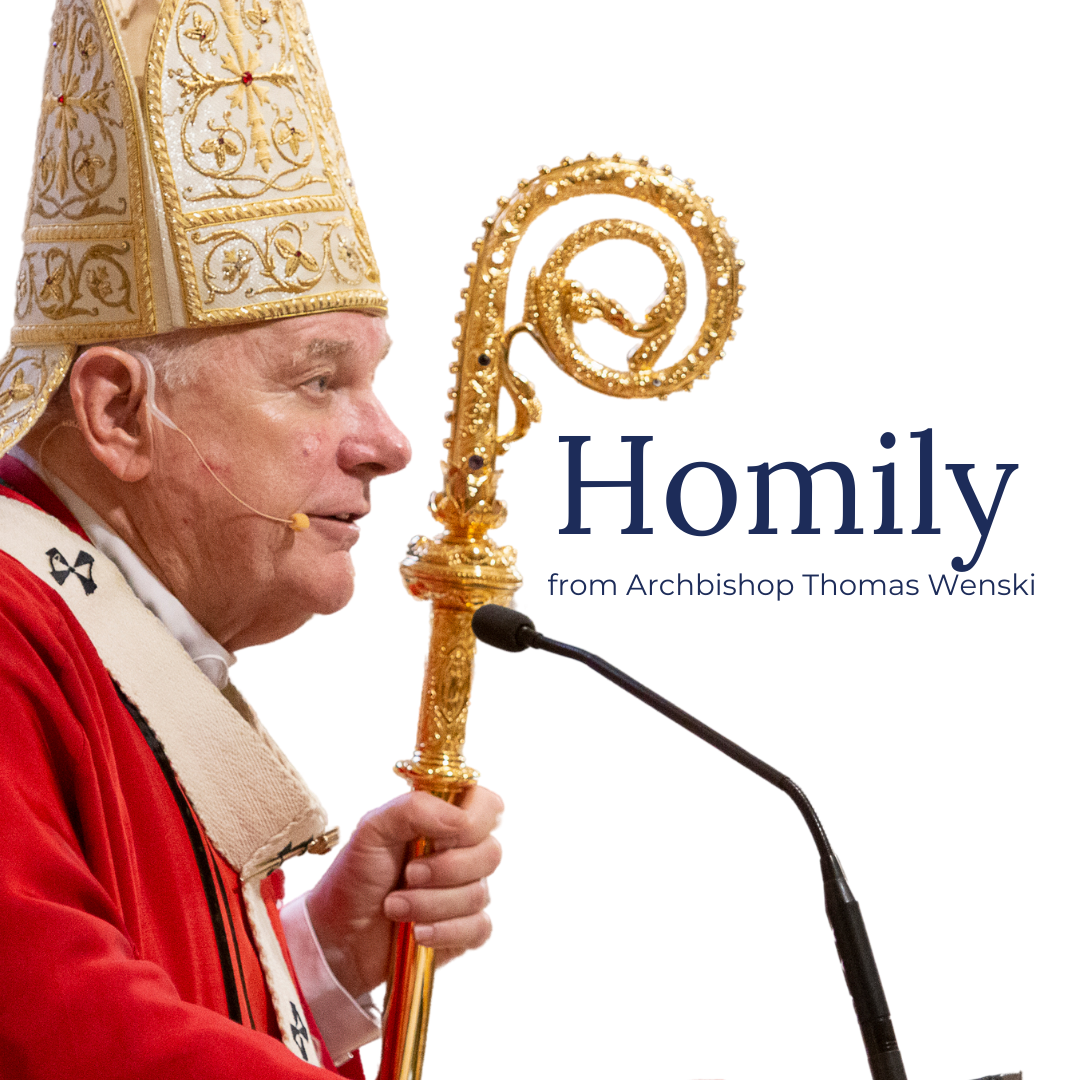
By Archbishop Thomas Wenski - The Archdiocese of Miami
Homily by Archbishop Thomas Wenski at 2026 Memorial Day Mass remembering those fallen in battle. Our Lady Queen of Heaven Cemetery, May 25, 2026.
Memorial Day was originally known as Decoration Day – and I remember that my mother always called it that. It was established to honor those fallen in battle during our nation’s Civil War. However, today Memorial Day honors those who have died not only in the far distant past; today, we honor not only our grandfathers and fathers who died in wars fought yesterday; today we also honor our sons and daughters, our brothers and sisters who have died in more recent wars including those who have fallen in recent weeks in the Middle East.
We owe these fallen heroes – and the families who mourn them – our gratitude for their sacrifice and our prayers for their eternal repose. Their sacrifice won the peace that allowed our great nation to grow and prosper. We pray for them; and here at this beautiful cemetery where many of you have laid your loved ones to rest, we pray for all the dead and for all the faithful departed. May they rest in peace.
In a few weeks we will observe the 250th anniversary of our Nation’s Independence. On the eve of our nation’s 250 birthday, we recognize that our American experiment in democracy is still a work in progress. As American Catholics we recognize how far short our nation falls in many areas in forming a more perfect union. But while we recognize flaws and work to correct them, we also acknowledge the blessings of liberty we enjoy in this great country. In spite of extreme polarization, bitter partisanship, and entrenched divisions, we Catholics do not despair of America.
We love America – but let’s love her as Jesus loves, not just with a sentimental, saccharine love but with love in truth – a love that is stronger than sin. A love that names the sin not to damn the sinner but to call the sinner to conversion of heart and mind. For the love that opened its arms on a cross of wood and opened its side to a soldier’s lance piercing his heart is love that believes that the sinner can be redeemed.
In his book, Memory and Identity, St. John Paul II wrote of the difference between a constructive patriotism and a destructive nationalism: Patriotism is love for everything to do with our native land: its history, its traditions, its language, its natural features. It is a love which extends also to the works of our compatriots and the fruits of their genius. Whereas nationalism involves recognizing and pursuing the good of one’s own nation alone, without regard for the rights of others, patriotism is a love for one’s native land that accords rights to all other nations equal to those claimed for one’s own. Patriotism, in other words, leads to a properly ordered social love.
In Dilexi Te, Pope Leo XIV invited us to contemplate Christ’s love, which moves us out on our mission to attend to our sisters and brothers suffering in the world today, particularly in our care for poor and vulnerable people.
We are called to bring our faith into the actions we take and the lives we lead in our communities. We celebrate the ways the Church has contributed to a more just world, and we invite all in our society to see the face of Christ reflected in each sister and brother.
On June 11, during their Spring meeting in Orlando, Bishops of the United States will gather at the Basilica Shrine of Mary, Queen of the Universe, to consecrate the United States to the Most Sacred Heart of Jesus. The consecration will celebrate America’s semi quincentennial, that is, the two hundred and fiftieth anniversary of the signing of the Declaration of Independence.
In linking the 250th anniversary of the Declaration of Independence with the devotion to the Sacred Heart, the Bishops invite us to reflect with gratitude on the blessings God has bestow on our nation but, at the same time, devotion to the Sacred Heart demands that we consider how we might foster truth, justice, and charity in American life. Thus, our celebrations around the Fourth of July will foster a constructive and forward-looking patriotism as opposed to a divisive, exclusionary, blind nationalism.
Devotion to the Sacred Heart, like the more recent devotion to the Divine Mercy, echoes the invitation that Jesus makes in the gospels to those who are “weary and heavily burdened” because of sin and hurt to turn to him for mercy, healing and restoration. Indeed, devotion to the Sacred Heart of Jesus and devotion to the Divine Mercy have one and the same message: namely, that humanity is good and is greatly loved by God, and God generously offers mercy to all.