
By Jim Davis - Florida Catholic
Photographer: COURTESY PHOTO
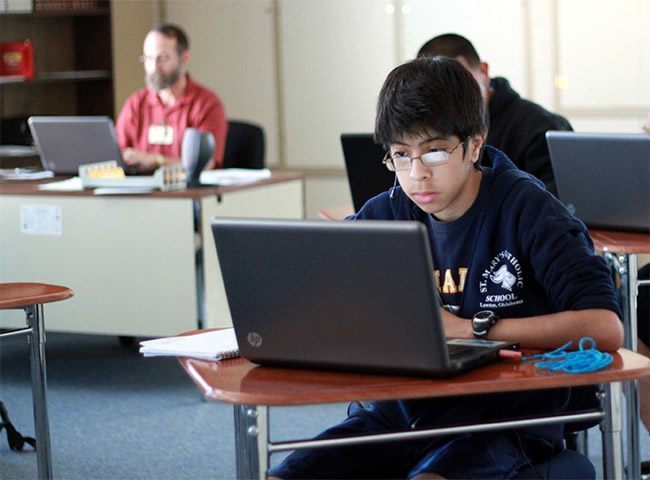
Carlos Dulcamara, 16, works on Virtual High School coursework from his school, St. Mary's Catholic School in Lawton, Okla.
MIAMI GARDENS | Yvette De La Vega teaches several students whom she has never met � because she�s in Florida and they're in Oklahoma.
After her regular classes at Msgr. Edward Pace High School, the English teacher logs on to the Archdiocese of Miami Virtual Catholic School and checks on their lessons. She grades them and answers any questions e-mailed to her.
"I never would have had the opportunity to work with them otherwise," De La Vega said. "We�ve gone from a local classroom to the global classroom."
 The new virtual school, which opened Aug. 19 under archdiocesan auspices, has no classrooms of its own. Instead, it lives online through Web-based lessons and worksheets, empowering students to get a Catholic education from just about anywhere.
Students log in via computer or iPad to www.adomvirtual.com, then read announcements and call up lists of lessons. The lessons often combine text and pictures, and may even take the form of playful brain teaser-type games.
Most of the bells and whistles are part of the BrainHoney platform. The versatile software allows videos and "virtual labs," where students can see dissections of frogs or worms. Some classes use Discovery Education, part of the cable TV Discovery Channel, clicking through the Virtual Catholic School site.
Miami is the first archdiocese to provide virtual classes for students, according to Archbishop Thomas Wenski.
"Our mission is to ensure that Catholic education is not only on the cutting edge, but setting the pace and setting new educational models to inspire students to maximize their God-given gifts," he said in his welcome letter this year. "It is important that all Catholic schools keep pace with the demands of the 21st century."
Cost of "attending" Virtual Catholic School is $2,575 per year for fulltime students. The school offers family discounts for the second, third and fourth child in the school. Students can also take individual courses at $445 each.
Organizers cite several advantages over traditional classroom-based education. Students can keep up with coursework while they're ill or away on athletic trips. They can work faster or slower, depending on their own aptitude.
The secular courses � including science, math, English, social studies and fine arts � measure up to the Common Core Standards set by the Florida Department of Education. The school also uses theological curriculum standards from the United States Conference of Catholic Bishops.
"We want them to feel a passion for Catholic identity, but also a passion for learning," said Rebeca Bautista, principal of Virtual Catholic School.
 Even in secular courses, teachers are free to add a spiritual, religious or theological facet. In math, for instance, they can illustrate with the biblical story of Jesus multiplying bread and fish. If it's history or geography, they may bring up the recent World Youth Day, which Pope Francis held in Brazil.
"It's a lot more than reading, writing and math," said Yvette De La Vega, herself a graduate of Pace. "It's about being a well-rounded person, having a relationship with God and helping others. It's not enough to have faith. You have to put it in action."
The spiritual side is one of the draws for Alexis Taylor, one of the six online high school students in Oklahoma. "One of the good things is having an education centered in God and Christ," said the 15-year-old.
Online research brought principal Paolo Dulcamara to Donald Edwards, assistant superintendent of schools in the Miami Archdiocese. Edwards pointed him toward CSK12, an early version of the online school based at St. Andrew School in Coral Springs.
Archbishop Paul Coakley of the Archdiocese of Oklahoma City approved the partnership in winter 2012. Archbishop Wenski then reorganized CSK12 on the archdiocesan level.
"A lot of education is information," Dulcamara says. "And a lot of times, software can do it more efficiently."
Having them attend a brick-and-mortar building provides "structure and environment," Quinnett says. "I also encourage crosstalk in the classroom, as long as it doesn�t disrupt."
Working at one's own pace is a favorite feature for Brianna Gancarz, 16. "If I get confused by a certain lesson, I can stay on it longer, not like regular high school."
Classmate Damian Alvarado-Cruz, 15, likes the access to teachers. "They're there to help when I need them. They're constantly communicating with me and giving encouragement."
One tradeoff is a lack of social contacts and group activities, said Alexis Taylor. As an Army child, she has lived in a lot of places � including Dallas, El Paso and Wichita Falls � and enjoys sports such as football, volleyball and crossfit.
"I wish they had more than an archery team," she said of St. Mary's School.
Working at one's own pace also makes students responsible for their own progress. Conner Wright, 17, said he likes that.
"You keep track of your work and get it in on time," said Wright, who will be one of the first graduates since St. Mary's School reopened. "It prepares you for what college is going to be like."
"We're pioneers," said Kim Pryzbylski, superintendent of schools in the archdiocese. "Virtual schooling is very, very new. It's exciting."
Bautista, the principal of Virtual Catholic School, is enthusiastic about its future. Like De La Vega, she sees spiritual as well as educational reasons.
"We're not limited by geographical locations or budget or student body size," Bautista says. "There are no limits with whom we can meet and teach. In turn, we can learn more about citizens across the country and share our faith.
"This is a unique opportunity."
After her regular classes at Msgr. Edward Pace High School, the English teacher logs on to the Archdiocese of Miami Virtual Catholic School and checks on their lessons. She grades them and answers any questions e-mailed to her.
"I never would have had the opportunity to work with them otherwise," De La Vega said. "We�ve gone from a local classroom to the global classroom."
Students log in via computer or iPad to www.adomvirtual.com, then read announcements and call up lists of lessons. The lessons often combine text and pictures, and may even take the form of playful brain teaser-type games.
Most of the bells and whistles are part of the BrainHoney platform. The versatile software allows videos and "virtual labs," where students can see dissections of frogs or worms. Some classes use Discovery Education, part of the cable TV Discovery Channel, clicking through the Virtual Catholic School site.
Miami is the first archdiocese to provide virtual classes for students, according to Archbishop Thomas Wenski.
"Our mission is to ensure that Catholic education is not only on the cutting edge, but setting the pace and setting new educational models to inspire students to maximize their God-given gifts," he said in his welcome letter this year. "It is important that all Catholic schools keep pace with the demands of the 21st century."
Cost of "attending" Virtual Catholic School is $2,575 per year for fulltime students. The school offers family discounts for the second, third and fourth child in the school. Students can also take individual courses at $445 each.
Organizers cite several advantages over traditional classroom-based education. Students can keep up with coursework while they're ill or away on athletic trips. They can work faster or slower, depending on their own aptitude.
The secular courses � including science, math, English, social studies and fine arts � measure up to the Common Core Standards set by the Florida Department of Education. The school also uses theological curriculum standards from the United States Conference of Catholic Bishops.
"We want them to feel a passion for Catholic identity, but also a passion for learning," said Rebeca Bautista, principal of Virtual Catholic School.
Photographer: COURTESY PHOTO
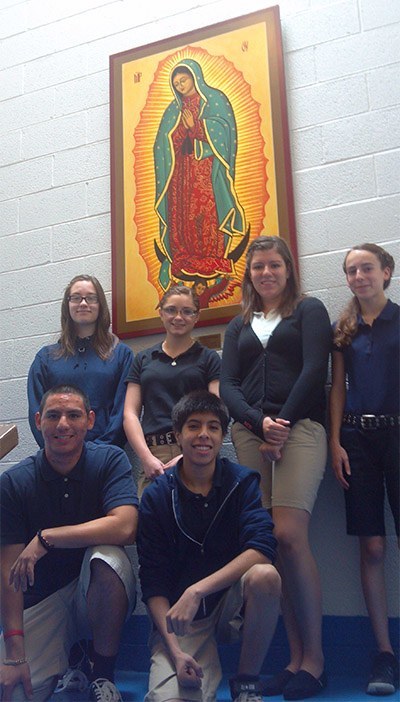
Students at St. Mary's Catholic School in Lawton, Okla., pause in front of a picture of Our Lady of Guadalupe. Back row: Conner Wright, 12th grade; Brianna Garncarz, 12th grade; Alexis Taylor, 10th grade; Hella Quinnett, 10th grade. Front row: Damian Alvarado-Cruz and Carlos Dulcamara, both in 10th grade.
"It's a lot more than reading, writing and math," said Yvette De La Vega, herself a graduate of Pace. "It's about being a well-rounded person, having a relationship with God and helping others. It's not enough to have faith. You have to put it in action."
The spiritual side is one of the draws for Alexis Taylor, one of the six online high school students in Oklahoma. "One of the good things is having an education centered in God and Christ," said the 15-year-old.
Virtual Catholic School was the only alternative for Catholics around Lawton, 165 miles southwest of Tulsa.
St. Mary's, the only Catholic school in southwest Oklahoma, closed in 1966, then reopened its middle school eight years later. But high school would be too costly for a mere handful of students.
Online research brought principal Paolo Dulcamara to Donald Edwards, assistant superintendent of schools in the Miami Archdiocese. Edwards pointed him toward CSK12, an early version of the online school based at St. Andrew School in Coral Springs.
Archbishop Paul Coakley of the Archdiocese of Oklahoma City approved the partnership in winter 2012. Archbishop Wenski then reorganized CSK12 on the archdiocesan level.
"A lot of education is information," Dulcamara says. "And a lot of times, software can do it more efficiently."
St. Mary's actually blends the virtual and physical. The high schoolers attend the campus weekdays, then go online for their studies. They also take a religion class with Robert Quinnett, an onsite religion teacher. And they can choose "enrichment" activities, like archery and radio broadcasting.
Having them attend a brick-and-mortar building provides "structure and environment," Quinnett says. "I also encourage crosstalk in the classroom, as long as it doesn�t disrupt."
Working at one's own pace is a favorite feature for Brianna Gancarz, 16. "If I get confused by a certain lesson, I can stay on it longer, not like regular high school."
Classmate Damian Alvarado-Cruz, 15, likes the access to teachers. "They're there to help when I need them. They're constantly communicating with me and giving encouragement."
One tradeoff is a lack of social contacts and group activities, said Alexis Taylor. As an Army child, she has lived in a lot of places � including Dallas, El Paso and Wichita Falls � and enjoys sports such as football, volleyball and crossfit.
"I wish they had more than an archery team," she said of St. Mary's School.
Working at one's own pace also makes students responsible for their own progress. Conner Wright, 17, said he likes that.
"You keep track of your work and get it in on time," said Wright, who will be one of the first graduates since St. Mary's School reopened. "It prepares you for what college is going to be like."
"We're pioneers," said Kim Pryzbylski, superintendent of schools in the archdiocese. "Virtual schooling is very, very new. It's exciting."
Bautista, the principal of Virtual Catholic School, is enthusiastic about its future. Like De La Vega, she sees spiritual as well as educational reasons.
"We're not limited by geographical locations or budget or student body size," Bautista says. "There are no limits with whom we can meet and teach. In turn, we can learn more about citizens across the country and share our faith.
"This is a unique opportunity."


Comments from readers