
By Ana Rodriguez Soto - The Archdiocese of Miami
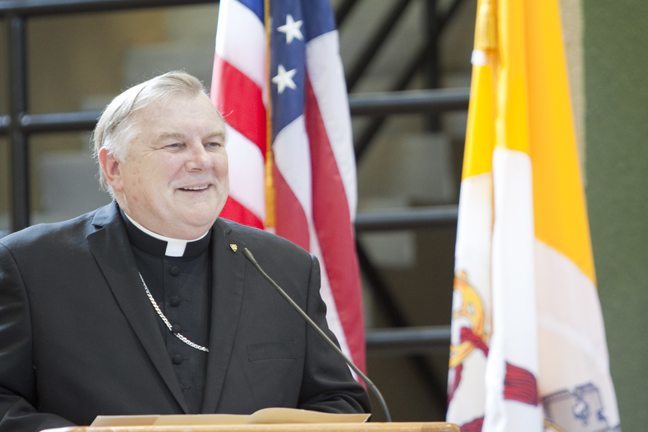
Photographer: ANA RODRIGUEZ-SOTO | FC
Archbishop Thomas Wenski speaks during the Jan. 12 press conference where he announced that the Archdiocese of Miami will be organizing a pilgrimage to Cuba to coincide with the visit of Pope Benedict XVI March 26-28.
MIAMI � When Pope Benedict XVI visits Cuba March 26-28, something will be different.
The pilgrimage will be by air since there was no time to arrange for a cruise ship, as had been done when Pope John Paul II became the first pope to visit the island in January 1998. That trip was announced a year in advance, while the exact dates of this one were only announced Jan. 1, 2012.
The 1998 pilgrimage was canceled due to vociferous opposition by sectors of the Cuban exile community. Instead, Miami�s then Archbishop John C. Favalora flew to Havana to take part in the final papal Mass with a very reduced group of South Florida priests, religious and laity.
This time, Archbishop Wenski expects to take as many as two planeloads, of about 250 people each, to the island, where they will have the option of taking part in both of the papal Masses as well as a Mass celebrated by Archbishop Wenski in Havana�s cathedral.
�Things have changed considerably� in the intervening years, said the archbishop, who was a Miami auxiliary bishop back in 1998. �Many of those who opposed the pilgrimage (then) changed their mind a week later,� after they saw the Cuban people�s reaction to the pope.
�In this community, you always get some heat no matter what side you take,� Archbishop Wensi said at the Jan. 12 press conference. �But the overwhelming majority of reactions that I have received so far have been very, very positive.�
�We have been saying for three years, �charity unites us�,� Bishop Aranguren told The Florida Catholic back in November. �That is a unity that is more than nostalgic. It is a project. It is something that we feel as a Church, as a people and as a family.�
The bishop was referring to �To Jesus through Mary: Charity unites us (or �one in charity�),� the theme of the three years of preparation undertaken by the Cuban Church to lead up to the 400th anniversary of the discovery of the original image of Our Lady of Charity in the waters of the Bay of Nipe.
That 400th anniversary is the reason Pope Benedict XVI is visiting the island this March. It was his namesake predecessor, Pope Benedict XV, who in 1916 declared Our Lady of Charity the patroness of Cuba.
The unity longed for by the Cuban Church is already being reflected in the parallel celebrations that took place Jan. 7: A Mass in the morning at the sanctuary of Our Lady of Charity in El Cobre, Cuba, and a Mass in the evening at the Shrine of Our Lady of Charity in Miami, to commemorate the start of the Marian Jubilee Year on the island.
Archbishop Wenski has proclaimed the jubilee year here as well and designated the shrine as a site where visitors can receive plenary indulgences through Sept. 8, 2012 � the feast day of Our Lady of Charity.
Archbishop Wenski also traveled to Cuba Dec. 30 to take part, alongside all of Cuba�s bishops, in a Mass marking the end of a year-long pilgrimage of an image of Our Lady of Charity from one end of the island to the other. The joyous and emotional reception that image received at every city, town and hamlet where it stopped surprised even the Cuban bishops.
�The pilgrimage of the virgin has shown us that Cuba is not atheist. But in this jubilee year, the mission of our Cuban Church is to ensure that Cuba is Christian,� Bishop Aranguren said. �We have to facilitate that encounter with Jesus, who is the savior of the world.�
He said Pope Benedict XVI would be �inserting himself as a pilgrim� in Cubans� celebration of their patroness� discovery.
�If Pope John Paul II came as a messenger of truth and hope, this pope comes as a pilgrim of charity,� Bishop Aranguren said. �He will stand in front of the image, place a flower and light a candle� at the sanctuary in El Cobre just as Cubans have done for four centuries.
When he spoke those words, Bishop Aranguren did not know the detailed itinerary for the papal visit. In fact, Pope Benedict will go to El Cobre and visit the sanctuary privately March 27. The day before, when he arrives in Santiago de Cuba from Mexico, he will celebrate a public Mass at Antonio Maceo Plaza, where Pope John Paul II also celebrated Mass in 1998. Pope Benedict will conclude his visit to Cuba March 28 with a Mass at Jose Marti Plaza in Havana, just as Pope John Paul II did 14 years ago.
�It�s another Cuba. It�s another pope,� Bishop Aranguren said. �But regardless, he will be following the instruction Jesus gave to Peter: Confirm your brothers in the faith.�
Bishop Aranguren said Pope Benedict will find in Cuba �a Christian community that is more stable. � The spaces (the Church has gained within the society) are more or less the same but more stable.�
He pointed out that there are now three seminaries on the island rather than two; clergy and religious from other countries are helping out in every diocese; religious education is being provided to children and adults; home mission churches are active throughout the island; the dioceses have established formation centers where lay people are being trained as catechists and lay ministers; there are Church-run libraries with collections of historical and theological books; and the Church provides a witness of service through programs run by Caritas for the poor, the sick and the elderly.
Bishop Aranguren also noted that the percentage of people who identify themselves as Catholic has grown, and as many as 60 percent of people now call a priest to visit a dying relative in the hospital or conduct the funeral rites.
�The reference to the Cuban Church as such today is more explicit than in 1998,� he said, and the pilgrimage of the image of Our Lady of Charity �has re-established the ties of the Cuban people with the Catholic Church.�
In Miami, too, the community seems more receptive to traveling to the island for the papal visit, said Father Juan Rumin Dominguez, rector of the Shrine of Our Lady of Charity.
�Many people have come asking for information,� he said.
Although members of the more recently arrived generations often return to Cuba to spend time with family members, �people who have been here for many years have approached me also to find out what they have to do to go to Cuba on this pilgrimage,� Father Dominguez said. �The Catholic community has a greater conviction of how important it is to take part in this papal visit. It is a way of accompanying a Church that is doing great missionary work.�
�The Church always gains spaces with a papal visit,� Father Dominguez added. �Aside from support and confirmation in the faith, it is recognition for a Church that has fought to stay alive.�
�That desire that remained a desire (14) years ago and now is a possibility � the desire for a pilgrimage,� said Bishop Emilio Aranguren of the Diocese of Holguin, Cuba, during a visit to Miami at the end of November.
Indeed, on Jan. 12, Archbishop Thomas Wenski announced that he would be leading a pilgrimage of South Florida Catholics to Santiago and Havana to take part in the papal Masses.
�We travel in solidarity with the Church in Cuba � and in response to their invitation to share with them this historic event,� Archbishop Wenski said.
The pilgrimage will be by air since there was no time to arrange for a cruise ship, as had been done when Pope John Paul II became the first pope to visit the island in January 1998. That trip was announced a year in advance, while the exact dates of this one were only announced Jan. 1, 2012.
The 1998 pilgrimage was canceled due to vociferous opposition by sectors of the Cuban exile community. Instead, Miami�s then Archbishop John C. Favalora flew to Havana to take part in the final papal Mass with a very reduced group of South Florida priests, religious and laity.
This time, Archbishop Wenski expects to take as many as two planeloads, of about 250 people each, to the island, where they will have the option of taking part in both of the papal Masses as well as a Mass celebrated by Archbishop Wenski in Havana�s cathedral.
�Things have changed considerably� in the intervening years, said the archbishop, who was a Miami auxiliary bishop back in 1998. �Many of those who opposed the pilgrimage (then) changed their mind a week later,� after they saw the Cuban people�s reaction to the pope.
�In this community, you always get some heat no matter what side you take,� Archbishop Wensi said at the Jan. 12 press conference. �But the overwhelming majority of reactions that I have received so far have been very, very positive.�
�We have been saying for three years, �charity unites us�,� Bishop Aranguren told The Florida Catholic back in November. �That is a unity that is more than nostalgic. It is a project. It is something that we feel as a Church, as a people and as a family.�
The bishop was referring to �To Jesus through Mary: Charity unites us (or �one in charity�),� the theme of the three years of preparation undertaken by the Cuban Church to lead up to the 400th anniversary of the discovery of the original image of Our Lady of Charity in the waters of the Bay of Nipe.
That 400th anniversary is the reason Pope Benedict XVI is visiting the island this March. It was his namesake predecessor, Pope Benedict XV, who in 1916 declared Our Lady of Charity the patroness of Cuba.
The unity longed for by the Cuban Church is already being reflected in the parallel celebrations that took place Jan. 7: A Mass in the morning at the sanctuary of Our Lady of Charity in El Cobre, Cuba, and a Mass in the evening at the Shrine of Our Lady of Charity in Miami, to commemorate the start of the Marian Jubilee Year on the island.
Archbishop Wenski has proclaimed the jubilee year here as well and designated the shrine as a site where visitors can receive plenary indulgences through Sept. 8, 2012 � the feast day of Our Lady of Charity.
Archbishop Wenski also traveled to Cuba Dec. 30 to take part, alongside all of Cuba�s bishops, in a Mass marking the end of a year-long pilgrimage of an image of Our Lady of Charity from one end of the island to the other. The joyous and emotional reception that image received at every city, town and hamlet where it stopped surprised even the Cuban bishops.
�The pilgrimage of the virgin has shown us that Cuba is not atheist. But in this jubilee year, the mission of our Cuban Church is to ensure that Cuba is Christian,� Bishop Aranguren said. �We have to facilitate that encounter with Jesus, who is the savior of the world.�
He said Pope Benedict XVI would be �inserting himself as a pilgrim� in Cubans� celebration of their patroness� discovery.
�If Pope John Paul II came as a messenger of truth and hope, this pope comes as a pilgrim of charity,� Bishop Aranguren said. �He will stand in front of the image, place a flower and light a candle� at the sanctuary in El Cobre just as Cubans have done for four centuries.
When he spoke those words, Bishop Aranguren did not know the detailed itinerary for the papal visit. In fact, Pope Benedict will go to El Cobre and visit the sanctuary privately March 27. The day before, when he arrives in Santiago de Cuba from Mexico, he will celebrate a public Mass at Antonio Maceo Plaza, where Pope John Paul II also celebrated Mass in 1998. Pope Benedict will conclude his visit to Cuba March 28 with a Mass at Jose Marti Plaza in Havana, just as Pope John Paul II did 14 years ago.
�It�s another Cuba. It�s another pope,� Bishop Aranguren said. �But regardless, he will be following the instruction Jesus gave to Peter: Confirm your brothers in the faith.�
Bishop Aranguren said Pope Benedict will find in Cuba �a Christian community that is more stable. � The spaces (the Church has gained within the society) are more or less the same but more stable.�
He pointed out that there are now three seminaries on the island rather than two; clergy and religious from other countries are helping out in every diocese; religious education is being provided to children and adults; home mission churches are active throughout the island; the dioceses have established formation centers where lay people are being trained as catechists and lay ministers; there are Church-run libraries with collections of historical and theological books; and the Church provides a witness of service through programs run by Caritas for the poor, the sick and the elderly.
Bishop Aranguren also noted that the percentage of people who identify themselves as Catholic has grown, and as many as 60 percent of people now call a priest to visit a dying relative in the hospital or conduct the funeral rites.
�The reference to the Cuban Church as such today is more explicit than in 1998,� he said, and the pilgrimage of the image of Our Lady of Charity �has re-established the ties of the Cuban people with the Catholic Church.�
In Miami, too, the community seems more receptive to traveling to the island for the papal visit, said Father Juan Rumin Dominguez, rector of the Shrine of Our Lady of Charity.
�Many people have come asking for information,� he said.
Although members of the more recently arrived generations often return to Cuba to spend time with family members, �people who have been here for many years have approached me also to find out what they have to do to go to Cuba on this pilgrimage,� Father Dominguez said. �The Catholic community has a greater conviction of how important it is to take part in this papal visit. It is a way of accompanying a Church that is doing great missionary work.�
�The Church always gains spaces with a papal visit,� Father Dominguez added. �Aside from support and confirmation in the faith, it is recognition for a Church that has fought to stay alive.�
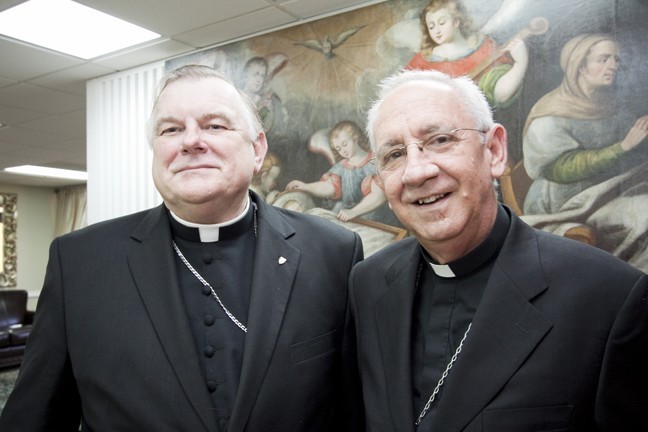
Photographer: ANA RODRIGUEZ-SOTO | FC
Bishop Emilio Aranguren of Holguin, Cuba, visited Archbishop Thomas Wenski in Miami at the end of November.