
Watching K-Pop Demon Hunters at the convent
Wednesday, December 3, 2025
Multiple Authors
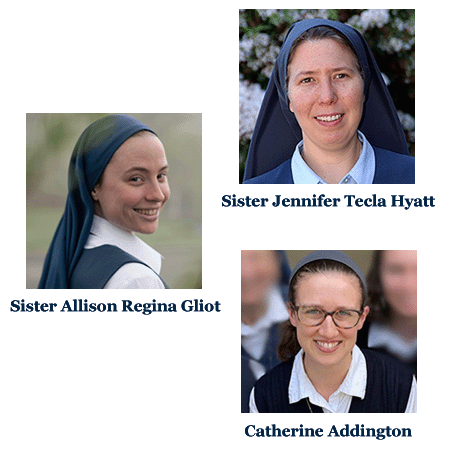
By Sister Allison Regina Gliot, FSP, Sister Jennifer Tecla Hyatt, FSP, and Catherine Addington
Editor’s note: This article is Part 1 of 2 in our K-Pop series running from December 2025-January 2026, rediscovering K-Pop through the Catholic worldview. Enjoy!
At first glance, a movie about Korean pop stars battling demons might seem like an unlikely choice for convent movie night.
However, as Daughters of St. Paul, religious sisters dedicated to evangelizing through modern media, we seek out the seeds of the Gospel in contemporary popular culture. Sometimes, that leads to unexpected discoveries—like the rich spiritual themes and surprising vocational resonance of the smash hit movie of the year, the animated Netflix musical K-Pop Demon Hunters. During this Advent season, as we prepare for Christ’s coming by watching for signs of His light breaking through the darkness, we hope you’ll find as much inspiration here as we did.
As the bold title suggests, K-Pop Demon Hunters tells the story of a Korean pop band whose members battle demons both onstage and off. Through their music, lead singer Rumi (Arden Cho/Ejae), lyricist Zoey (Ji-young Yoo/Rei Ami), and dancer Mira (May Hong/Audrey Nuna) spread light and positivity that strengthen a supernatural shield called the Honmoon, which keeps most demons away—and for those it doesn’t, there’s sword-fighting. Everything is going according to the Hunters’ plan…until the demons form a rival boy band of their own.
What follows is a roundtable discussion on the spiritual themes that emerged during our community discussion of the film. We invite you to do your own prayerful viewing of the movie and share your reflections with family or friends—check out our guide to cinema divina at the end of this article!
Catherine (novice): The most striking aspect of the movie for me was how it portrays the spiritual stakes of producing and consuming media. In K-Pop Demon Hunters, music is the battlefield between light and darkness, with the Hunters using “songs of courage and hope” to combat the demonic influence over their fans’ souls.
While the movie’s premise is fictional, the story does capture a real truth about media’s spiritual impact. Media really does have the power to draw souls closer to God through beauty and truth, or to spread division and harm instead. That’s one of the reasons why Blessed James Alberione founded our community, the Daughters of St. Paul, to use the media for good and to teach others to do the same. When I watched this movie, I couldn’t help but see the Hunters as an amazing parallel to our own vocation as media apostles. Like them, we are called to use our gifts and the media tools God has given us to spread the light of the Gospel in today’s world and counter the forces that would lead souls away from God.
Sister Allison: I think the theme of owning up to our sins and seeking forgiveness is the element of the film that most speaks to me. One of the characters struggles greatly with a selfish choice he made in the past, one that had grave consequences for his family. He is ashamed of what he did, and the ruler of the Demon Realm uses this shame to control him. But throughout the film, this character learns to see himself as more than the sum of his sins, and when he finally asks for forgiveness, he is definitively freed from the demon ruler’s control.
This reminded me of the grace God always offers us through the Sacrament of Reconciliation. Our automatic reaction when we sin might be to hide these dark parts of ourselves or pretend they never happened. We can let shame fester and find ourselves falling down a slippery slope into even more sin. But in Confession, God invites us to be honest about the evil we have committed—not so that we hate ourselves, but so that we can be sorry for those sins and ask him for forgiveness. Doing so breaks the hold that sin has over us and invites God’s infinite mercy and healing grace into our lives.
Sister Jennifer Tecla: In the film, each of the Hunters has her own talents, struggles, and role to play. This is just like in St. Paul’s teaching, “the body does not consist of one member but of many” (1 Cor 12:14). Their diversity becomes their strength. No single character can fight alone; they succeed when they lean on one another. This reflects the Church’s call to unity.
Healing comes when each character chooses honesty and trust in one another. The story shows that we shine brightest together, not apart. Similarly, the Body of Christ is strongest when we support one another. In the Church, each of us — with our different gifts and struggles — makes up the Body of Christ, and we are called to live in unity and bring Christ’s light against the darkness.
Catherine (novice): I also loved that the movie wasn’t about a singular hero, but a trio of Hunters who have to learn to come together as a community in order to accomplish their mission. It’s only once they step out of their roles as “saviors,” admit their vulnerabilities, and receive love from one another that they are able to overcome the forces of darkness. It’s like that in real life, too—even if we all have our individual relationships with Jesus, he calls us into community as a Church and has entrusted her saving mission to all of us together.
I saw a lot of wisdom in the story of the main character, Rumi, and her journey toward authentic self-acceptance. Over the course of the movie, she comes to embrace her past and her struggles rather than hiding from them, which enables her to bring her whole self to her calling as a Hunter. That journey mirrors a crucial aspect of vocational discernment and religious formation: recognizing and accepting the person God made you to be, allowing Him to love every part of you. It also resonates with the Advent call to prepare room in our hearts for Christ—not by presenting a false, “cleaned-up” version of ourselves, but by allowing him to meet us exactly where we are.
Sister Allison: Something that struck me about Rumi’s journey was the theme of integration. Rumi initially hides parts of herself from her loved ones and tries to compartmentalize her life to such a degree that her internal struggles impact her ability to sing and work in harmony with the other members of her band. She is afraid to look at her whole self and take stock of all the jagged edges in her life, so she avoids doing the necessary heart-work to repair her internal discord and instead looks for outward solutions: a tonic to fix her voice, or a new song to win back the fans.
But she comes to realize that outward solutions can't fix a problem that's inside of her. And when she learns how to look at herself with compassion and honesty—with the help of the loved ones in her life—she starts to see how those jagged edges she was so afraid of actually do fit into the bigger picture. Her full, integrated self isn’t what she originally envisioned, but it is more beautiful and powerful than she ever could have imagined.
The same can go for us. It’s hard to thrive and have meaningful relationships with others and with God when we’re inwardly discordant. Facing the inconsistencies, sins, and sharp edges within us can be a daunting task, but God challenges us to do it anyway. Sustained by his unconditional love and grace, we can take small steps every day to move toward greater wholeness, trusting that he will provide the support and circumstances we need to grow into the people he calls us to be.
Sister Jennifer Tecla: What I also enjoy about this movie is that the story is told through the music. Many movies use music to draw us into the story, and this movie is no different! Each song reveals more deeply what is happening. The song “Golden” has become one of the ten longest leading top songs from a movie in history. It is an upbeat song with a somber bridge that functions as a classic musical number, conveying the characters’ feelings of being lost and isolated before a climatic climactic embrace of identity and solidarity.
I kept asking myself, why is this song still on the top of the charts? Could it be that many connect with the lyrics, which speak of stepping out of fear and doubt and into confidence, strength, and self-acceptance? Whatever the reason, it is meant to inspire listeners to embrace their best selves… to become “golden,” which is a metaphor for being radiant, valuable, and unshakable.
The song emphasizes unity: “together we’re glowing.” In faith, we don’t carry the light alone. As the Body of Christ, when we live in love and community, our shared witness radiates Christ’s light even stronger.
As we continue our Advent journey toward Christmas, we hope this peek into movie night at the convent inspires you to watch for Christ’s light in unexpected places! If you want to learn more about how to approach movies with a spiritual lens, check out this guide to cinema divina by Sr. Jennifer Tecla. (And if you want to listen to some real-life media apostles who use music to spread the light of Christ, you can find our choir wherever you stream music—and our Sisters from Korea, too!)


Comments from readers