By Archbishop Thomas Wenski - The Archdiocese of Miami
Archbishop Thomas Wenski preached this homily on the last night of Simbang Gabi, the Filipino tradition of an Advent novena of Masses in anticipation of Christmas. This final Mass was celebrated Dec. 23, 2019, atSt. David Church in Davie.
In the first reading, God speaks through the prophet, Malachi, and says: “I am sending my messenger to prepare the way before me.” That messenger, of course, was John the Baptist, about whose birth the Gospel today tells us. And today, we conclude our Simbang Gabi celebrations. This novena of Masses is also about preparing our way for the Lord. Simbang Gabi helps the Filipino people prepare themselves for Christmas. But it also serves to help us to be like John the Baptist and help prepare the way for others. Preparing the way is what we mean by evangelization: we “evangelize” ourselves by accepting the good news of Jesus Christ who in Bethlehem was born a Savior for us. But we also must be prepared to “evangelize” others and introduce them to what has been “good news” for us. As Pope Francis told the Filipinos in Rome when he celebrated Simbang Gabi with the Filipinos living in Rome: You must be “smugglers” of the faith. Some people didn’t understand what the Pope was saying; but I am sure that those Filipinos who work in Saudi Arabia and must practice their Catholic faith in secret had an idea of what he was saying.
Photographer: Via Instagram @thomaswenski
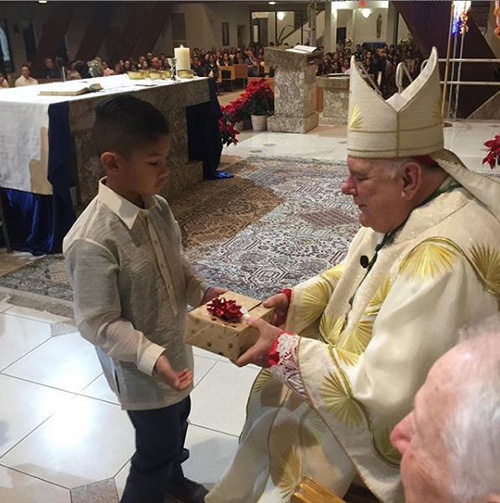
Archbishop Thomas Wenski receives a gift from a child during the last Mass of the traditional Filipino novena of Simbang Gabi, which he celebrated Dec. 23, 2019, at St. David Church in Davie. "After Mass (with a full church), a delicious meal of Filipino food was served to all," the archbishop wrote on his Instagram account.
But even for us who enjoy freedom of religion as we do, for the most part, here in the United States, the idea of smuggling the faith as if it were something contraband has its cogency for us. Even in this country, many people have yet to know Jesus Christ, others have drifted away from him, and growing numbers either because of the hostility of the culture towards faith, or because of our own sinfulness, do not look to us to tell them anything about him. Our life in Christ, because of our inconsistencies and incoherence, too often fails to convince.
Today, many people see the Gospel – especially in its hard sayings – as something against them; and not for them. People think that our religion is a bunch of “noes.” And certainly, we often don’t help the matter – with the bureaucracy that necessarily comes with a complex organization. Too often I have heard about that proverbial parish receptionist whose first word to someone who walks into the rectory office is, “Are you registered?” instead of “How can I help you?”
The statistics tell a sobering story. Pew Forum on Religion and Public Life states: “The Roman Catholic Church has lost more members than any faith tradition because of affiliation swapping... While nearly one in three Americans were raised Catholic, fewer than one in four say they’re Catholic today. That means roughly 10 percent of Americans are ex-Catholics.” Thanks to immigration, the number of Catholics in the U.S. remains at about 24 percent of the population. One in three Catholics in the U.S. is Hispanic. And Filipinos make up a significant percentage of Catholics in the U.S. As Pope Francis told the Filipinos in Rome: “We are all called to proclaim the Gospel together, the Good News of salvation, in all languages, so as to reach as many people as possible.”
And many of the problems we face in this country and not only in this country: the decline in Mass attendance, the crisis in vocations, the ignoring of Church teachings on matters of morality, the “religious illiteracy” among many of the faithful, not to mention the sexual abuse crisis of recent years, all underscore the need for what all the popes since Vatican II have called “a new evangelization.”
Our faith needs to be attractive. In fact, that’s how the Gospel won over the ancient world. “See how they love one another.” The love of the first Christians – even towards their enemies – was attractive.
In my college days, I remember reading the psychologist, Carl Rogers. In training new counselors, he insisted that a counseling relationship would not be successful unless the counselor had “unconditional positive regard” for his clients. If Peter and Paul and all the saints of the primitive Church labored and struggled and suffered martyrdom to bring the Gospel ad gentes, it was because they felt that these souls were worth saving. They preached the Gospel to the house of Israel and then to the Gentiles. They preached uncompromisingly – but with unconditional positive regard for the pagans they sought to save for Christ. That same “unconditional positive regard” should still motivate our missionary activity today. In other words, you will not “evangelize” anyone if you do not enter into a relationship that shows “unconditional positive regard” for them: You got to love them.
Allow me now to introduce a Marian theme here. The Virgin Mary is our model of evangelization. Mary did not communicate to the world an idea; she gave birth to a son. We must always remember this – our faith is not about an idea, an opinion, an ideology or a theory; our faith is not even primarily about ethics and teaching people how to be good. Our faith is about an encounter, an encounter with a person, Jesus Christ, who invites us into a relationship with him, a relationship in which he calls us his friends.
Mary was the first disciple, the first Christian. She shows us that Christianity is not a series of “noes” but a lived “yes” to a living person, Jesus Christ. St. John Paul II with good reason called Mary the Star of the New Evangelization.
People today are being sacrificed on altars erected to the false gods of our age. These are the same ancient gods of power, pleasure and plunder dressed up in new disguises. The human sacrifices they demand continue in our day. The inconvenient are disposed of through abortion and euthanasia. An epidemic of addiction kills more people every year in the U.S. than died during the entire Vietnam War. We see a globalization of indifference and complacency towards the migrant, the poor, the marginalized.
We must make to the world an attractive proposal about a God that does not want death for us but life, a God who so loved the world that he gave us his only begotten Son so that we might have life – abundant life.
Our efforts to evangelize will bear fruit if we in our time prepare the way of the Lord as Zacharia’s son, John the Baptist, did in his time. The Gospel must be seen by our contemporaries as not against them but for them, not taking away their freedom but allowing them to know the true freedom of the Sons of God.
As so we pray: O King of all nations and keystone of the Church;come and save man, whom you formed from the dust!