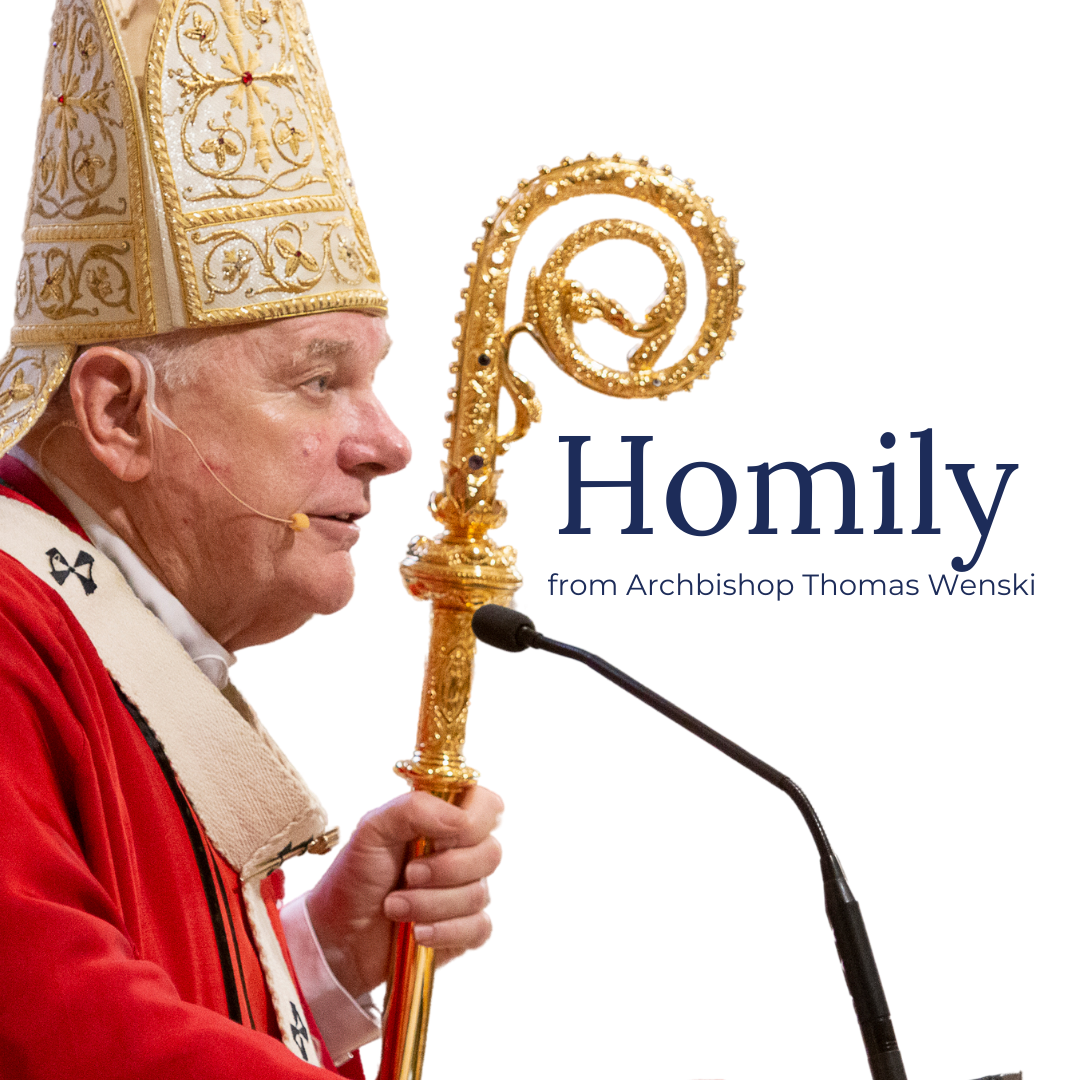
By Archbishop Thomas Wenski - The Archdiocese of Miami
Talk delivered by Archbishop Thomas Wenski at a Shabbat Service focusing on the value of repairing the world, held at Temple Bet Am in Pinecrest, FL. March 20, 2026.
Good evening. A Rabbi…. a priest…This has the makings of a good joke but we’re missing an Iman or a Baptist preacher. So, no joke.
But I thank you for having me today. I welcome this opportunity to speak tonight at this Shabbat service. I speak as a Catholic and in doing so I want to emphasize that the Catholic faith is committed to interreligious dialogue. This is especially true especially since the 1960’s when at the Second Vatican Council, the bishops issued an important document, Nostrae Aetate, that informs our efforts to engage men and women of other faiths in dialogue. So, I am not here to make converts; nor will I attempt “to split the differences” on where we might disagree so to reconcile the various teachings of one faith with those of the other nor should my talk be seen as an exercise in apologetics which seeks to answer another’s objections concerning the propositions of the faith.
Hopefully this talk will continue to build relationships of understanding, respect and cooperation even though we adhere to faiths that cannot be simultaneously true. For example, Christians say that Jesus is God; and Jews say he is not. But the historical divide that exists between persons of other faiths has been created not so much by religious dogma but by religious history – and history is made by flawed men. And that I am here speaking tonight is perhaps Tikkun Olam, a small contribution to the healing of the world.
I am, of course, the Roman Catholic Archbishop of Miami where we have 110 parishes with an estimated 1.3 million parishioners. (Hopefully about half of them attend Mass on Sundays.) The archdiocese also operates a large school system with 49 elementary schools, 10 high schools and a university. Our Catholic Health Services operates 2 rehabilitation hospitals, 2 assisted living facilities, 3 nursing homes, hospice, and home health care. It oversees 19 senior housing projects serving 2,300 people. Our Catholic Charities runs Head Start day care centers, food pantries, counseling, senior day care, meals for seniors in several parishes, and housing assistance to people in crisis and a shelter for unaccompanied minors. We also have pregnancy assistance centers. Our Catholic Legal Services with some 39 lawyers sees between 2,000 and 3,000 people a month to help with their immigration issues. We have men and women engaged in prison ministries and many clergy serve as chaplains to fire fighters and police officers. And, of course, we have had a long and fruitful relationship with faith-based organizations like PACT in Miami-Dade and Bold Justice in Broward County.
So, while the words, Tikkun Olam, might not be part of our Catholic lexicon, the concept behind it certainly is. We are our “brothers’ keepers” and that will necessarily engage us with repairing brokenness we find in the world. Faith has to be more than just “navel gazing”; and while faith is personal it can never be “private”. Too often in our increasingly secularized world, we are told to keep our faith to ourselves – something to be confined to what we do in the privacy of our homes.
When I was still a seminary student more than 50 years ago, I read a book on Pastoral Counseling by Howard Clinebell, he was a Methodist minister who died in 2005. In his book, he presented a parable that I wish to share with you if you will indulge me.
It’s a parable about a certain lifesaving station. Here goes.
On a dangerous seacoast, where shipwrecks often occur, there was once a crude little lifesaving station. The building was just a hut, and there was only one boat, but the few devoted members kept a constant watch over the sea. With no thought for themselves, they went out day and night, tirelessly searching for the lost. Many lives were saved by this wonderful little station, and it became quite famous. Some of those who were saved, and various others in the surrounding area, wanted to become associated with the station and give their time, money and efforts for the support of its work. New boats were bought and new crews trained. The little lifesaving station grew.
Some of the members of the lifesaving station were unhappy that the building was so crude and poorly equipped. They felt that a more comfortable place should be provided as the first refuge of those saved from the sea. So, they replaced the emergency cots with beds and put nicer furniture in the enlarged building. Soon, the lifesaving station was decorated beautifully and furnished exquisitely. Now the lifesaving station became a popular gathering place for its members, and they used it as a sort of club. As time passed, fewer and fewer members were interested in going to sea on lifesaving missions and they hired lifeboat crews to do this work.
The lifesaving motif still prevailed in the club’s decor and there was even a liturgical lifeboat in the room where the club initiations were held. About this time a large ship was wrecked off the coast and the hired crews brought in boatloads of cold, wet and half-drown people. They were dirty and sick. Some of them had black skin and some had yellow skin. The beautiful new club was in chaos. So, the property committee immediately had a shower house built outside the club where victims of a shipwreck could be cleaned up before coming inside.
At the next meeting, there was a split in the club membership. Most of the members wanted to stop the club’s lifesaving activities and viewed them as unpleasant and a hindrance to the normal social life of the club. Some members insisted upon lifesaving as their primary purpose and pointed out that they were still called a “lifesaving” station. But they were finally voted down and told that if they wanted to save the lives of all the various kinds of people who were shipwrecked in those waters, they could begin their own lifesaving station down the coast. So they did.
As the years went by, the new station gradually experienced the same changes that had occurred in the old. It evolved into a club and yet another lifesaving station was founded. History continued to repeat itself and if you visit that seacoast today, you will find a number of exclusive clubs along that shore. Shipwrecks are still frequent in those waters, but most of the people drown.
We are in the life saving business, or at least we are supposed to be. People are drowning - and we have to rescue them. Tikkun Olam.
We are not to be of the world; but we are in the world to change the world.
This world is our highway to heaven — that highway needs to be straightened out, it needs to be paved, it needs good signage. That why we Christians and Jews must be involved in the world. Our faiths are teleological. We are going somewhere, our lives have purpose, our lives have direction — but as move through this world, this highway, if we don’t take care of the potholes, we can break an axle, or without clear signage we can veer off course and get lost. Karl Marx was wrong in saying that religion is the opiate of the people. Those who say that we, as Christians or Jews, don’t care about the world do not understand what the Torah and prophets taught. An atheist believes we’re living on a dead-end street. Dead-end streets don’t require much maintenance or repair. But highways do.
God’s love for all his creatures must be mirrored in the way we care for one another through acts of love and solidarity that are grounded in the truth that every human life is sacred and that all humanity forms one family.
This is the core of what has come to be called Catholic social teaching. While the arguments of this teaching can seem to be quite complex, (and reading a Pope’s encyclical can be a cure for insomnia). But I I believe that Catholic social teachings – or the way we try to Tokkun Olam - can be summarized in one simple phrase: no man is a problem. No human being, no matter how poor or how weak, can be reduced to being “just a problem”. Whether we are talking about the homeless, the mentally ill, the addict or the unwed mother, the troubled child in one of our failing schools or the migrant - to view any human being as merely a problem is to offend his or her dignity - and when we indulge in such reductive thinking we give ourselves permission to look for expedient but not just solutions – and, as the tragic history of the 20th century shows even “final solutions”.
For this reason, there is no such thing as a ”problem pregnancy”, only a child who is to be welcome in life and protected by law. The immigrant - even one without legal papers - is not a problem. He may perhaps be a stranger but one who is to be embraced as a brother. Even those incarcerated in our prisons for all the horror of their crimes do not lose their God-given dignity as human beings. They too must be treated with respect even in their punishment. This is why Catholic social teaching condemns torture and advocates for the abolition of the death penalty.
Without reference to the truth about the human person -- a truth universally knowable through the moral law written on the hearts of all -- freedom deteriorates into license in the lives of individuals, and in political life, it becomes the caprice of the most powerful and the arrogance of power.
"The arc of the moral universe is long, but it bends towards justice" is a famous quote popularized by Dr. Martin Luther King Jr. in 1965.
Often, justice is taken to be something cold and calculating. When we think about the “justice system”, it implies a certain impersonal objectivity.
But justice is first and foremost a virtue. The catechism of the Catholic Church describes the virtue of justice as “the constant and firm will to give their due to God and neighbor (CCC 1807). In other words, justice is the virtue by which we turn outward toward to God and other people, to affirm their fundamental dignity, and we strive to act in accord with their true good. To be a just man – or woman – is to be a person who turns outward to other people seeing them as God sees them, which is of course with perfect and unwavering charity.
So, let me conclude with another story that illustrates what I think Tikkun Olam means; it is a true story about a famous mayor of New York. You might have heard of him — there’s an airport named after him.
Mayor Laguardia would often serve as a judge at night court — and one night during the depths of the Great Depression, he presided over the court in one of the poorest precincts of the city. A poor old lady was brought before the court charged with stealing a loaf of bread. “Did you steal the bread,” he asked her. She admitted she had but explained that she lived with her daughter and her two grandkids, her son-in-law had deserted the family, and they had no money and nothing to eat. The mayor looked at the shopkeeper and asked him, given the circumstances, did he really wanted to press charges. The shopkeeper said that he felt sorry for her but it’s a bad neighborhood and the woman needed to be punished to set an example for everyone.
LaGuardia was in a dilemma — the law was the law but to punish this old woman would be a miscarriage of justice. What would you do? The penalty was $10 or 10 days in jail. What did LaGuardia do? He took ten dollars out of his wallet and gave it to a bailiff to pay the fine.
Then he looked out at the crowded courtroom and fined everyone there 50 cents for living in a city in which a grandmother had to steal a loaf of bread to feed her grandchildren. He directed the bailiff to collect the fines and hand the money to the defendant. The total collected came to $47.50 including the 50 cents willingly paid by the shopkeeper.