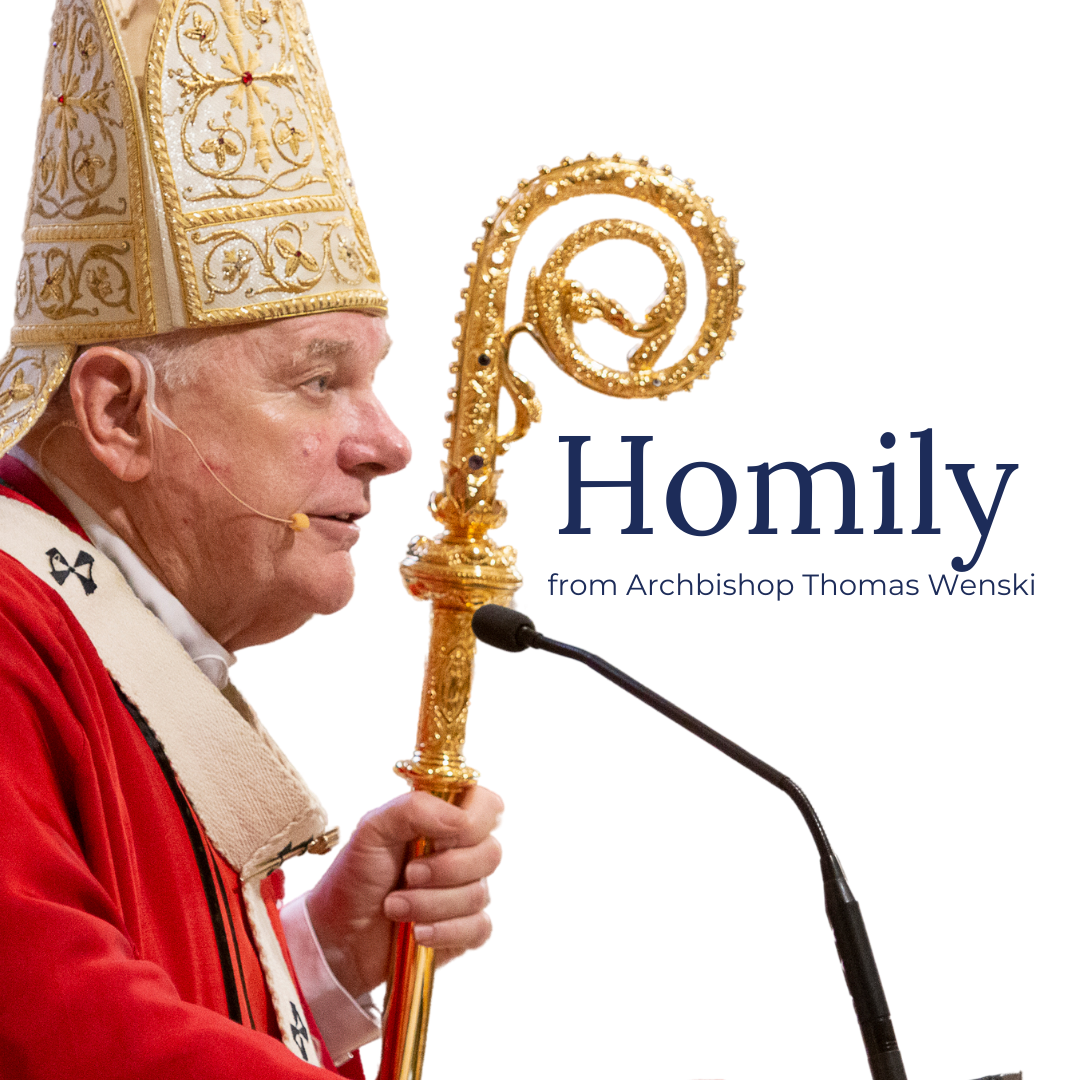
By Archbishop Thomas Wenski - The Archdiocese of Miami
Homily by Archbishop Thomas Wenski homily at Mass at St. John Vianney Seminary. Oct. 15, 2026.
Today, in the morning, the bishops of Florida met as the board of the Florida Conference of Catholic Bishops; and then after lunch we joined other board members for our semiannual meeting of the board of directors of this College Seminary. So, from about 9:00 to about 3:00 with a break for lunch, your bishops have been in meetings. Tomorrow, we have another meeting of the board of St. Vincent de Paul Seminary. If anyone wants to know why these meetings are called, boards. Ask me.
But, more seriously, in this passage, Jesus delivers a sharp rebuke to the scholars of the law, saying, "Woe to you who build the memorials of the prophets whom your fathers killed". He challenges their external displays of piety that mask an internal resistance to God's true wisdom, concluding with the warning, "Woe to you, scholars of the law! You have taken away the key of knowledge".
For a community of young scholars discerning a vocation to the priesthood here at St. John Vianney College Seminary, this gospel reading says something important to you as well.
Jesus warns against the "scholars of the law" who block access to genuine divine truth. For seminarian scholars engaged in intense intellectual and spiritual formation, it serves as a reminder that your studies in theology and philosophy must never become sterile academic exercises but should always lead to a deeper personal relationship with Christ.
Today, we also celebrate the feast of St. Teresa of Jesus, Teresa of Avila, whose writings on the spiritual life are classics. She was the first woman to be recognized as a doctor of the Church. But besides being a contemplative nun which a rich interior life, she was also “a mover and a shaker” and despite intense opposition, bureaucratic resistance and misunderstanding from ecclesiastical authorities, she set out to return the order to its original, austere roots and succeeded in reforming the Carmelite order. Like those prophets mentioned in the Gospel, she spoke truth with conviction. She traveled across Spain starting new foundations of Carmelite monasteries. There is a story that during one trip she was crossing a stream, and her horse threw her into the water. (I appreciate this because last January I fell off a horse too.)
Because she was doing the Lord’s work, she was frustrated that the Lord would allow something like this to happen and she cried out in exasperation, “Lord, if this is the way you treat your friends, it is no wonder that you have so few.”
She wrote a short poem and prayer: Nada te turbe, Let nothing disturb you. It is a summary of her theological masterpiece, The Interior Castle. It captures the radical trust that sustained her through many trials and tribulations.
Todo se pasa,
La paciencia
Todo lo alcanza;
Quien a Dios tiene
Nada le falta: Solo Dios basta.
Let nothing frighten you,
All things are passing,
God must not change.
Patience Obtains all things;
Whoever has God Lacks nothing:
God alone suffices.
"Todo se pasa" (All things are passing): A reminder that earthly trials, like falling into a muddy stream or facing fierce opposition from critics, are temporary.
"Dios no se muda" (God does not change): Anchors the soul in the absolute stability and unchanging nature of God.
"Solo Dios basta" (God alone suffices): The ultimate statement of detachment. St. Teresa taught that when a person empties themselves of worldly desires, possessing God is enough to fulfill every human need.
Nada te turbe. Let nothing disturb you, because as St. Paul tells the Ephesians in this evening’s first reading: “In Christ we have redemption by his Blood, the forgiveness of transgressions, in accord with the riches of his grace that he lavished upon us.”