By Jim Davis - Florida Catholic
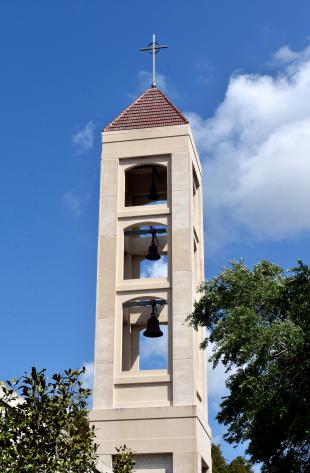
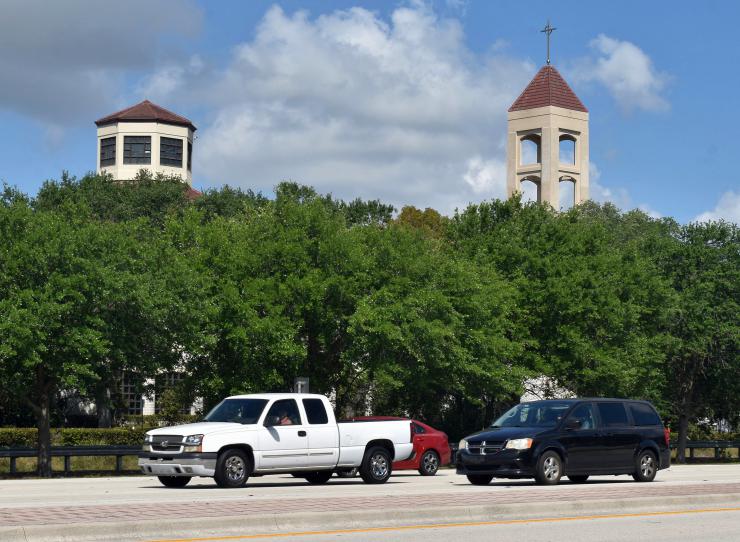 St. Mark's tower shelters three bells.
 The church nave follows the octagonal pattern of the lantern clerestory.
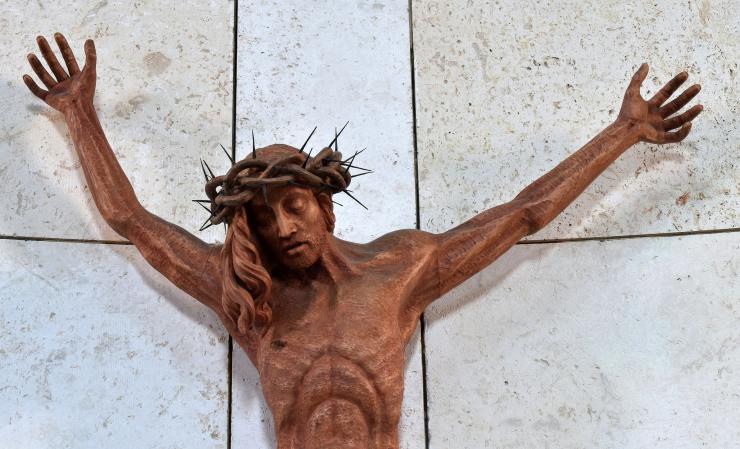
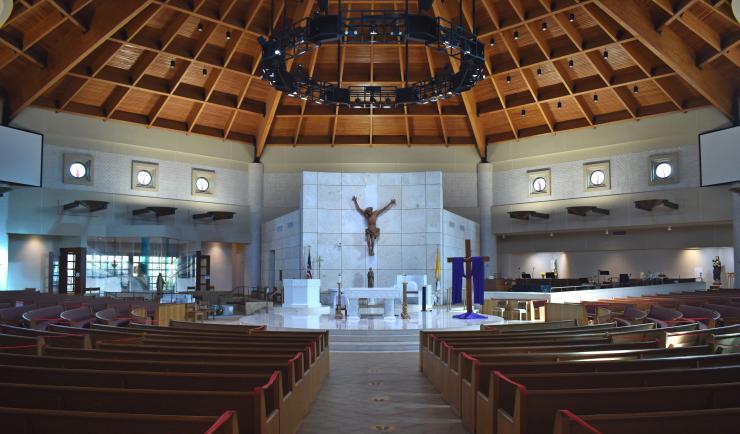 The life-size corpus of Christ hangs on a stylized cross made of wall tiles.
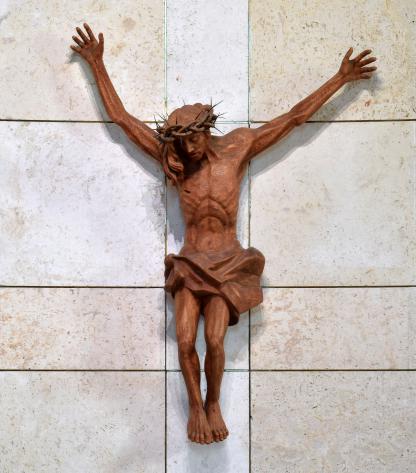 The figure shows Christ's agony, yet it appears to float free of the wall -- a statement that even death could not hold him.
 The nativity window is ringed with symbols of stories from Jesus' life.
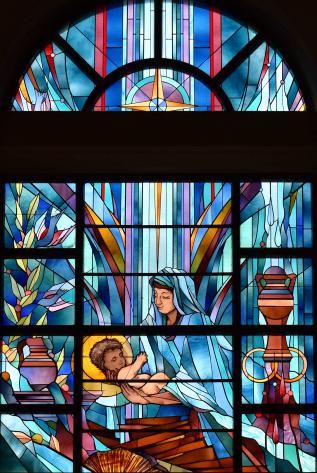 In contrast to the blues of the Nativity window, reds dominate the Crucifixion window, for the blood Christ shed to redeem humanity.
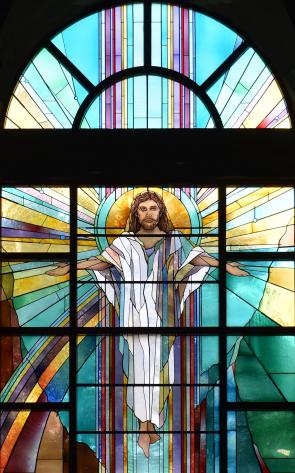
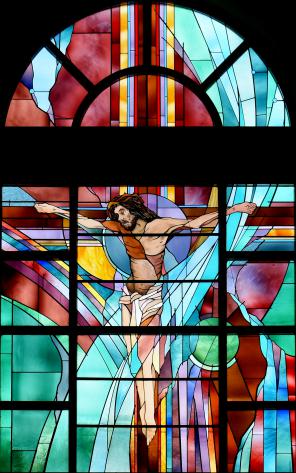 Brighter shades mark the Ascension window on the east wall of St. Mark's, catching the rising sun of morning.
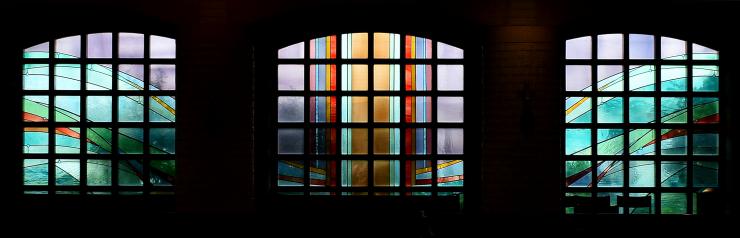
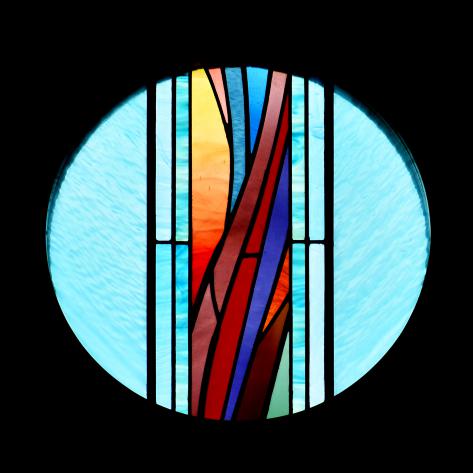
 Wavelike patterns in the side windows suggest the waters of baptism.
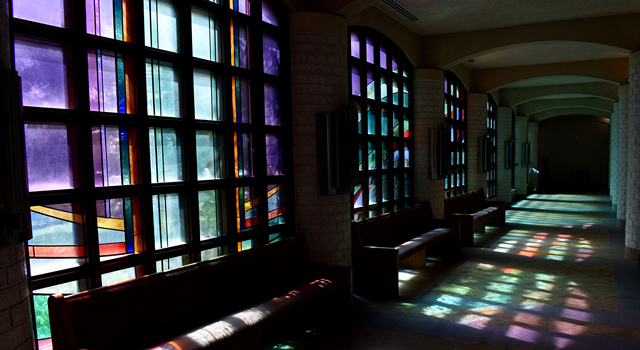
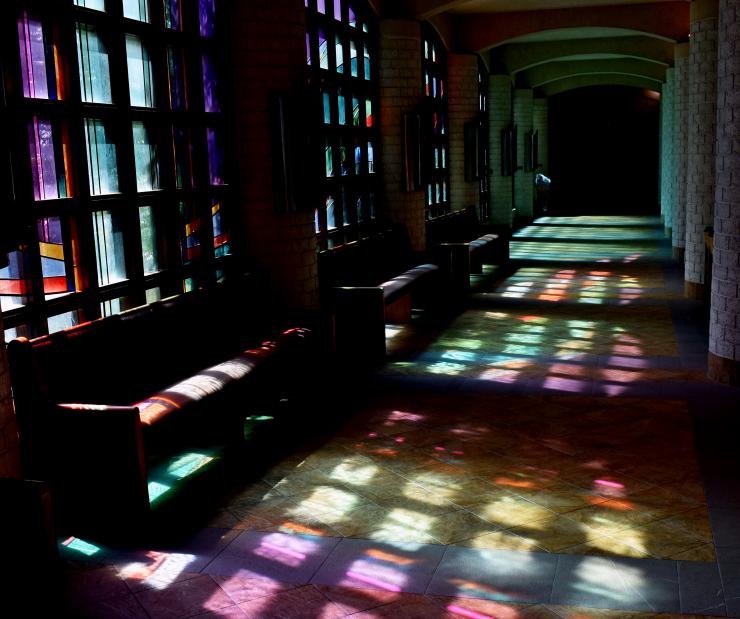
 Sunlight throws multicolored designs on an aisle.
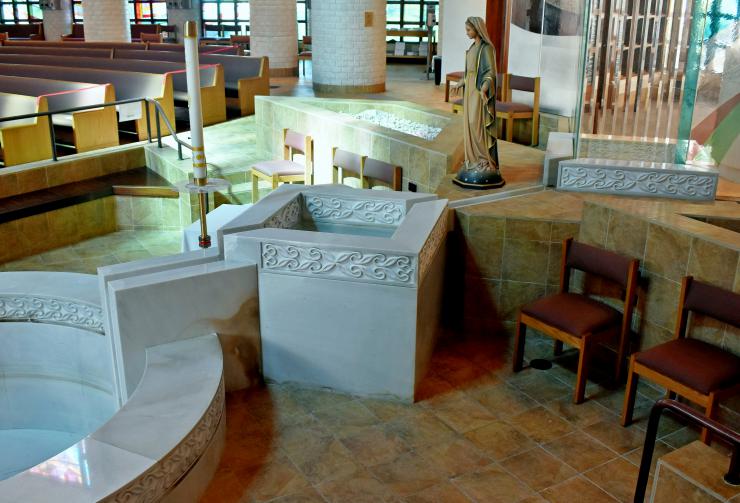
 Baptisms are done in a marble immersion pool.
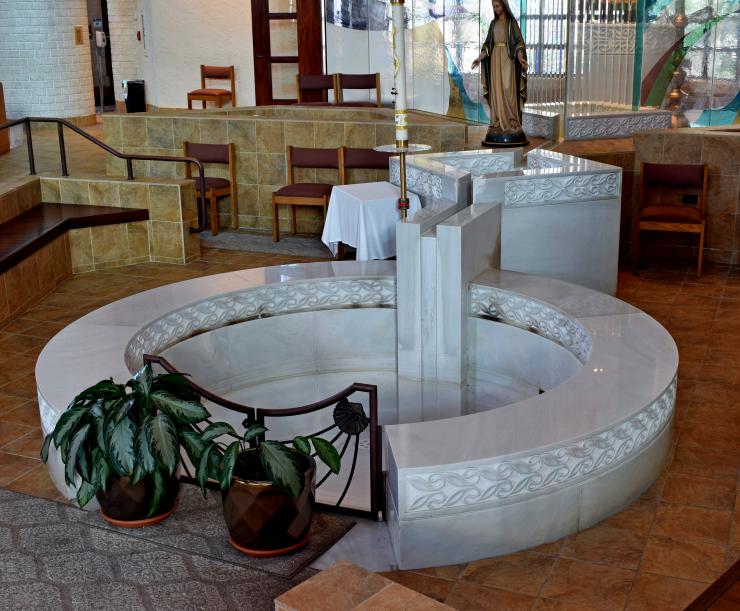 Water flows into the pool from a font just behind the church's Tabernacle, connecting the Eucharist with baptism.
 Twelve clerestory windows, for the original 12 disciples, feature the flames of anointing. However, the window for Judas, who betrayed Jesus, is left colorless.
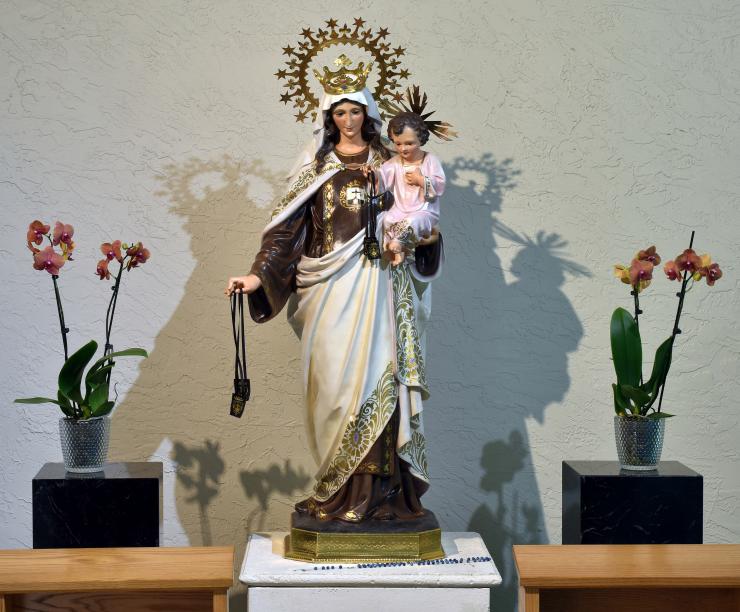
 Brown-clad statuette proclaims Mary as Our Lady of Carmel. Both she and the Christ Child hold scapulars, reminders of the order's service vocation.
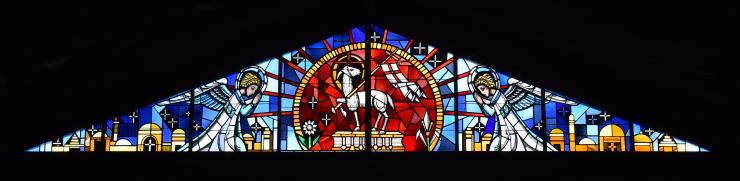
 Angels bow before the risen Christ, symbolized by a victorious lamb, in this gable window at St. Mark School.
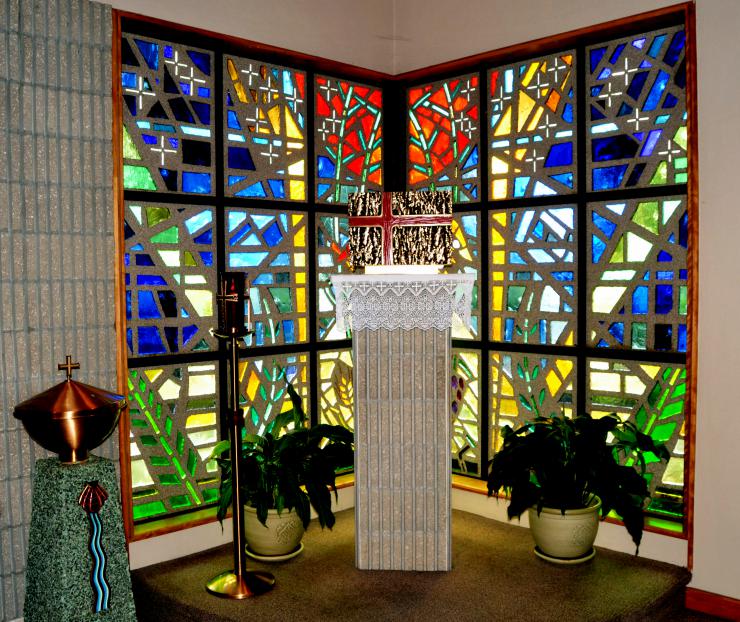
 A Tabernacle stands in its own niche in the Parish Center Chapel. Behind it are windows showing wheat and grapes, for the bread and wine of the Eucharist.
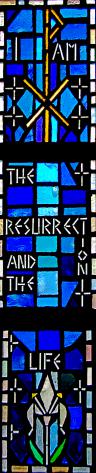
 A Chi-Rho monogram dominates this window in the Parish Center Chapel, proclaiming Jesus as the Resurrection and the Life. The monogram has the first two letters from the Greek word "Christos."
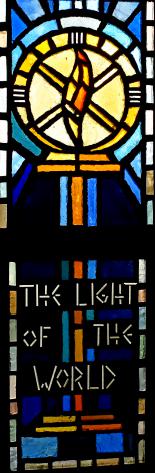
 Flaming colors mark this window in the Parish Center Chapel, symbolizing Jesus as the Light of the World.
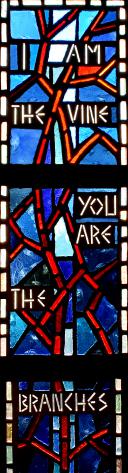
 Twig-like image in St. Mark’s chapel enshrines Jesus’ statement in John 15 that “I am the vine, you are the branches.”
 Twelve icons from the life of Christ surround a central icon of Mary and the Christ Child.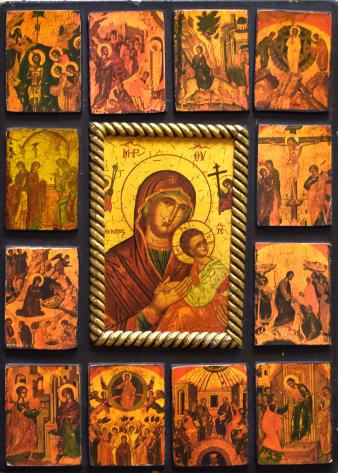
Photography: Jim Davis
SOUTHWEST RANCHES | Some called him John, some called him Mark, some called him both. St. Mark is widely known as the writer of the second book of the New Testament, which became a model for two others. Many Christians honor him also as the founder of a major church of the ancient world.
Although Mark was not one of the 12 disciples, his family were friends with early church leaders. The New Testament indicates that Mark was a cousin of St. Barnabas, a fellow evangelist with St. Paul. He was so close to St. Peter that the latter called him "my son."
He accompanied Peter on a missionary journey around Jerusalem and Judea. Peter went to the house of Mark's mother after being miraculously released from prison. And Peter gave Mark much of the material for his New Testament book.
Mark also preached, along with Paul and Barnabas, in Antioch, Cyprus and Asia Minor. For some reason, Mark then left them and returned to Jerusalem, causing a rift with Paul. They must have made up, however, for Paul asked him to visit while he was imprisoned in Rome.
Some scholars believe also that Mark was the young man clad in a linen cloth who followed the soldiers after Jesus was arrested. According to Mark 14, they seized him, but "he left the cloth and ran off naked." Matthew, Luke and John don’t mention the episode.
Western Church traditions say little beyond that. But Coptic Orthodox Christians, most of whom live in Egypt, draw on several other traditions.
In one, Mark was born to wealthy Jewish parents in what is now Libya. He was well educated and spoke Greek, Latin and Hebrew. He and his parents, Mary and Aristopolos, fled pagan persecution for a new home in Jerusalem.
Copts further believe that Mark was a servant at Cana when Jesus turned water into wine. Another tradition says Peter was a cousin of his father. Still another story says that Mark rescued himself and his father from lions through prayer.
Other Eastern traditions hold that his mother's home was the site for the Upper Room in which Jesus held the Last Supper with his 12 disciples. It was also in that room where he appeared to them after his resurrection, and where the Holy Spirit poured out onto them on Pentecost.
After his stay in Rome, the adult Mark went to Africa and entered Alexandria, a center of Greek scholarly life. A Coptic tradition says a miracle birthed their church there.
According to the story, Mark's sandal strap broke, and he sought out a cobbler. Anianos, the cobbler, accidentally pierced his hand with an awl and cried out, "O One God!" That prompted Mark to heal his hand and preach the Gospel to him. Anianos not only accepted Jesus, but invited Mark to preach to his family and neighbors. Some years later, he appointed Anianos as bishop of the young Church of Alexandria before leaving for Rome.
Mark is thus also recognized as the founder of one of the four main "sees," or major centers of early Christianity. While other Christian leaders founded centers in Rome, Antioch and Jerusalem, Mark founded the See of Alexandria.
Besides that church, Mark founded the School of Alexandria, a great intellectual center. He also wrote a liturgy that, modified by St. Cyril, is still used today.
Pagan resentment at his success boiled over, and a mob dragged him through the streets on two successive days until he died. Christians took his torn body, wrapped it and interred it in a tomb beneath the church altar.
Some of Mark's relics are also at San Marco Cathedral in Venice, Italy, where he's the patron saint. His feast day is April 25 for western Christians, May 8 for Copts.
The Gospel according to Mark is the shortest of the four biographies of Jesus, but it may be the most influential because Matthew and Luke borrowed heavily from it. Bible scholars once looked down on the book for its spare detail; but in recent years, many have come to appreciate its rapid pace and urgent tone.
The parish in South Florida that bears his name began as a mission of St. Bernadette Church in Hollywood. The late Archbishop Edward McCarthy named it for St. Mark on its formal founding in July 1985.
For several years, the fast-growing congregation worshiped first at a firehouse, then the chapel of the Schott Memorial Center. During the late 1980s, the church developed its annual picnic and Country Carnival, which became parish traditions.
Along the way, two of St. Mark's pastors went on to larger responsibilities. In 1995, Msgr. William Hennessey, its founding pastor, became vicar general for the archdiocese. His replacement, Msgr. Robert Lynch, was chosen bishop of St. Petersburg later that year.
Other changes delayed the building of a home for the church, including bad weather and the death of the project manager and general contractor. Finally, the whole complex — including the church, administration building and 107-foot bell tower — was dedicated in May 2006.
The main worship center uses several traditions of church design: an octagonal nave, arched doors and windows, glass and marble materials. The ambulatory windows bear wavy, blue-green patterns suggesting water, flowing to the sanctuary area.
Larger windows, on the east, west and south walls, depict the nativity, crucifixion and ascension of Christ. Against the northern wall hangs a full-size corpus of Jesus. The figure appears to be suspended, but the coquina wall tiles suggest a cross behind it.
Another water theme is taken up at the baptismal font. The square font feeds a channel to a large immersion pool, evoking Jesus' promise to provide "living water."