By Archbishop Thomas Wenski - The Archdiocese of Miami
Archbishop Thomas Wenski preached this homily during a Mass with the Filipino community in anticipation of the feast day of St. Lorenzo Ruiz. The Mass was celebrated the afternoon of Sept. 26, 2021 at St. Mary Cathedral.
"Isa akong Katoliko — I am a Catholic and I wholeheartedly do accept death for the Lord." These are the last words of Lorenzo Ruiz as he gave his life after having been tortured. He died a martyr for his faith.
We gather today to celebrate his feast day, celebrated on the 28th of September. He is the first saint and martyr of the Filipino nation. And so, we invoke his intercession asking that his prayers win for us the grace to live for the Faith with the same courage he showed in accepting to die for the Faith.
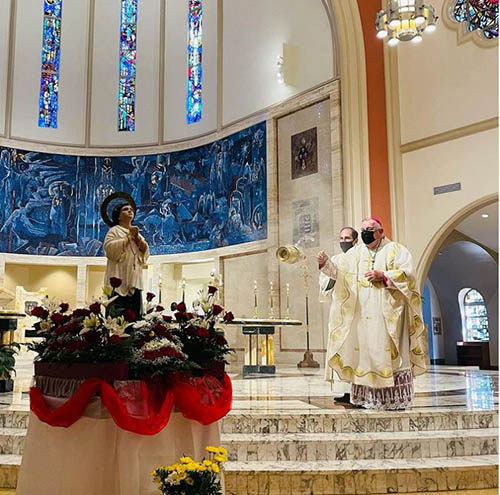
Photographer: Via Instagram @thomaswenski
Archbishop Thomas Wenski blesses an image of San Lorenzo Ruiz, the first Filipino saint who was martyred in Japan in the 17th century, during a Mass with the Filipino community at St. Mary Cathedral, Sept. 26, 2021. The saint's feast day is Sept. 28.
Lorenzo was a married man and a father. It is said that by trade he was a calligrapher: Before there were computers or even typewriters his job was to write out documents with beautiful penmanship. His skills were in great demand. Calligraphers would write out with beautiful style and penmanship important documents. And he wrote with great clarity; he also lived and died with even greater clarity.
He was falsely accused of murder, and he sought refuge with some Dominican friars who took him with them to Japan. They arrived there at a time when there was a fierce persecution of the Catholic faith. He was imprisoned now, not on trumped-up charges of being a wrongdoer, but for being a Christian, a Catholic. He fled his native land because he would not accept being falsely labeled a wrongdoer; but in Japan, he did not shirk from being labeled a Christian, a Catholic.
Lorenzo and his companions were hung upside down in a pit. They were tied up, but one hand was left free so that if anyone wished to recant, he could signal with his hand and then be set free. Perhaps, he thought, why not just recant, deny the faith, get out of Japan and then repent and go back to being a Christian as before? Why not be an apostate rather than a martyr? Certainly, in the course of history, many Christians in the face of persecution — and some just in the face of ridicule — do deny Christ.
In today's Gospel Jesus says: "Whoever causes one of these little ones who believe in me to sin, it would be better for him if a great millstone were put around his neck and he were thrown into the sea." Unlike so many of us who can rationalize the easy compromises we make in our betrayals of Christ both small and great, Saint Lorenzo could not and would not betray the Lord, for if he had, surely his betrayal might cause "one of these little ones...to sin." Had he renounced his faith, his betrayal would give scandal and weaken others' faith.
The life and death of San Lorenzo Ruiz reminds us that the Christian message is sown and takes root when it is lived authentically and eloquently. And nothing speaks more authentically or more eloquently than the blood of martyrs. The blood of martyrs is the seed of faith.
We need today people like San Lorenzo, who live their faith with clarity even in the face of obstacles and resistance. There is a question often posed during retreats to young people — a question which in these times when religious freedom is being eroded even in this country is not a farfetched one: If Christianity was a crime, would there be enough evidence to convict you? If being a Christian was against the law, would they find enough evidence to convict you? We can imagine the courage of San Lorenzo who, when recognized as a Catholic Christian in Japan, refused to renounce his faith. We might wonder whether we would have the same courage as he did. And we should wonder as well whether the enemies of the faith would recognize us as Christians, as Christians they should be worried about.
Following Jesus does not always bring wealth, health and happiness. As Catholics, we do not proclaim the Gospel of Nice; rather we proclaim the Gospel of Christ. There can be times of suffering for believers and even times when believers are put to death. We should keep in mind your own countrymen and women who work in countries like Saudi Arabia where they cannot practice their Christian faith openly. There they must practice their faith secretly. But faith grows when and where it is lived.
And here is precisely why we honor San Lorenzo Ruiz. We can imagine the trials faced by Lorenzo. Certainly, the circumstances that led to his leaving his native land had to be a time of great darkness for him. Perhaps leaving the Philippines and then being imprisoned in Japan was an experience of what spiritual writers call "the dark night of the soul," when one must trust in God and in his love despite all apparent evidence to the contrary.
Catholic faith is God's most precious gift to us. It is worth living for, and as San Lorenzo Ruiz shows us, it is worth dying for.
Through his prayers, may our witness of life grow in credibility. "Isa akong Katoliko."