By Marcy Knight - Florida Catholic
Fotógrafo: MARLENE QUARONI | FC
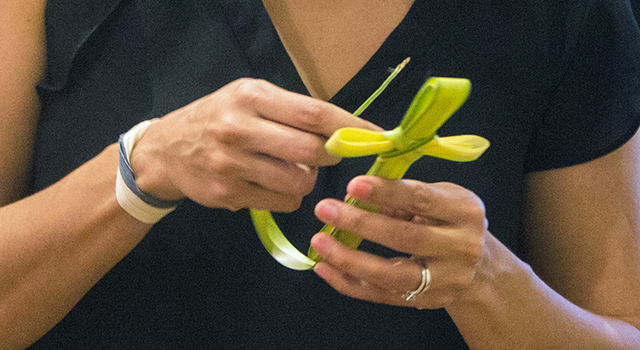
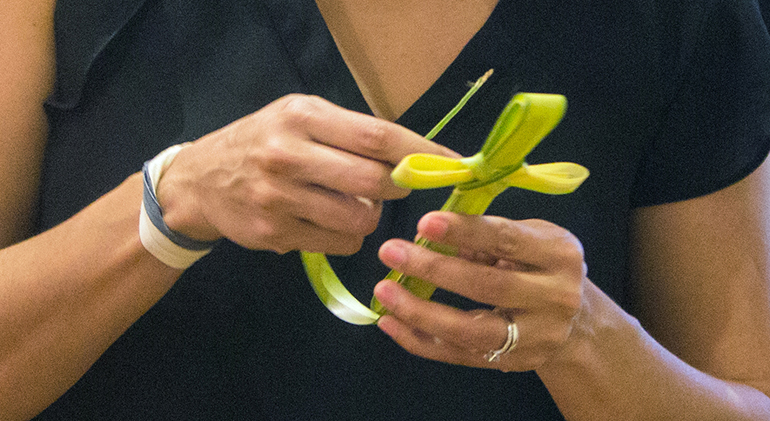
En esta foto de archivo, una mujer crea una cruz con una hoja de palma durante la Misa del Domingo de Ramos celebrada en la Catedral de St. Mary, en Miami. Debido a que están bendecidas, estas palmas nunca deben desecharse. Las palmas benditas se pueden devolver a la iglesia para que las quemen el Miércoles de Ceniza, o se pueden devolver a la naturaleza enterrándolas o quemándolas con las cenizas esparcidas afuera.
MARGATE | Sometimes the simplest things have the deepest meanings. The significance of a gold cross on a chain around someone’s neck visually expresses that individual’s faith. A small silver coin with the image of St. Michael imprinted on it instills strength to combat fears. Beads on a chain worn by touch provide hope and comfort.
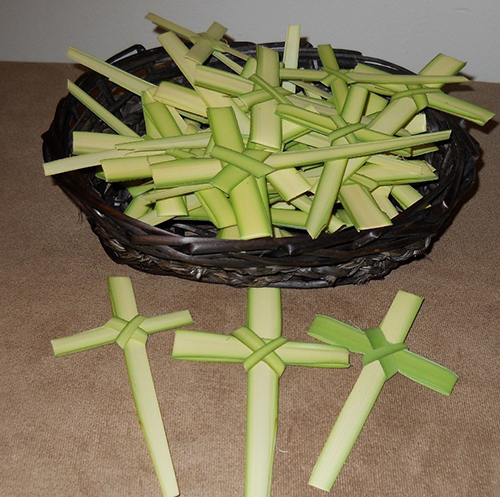
Fotógrafo: Thomas Sowell | Southeast Palm and Foliage
Aunque son bendecidas, las palmas del Domingo de Ramos no parecen recibir tanta reverencia como otros artículos religiosos, como los rosarios. Por lo general, se colocan en un estante o se cuelgan detrás de una imagen religiosa y se olvidan.
All three of these items provide a way for the faithful to be closer to God. But other similar objects do not appear to get as much reverence. One such item, typically put on a shelf or hung behind a religious picture and forgotten, is the blessed palm from Palm Sunday Mass.
Palm Sunday marks the sixth and final Sunday of Lent, and the beginning of Holy Week. This feast celebrates Jesus’ “triumphal entry” into Jerusalem. While shouting “Hosanna,” crowds threw down clothes and palms on the path in front of him. Less than a week later, the same crowds would shout “Crucify him, crucify him.”
Before the Palm Sunday Mass on that day, the palms are solemnly blessed. Parishioners are directed to wave their palms as the priest processes in, and they are encouraged to hold their palms throughout the reading of the Passion.
WHY WAVE PALMS?
Palms have a rich history. It was a customary practice in the ancient world to welcome home a king by placing palm branches on the ground for him to walk or ride on.
Palms have also been recognized as a symbol of peace, victory, and eternal life.
In other societies, palms have added meanings:
- Ancient Greece: The palm branch represented “victory.” It was awarded to winning athletes at events.
- Romans: Like Ancient Greece, they too correlated palm trees with “victory.” Gladiators were awarded palm branches when they were victorious at tournaments.
- The coins issued under Roman Emperor Constantine reflected his face in profile. He wore woven palm leaves on his head signifying that he was a victorious ruler.
- Assyria: The palm is viewed as a sacred tree connecting heaven to earth. Images of winged creatures holding palm fronds have been found in this region.
- Egypt: The Israelites used palm branches to signify jubilation, while the Egyptians believed palms represented eternal life and immortality. Egyptian funeral processions carried palms.
ARE PALMS IN THE BIBLE?
Yes. Palms are referenced in the Bible, both Old and New Testaments.
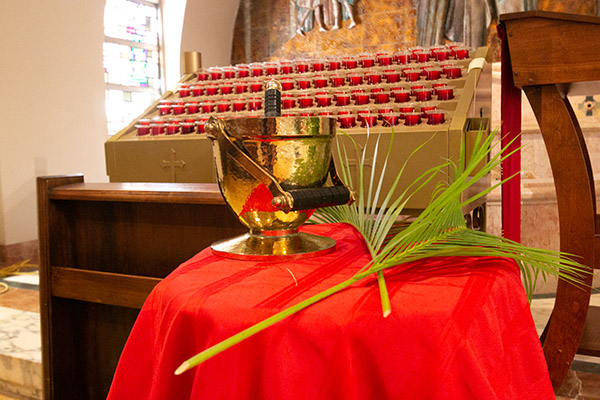
Fotógrafo: ANA RODRIGUEZ-SOTO | FC
Las palmas y el agua bendita descansan sobre un soporte en un altar lateral de la Catedral de St. Mary en esta foto de archivo. La mayoría de las ramas de palma que se usan en las iglesias de América del Norte para el Domingo de Ramos provienen de los Everglades de La Florida, tierras no urbanizadas de La Florida, Texas y la costa del Golfo de México.
The palm tree was used as an important symbol during holy assemblies. In Leviticus, the Israelites celebrated the feast of Tabernacles honoring the freedom they received from the hands of the Egyptians. “On the first day, you shall gather foliage from majestic trees, branches of palms...” (Lev 23:40)
Again, for the feast of Tabernacles, the gathering of palms is referenced in Nehemiah: “Go out into the hill country and bring in branches of olive trees, oleanders, myrtle, palm, and other leafy trees, to make booths.” (Nem 8:15)
King Solomon, understanding the significance of palms, had images carved into the walls of the temple. “The walls on all sides of both the inner and the outer rooms had carved figures of cherubim, palm trees and open flowers.” (1 King 6:29)
When Simon Maccabees liberated the citadel from the enemies of Israel, “... the Jews entered the citadel with shouts of jubilation, waving of palm branches.... because a great enemy of Israel had been destroyed.” (1 Mac 13:51)
IS IT ALWAYS PALMS?
No. Palm branches can be difficult to source throughout the Christian world. Because of this shortage, branches from other trees and bushes have been substituted for the Palm Sunday Mass. Such substitutes have included spruce, olive, and box elders.
In Poland and other Slavic nations, the pussy willow is used. According to Polish legend, Jesus visited a forest on Palm Sunday and commanded his angels to gather up pussy willows that had the first bloom of spring. And since the pussy willow twig can burst forth to life with a beautiful flower, it is a perfect substitute.
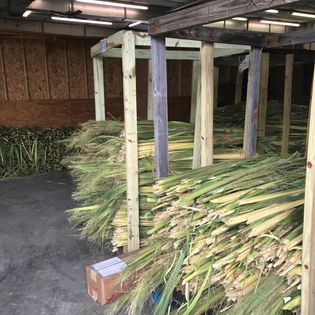
Fotógrafo: Thomas Sowell | Southeast Palm and Foliage
La mayoría de las ramas de palma que se usan en las iglesias de América del Norte para el Domingo de Ramos provienen de los Everglades de La Florida, tierras no urbanizadas de La Florida, Texas y la costa del Golfo de México. Y aunque la Iglesia Católica obtiene ramas de palma para esta Misa significativa, para los proveedores de palmas, este proceso es un trabajo de todo el año.
WHERE DO PALMS COME FROM?
The majority of palm branches used in North American churches for Palm Sunday come from the Florida Everglades, undeveloped Florida land, Texas, and the Gulf Coast of Mexico.
The process to harvest the palms is labor intensive. When harvested, the branches must be stored at approximately 25 degrees Fahrenheit for no longer than three weeks to guarantee freshness. And even though the Catholic Church obtains palm branches for this one significant Mass, for palm suppliers, this process is a full year-round job.
For many years there were only two major palm suppliers/farmers in the U.S. One such supplier is Thomas Sowell of Southeast Palm and Foliage in Astor, Florida. Sowell has been harvesting palms since the early 1970s. He also provides ash for Ash Wednesday services.
The majority of the palms he harvests are wild. He has developed relationships with local ranchers and landowners who harvest palms on their property for him.
Sowell explained that Florida’s palms have a long history; they have been harvested since 1520 and shipped up to the East coast to missions and settlements for Palm Sunday services.
The biggest challenge he is facing now deals with the increased land development in Florida due to the state’s growing population. Palm branches are becoming harder to get.
Every year his palms are an integral part of the Palm Sunday Mass throughout the U.S. and Canada. “I feel as if it is a calling, a purpose,” he said. “The responsibility is beyond words, and I am grateful for the opportunity to serve the Lord in this capacity.”
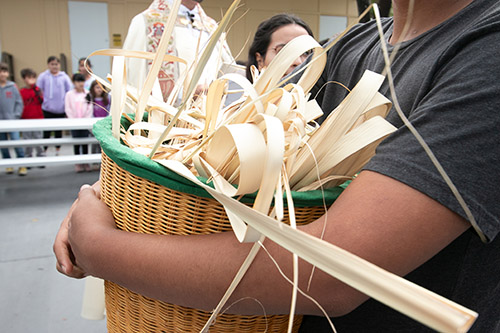
Fotógrafo: ANA RODRIGUEZ-SOTO | FC
En esta foto de archivo, un estudiante del programa de educación religiosa en la iglesia St. Matthew, en Hallandale Beach, sostiene una canasta con las palmas del Domingo de Ramos del año pasado, que se quemarán y se convertirán en las cenizas del Miércoles de Ceniza de este año.
ARE PALMS SACRAMENTALS?
Yes. Because the palm branches used for Palm Sunday have been blessed by a priest, they are now sacramentals. Parishioners can return their palms to the church or take them home and keep them for a year. Sacramentals must be treated with great respect, and these palms are never to be thrown away. The blessed palms can be given back to the church to be burned for Ash Wednesday, or they can be returned to nature by burying or burning them with the ashes spread outside.
YOUR PALMS
The simple palm branch is a reminder that God is a God of change. He can change blindness to sight. The lame walk. Lepers are cleansed. The deaf hear. He can transform sickness into health. Death to life. He can change a Good Friday into an Easter Sunday. That small palm branch in parishioners’ hands reminds them every day that God can transform their lives.
His victory over death – that is the victory represented in the palms.
FIND OUT MORE
Interesting facts about Palm Sunday of the Lord’s Passion:
- Date: April 2, 2023, the Sunday before Easter Sunday
- Also known as: Passion Sunday, Sunday of the Passion, Yew Sunday, Flower, Olive, Willow, Blossom, and Fig Sunday
- Type of feast: Solemnity
- Catholic parishes: Over 17,000 in the U.S. will be celebrating Palm Sunday
- Palm leaves: Over a million palm leaves will be used throughout the U.S. for Palm Sunday
- Color for Mass: Red. Symbol of blood and fire, used on feasts of martyrs, Apostles, Pentecost, and those connected to the Passion.
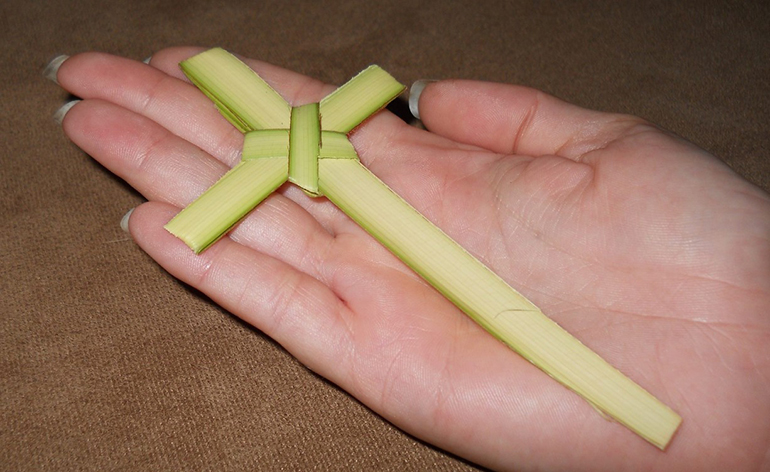
Fotógrafo: Thomas Sowell | Southeast Palm and Foliage
Debido a que las ramas de palma utilizadas para el Domingo de Ramos han sido bendecidas por un sacerdote, ahora son sacramentales. Los feligreses pueden devolver sus palmas a la iglesia o llevárselas a casa y conservarlas durante un año. Los sacramentales deben ser tratados con gran respeto, y estas palmas nunca deben botarse.