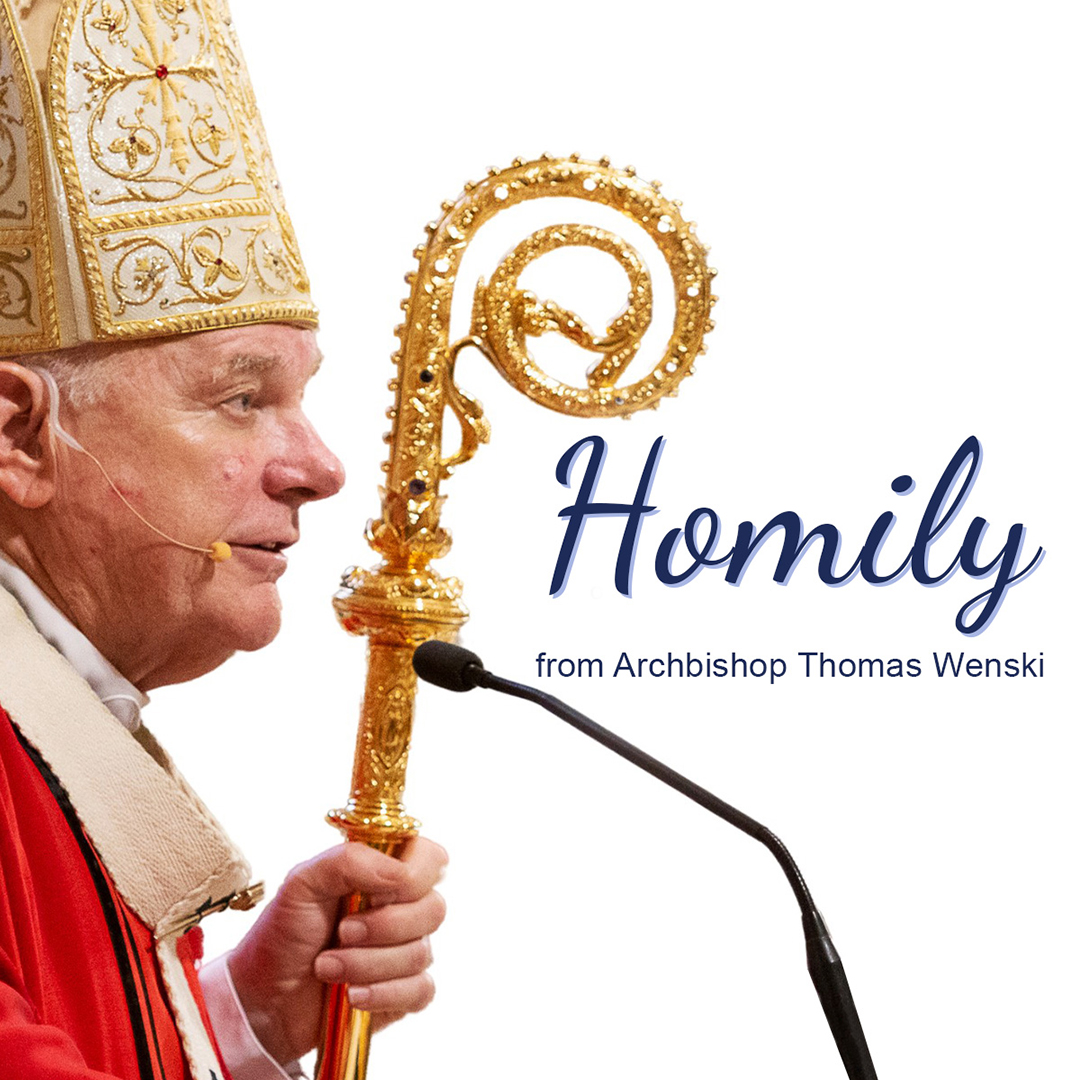
By Archbishop Thomas Wenski - The Archdiocese of Miami
Archbishop Thomas Wenski preached this homily during a Mass he celebrated Dec. 14, 2024, with the Catholic community in Ocean Reef (Key Largo) on the third Sunday of Advent.
Today, midway through Advent, the Liturgy exhorts us to “Rejoice”, we rejoice because the Lord is near.
We are in fact living in a time of great historical change; and we all can applaud much of what that change has brought us. Nobody would want to give up their smart phones or any other conveniences of modern life. Yet, we are beset by great challenges. And it is not difficult to recite a litany of woes that not only frighten us but leave us feeling helpless and powerless.
The world is at war: we struggle for peace: among nations, among ethnic groups, peace at home. We see mass migrations of peoples and here in South Florida we are surrounded by failed states – Haiti, Cuba, Venezuela and Nicaragua. Our nation faces a 50-year-old drug epidemic fueled by a co-dependency, a mutual addiction between the greed for money and the need for drugs.
We have issues that affect each of us: the family crisis. People are not getting married or having children much anymore. There are the economic and social inequalities that fuel unrest and despair in much of the world, our nation faces a 50-year-old drug epidemic fueled by a co-dependency, a mutual addiction between the greed for money and the need for drugs.
But, in the midst of so much “bad news”, the Church is to proclaim the “good news”. “The Lord is near”. Our mission is always to proclaim the “Joy of the Gospel,” and “to offer more evident signs of God’s presence and closeness.”
“The Lord is near.” That’s what all the scripture readings tell us today, Advent, with its call to repentance and a change of heart in advance of the Lord’s coming, is a time for us to clean up our act. So just like those who heard the preaching of John the Baptist, we too must ask, “What must we do?”
John the Baptist’s answer was to challenge people’s generosity and sense of fairness so that others may have reason to rejoice. Give bread to the hungry and clothes to those who have none. To tax collectors, to soldiers who provide the muscle to the tax collectors, he tells them to stop stealing from the poor and the weak and to be happy in doing what is just.
Now it would be easy to see John the Baptist as a bit of a scold. And too often the Church is perceived in the same way. John’s message is not just about condemning people for their bad behavior. (Once, I saw a cartoon that depicted John the Baptist saying, Jesus is coming – and boy is he mad.). But John’s message, Jesus’ message -his “good news”- is telling us about God’s mercy. It is always a call to conversion; our mission is not about condemning people but about leading men and women to salvation in the Lord.
“What should we do?” As John told his listeners to feed the hungry and clothe the naked, we both as individuals and as a Catholic community, are encouraged to perform more intentionally the Corporal and Spiritual Works of Mercy.
Advent is a call to repentance, to conversion, for if we do not recognize our need for God, if we don’t acknowledge that only He can save and that we cannot save ourselves, then what meaning would Christmas have for us?
This aspect of Advent, of course, is easy for us to miss, especially as the secular aspects of the Christmas season have us busy with Christmas parties and shopping. Many do spend a lot of time buying gifts and wrapping them up for Christmas Day.
But let’s be careful lest we get so absorbed in the gifts that we forget about the gift that is, after all, the reason for the season: the Christ Child, God become our own flesh, through whom, as we sing in the Christmas carol, “God and sinner are reconciled.”
A wise man once said, anybody wrapped up in himself or herself makes himself a very small gift. So, while we might spend some time wrapping gifts, What should we do? Advent reminds us that we must first unwrap ourselves, we must come out of our living only for ourselves, we must come out of our self-absorption, our self-centeredness, our self-pity to be able to welcome the Lord who comes into our lives.
And so as not to intimidate us, or frighten us, or shame us, He will come as a little child, a little bambino, with arms outstretched, seeking our embrace, our love.
God enters into our lives and offers each one of us new hope.
Gaudete! Rejoice!