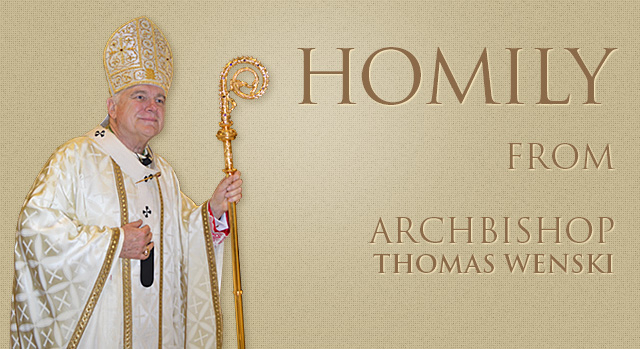
By Archbishop Thomas Wenski - The Archdiocese of Miami
Archbishop Thomas Wenski preached this homily Sept. 18, 2016, during the annual Mass of the Holy Spirit celebrated at the beginning of each academic year at St. John Vianney College Seminary in Miami.
There's a story about little Johnny who was quite a handful and often would exasperate his mother. One time, she lost patience with him and shouted at him "Johnny, you're good for nothing.” Of course, Johnny's mother didn't mean what she said. And thankfully, Johnny was not a fragile child. He gave as good as he took: With an impish grin, Johnny looked at his mother and said, “I am too good for something. I am good for being a bad example.”
Well, in today's Gospel, Jesus presents the dishonest steward not because he wanted to praise or commend his dishonesty. What we have here is a ingbad person giving a good example. Jesus obviously thought that this rascal would be a perfect illustration for a spiritual lesson about the Kingdom of God.
What's the point that Jesus is trying to make? He is commending the steward for his shrewdness � or as we heard in the Gospel � "for acting prudently.” Obviously, the steward was in a real jam, but he was shrewd enough, prudent enough to assess his situation and act decisively with some foresight. Now, of course, Jesus is concerned here with something more important than a financial crisis. He is concerned that we avert spiritual crisis through the exercise of faith and foresight. In other words, he is saying, "Shouldn't we believers expend as much energy and forward thinking about spiritual matters that do have eternal consequences as much as we do in earthy matters which have consequences that are only temporal?” If we did so, Jesus is telling us, we would be better off, both in this life and in the life to come.
Last Sunday, you might have heard the parable of the Prodigal Son � he took his share of his father's inheritance and squandered it; and the steward squandered his master's property. But both took steps to assure their futures. Again, what Jesus is concerned with is the lack of spiritual foresight on the part of His followers. “For the children of this world,” Jesus says, "are more prudent in dealing with their own generation than are the children of light." The point is that we all ought to be as foresightful and prudent in planning ahead for our spiritual futures as the worldly-wise are in planning ahead for their financial and material futures. So, he is telling us to be just as enterprising � not in wrong doing � but in caring for the future of our souls.
So the question to ask ourselves � in light of the Scriptures we have heard � is simply: How zealous am I in providing for my spiritual future? To assume that God is some sort of Sugar Daddy in the sky who is going to take care of me no matter what I do is not a prudent course of action. Of course, our God is a God of mercy � a God who believes in second chances, and often third or fourth chances. But to assume that what I do or what I don't do in this life doesn't matter really insults God who is merciful, but also just.
Today's Gospel reading ends with Jesus saying, "No servant can serve two masters. He will either hate one and love the other, or be devoted to one and despise the other. You cannot serve both God and mammon.”
These words also invite some reflection about what we consider to be our possessions. If we think prudently � not in worldly terms as the dishonest steward � but as "children of the light,” then we have to acknowledge that what we have we do not own outright. In fact, the only things that we can claim to own are our sins; the rest belongs to God and we hold that in trust � and it's all going back to God eventually. St. Ambrose, a 4th century bishop, said in speaking about the Gospel parable in which a rich man decided to build bigger barns to store his wealth and then died before he could enjoy it: "The bosoms of the poor, the houses of widows, the mouths of children are the barns which last forever." True wealth consists not in what we keep but in what we give away.
Love of money and wealth can easily crowd out love of God and love of neighbor. And so, Jesus makes clear that our hearts must either be possessed by God's love or our hearts will be possessed by the love of something else. If that's true � and we know it is � can we learn something from the "bad example" of the dishonest steward and commit ourselves to a prudent course of action in caring for the future of our souls?
Today, at the beginning of a new academic year, we invoke the Holy Spirit as you begin another year of formation in your discernment of your futures. We pray that you will be truly wise � and exercise an honest stewardship of the gifts entrusted to you. The years spent here at St. John Vianny should not be squandered. You will hear often about the four pillars of priestly formation: These pillars are the human, the academic, the pastoral and the spiritual. To progress in formation requires your active participation and cooperation. What’s at stake is not a career or a profession. And to be sure, a B.A. in philosophy is not going to guarantee you a high paying job. But what is at stake is your spiritual future and that of the dioceses � the local churches � for which you are studying.
There is a hymn which we sing from time to time in the Liturgy of the Hours. I think it sets forth a program for you to follow � under the guidance of the Holy Spirit � as you begin this academic year.
Lord Jesus,
once You spoke to men
Upon the mountain and the plain,
O help us listen now as then
And wonder at Your words again.
We all have secret fears to face,
Our minds and motives to amend.
We seek Your truth, we need Your grace,
Our living Lord and present friend.
The gospel speaks; and we receive
Your light, Your love, Your own command.
O help us live what we believe,
In daily word of heart and hand.