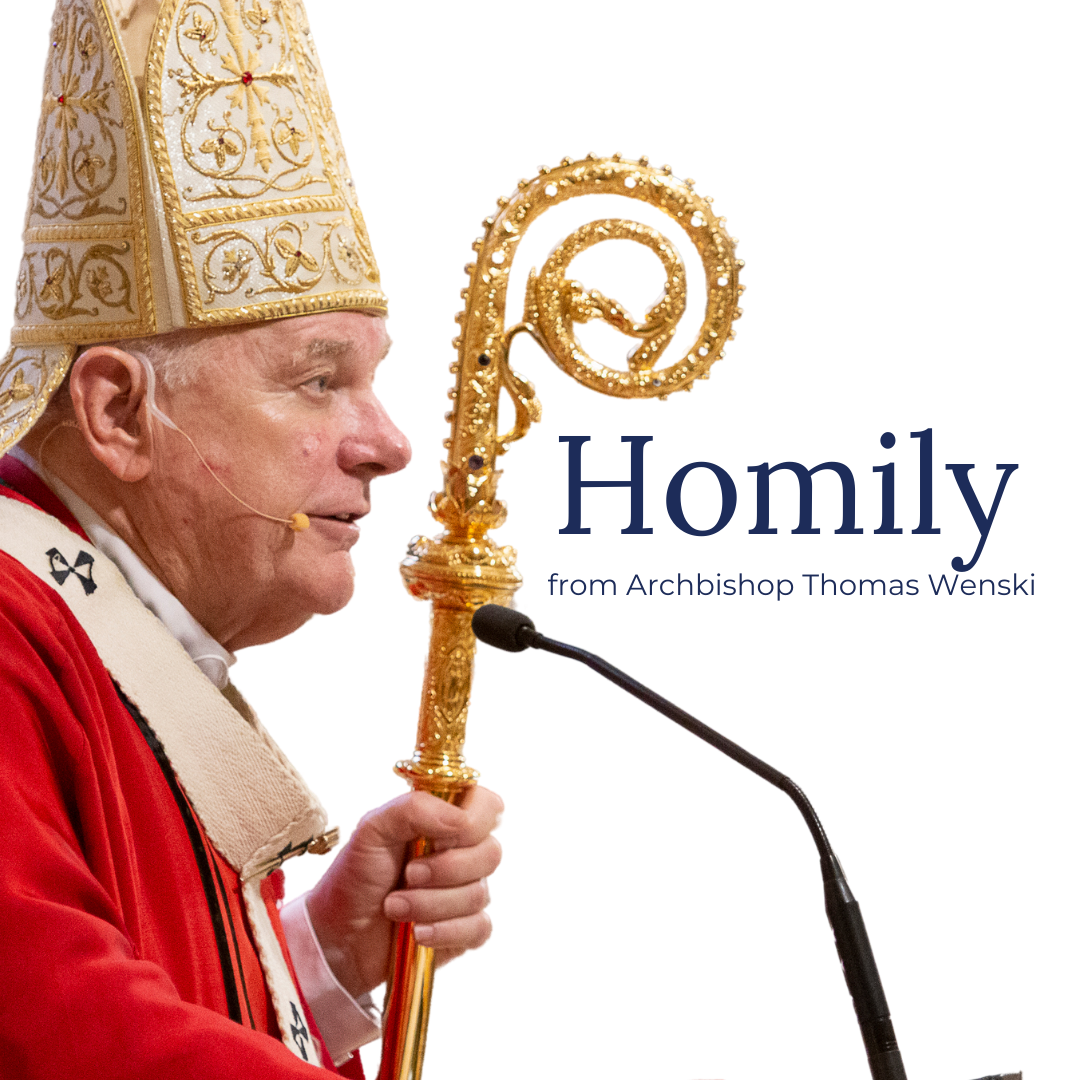
By Archbishop Thomas Wenski - The Archdiocese of Miami
Homily by Archbishop Thomas Wenski at Mass with the Filipino community in Miami for the Feast Day of San Lorenzo Ruiz. St. Mary Cathedral, Sept. 27, 2026.
Once again, we gather in St. Mary’s Cathedral, the Mother Church of our Archdiocese, to celebrate San Lorenzo Ruiz, the first canonized Filipino Saint and proto martyr.
And it happens that today the universal Church also marks the World Day of Migrants and Refugees. Perhaps, we should see this as a “double blessing”. For his story is the story of thousands, of millions of migrants and refugees.
Falsely accused of a crime, this ordinary man – a husband, a father of three, an Escribano (calligrapher), was forced to flee Manila. He had to leave his homeland on a ship, stepping into the terrifying unknown. He became an immigrant, a refugee, an overseas worker. When we look at San Lorenzo, we see the story of the Overseas Filipino Worker, the story of an immigrant, the story of every family in these pews who sacrificed everything to build a life across the ocean.
In today’s Gospel from Matthew, Jesus speaks of the two sons. The first son says "no" but later changes his mind and works the vineyard. The second son says "yes" with polite words but never goes.
Filipino culture is deeply rooted in respect, paggalang; and sometimes that means just saying "yes" to keep the peace. But Jesus reminds us that a "yes" to God has to be more than polite words. It must be a yes lived out through actions.
The Haitians say: Di wi, pa monte mòn. Saying “yes” doesn’t get you over the mountain.
When he was arrested in Japan and subjected to brutal torture, he faced a moment of profound temptation to say "yes" to his captors and deny Christ just to save his skin.
But his faith wasn’t just on his lips. His action matched his faith. He gave the ultimate "yes" to the Father when he famously declared: “Isa akong Katoliko... Had I a thousand lives, all these to Him I shall offer.” Like the son who went to work in the vineyard, Lorenzo showed his fidelity not through comfortable words, but through the sacrificial giving of his very life. His “yes” led him to climb the mountain of Calvary with Jesus.
St. Paul tells the Philippians to “have in you the same attitude that is also in Christ Jesus.” Christ emptied Himself, taking the form of a servant.
Jesus’ humility – and his compassion – certainly inspired Lorenzo Ruiz as he faced the difficulties of being uprooted from his native land. But your own lives in the “diaspora” have also been “an imitation of Christ”. Think of the sacrifices made by nurses, care providers, teachers, and laborers working long hours in the United States, emptying themselves of comfort to send remittances home, supporting families, and building up parishes.
But your immigrant story – with its joys and its sorrows - must open our hearts to others. Having the "same attitude that is also in Christ Jesus’ means we cannot close ourselves to others. We are called to welcome, protect, promote, and integrate the new strangers at our own doors, just as we once hoped to be welcomed.
To welcome means letting go of fear-driven rhetoric and making space in our communities and our pews for the stranger.
To protect means standing as a shield for the vulnerable who arrive with nothing-no rights, no language, and no allies.
To promote means lifting up their human dignity, sharing their stories, and recognizing the immense gifts they bring rather than seeing them as a burden.
To integrate means tearing down the walls we build in our societies and replacing them with bridges of true belonging.
San Lorenzo Ruiz did not choose to leave Manila to become a martyr; he left as a frightened migrant seeking safety. Yet, God used his displacement to manifest the greatest witness of faith in the history of your homeland.
Your presence here as Filipino Americans is not an accident of geography or economics. It is a mission. You are the modern-day Escribanos, writing the love of God into the fabric of this country through your joy, your deep faith, and your hospitality.
At the Lord’s table, there are no foreigners and no outcasts; there are only sons and daughters of God. So on the feast of San Lorenzo Ruiz and on this World Day for Migrants and Refugees, as we approach this altar today, let us pray for the strength to look past our borders and our differences. May we see every migrant and refugee not as a headline or a political crisis, but as a brother, a sister, and a mirror of Christ, who knows what it means to search for a safe place to call home.
Let us pray through the intercession of San Lorenzo Ruiz. When the challenges of living in a foreign land weigh heavily on us, may we find the courage to say, “Isa akong Katoliko.”Viva San Lorenzo Ruiz!

