By Priscilla A. Greear - Florida Catholic
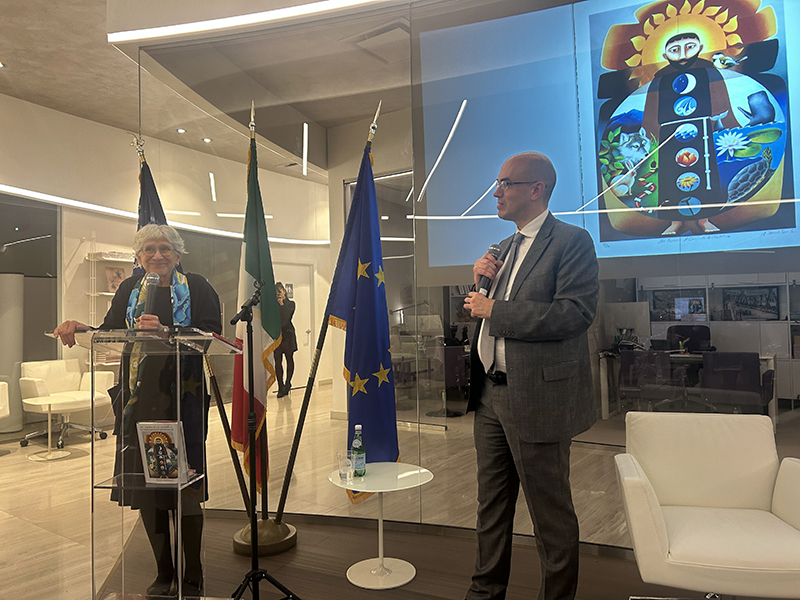
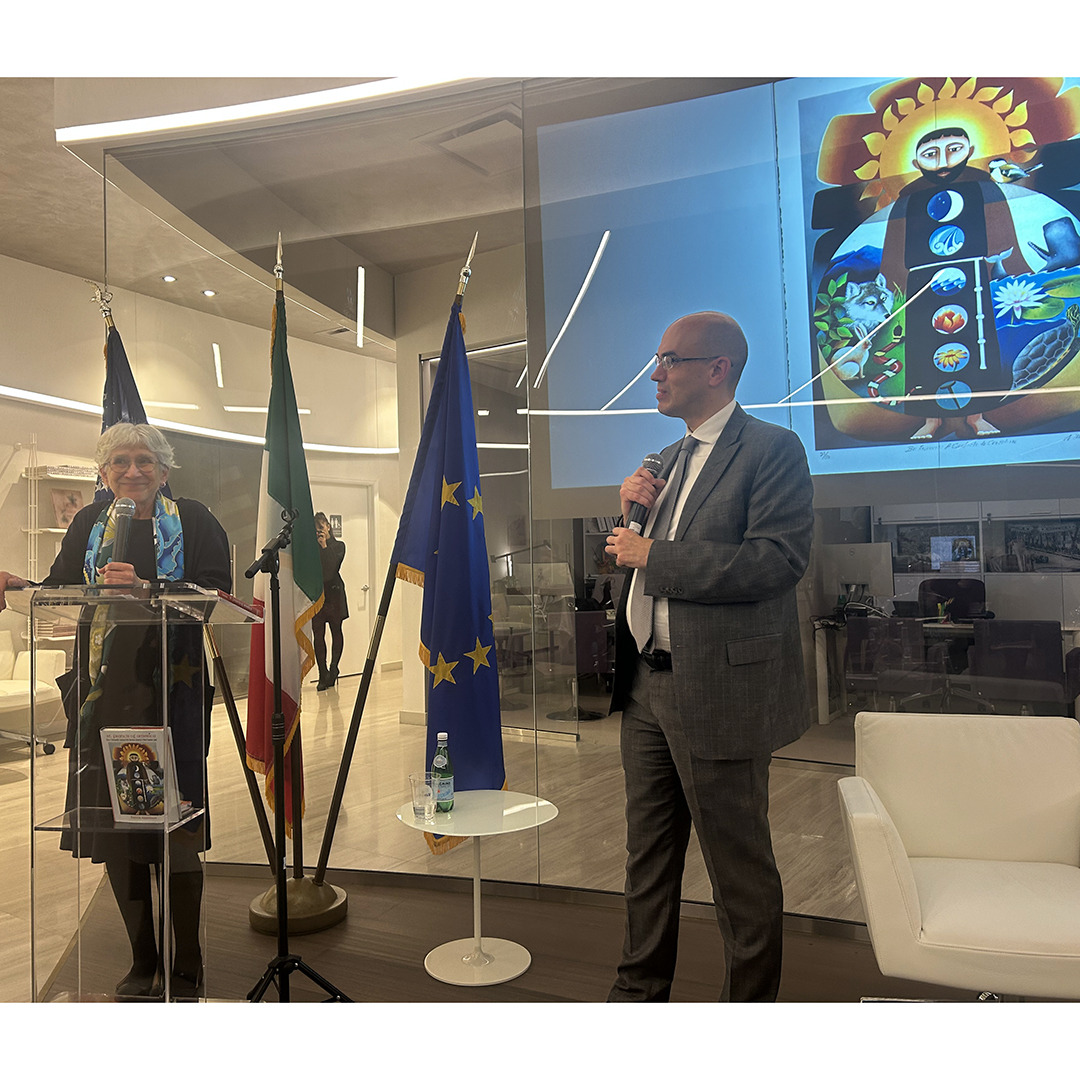
Photographer: PRISCILLA GREEAR| FC
Prof. Patricia Appelbaum lectures on the spiritual and cultural legacy of St. Francis of Assisi in the United States at the Italian Institute of Cultural of Miami located in Coral Gables. Standing next to her is Stefano Cerrato, director of the Institute. The event marked the 800th anniversary of his death.
CORAL GABLES | Through the history of the United States, St. Francis of Assisi has reigned as America’s quintessential saint: from an evangelical preacher, a bridge to Protestants and a guardian of creation to a social Gospel reformer, a hippie icon and an ambassador of Italian civilization.
As America marks its 250th centennial, Italy commemorates the 800th anniversary of the death of its beloved patron saint in 2026, with his feast day of Oct. 4 as a new Italian national holiday. Marking the celebration, the Italian Institute of Culture of Miami in Coral Gables hosted a lecture by independent scholar Professor Patricia Appelbaum on her book “St. Francis of America: How a Thirteenth Century Friar Became America’s Most Popular Saint.”
Appelbaum discussed the celebrity saint’s down-to-earth spiritual and cultural legacy in the United States with his message of love for neighbor, the stranger and creation. Italian Americans gathered on Jan. 20 at the institute, opened in 2024 to foster cultural exchange between Italy and Florida.
Father David Zallocco, parochial vicar of the Church of the Little Flower in Coral Gables, who was ordained last year and began to celebrate Sunday Mass in Italian, represented the Miami Archdiocese.
Appelbaum reflected on St. Francis’ gentle call to faith and action. “American Protestants who didn’t love saints came to love Francis. He has often been the symbol of connection with Italy, of settlement houses and peace movements and missions and shelters, simple living and voluntary poverty. He has lived in suburban gardens, churches and dog chapels and the wealthiest estates. People have embodied him, spoken in his voice. He has suffered with debtors and outcasts and the sick. He has been a true mirror of Jesus,” Appelbaum said.
“He’s a person across boundaries, not only between Protestant and Catholic but between Christians and other religions and those outside religion and our nation. I would like to think that it doesn’t get much more American than that.”
Consul General Michele Misto of the Consulate General of Italy of Miami explained that “cultural diplomacy” is an essential part of Italian foreign policy and said that the Italian government called on institutes, consulates and embassies worldwide to mark the anniversary. “Culture is an act of sharing values, sharing viewpoints and exchanging them. And it’s beautiful that St. Francis has been calling us all over the world to this vocation,” he said.
St. Francis model for peace and dialogue
St. Francis is a model for peace and dialogue and a founding father of literature starting with “The Canticle of the Sun.”
“We remember him in our art, our literature, in our history. We don’t remember him only as a saint, a holy figure, as the patron saint of Italy, but also as a man in his weaknesses, in his values, in his strife and in his triumphs,” Misto said.
St. Francis was the son of a wealthy Assisi merchant who lived from 1181-1226. He was captured during a military expedition and turned to God, renouncing wealth and living in poverty.
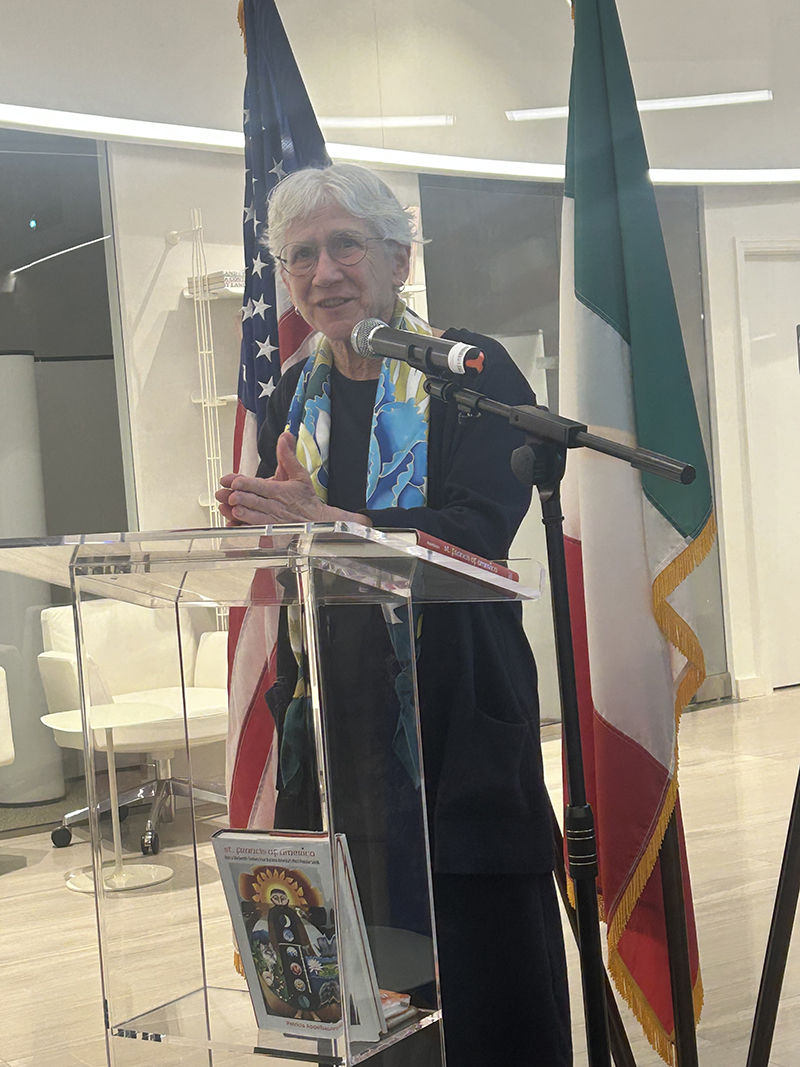
Photographer: PRISCILLA GREEAR| FC
Prof. Patricia Appelbaum lectures on the spiritual and cultural legacy of St. Francis of Assisi in the United States at the Italian Institute of Cultural of Miami located in Coral Gables. The event marked the 800th anniversary of his death.
He ate with lepers, cared for the sick and met with the Egyptian sultan during the Crusades. He founded the Franciscans and attracted thousands. “He wanted to own nothing and have no permanent residence. He wanted to identify with Christ,” said Appelbaum.
The scholar described how Franciscans journeyed with Spanish explorers to the Americas and that there were once 36 Franciscan missions in Florida and Georgia. Franciscans established cities like San Francisco. Protestants suspicious of Catholic devotions eventually warmed to the friar in a nostalgic medievalist spirituality movement during the industrialization of the 1800s.
Seekers of the Transcendentalist and interfaith movements also embraced him. With westward annexation in 1843 Protestants encountered more Catholic immigrants and wealthy Americans journeyed to Rome for art and culture. “Italy was particularly important to American travelers partially because they saw Roman civilization as one of the roots of democracy,” Appelbaum noted.
He emerged as the image of Christ with his purity, poverty and love of nature. “This was a groundbreaking idea to show that it’s possible to live like Jesus,” she said. “We don’t need to decide if Catholics or Protestants got it right. We just go out and take action like Jesus and Francis did,” explained Appelbaum.
By the early 1890s his statue began to appear in estate gardens and later in church grounds. One New Hampshire estate featured a meditative Francis statue looking at birds rather than a crucifix, which universalized him, and reflected the owners’ concern for the poor.
Reformers began to embody his care for the poor in the Catholic Worker Movement of the 1930s. The “Prayer of St. Francis” became ubiquitous by 1942 even though he didn’t write it.
St. Francis patron saint of ecology
After World War II seekers sought Francis through Roman pilgrimages as well as artworks. By 1967, Francis became the “original hippie” of San Francisco’s counterculture. In the 1970s he was adopted by the environmental movement and St. John Paul II declared him the patron saint of ecology.
In 1984 the Cathedral of St. John the Divine in New York held a grand blessing of the animals, which popularized the ritual and led to pets being viewed as family members.
Pope Francis wrote his environmental encyclical Laudato Si and reignited the Franciscan spirit. “He lived simply and made poor people a priority and he turned the church’s attention to environmental issues,” Appelbaum noted.
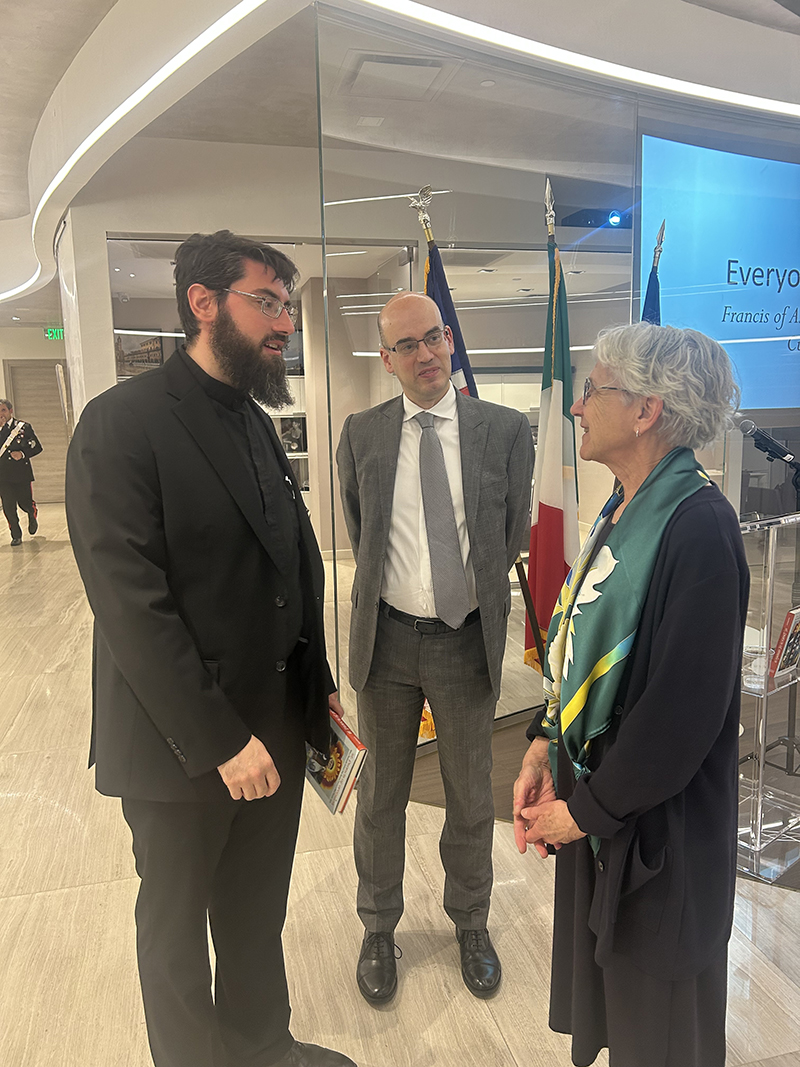
Photographer: PRISCILLA GREEAR| FC
Father David Zallocco speaks with Prof. Patricia Appelbaum, author of “St. Francis of America: How a Thirteenth-Century Friar Became America’s Most Popular Saint,” at the Italian Institute of Culture on Jan. 20, 2026. Looking on is the institute director Stefano Cerrato.
Joseph Gulino, vice chair of international affairs of the National Italian American Foundation, noted the historic role of the Church and St. Francis in strengthening Italian immigrant communities.
“The Catholic Church was so important as a community, as a base for the immigrants coming to the U.S. That’s why so many Italian Americans in the U.S. still consider themselves Catholic,” Gulino reflected.
Father Zallocco affirmed St. Francis’ call to peace-building and humility. “When Christ is at the center of everything it gives you meekness and makes you live in communion.”
He finds inspiration from St. Francis’ radical surrender to Christ. “He was so close to Christ that Christ made him like himself crucified,” Father Zallocco explained.
“In personal crises, in moments when I feel afraid, I think of St. Francis. If God did it for him, he can do it also for me.”