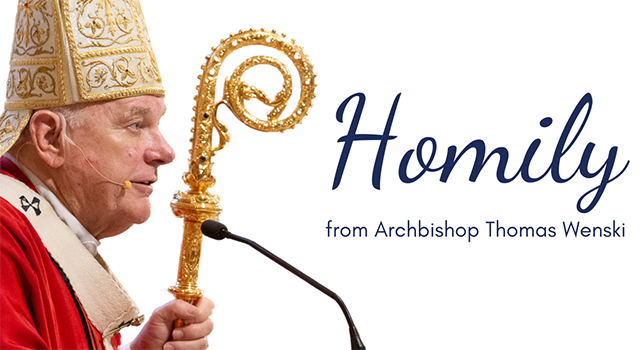
By Archbishop Thomas Wenski - The Archdiocese of Miami
Archbishop Thomas Wenski preached this homily while celebrating the vigil Mass for the Second Sunday in Ordinary Time at Assumption Church in Lauderdale-By-The-Sea, Jan. 13, 2024.
“Speak, Lord, for your servant is listening.” In our first reading this is how Eli instructed Samuel to answer the next time he heard the Lord call out “Samuel, Samuel.”
“Listening” is increasingly a lost art in our culture. The French have a saying, “Dialogue des Souds” or a dialog of the deaf and it refers to a conversation or interaction in which two or more people are unable or unwilling to truly listen or understand each other’s perspective, resulting in a lack of meaningful communication.
We see this inability or unwillingness to listen or understand the other with the Palestinians and the Israelis, we see it with Republicans and Democrats, with conservatives and liberals. In fact, “dialogue des souds” or dialog of the deaf pretty much describes much of what passes for political debate today in this time of increasing polarization, doesn’t it? We shout at each other, but one doesn’t listen to the other. 2024 is going to be a long, noisy year.
And since the Church is in the world – and the world is in the Church – we can find a similar “deafness” or the inability or unwillingness to hear and listen to one another. I think this explains why Pope Francis is so keen on promoting “listening sessions.”
We need to recognize the signs of this “dialogue of the deaf” and then try to remedy it by striving for effective communication through actively listening, being open to different perspectives, avoiding assumptions, managing emotions, and seeking common ground to facilitate meaningful dialog and problem solving.
In the Gospel reading, John the Baptist points to Jesus, there is the Lamb of God, and sends his disciples to him. “Come and see,” Jesus invites them – and they spend the day with him, talking and listening to the point that they believe they have met the Messiah.
“Come and see” is the first step on the path of discipleship. Notice that Jesus doesn’t start off by telling them about the Cross – he doesn’t start off telling them about the Holy Eucharist and how he will change bread and wine into his very Body and Blood. He starts off with an invitation, with an offer of friendship, he initiates a relationship of trust.
And we should seek to evangelize others in the same way – with an invitation to come and see, with an offer of friendship, in a relationship of trust.
I think this is what Pope Francis is striving to do when he insists that we be a welcoming Church – and that all, no matter the messiness of their lives, are welcomed. Some are taken aback, some are scandalized – and don’t forget that Jesus scandalized the Pharisees because he ate and drank with sinners.
“Come and see,” as I said, is the first step on the path of discipleship; but it is not the last step. The Gospel is given as an invitation to all. Come as you are – but don’t stay as you were. Discipleship means to walk with Jesus – and he will lead us to glory – but the road to glory passes along the way of the Cross, the way of conversion of our minds and hearts. As Christians, our task is not to change the Gospel but to allow the Gospel to change us. I think one reason we call ourselves “practicing Catholics” is that we recognize that each one of us needs to keep “practicing” until we get it right.
And so, we hear St. Paul tells us in the second reading, “…you are not your own. For you have been purchased at a price.” “Do you not know that your bodies are members of Christ? But whoever is joined to the Lord becomes one Spirit with him. Avoid immorality.” I think it’s pretty clear – as Catholics we ask the Lord to forgive our sins, not to bless them.
“Speak, Lord, for your servant is listening.” I don’t know what your morning prayer is when you first wake up, or what prayers you say before retiring at night, but “Speak, Lord, your servant is listening” would be a good one to add to your repertoire of prayers. It could also remind us that our prayers should not be just monologs – with us doing all the talking – prayer should always be a dialog. We talk to God, but we also must listen to him if we are to know his will.
When a child is baptized, the priest or deacon touches the child’s ears and mouth praying:
The Lord
Jesus made the deaf hear and the dumb speak.
May he
soon touch your ears to receive his word,
and your
mouth to proclaim his faith,
to the
praise and glory of God the Father.
Let me repeat this prayer of Ephphatha once more and please when I do so touch your ears and your mouths as I pray.