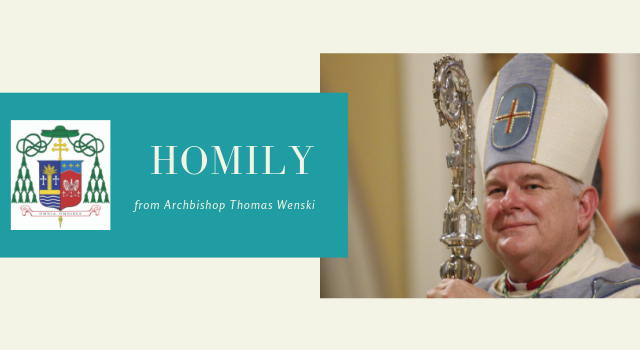
By Archbishop Thomas Wenski - The Archdiocese of Miami
Archbishop Thomas Wenski preached this homily during a Mass Feb. 24, 2022 at St. John Vianney College Seminary in Miami. The Mass was concelebrated by all the bishops of Florida, gathered at the seminary for their bi-annual Board of Trustees meeting.
In today’s Gospel, Jesus speaks some harsh words. And as Scripture scholars are quick to reassure us, Jesus does not mean that we should literally cut off our hands or our feet or pluck out our eyes if they should be occasions of sin. But he uses Semitic exaggeration to drive home a point – and we should hear in these harsh words the depth of Jesus’ concern for the “little ones.” To lead astray the needy, the helpless, the defenseless is the blackest of sins deserving the punishment of Gehenna. Gehenna was Jerusalem’s city dump where maggots feed on the refuse and fires burn constantly. Quite a metaphor for hell.
And this is essentially what St. James is telling us in the letter that we have been hearing this week in our first readings. This should provoke within us a sincere examination of conscience. After all, when compared with most of the world’s population, we are rich, well fed, and comfortable.
I am sure many of you have already visited the shelter and soup kitchen of the Missionaries of Charity near downtown Miami. In the sisters’ chapel – and in every chapel of the Missionaries of Charity – you will find next to the crucifix these words of Jesus: ‘I thirst.’
Mother Teresa taught her sisters that their vocation was and is the love of Jesus and that they were to recognize Jesus – Jesus who suffers, Jesus who thirsts in every person.
She would say, “I see Jesus in every human being. I say to myself this is hungry Jesus; I must feed him. This is sick Jesus. This one has leprosy or gangrene. I must wash and tend to him. I serve because I love Jesus.” And if people “are unreasonable, illogical and self-centered. Love them anyway.”
Jesus says in his parable of the Last Judgment, “Whatsoever you do to the least of my brethren, you do to me.” Or as Pope Francis says, “to ignore man’s suffering is to ignore God.”
In this sense, there can be no true worship of God if our worship does not bring us to serve our neighbor. But this service of neighbor cannot be sustained without constant and continued prayer. Prayer, to quote Mother Teresa again, "makes the heart large enough until it can contain God’s gift of himself.”
For this reason, Jesus gives himself to us hidden under the appearances of bread and wine so that we give ourselves to him as he appears to us hidden in various disguises — even those most disagreeable ones.
Jesus comes to give us a new commandment: to love one another just as he has loved us. If we have the salty seasoning of Jesus’ spirit in us and stand up for the just rights of God’s ‘little ones,’ we might encounter ridicule or opposition, but we will have peace of mind.
“I thirst,” Jesus cries out in the persons of the exploited, the excluded, the forgotten or the discarded. But if anyone gives even a cup of water to another in the name of Christ, it changes everything. Love changes everything.