By Jim Davis - Florida Catholic
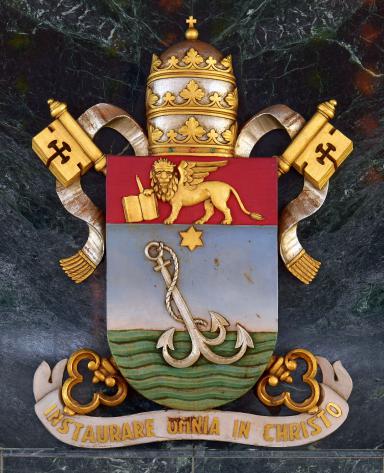
 Instead of the Last Supper, a traditional image on the front of the altar, St. Pius X shows the coat of arms of its patron saint.
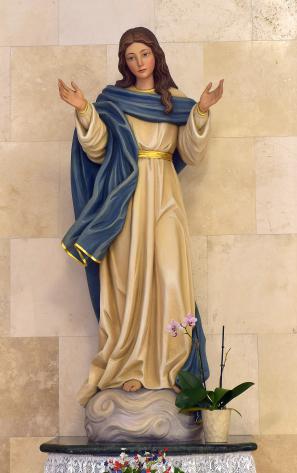
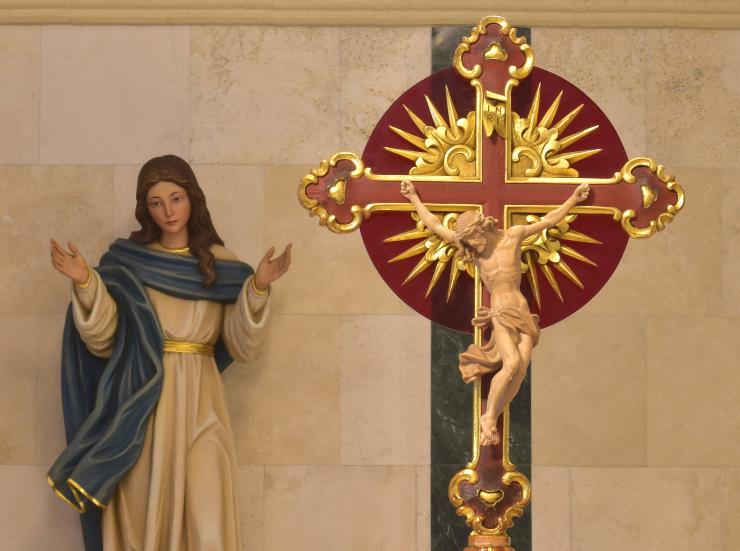
 In this statuette, Mary is portrayed as a young girl with unveiled hair.
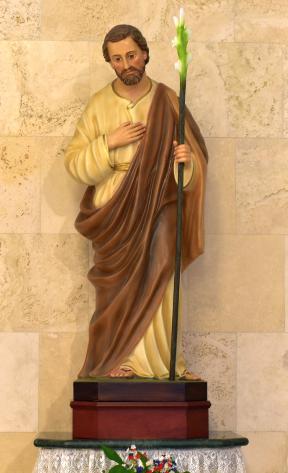
 Statuette of St. Joseph poses him with a flowering staff. A legend says the rod bloomed when he met Mary, as a divine sign that he was to marry her.
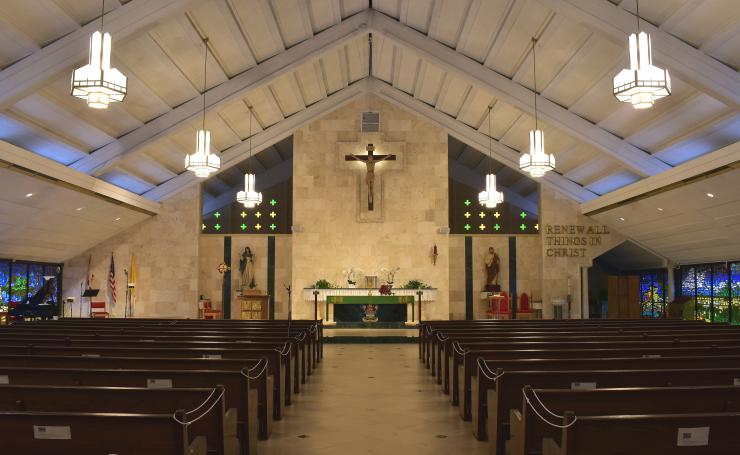
 The statuette of Mary seems to emulate the posture of the Christ corpus on the processional cross.
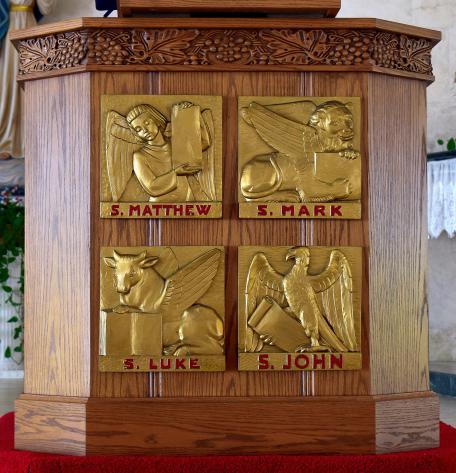
 Bas-relief on the pulpit shows winged creatures associated with the four evangelists: a man for St. Matthew, a lion for St. Mark, an ox or calf for St. Luke, an eagle for St. John.
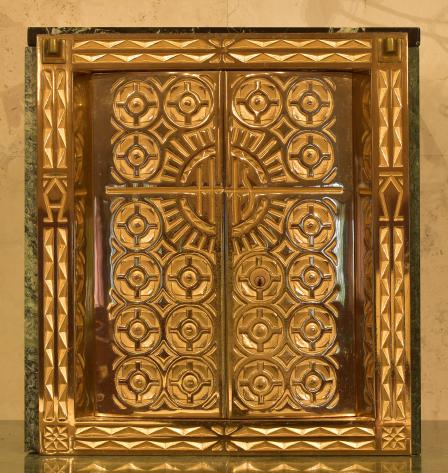
 Ornate Tabernacle holds the consecrated bread of the Eucharist.
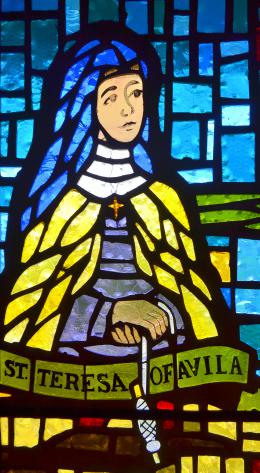
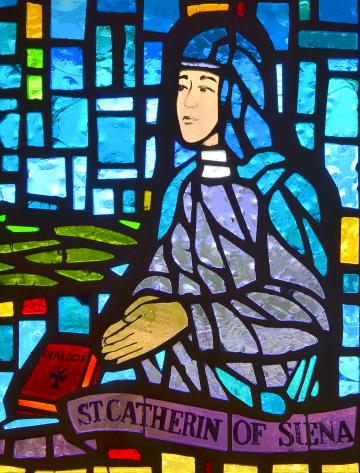
 Panoramic window for the Woman's Club shows two female Doctors of the Church: St. Teresa of Avila, left, and St. Catherine of Siena.
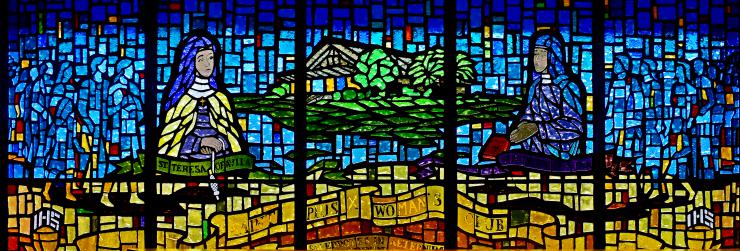 St. Teresa of Avila was a 16th century noblewoman who became a Carmelite nun.
 St. Catherine of Siena was a 14th century mystic who prodded Pope Gregory XI to return to Rome from Avignon, France.
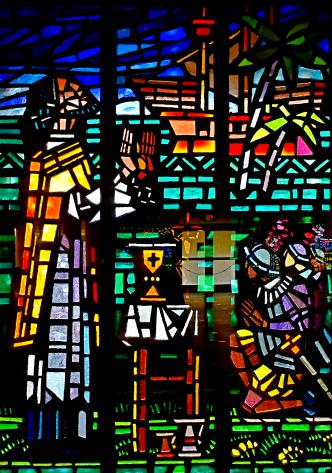
 This faceted window shows a priest celebrating Mass for Spaniard soldiers in the New World.
 Noah makes an offering of thanks after the flood, with a rainbow in the background.
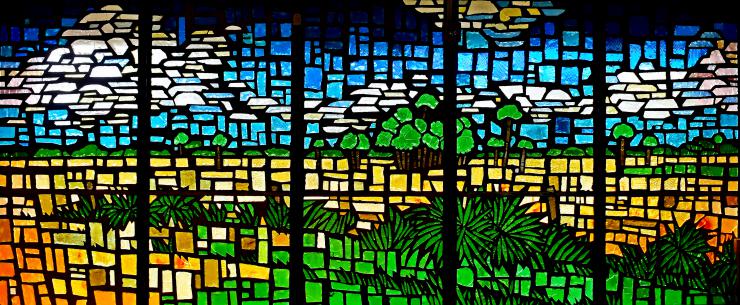
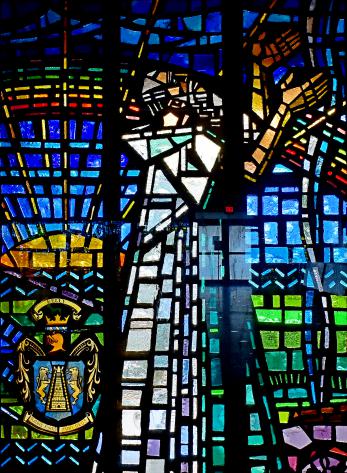 Faceted-glass window offers a sweeping view typical of South Florida.
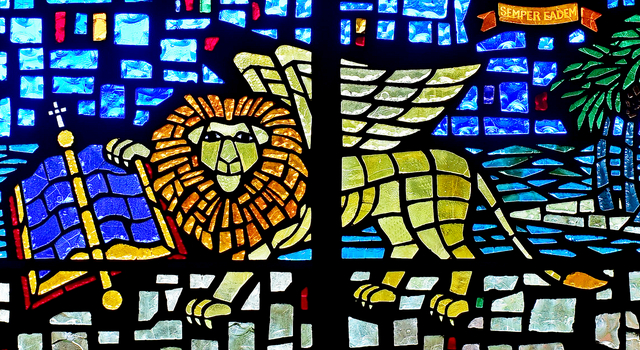
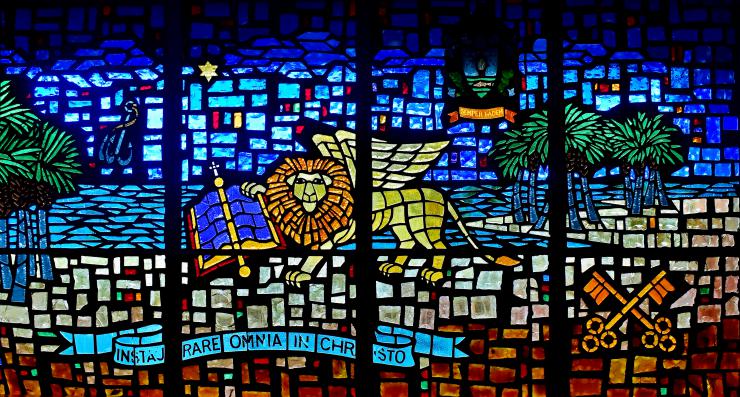
 A winged lion, from St. Pius X's coat of arms, stands on a Florida shore in this faceted-glass window. The phrase, "Instaurare Omnia in Christo," was Pius' motto: "Restore all things in Christ."
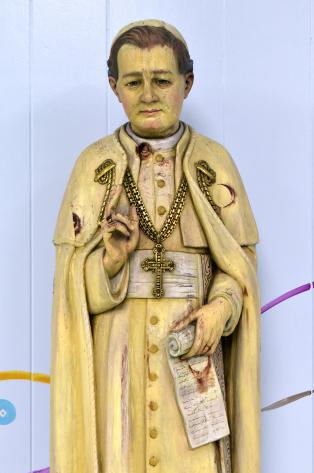
 A grave-looking statuette of St. Pius X offers a blessing. Pius actually was known for his quick wit.
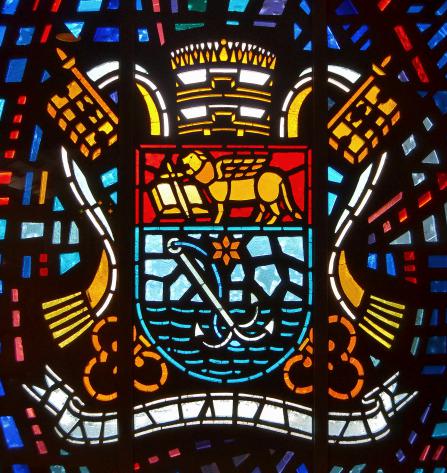
 St. Pius X's coat of arms is rendered in faceted glass at the main entrance to the church.
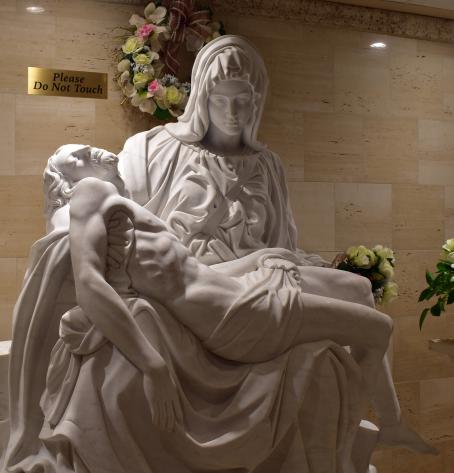
 A replica of La Pieta by Michelangelo stands in the narthex.
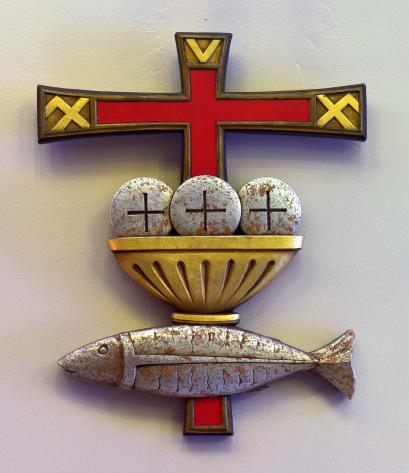
 This wall decoration includes a fish and bread, recalling when Jesus fed 5,000 people. But the bread loaves are marked with crosses, relating them to the Eucharist.
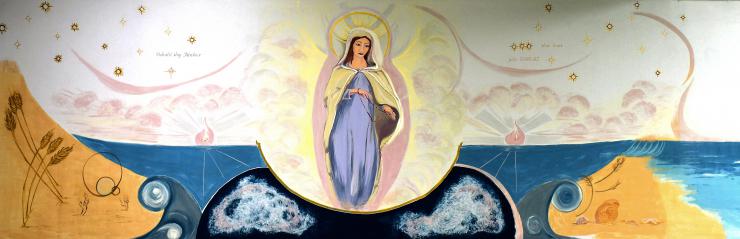
 'Behold Thy Mother,' a mural in the parish hall, was painted by a church member.
 St. Bernadette kneels before Mary at a grotto outside St. Pius X Church.
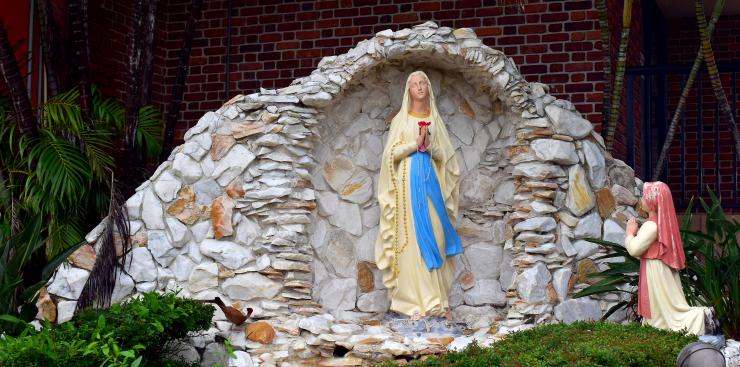 A cascade of water flows from the grotto.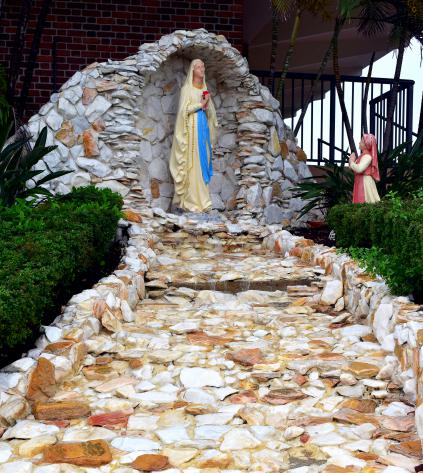
Photography: JIM DAVIS | FC
FORT LAUDERDALE | This month’s patron saint was a self-described poor man who ascended to the papacy, then set the stage for the Church of today. St. Pius X, whose feast day is Aug. 21, made sweeping changes in how the Church ran and how people learned, sang and worshiped.
Through it all, he retained a rigorous humility. “I was born poor, I lived poor, I will die poor,” he said in his last will and testament.
The future Holy Father was born in 1835 in the Venetian region, son of a mailman and a dressmaker. It may have been only a poor Italian family, but Giuseppe Sarto knew what he wanted: At the age of 11, he told his father that he wanted to become a priest.
Bepi, as he was nicknamed, got his break when his pastor arranged for him to attend a nearby Catholic school. He graduated at 15, then attended seminary in Padua – graduating first in his class each time. He was ordained at the age of 23.
At his first parish, in a farming village, Father Sarto showed dual gifts of preaching and teaching. He began an after-school program for youths, then evening classes for adults.
He got his first pastorate at 32, aiding the poor and supporting the local hospital. His bishop, recognizing Father Sarto’s talents, appointed him chancellor of Treviso and spiritual director of the local seminary. He also raised support for a nearby hospital.
He became bishop of Mantua in 1884, then was elevated to cardinal only nine years later. But he brought his love of worship and education with him, personally teaching theology to seminarians.
After Pope Leo XIII died, Monsignor Sarto was elected pope in 1903 by 55 out of 60 votes. He greeted his new post reluctantly, choosing the name Pius. “As I shall suffer,” he quipped, “I shall take the name of those popes who also suffered.”
He took as his papal motto Instaurare Omnia in Christo (“Restore All Things in Christ”), and his 11 years at the Vatican reflected that value. He codified canon law and reformed the Curia, the Church’s governing body. He opposed Modernist theology, which made religious beliefs secondary to rationalism. He beefed up scriptural studies, launching a new Biblical Institute under Jesuit guidance.
He urged everyone, including children, to receive Holy Communion often. He encouraged Catholics to sing hymns during the Mass. And during his first year as pope, he ordered the Gregorian chant to be used everywhere.
Some of Pius’ changes may seem obscure, but they laid the groundwork for the reforms of Vatican II, which have affected all living Catholics. Yet it never seemed to go to his head.
“Look how they have dressed me up,” he complained to a friend about the elaborate papal rituals and vestments. “It is a penance to be forced to accept all these practices.”
He pushed back against the isolation of his position, inviting priests to dinner each night. He also liked to sneak out at night through the Vatican Garden passages, visiting the sick at local hospitals.
Although he didn't major on social justice as did Leo XIII, Pius protested the treatment of plantation workers in Peru. He also moved to support the spiritual needs of immigrants from Europe, founding 28 dioceses, mostly in the United States, Brazil and the Philippines.
Nor did Pius X forget missions of mercy. He launched special appeals after earthquakes in Calabria and the eruption of Mount Vesuvius. He likewise raised support after disasters in Ireland and Portugal.
He is said to have had visions of a terrible conflict, and World War I did start in 1914. He didn't see the worst of it, though: He died Aug. 20 that year, a little more than a month after the war began.
In Fort Lauderdale, St. Pius X parish was formed in 1959, the 11th in Broward County. The congregants worshiped first on the bandstand of the Marie Antoinette Dinner Club, then the dining room of the Beach Club Hotel. But they had their own church home by December 1960, dedicated by Bishop Coleman F. Carroll, the first bishop of Miami.
The church has a niche containing a relic of St. Pius X. It also has a framed case with table linens used by St. Pius X. The items were donated by a member of the parish whose family were neighbors of the Sarto family.
An outdoor shrine to Our Lady of Lourdes was added in 1992. Made of unfinished marble, the shrine includes a cascade of water flowing from the base of the Marian image.
Although many of the parishioners are seasonal residents, the church maintains a range of activities year round. It holds Knights of Columbus meetings and weekly Adoration of the Blessed Sacrament.
Members donate to the local Respect Life office and St. Vincent De Paul food bank. And in July, the congregation held meet-and-greet nights for Father Jean Jadotte, the new parochial administrator.
In 2018, the parish hosted members of the United States Conference of Catholic Bishops, who held their spring meeting in Fort Lauderdale that year. The Mass featured Haitian liturgical dancers and a 35-voice inter-parish choir.