
By Anne DiBernardo - Florida Catholic
Photographer: ANNE DIBERNARDO | FC
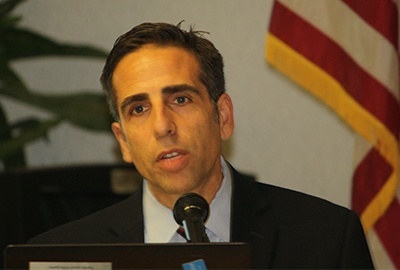
Bobby Schindler addresses guests at the annual banquet hosted by St. Malachy's pro-life ministry, Mary for Life, held on the Feast of the Immaculate Conception.
But that�s the ominous redefinition that is allowing hospital ethics committees, guardians and healthcare professionals to deny basic food and water � via feeding tube � to individuals who otherwise are not dying, says Bobby Schindler, executive director of Terri Schiavo�s Life and Hope Network.
Schindler�s sister, Terri Schiavo, died after her husband won a contentious court battle to remove the feeding tube that was providing her with sustenance and hydration. Since then, she has become an icon for one of the most controversial issues of our day � denying food and water to the disabled.
�Not that long ago it would have been barbaric or inhumane to even consider starving and dehydrating a human being to death,� said Schindler, who spoke last month at the annual dinner hosted by the Mary for Life group at St. Malachy Parish in Tamarac. �We can�t do this to an animal�it�s a felony crime. We can�t do it to those on death row. We shouldn�t be able to do it to any human being. Yet we are doing it every single day to those we have now deemed as non-persons.�
Photographer: ANNE DIBERNARDO | FC
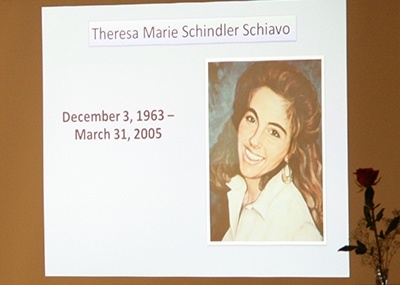
As Bobby Schindler spoke, this photo of his late sister, Terri Schiavo, taken before she sustained a brain injury, was projected on the screen behind him.
Schiavo, a resident of St. Petersburg, Fla., collapsed at her home in 1990 and subsequently suffered brain damage which left her with what her brother described as �a severe cognitive disability� and the inability to swallow.
Beginning in 1998, her husband Michael Schiavo, contending that Terri was in a �persistent vegetative state,� pursued a court order to remove his wife�s feeding tube � despite the fact that she was not dying and her parents were willing to care for her.
The two sides continued battling in court � even Congress and the Florida legislature got involved � until March 18, 2005, when the feeding tube was removed for the last time. Schiavo died March 31, 2005.
After her death, Schindler left a teaching career to devote himself fulltime to protecting other people with disabilities and raising public awareness about the nation�s diminishing respect for human life. He speaks extensively throughout the United States and internationally, and co-authored a book with his family, �A Life That Matters,� that chronicles their struggle to care for his sister.
�What happened to Terri Schiavo was not an isolated case,� Schindler said. �It�s happening every day in the United States and the situation is getting worse.�
According to Schindler, the mainstream media misreported the situation and generated a sense of confusion regarding the circumstances of Schiavo�s case.
�They like to peg her with this label as being in a vegetative state, which really morphs into a �vegetable��one of the most upsetting and dehumanizing terms you can apply to a human being,� he said.
He emphasized that it is important to draw a distinction between his sister�s case and that of people who are hooked up to machines but whose death would be imminent otherwise.
�It�s easy to lump Terri�s issue into end of life discussions but Terri was never dying. She had a cognitive disability and needed one thing that we all need to survive � food and water,� Schindler said.
He said a cognitive disability such as a persistent vegetative state has become a lethal diagnosis, a criteria to kill people. He added that it is misdiagnosed 40 percent of the time, including in his sister�s case.
Schindler said that for the first couple of years after her collapse, Schiavo received aggressive therapy and was starting to respond and speak and form words. However, in 1993 there was a rift between Michael Schiavo and the Schindler family.
�At that time Michael really moved on with his life and we couldn�t do anything to improve Terri�s quality of life because he was in full control. From 1993 to 2000, while the case was in the courts, Terri received no rehabilitation therapy and deteriorated significantly because of her brain injury,� Schindler said.
�My parents and I knew she wasn�t going to improve too much but we loved her and were willing to care for her � and we believed she would have improved to some level,� he continued. �If she were alive, she could be here today � all she needed was a wheelchair, but the media didn�t portray this.�
He quoted from pro-life author Wesley Smith�s book, �Culture of Death � the Assault on Medical Ethics in America,� in which Smith attributes the following quote to bioethicist Daniel Callahan: �The denial of nutrition may become the only effective way to make certain that a large number of biologically tenacious patients actually die.�
�Basically what they were saying is that feeding tubes are an obstacle to the death movement,� said Schindler, also referencing a 1986 opinion by the American Medical Association that listed artificial supplies � such as nutrition and feeding tubes � as a medical treatment instead of a basic requirement for life.
Photographer: ANNE DIBERNARDO | FC
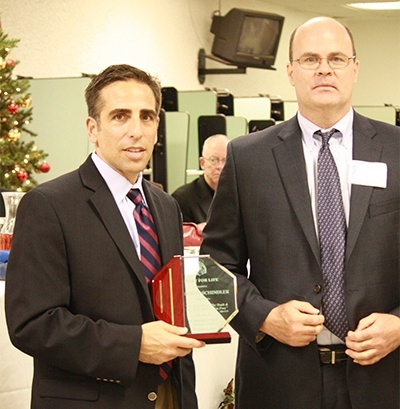
Bobby Schindler receives the annual John Paul II Award from St. Malachy's Mary for Life president, Eugene Cunningham.
Another philosophy being considered by a growing number of bioethicists is the theory of personhood, which defines some people as being non-persons, Schindler said. These bioethicists assert that what counts morally is not being human, but being a person, a status affirmed by possessing identifiable mental capabilities such as being self-aware or having the ability to engage in rational behavior.
�If you are defined as a human non-person, then society can make a determination of whether or not you live or die. Many of our doctors are being taught this in medical schools,� Schindler said.
He pointed out the natural connection between abortion and euthanasia, but said euthanasia is not opposed with the same frequency or fervor as abortion.
�Once parents got comfortable killing their children, how long will it be before they got comfortable killing their parents? Devalue one life, devalue all lives,� he said. �We look at a baby and we say, yes, let�s fight for that baby � and you should. But then we look at someone like Terri in her broken state, someone with a disability. And we say to ourselves, well, perhaps she has value and dignity, but who would want to live that way? I think that�s what goes through our minds and we don�t get the same type of zeal to fight for these people like we do for the unborn child.�
Ironically, although the Schindlers lost their battle to save Terri Schiavo, in the end it was Schiavo who saved her brother�s life, he said � at least in the eternal sense. �I went from not ever wanting to walk into a church again to attending daily Mass and taking the sacraments and Eucharist as much as I can.�
Photographer: ANNE DIBERNARDO | FC
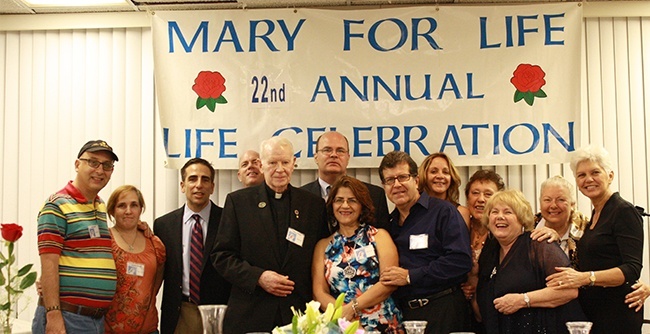
Bobby Schindler, third from left, executive director of Terri Schiavo Life & Hope Network, poses with St. Malachy's pastor, Father Dominic O'Dwyer, and members of the parish's pro-life ministry, Mary for Life.