By Rocio Granados - La Voz Catolica
Photographer: ROCIO GRANADOS | FC
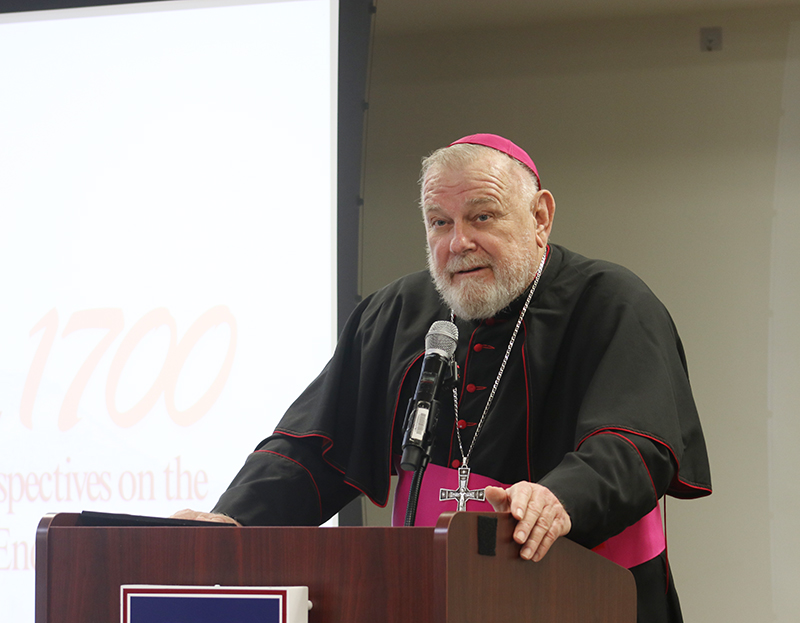
Archbishop Thomas Wenski talks about the importance of the Council of Nicaea for Christians, which was held 1,700 years ago, during a talk organized by St. Thomas University in Miami Gardens on Nov. 17, 2025.
MIAMI | To foster even greater dialogue and a deeper understanding among Christians, the Office of Mission and Ministry and the School of Theology at St. Thomas University (STU) organized “Nicaea 1700,” a conference on the importance of the Council of Nicaea for Christians.
This year marks “the 1700th anniversary of the Council of Nicaea and the Nicene Creed that came from it. This is the event to be celebrated,” said Archbishop Thomas Wenski at the beginning of the talk Nov. 17 at STU in Miami Gardens.
In addition to Archbishop Wenski, participants in the event included Father Joseph Lucas, rector of Christ the Savior Orthodox Cathedral in Miami Lakes, who led the talk; William J. Tighe, professor of history at Muhlenberg College and member of St. Josaphat Catholic Church in Pennsylvania; Cyril Gary Jenkins, professor of history at Eastern University and director of St. Basil Center for Orthodox Thought and Culture; archdiocesan priests; members of the STU School of Theology; and university students.
Photographer: ROCIO GRANADOS | FC
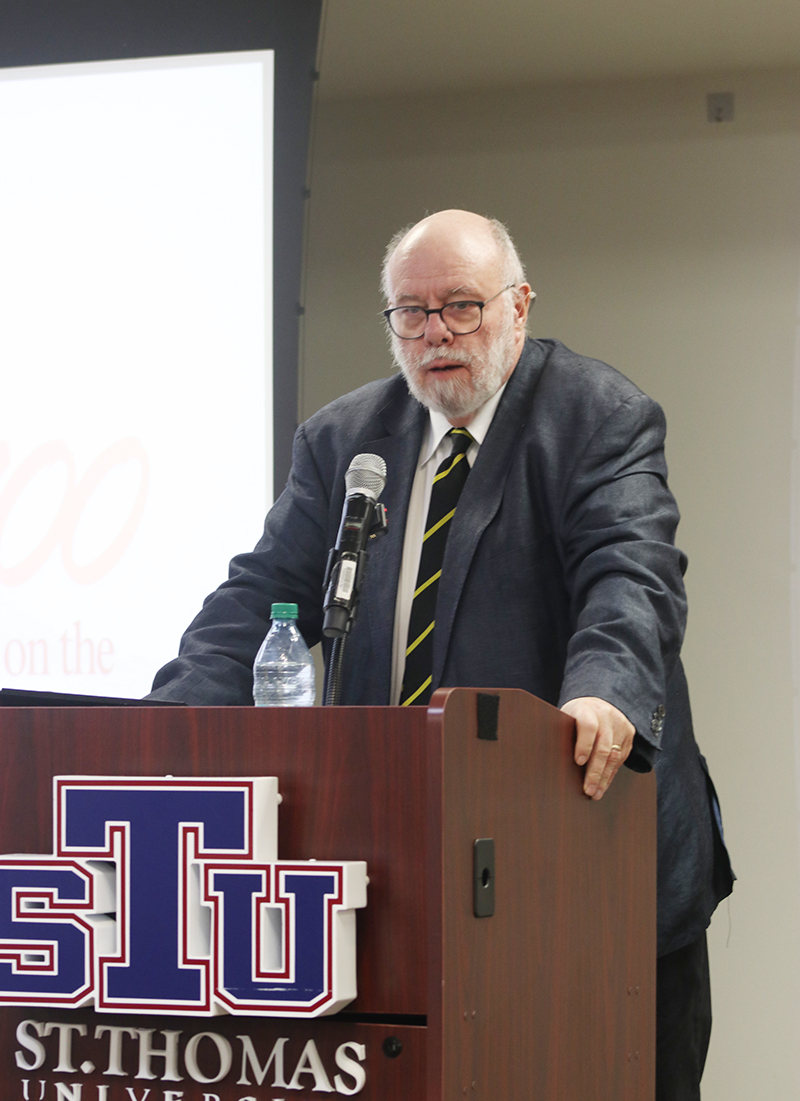
William J. Tighe, a history professor at Muhlenberg College and a member of St. Josaphat Catholic Church in Pennsylvania, speaks about “The Papacy and the Council of Nicaea,” from a Catholic perspective, during the Nicaea 1700 talk organized by St. Thomas University in Miami Gardens on Nov. 17, 2025.
Tighe, in his presentation from a Catholic perspective on “The Papacy and the Council of Nicaea,” said that Roman Emperor Constantine played an important role in the Council of Nicaea. Although he was not a catechumen, he was baptized on his “deathbed” and believed “that it was his responsibility as emperor to deal with the issue of church division.”
According to Tighe, “no pope was present” at the first ecumenical councils, including that of Nicaea, because they wanted to preserve Rome's freedom to judge the councils a posteriori.
In his presentation on "The undulating legacy of Nicaea in the Orthodox Church" from an Orthodox perspective, Jenkins pointed out that the Council of Nicaea created “a precise theological vocabulary and grammar" that was essential to the way the Church formulated theology and addressed its ecclesiastical controversies. The term homoousios (consubstantial) affirmed that the Son is "of the same substance" as the Father, marking a clear distinction between Creator and creation.
The Council of Nicaea was held in 325 in Nicaea, in pesent-day Turkey.
Photographer: ROCIO GRANADOS | FC
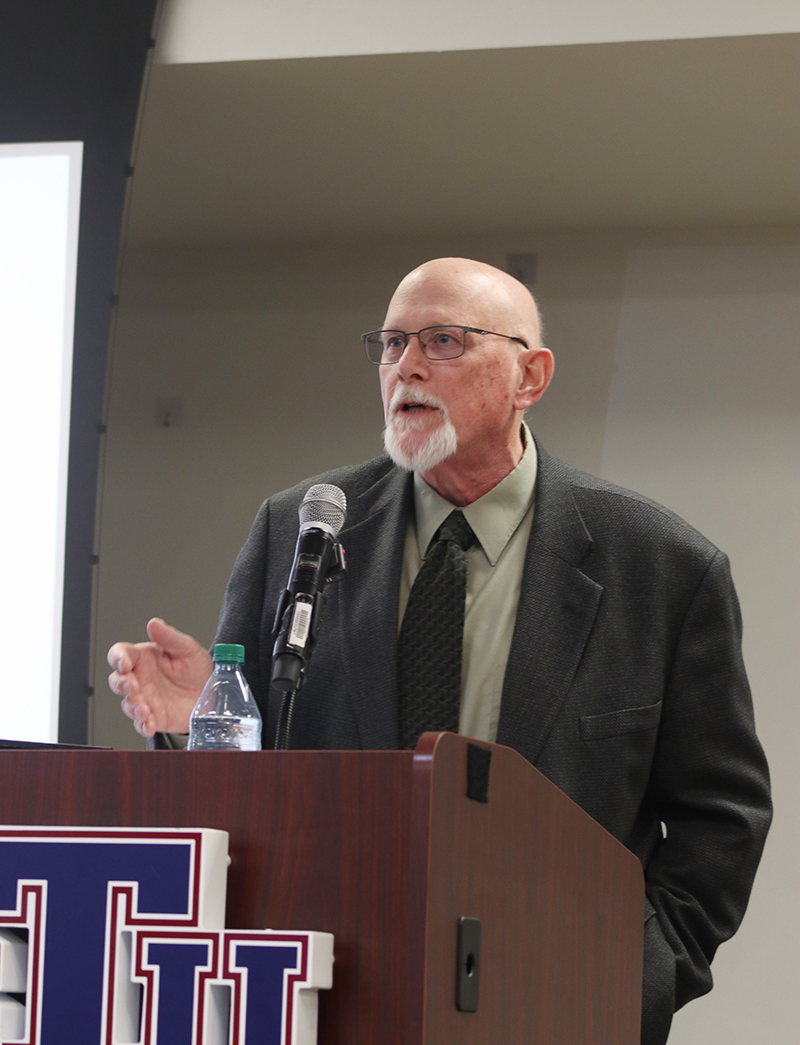
Cyril Gary Jenkins, professor of history at Eastern University and director of St. Basil Center for Orthodox Thought and Culture, speaks about "The undulating legacy of Nicaea in the Orthodox Church," from an Orthodox perspective, during the Nicaea 1700 talk organized by St. Thomas University in Miami Gardens on Nov. 17, 2025.
Nicaea is “the first ecumenical council, where the first version of the Nicene Creed was agreed upon. The Creed was finalized as the Second Ecumenical Council of Constantinople," said Father Lucas after the conference. He added that "the creed as a whole is kind of a glue that still binds the two churches, the Orthodox Church in the East and the Roman Catholic Church in the West.”
Archbishop Wenski said the Nicene Creed "is the only ecumenical creed accepted by Catholics, Eastern Orthodox and major Protestant churches.”
The creed “affirms some more doctrines of our Christian faith as the Trinity and the full divinity of Jesus Christ,” the archbishop added.
Although the Council of Nicaea was convened by Emperor Constantine to resolve disagreements between Christian churches, the failure to reach an agreement led to a gradual rift.
At the center of these differences is the creed. In the Latin version of the creed from the ninth century, the term filioque (and from the Son) was added regarding the origin of the Holy Spirit. “That began to cause some friction between the Church of Rome and the Church of the East,” explained Father Lucas.
Additionally, the political situation at the time indicated that the empire was no longer unified: there was one emperor in Constantinople, ruling the eastern half of the Mediterranean, and another in Rome, ruling the western half.
Photographer: ROCIO GRANADOS | FC
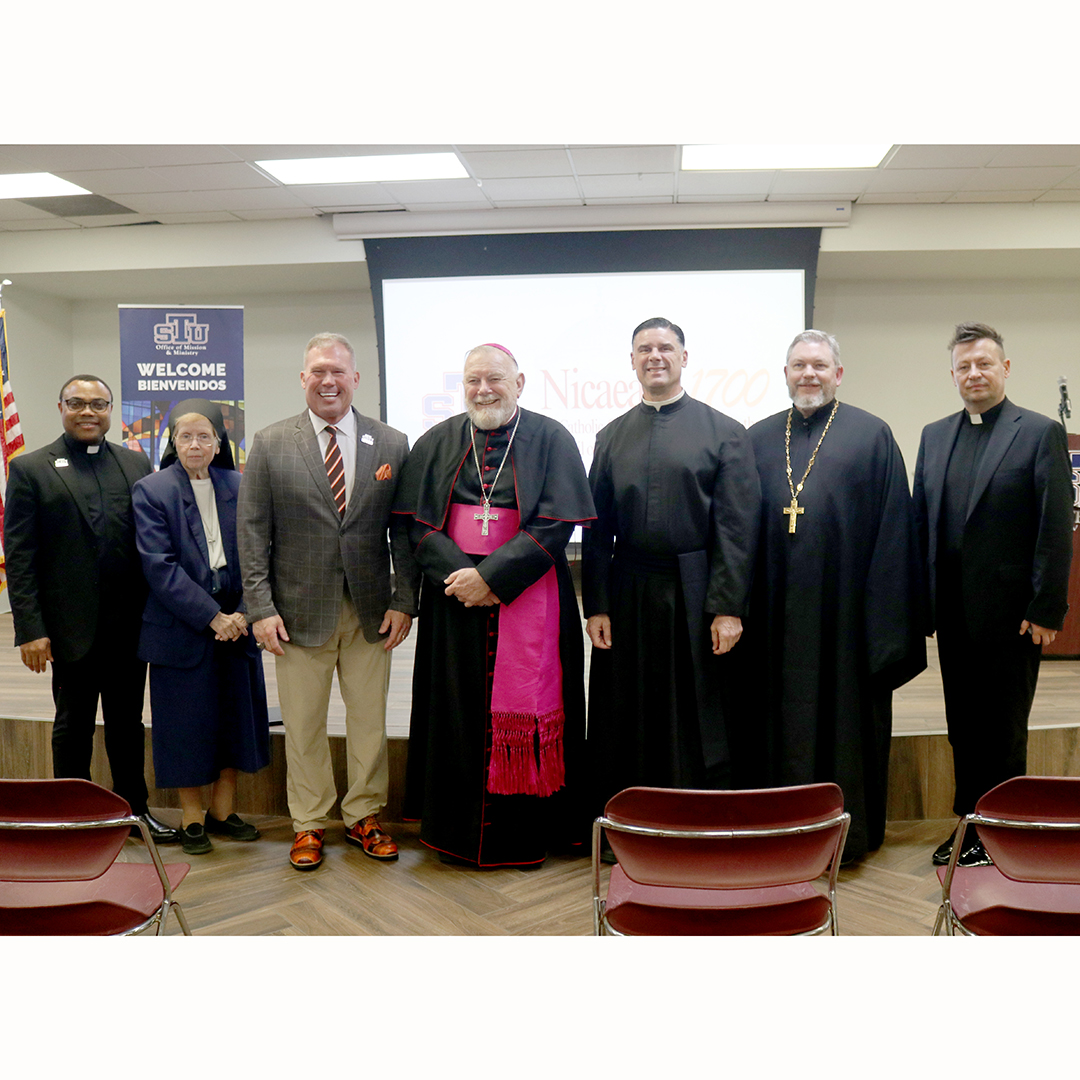
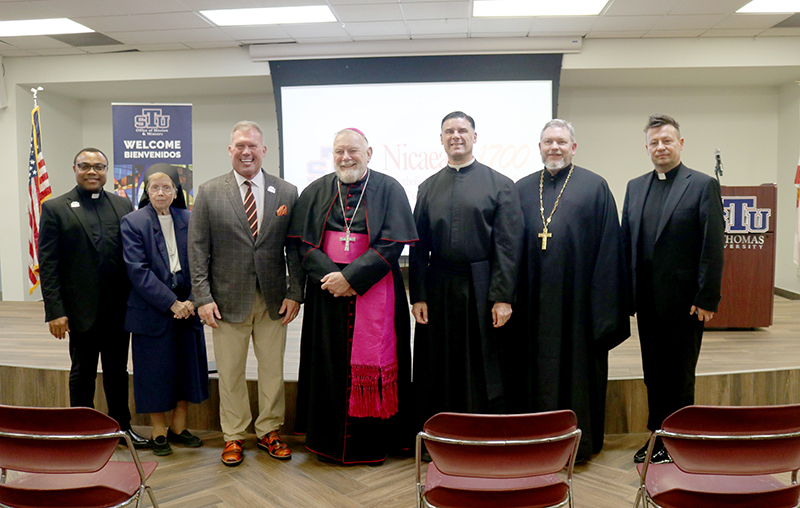
Archbishop Thomas Wenski poses for a photo with organizers and attendees of the Nicaea 1700 talk Nov. 17, 2025, at St. Thomas University (STU) in Miami Gardens. From left are Father Hilary Nwainya, theology professor at STU; Sister Elizabeth Worley, chancellor for administration and chief operating officer of the Archdiocese of Miami; David Armstrong, president of STU; Archbishop Thomas Wenski; Father Rafael Capo, vice president of mission and ministry at STU; Father Joseph Lucas, rector of Christ the Savior Orthodox Cathedral in Miami Lakes; and Father Grzegorz Rozborski, professor of theology at STU.
There was also a linguistic difference. In Rome, there was a gradual transition from Greek to Latin during the first three centuries. Latin was the language of the general population, and although the Bible was written in Greek, churches gradually transitioned to Latin during worship, and the Bible was translated into Latin. “The West began using Latin only, and the East used Greek mostly," said Father Lucas.
Over the centuries, political issues during the schism of 1054 cemented the differences. Then came the events of the Fourth Crusade, when the Crusaders sacked Constantinople. This “left a lot of bitter feelings in the eastern half of the empire towards the Crusaders,” said Father Lucas.
THE RAPPROCHEMENT OF THE POPES
In recent times, in 1964, Pope Paul VI and Patriarch of Constantinople Athenagoras I embraced in Jerusalem and began renewed interaction.
Pope John Paul II, who had Orthodox relatives, played a key role in the Christian rapprochement. In 1995, he wrote the apostolic letter Orientale Lumen (The Light of the East), in which he affirmed that the Eastern Church has a deep Christian heritage and that a new mutual recognition is emerging.
Pope Benedict XVI and Pope Francis continued the rapprochement.
Photographer: ROCIO GRANADOS | FC
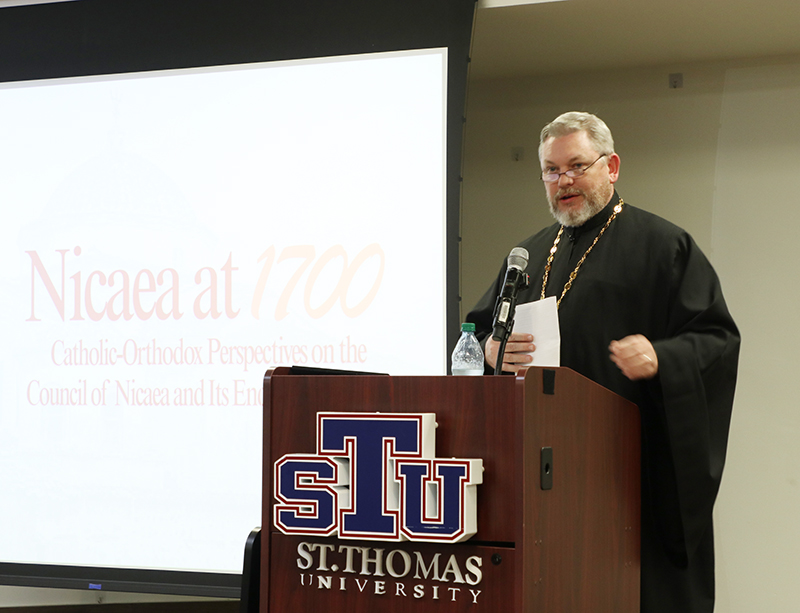
Father Joseph Lucas, rector of Christ the Savior Orthodox Cathedral in Miami Lakes, and one of the organizers of the Nicaea 1700 talk, welcomes attendees at the event held Nov. 17, 2025, at St. Thomas University in Miami Gardens.
Last November, history was made when Pope Leo XIV visited Turkey to commemorate the 1,700th anniversary of the Council of Nicaea, which was held on the shores of Lake İznik, ancient Nicaea.
Together with Patriarch Bartholomew I and leaders of the Orthodox and Protestant Christian churches, the Pope participated in an ecumenical prayer and recited the Nicene Creed of 325.
Pope Leo XIV emphasized “the search for brotherhood.” Patriarch Bartholomew I, for his part, invited everyone to "follow the path of Christian unity that has been laid out for us, despite the divisions" of past centuries. Representatives of numerous churches were present including Coptic, Greek, Armenian, Syriac, and Anglican traditions.
According to Father Lucas, it is difficult to explain the differences between the Roman Catholic and Orthodox churches simply by saying, "This is where they differ."
"Most of the differences that people notice are more superficial," said Father Lucas. "For example, most Orthodox priests are married. Our dress is slightly different, but that was the common way that we all (Christians) used to dress until very recently,” he added.
Talking about “the meaning of the Creed and the importance of their tradition is meant to foster more dialogue. Ultimately, the goal would be that someday there will be complete reconciliation between the Eastern and the Western Church again. After all of these centuries, the Creed is what we have in common,” said Father Lucas.
Photographer: ROCIO GRANADOS | FC
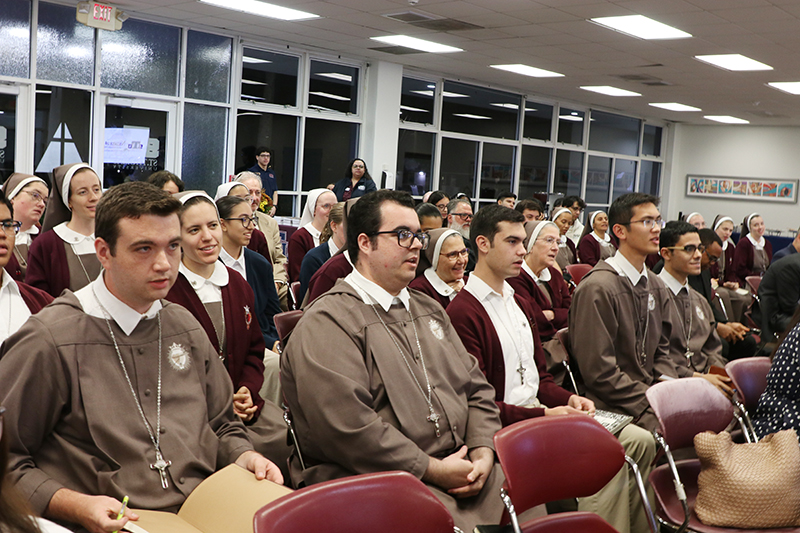
Members of the Servants of the Pierced Hearts of Jesus and Mary and theology students from St. Thomas University, STU, in Miami Gardens participate in the Nicaea 1700 talk on the importance of the Council of Nicaea for Christians, organized by STU Nov. 17, 2025.