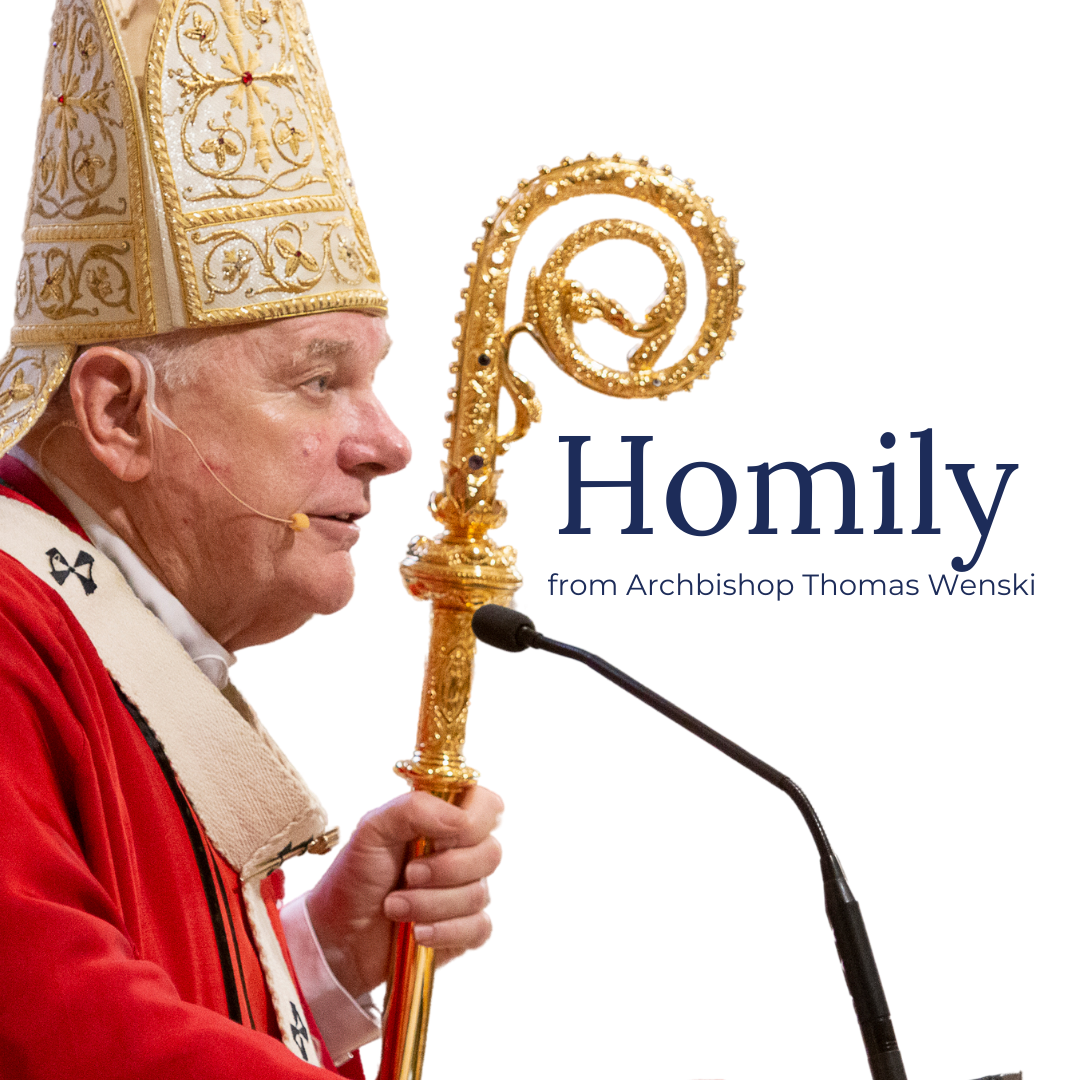
By Archbishop Thomas Wenski - The Archdiocese of Miami
Christmas Homily preached by Archbishop Thomas Wenski at St. Mary Cathedral in Miami on Dec. 24, 2025.
We are gathered in this beautiful cathedral to celebrate the birth of Christ. And what we are doing tonight is being repeated throughout the world: in magnificent basilicas, like St. Peter’s in Rome, where Pope Leo XIV is celebrating his first Christmas as Pope, but also, in more humble places, like poor chapels in Haiti and Cuba, or the small Catholic Church in bombed-out Gaza.
The celebration of Christmas brings families together, and for those separated from their families for whatever reason, the Christmas message can bring comfort and hope. Tomorrow morning, I will celebrate Mass once again at the Krome Avenue Detention Center and then later at the facility called “Alligator Alcatraz.” There, I will tell them that Christmas is also for them - that the Christ Child, who was born in a stable because there was no room for him in the inn, is close to them who face deportation because our immigration policies also tell them there is “no room for them” in the “inns” of this land of wealth and opportunity.
Yes, the Christ child’s coming among us is reason for “hope” because he is Emmanuel, God with us; we dare to hope for peace among the nations, we hope for reconciliation among peoples, we hope for the forgiveness of our sins.
For the birth of Jesus is not just the birth of another religious prophet among many others; it is not just the birth of one founder of a new religion among many others; it is not just the birth of one good man among many others. The birth of Jesus, in the poverty of Bethlehem, is about the joining of humanity with divinity.
The Word of God becomes flesh, God becomes man. In the baby of Bethlehem, the son of Mary, we contemplate the human face of God and the divine face of Man.
This is the reason for our hope that motivates us to join the angels in their song, “Joy to the world.” Joy fills our hearts not because his coming among us gives us a “free ticket” through life, a life free of fear, of loss, of suffering. We still have to get up each morning and face the challenges of the day, the difficulties of living in this “vale of tears” with its pain, loneliness, and the many uncertainties that vex us. But we celebrate because through all the hopes and fears, the joys and sorrows of this life, God is with us. A world without God would be a world without hope, a world without a future. In Christ born today for us, we can embrace a future of hope.
You shall name him “Emmanuel,” the angel told his mother: God with us.
He is with us, and we dare say, he is part of us even as we struggle. The Christian God is not aloof or far away, isolated from us. No, our God has made our story his story, and this is what we celebrate on Christmas Day: God is living out with us, through us, and within us, the full measure of human suffering. He is saving us within all that we face. “Unto us a savior is born. He is Christ the Lord.” He who was warmed by the sheep and the lambs that crowded the stable where he was born is now the Lamb of God who takes away the sins of the world. He was born in Bethlehem, a word that in Hebrew means “the house of bread,” and he has become for us the Bread of Life.
En el Niño Dios vemos el rostro humano de Dios y el rostro divino del hombre. Así, esta fiesta renueva nuestra esperanza, pues Dios está con nosotros y comparte nuestra condición humana, menos en el pecado, para que podamos compartir su condición divina. Por eso, los retos que enfrentamos en este valle de lágrimas se vuelven el camino que nos lleva a la Vida Eterna, que es el regalo que nos ofrece el Niño Dios que hoy ha nacido en Belén.
Paw�l Bondye tounen moun menm jan ak nou sòf peche li pa te fè. Li vin menm jan ak nou, li pataje mizè nou, tèt chaje nou. Si li vin samble ak nou nan tout bagay se te pou fè rive samble avèk li,pou fè nou tounen vin zanmi li epi pou n viv nan kè poze ak tout moun.
At every Mass, when the priest (or the deacon) prepares the chalice which contains the wine that will become the Blood of Christ, he mixes a drop of water with the wine and prays: “May we come to share in the divinity of Christ who humbled himself to share in our humanity.” And at the Mass, we repeat Jesus’ words once again, “Take and eat, this is my body; take and drink, this is my blood.” The Word became flesh so that we can feed on it and have life, his life, eternal life. This is God’s gift to us: Life. It is given freely because he loves us. Even in our poverty and our neediness, in our brokenness and our sinfulness, God loves us and gives us his Life.
This is God’s Christmas gift to you. What will you give to Him? Will you give Him the gift of yourself and of your love?