By Tom Tracy - Florida Catholic
MIAMI | Thanksgiving weekend set the stage for a fourth, possibly final, air delivery of emergency foodstuffs from Catholics in Miami to the people of eastern Cuba following this year’s Hurricane Melissa.
Hurricane Melissa brought catastrophic damage to the Caribbean in late October. It made landfall in Jamaica as a Category 5 storm before passing over Cuba, the Bahamas, the Dominican Republic and Haiti.
Dozens were killed, mostly in Jamaica and Haiti, but Cuba’s weakening economic situation prompted action from a small group of donors on the part of Catholic Charities of the Archdiocese of Miami.
A special hurricane emergency appeal in the archdiocese following Melissa raised funds for the impacted islands through Miami Catholic Charities, with assistance allotted for Jamaica and Haiti.
Photographer: COURTESY
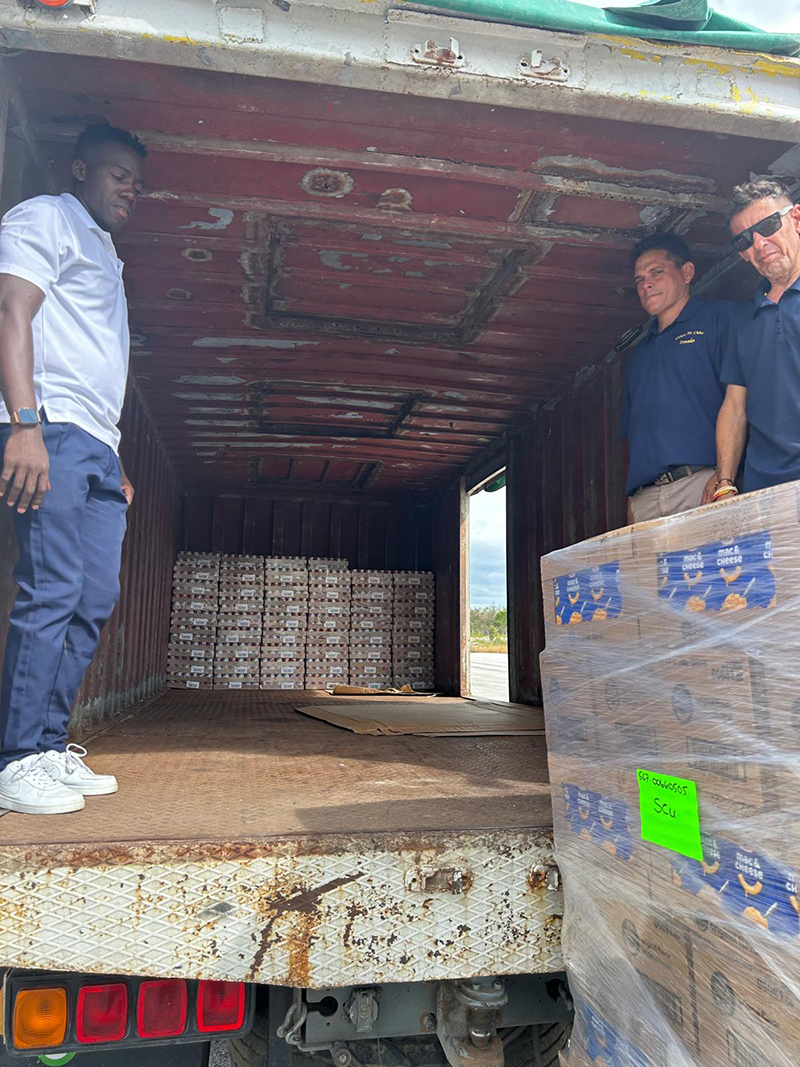
Thanksgiving weekend set the stage for a fourth, and likely final, air delivery of emergency foodstuffs from Catholics in Miami to the people of eastern Cuba following this year’s Hurricane Melissa. Thus far, the assistance amounts to about 44,000 pounds of foodstuffs.
But the effort also included special arrangements and government permissions to send basic relief items by cargo flights to Catholic Church partners in Cuba, including groups such as Caritas Cuba and four Catholic dioceses most affected by the hurricane, according to Peter Routsis-Arroyo, CEO of Catholic Charities of the Archdiocese of Miami.
On Nov. 22, 2025, Routsis-Arroyo and two other archdiocesan representatives traveled to Cuba to accompany the third shipment, which departed from Miami International Airport and arrived at Antonio Maceo International Airport in Santiago, Cuba.
Santiago is located in the eastern part of Cuba, where the hurricane had the greatest impact.
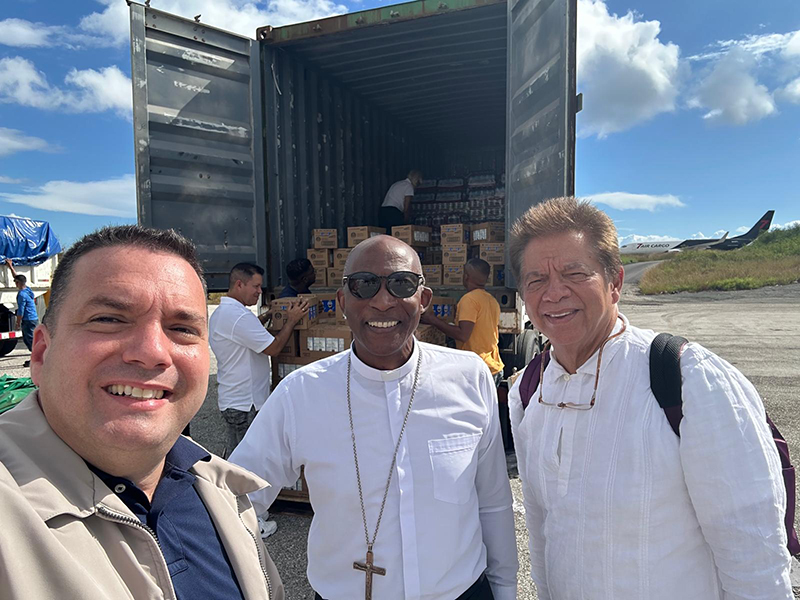
Greeting the Miami delegation at the airport was Bishop Silvano Pedroso Montalvo of the Diocese of Guantanamo-Baracoa. The diocese is situated in an area that received hurricane assistance.
“We landed at the airport and were greeted by the bishop and his volunteers; we only had two hours on the ground,” Routsis-Arroyo said, adding that the Cuban bishop drove the Miami group to the National Shrine Basilica of Our Lady of Charity del Cobre, giving the Miami visitors an opportunity to observe some of the hurricane’s impact along the route.
“It was a 45-minute drive so we could see damages among the houses and the trees and everything. It was a good drive going both ways to see the damage,” Routsis-Arroyo explained.
“We were there making sure there were no issues with the Church being able to move the goods (to those in need),” he added.
Accompanying Routsis-Arroyo from South Florida were Father Oscar Perez Dudamel, pastor of San Pablo Parish in the Florida Keys, and Raul Panellas, a lay employee of St. Augustine Parish in Coral Gables.
The humanitarian relief effort in Cuba aims to assist people in four dioceses, including Guantanamo-Baracoa, the Archdiocese of Santiago de Cuba, the Diocese of Holguín, and the Diocese of Bayamo-Manzanillo.
Photographer: COURTESY
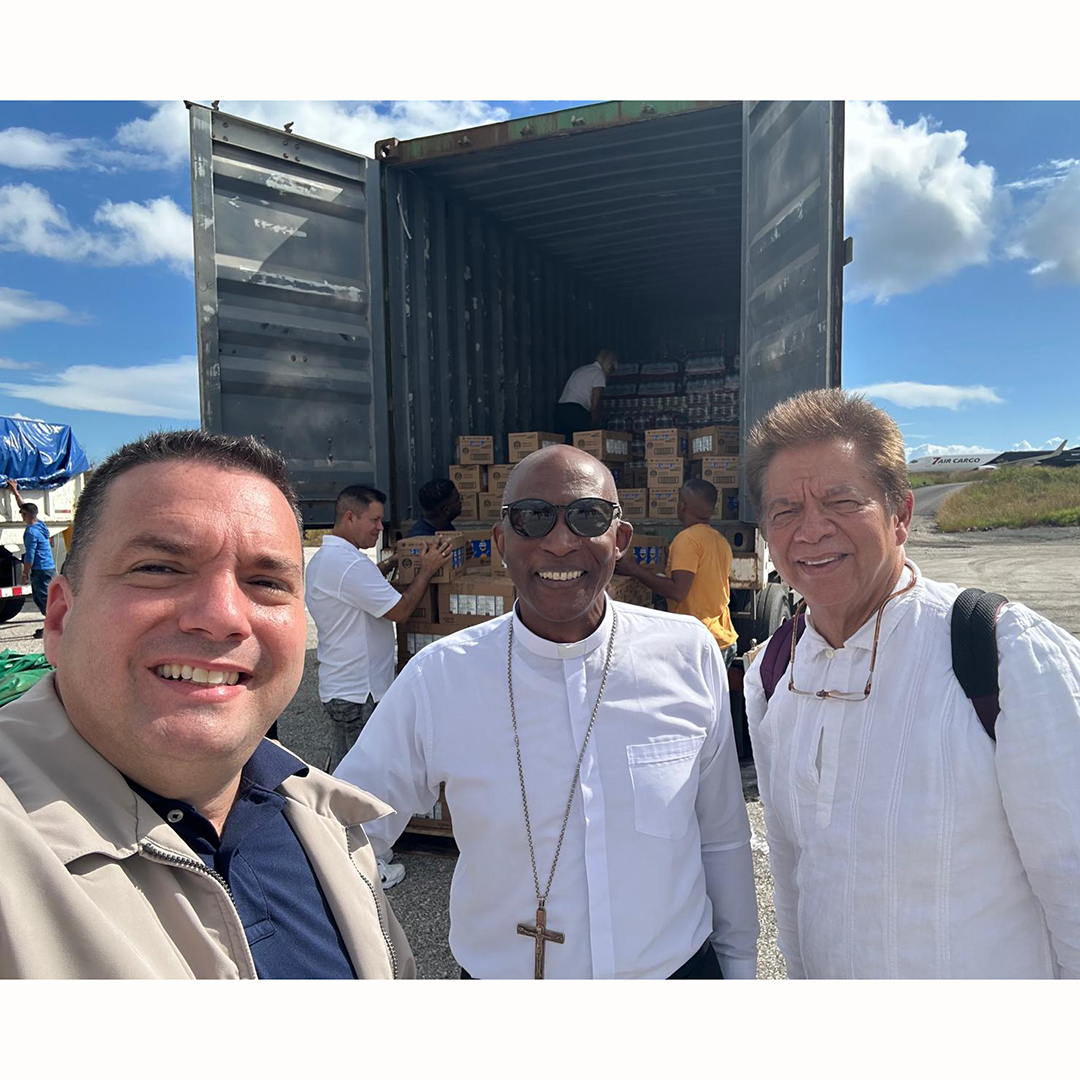
Bishop Silvano Pedroso Montalvo, center, of the Diocese of Guantánamo-Baracoa poses for a photo with Raúl Panellas, a lay employee of St. Augustine Parish in Coral Gables, left, and Peter Routsis-Arroyo, executive director of Catholic Charities of the Archdiocese of Miami, on Nov. 22, 2025, at the Antonio Maceo International Airport in Santiago, Cuba, after receiving donated food for victims of Hurricane Melissa, which struck the island in October.
At the airport, volunteers unloading the supplies included Emmaus ministry members from the Diocese of Guantanamo, according to Routsis-Arroyo.
The assistance included food, bottled water, rice, and canned food, “because they are in need of the basic necessities. We have heard we may be the only humanitarian flights that have gone into the island since the hurricane and we were able to charter the plane and containers through donors supporting the initiative,” Routsis-Arroyo added.
“We are happy that both governments have agreed to help and with their government accepting the help through the Catholic Church” he added.
The U.S. National Science Foundation National Center for Atmospheric Research recently said that Melissa’s wind gusts reached a record-breaking speed shortly before the storm made landfall, according to data recorded during the deadly event.
One “dropsonde” device used during Hurricane Melissa clocked a wind gust of 252 miles per hour shortly before falling into the ocean, according to the agency.
The fourth shipment was made on the weekend after Thanksgiving. Father Richard Vigoa, pastor of St. Augustine Parish in Coral Gables, led previous aid shipments to Cuba, along with donors Frank and JoAnn del Río. Father José Espino, rector of the National Shrine of Our Lady of Charity in Miami, made a second flight, accompanied by Sister Eva Pérez-Puelles of the Daughters of Charity of St. Vincent de Paul in Miami.
After the final flight, any additional Miami Catholic Charities assistance to Cuba would likely be through shipping containers by sea rather than air transportation, Routsis-Arroyo noted.
Routsis-Arroyo added that the project was further supported by financial donations from South Florida’s Cuban American community.
Photographer: COURTESY
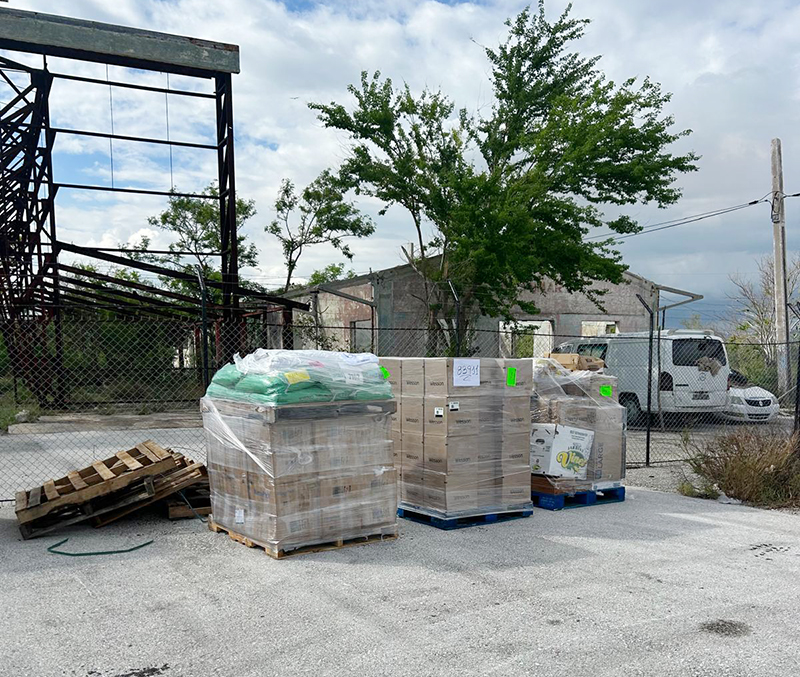
Thanksgiving weekend set the stage for a fourth, and likely final, air delivery of emergency foodstuffs from Catholics in Miami to the people of eastern Cuba following this year’s Hurricane Melissa. Thus far, the assistance amounts to about 44,000 pounds of foodstuffs.
Thus far, the assistance amounts to some 20 tons of foodstuffs per flight.
Speaking recently to archdiocesan pastoral center staff in Miami Shores, Miami Archbishop Thomas Wenski noted that one special reason to be thankful at the end of November is the conclusion of hurricane season, which spared Florida and the U.S.
“Jamaica, Cuba and Haiti were not so fortunate. Our Catholic Charities mobilized – and the people of the archdiocese contributed some $200,000 online for hurricane relief,” Archbishop Wenski said during a homily.
“The charter company (providing air support) said that they had flown some 30 flights to Jamaica – and the only flights with aid to Cuba were the three that the Archdiocese of Miami sent,” said the archbishop. 'Giving thanks, can mean both expressing gratitude and being generous. So ways to give thanks include performing acts of kindness and being generous, especially to those less fortunate than ourselves,” the archbishop added.
For his part, the Miami Catholic Charities chief said the humanitarian flight offered his first-ever footsteps in Cuba and a brief opportunity to give thanks while at the National Shrine Basilica of Our Lady of Charity del Cobre, which he said showed slight hurricane damage to the church grounds but no major structural damage following Melissa.
“There was some water damage. The grounds were ruffled up, trees down, some window damage, but nothing compared to those who lost their houses. There were also people at the Basilica praying,” Routsis-Arroyo said. “I think it goes to show the power of faith, some 66 years later after the (Cuban) Revolution and who is still there helping the people is the Catholic church and people of faith.”
Of the assistance to Cuba, he added: “The basic necessities are needed, and if you are hungry nothing else matters, and the housing there is not what we have here. So when Hurricane Melissa hit with Category 4 strength in Cuba, it was devastating.”
Aid to Cuba: “Something we have been doing for a long time”
The aid being sent to Cuba “is something that we've been doing for a long time,” said Archbishop Thomas Wenski, adding that “in the last five years we’ve probably sent 45 containers to Cuba to help out in the dioceses or religious communities and their work with the poor, especially elderly people.”
Archbishop Wenski recalled that in 1996, when he was director of Catholic Charities of Miami, he organized a campaign to collect food after Hurricane Lili struck Cuba. "We were able to send that food on two planeloads, one in October and one in January,” he said.
That shipment was made possible thanks to the relationship he had developed with the director of Caritas Cuba. But it was also very controversial because it was the first time aid had reached Cuba from the Cuban community in Miami, even though “a lot of the people of Miami opposed it, and it was right after the shootdown of the Brothers to the Rescue planes.”
“We had to get special authorization from the White House,” said the archbishop, who added, “Since that time, the Archdiocese of Miami has continued helping the Church in Cuba. And I think we've overcome most of people's, on this side, objections or suspicions that the help would not reach the people because we've really set up a track record that shows that through our work with Caritas Cuba, or with the Knights of Malta in Cuba, or with the various dioceses, the aid that we send does reach the intended people.”
Archbishop Wenski also noted that he is in contact with several bishops in Cuba, as well as with bishops in Haiti.
For the moment, sending aid to Haiti “is a bit of a challenge,” the archbishop said. “But we're trying to work on the way to get some help down there, especially to those in the southwestern part of Haiti that was most affected by Hurricane Melissa,” he added.
The archbishop hopes that more shipments will be sent to Cuba in the future.
FIND OUT MORE
- Local Catholics wishing to contribute to the relief efforts for Jamaica, Haiti and Cuba can visit the Catholic Charities of the Archdiocese of Miami website here.
Photographer: COURTESY
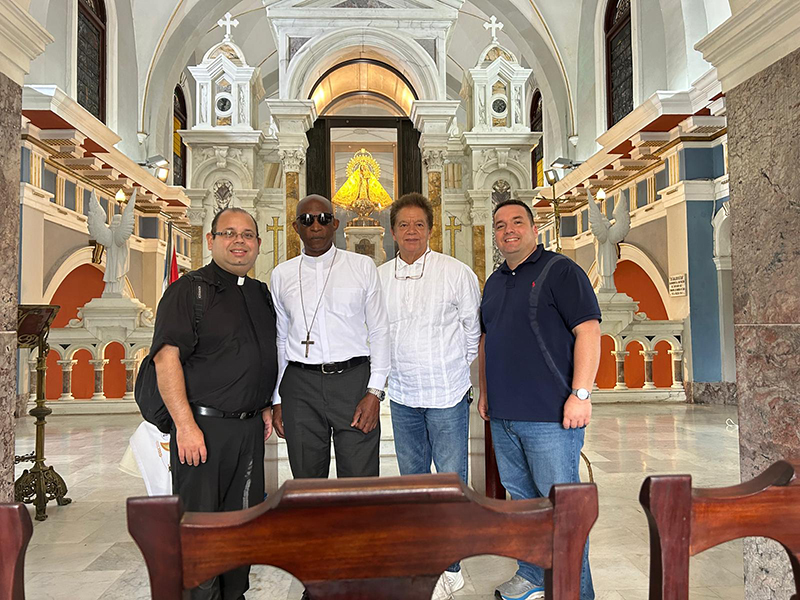
The Miami delegation, which took a humanitarian flight carrying food for victims of Hurricane Melissa in Cuba, poses for a photo Nov. 22 during their brief visit to the National Shrine Basilica of Our Lady of Charity of El Cobre in Santiago, Cuba. From left are Father Oscar Perez Dudamel, pastor of San Pablo Parish in the Florida Keys; Bishop Silvano Pedroso Montalvo of the Diocese of Guantanamo-Baracoa, Cuba; Peter Routsis-Arroyo, CEO of Catholic Charities of the Archdiocese of Miami; and Raul Panellas, a lay employee of St. Augustine Parish in Coral Gables.