By Archbishop Thomas Wenski - The Archdiocese of Miami
This year marks the 800th anniversary of the first living Nativity created by St. Francis of Assisi in a small hamlet called Greccio, about 60 miles outside of Rome. In 1223, the pope had just approved his religious order and Francis had recently returned from a pilgrimage to the Holy Land. The caves of Greccio reminded him of those of Bethlehem and he wanted to “bring to life the memory of that babe born in Bethlehem, to see as much as possible with my own eyes the discomfort of his infant needs, how he lay in a manger, and how, with an ox and an ass standing by, he was laid upon a bed of hay.”
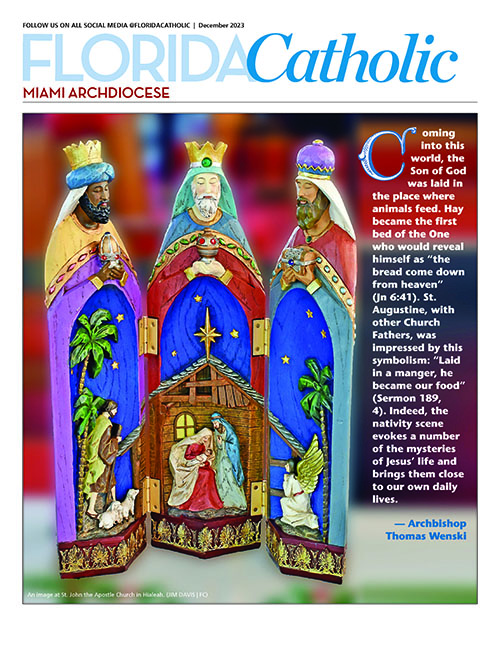
Photographer: JIM DAVIS | FC
The front page of the December 2023 edition of the Florida Catholic features a triptych of the Wise Men atop a table, with insets showing a Nativity scene. It was photographed by Jim Davis for a feature on the artworks at the parish that ran in December 2022.
And so, for eight centuries, following his initiative, in thousands of churches, from great basilicas to humble rural chapels, a crèche enhances the usual liturgical décor. Even many of our Protestant brethren, who normally tend to be iconoclastic, proudly have in their places of worship a crèche which originated with that Catholic saint, Francis of Assisi.
While the crèche, or nativity scene, has been widely banished or sidelined from public display — whether in our cities’ parks or even on the private property of our shopping malls — it remains the foremost “icon” of Christmas that speaks across the ages and across cultures and tells us of “glad tidings.”
They say that a picture speaks a thousand words. And in church art, icons are drawn in such a way so as to speak the Word of God through the signs and symbols represented through the artist’s talent. These nativity scenes, no matter how elaborate or simply made, are a living Gospel rising up from the pages of Scripture, inviting our contemplation and leading those of us who gaze on them through the eyes of faith to awe-filled prayer. This depiction of Jesus’ birth in the poverty of Bethlehem is itself a simple yet joyful proclamation of the Incarnation of the Son of God who becomes a man in order to encounter every man and woman. So great is his love for us that he becomes one of us — so that we, in turn, might become one with him.
Bethlehem was David’s city — and so when the decree for a census went out, Joseph of Nazareth, being of the tribe of Judah and a descendant of David, had to travel to his own city, to Bethlehem, with his pregnant wife to register.
While Bethlehem is on the edge of the Judean desert, it was likely a fertile land where shepherds would pasture their flocks of sheep. And the name, Bethlehem, or Beit Lehem in Hebrew, which means House of Bread, suggests that the fields were perhaps planted with wheat and barley. So even the name, Bethlehem, points to the reason why Christ was born.
Coming into this world, the Son of God was laid in the place where animals feed. Hay became the first bed of the One who would reveal himself as “the bread come down from heaven” (Jn 6:41). Saint Augustine, with other Church Fathers, was impressed by this symbolism: “Laid in a manger, he became our food” (Sermon 189, 4). Indeed, the nativity scene evokes a number of the mysteries of Jesus’ life and brings them close to our own daily lives.
At Greccio, 800 years ago, Francis asked a priest to celebrate a solemn Mass over the manger that he had constructed, thus showing the bond between the Incarnation of the Son of God and the Eucharist. For Christ became man to be one with us and so that we may become one with him through our communion in His Body and Blood. Christ was born to die one day so that we would not die forever because of our sins.
During Advent, we remembered that Christ came in history and that he will come in majesty at the end of time. But Advent also reminded us that Christ comes today in Word and Sacrament. Through our worthy reception of holy Communion and our participation in the Sacrifice of the Mass, the re-presentation of Christ’s gift of himself to us on Calvary, we come “to share in the divinity of Christ who humbled himself to share in our humanity.”
Joy to the world! The Lord is come!