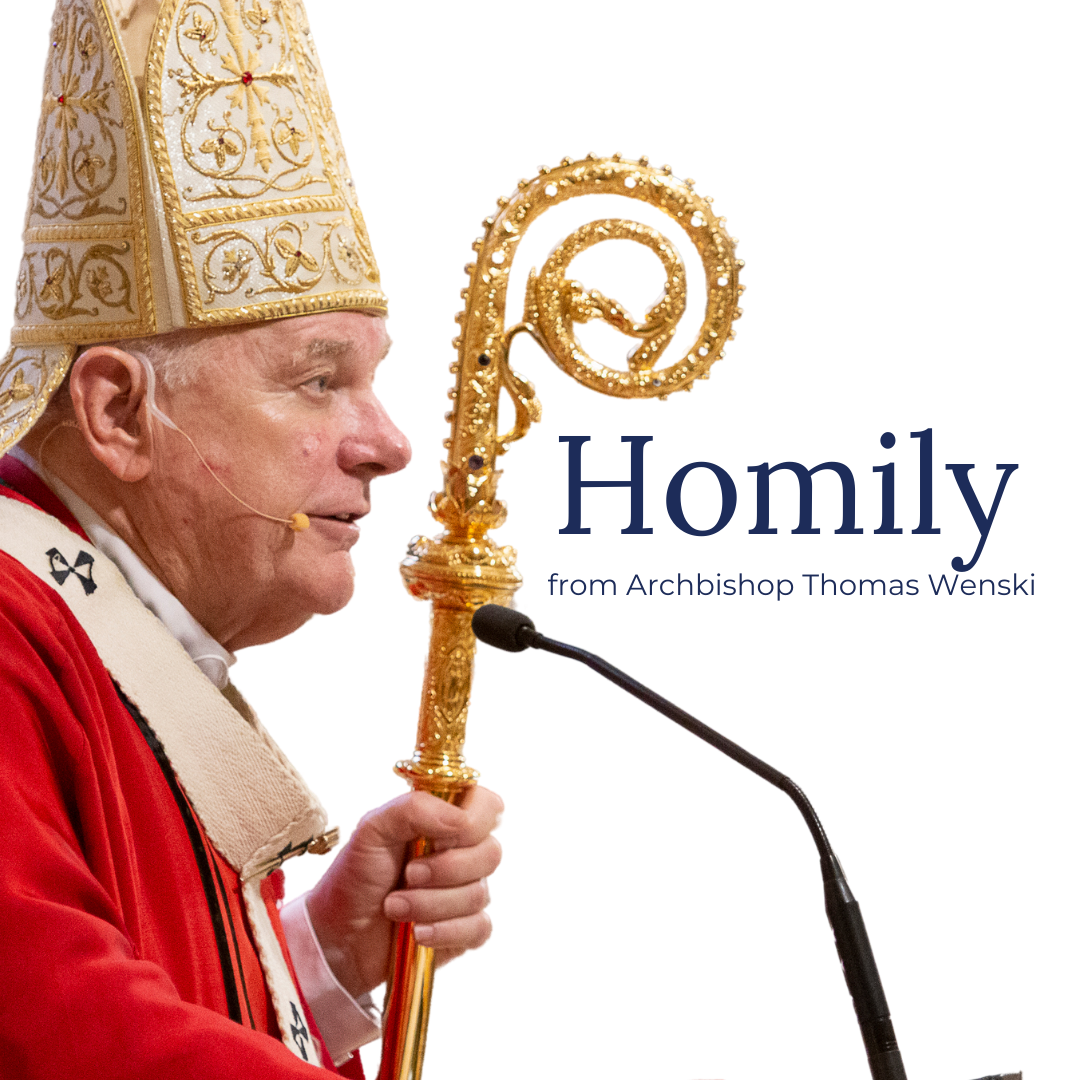
By Archbishop Thomas Wenski - The Archdiocese of Miami
Homily by Archbishop Thomas Wenski at Mass at Barry University for the announcement of its new interdisciplinary initiative: Heath, Arts, and Spirituality. Nov. 5, 2026.
In a university setting, you are encouraged to pursue excellence. Internships can enhance resumes; grade point averages are given a lot of weight. Your credits, degrees and other achievements can help you do well in life. And so, we check the boxes that society tells us define our value. But an education in a Catholic institution such as Barry is not only about equipping you to do well in life but also to do good. Society may define our value – by our degrees, our incomes; society may define our worth – because of our family or work connections; for Jesus, sinners and tax collectors have value not for what they have but for who they are: creatures made in the image and likeness of God. They have worth not because they never sinned but despite their sins. To redeem them from sin, to heal their brokenness of heart and spirit, Jesus suffered and died for them.
In our first reading today, St. Paul lays out his own impressive spiritual and cultural credentials. He was blameless under the law, full of zeal, and possessed the perfect pedigree. He was, before his conversion, in all respects an excellent Pharisee. Yet he throws a radical curveball: “Whatever gain I had; I counted as loss for the sake of Christ.”
Paul realized that the metrics of human achievement can sometimes become an obstacle if we rely on them for our ultimate security. He traded the exhausting pursuit of self-advancement and self-realization for the “surpassing worth of knowing Christ Jesus my Lord.”
The Gospel perfectly illustrates why this trade is worth it. Luke introduces us to two groups of people: the tax collectors and sinners who are crowding around to listen to Jesus, and the Pharisees and scribes who are grumbling, saying, “This man welcomes sinners and eats with them.”
The religious elite thought proximity to brokenness would compromise their righteousness. But Jesus responds with two beautiful stories about a lost sheep and a lost coin. Notice the intense, almost reckless nature of the search. The shepherd leaves ninety-nine sheep in the desert to track down just one. The woman lights a lamp, sweeps the entire house, and searches thoroughly until she finds her single lost coin.
Catholic university rooted in the Dominican tradition speaks often of Veritas (Truth) and Caritas (Charity). Today’s Gospel reveals a profound truth about charity: God’s love is not a meritocracy. God doesn’t love us because we are good; he loves us even when we are not. But if we do good, it is because of the love of God working in us – and through us.
The coin didn’t do anything to deserve being found; it was valuable simply because of whose image was stamped upon it. Maybe the coin was the equivalent of a wad of Benjamins.
You and I carry the image and likeness of God. When we wander, lose our way in a sea of stress, or make choices that leave us feeling empty, Jesus does not distance Himself to protect His reputation. He pursues us.
When the shepherd finds the sheep, he doesn't scold it or lecture it. He joyfully places it on his shoulders and carries it home.
Whether you are here today feeling like you have everything together, or you are quietly carrying a burden, a failure, or a sense of being lost—know that Jesus' gaze is on you right now. He welcomes you unconditionally. We don’t have to prove our worth to Him through our academic or social credentials. Our worth is already settled by the fact that He refuses to lose us.
That is a profound and beautifully accurate way to understand the Eucharist. In fact, the Eucharist is the direct continuation of Jesus eating with tax collectors and sinners in today’s Gospel. In fact, we acknowledge this at every Mass. Mass begins with us acknowledging our sins. “Lord, have mercy! Christ, have mercy! And before we approach to receive Holy Communion, we pray: “Lord, I am not worthy….heal my soul.”
When the Pharisees complained that Jesus “welcomes sinners and eats with them,” they were pointing out something revolutionary: in the ancient Near East, sharing a meal was the ultimate sign of peace, acceptance, and intimacy. By sitting at the table with people broken by their sins, Jesus was saying, "You belong with me."
Every time we celebrate the Mass, that same reality happens:
The Altar is His Table: He calls not those who are perfect but those who are hungry to share a meal with Him. He doesn't just provide the food—He is the food. He feeds us with His own life to transform our weakness into His strength. And the Eucharist is a taste of the eternal feast where all longing is satisfied, and no one is excluded.
At Barry University, when the community gathers for Mass, it is a living reminder that the Eucharist is where our human brokenness meets His divine hospitality. Jesus is still welcoming us and eating with us today. He is the good shepherd, and he is looking for us.
Let us allow Him to find us today in this Eucharist, and let us rejoice in a mercy that reclaims us completely

