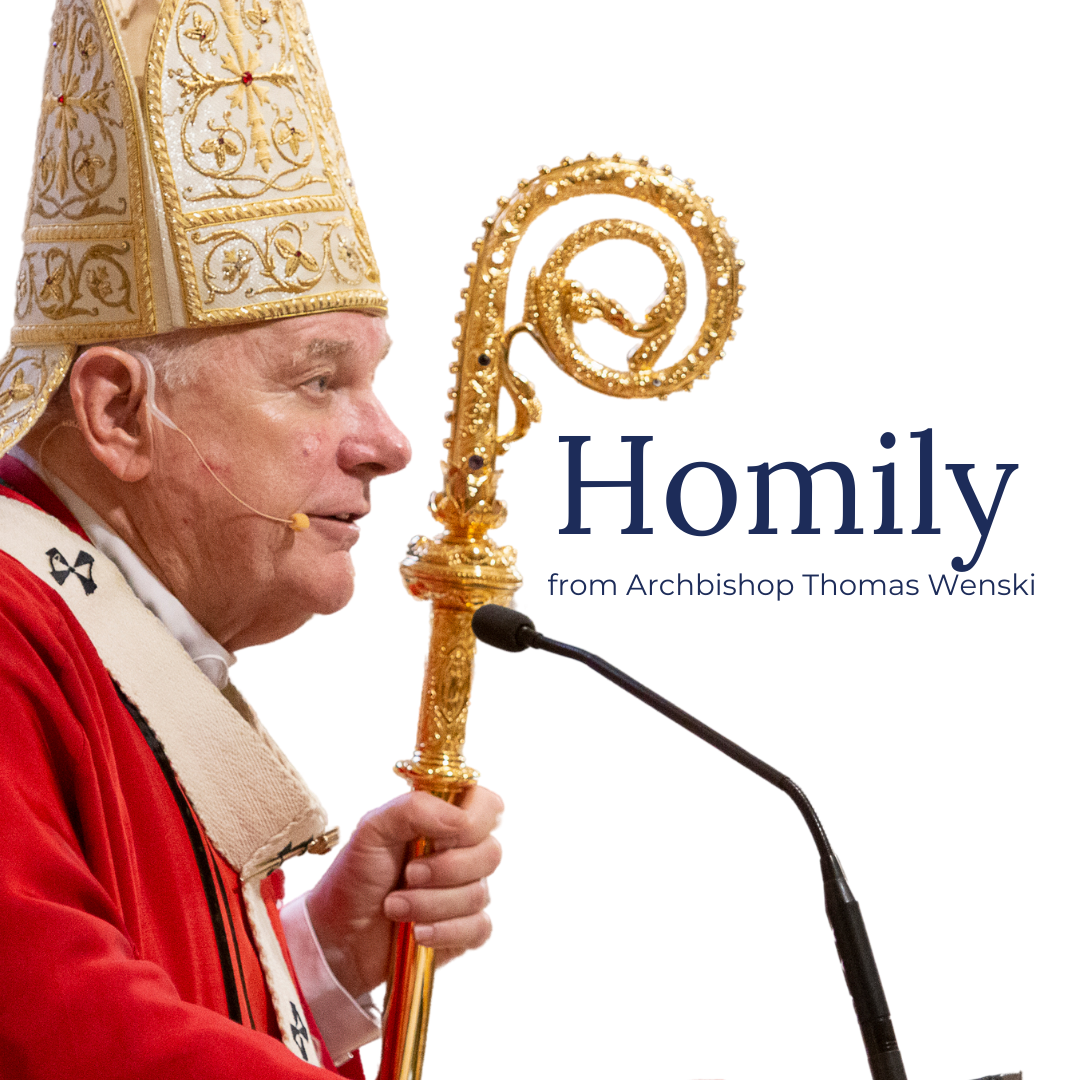
By Archbishop Thomas Wenski - The Archdiocese of Miami
Archbishop Thomas Wenski preached this homily while celebrating Mass for members of Legatus on Dec. 16, 2025.
In this gospel reading, Jesus is on his way to Jerusalem to be crucified, so the tension between Jesus, the scribes, and the Pharisees is mounting. In yesterday’s gospel reading, there was verbal sparring between them and Jesus. Jesus continues the sparring with the parable of the two sons.
The issue of who does the Father’s will is not about what is said, but in what is done and one’s heart in doing it. Saying your rosary, coming to church, listening to Hallow or Bishop Barron, and reading Christian books are all good, but if you agree with the message and do not change your actions, then you are like the son who lied. He said, “Yes,” but he did not go to work in the Father’s fields.
People admit their need for discipline with time and finances, and trust God while seeking first His kingdom and righteousness. They will agree they should proclaim the gospel to others. It is easy to say “yes,” but that is only lip service unless you also strive to do it.
Obviously, it is best to say “yes” to God and do what He says, but if you have been rebellious in the past, saying “no” to Him, or if you say “yes,” but fail to follow through, then God wants you to repent. You must change your mind and heart to believe and follow the Lord. He is gracious to the humble, offering forgiveness, communion with Him, and His blessings.
As I said, the gospel reading places us in the final days of Jesus’ earthly life, on the outskirts of Jerusalem, where he will die. Some might think a more “Christmassy” reading would be more appropriate, but they would think wrongly – for the Word became flesh of our flesh, a man like us in everything but sin, so that he could die to save us. Advent is a call to repentance, to conversion, for if we do not recognize our need for God, if we don’t acknowledge that only He can save and that we cannot save ourselves, then what meaning would Christmas have for us?
This aspect of Advent, of course, is easy for us to miss, especially as the secular aspects of the Christmas season keep us busy with Christmas parties and shopping. Many spend a lot of time buying gifts and wrapping them up for Christmas Day.
But let’s be careful lest we get so absorbed in the gifts that we forget about the gift that is, after all, the reason for the season: the Christ Child, God become our own flesh, through whom, as we sing in the Christmas carol, “God and sinner are reconciled.” That reconciliation happens on the wood of the cross.
A wise man once said, “Anyone wrapped up in himself or herself makes himself a very small gift.” So, while we might spend some time wrapping gifts, Advent reminds us that we must first unwrap ourselves. We must step out of living only for ourselves, self-absorption, self-centeredness, and self-pity, to be able to welcome the Lord who wants to come into our lives.
So, back to the parable: who does God’s will? The apostle John put it this way in his first epistle (1 John 3: 16-19), “If someone who has worldly means sees a brother in need and refuses him compassion, how can the love of God remain in him? Children, let us love not in word or speech but in deed and truth.”
God wants to hear from us, not just with a “yes” from the mouth, but a “yes” from the heart. As we prepare for the Christmas holidays, which we see many of us celebrating with our families – whether in the warmth of Florida or in the cold of Aspen or Steamboat Springs- let us not forget those brothers and sisters in need of our compassion.
We all, at one time or another, experience a passage through this life as a “vale of tears.” The joys of the season, like any joy experienced on this side of Eternity, are always tempered by the pain of loss and separation. Thus, Christmas is always a bittersweet holiday.
It is a time for joy and Christmas cheer, but even as we celebrate with family and friends, we are reminded of those who are not with us - the loved ones who died in the past year, the friend or relative in military service stationed in a far off land, and the family member whom we will not see this Christmas for one reason or another.
Christmas is especially a bittersweet holiday for thousands of immigrant families across the United States and in our own parishes here in South Florida. Our broken immigration system has been broken for years, but an enforcement-only approach is no solution. Some 60,000 people will spend Christmas in detention facilities throughout the US awaiting deportation, and hundreds of thousands of immigrants have already been deported, separating husbands from their spouses and parents from their children. Only a small faction of these detainees and deportees are what could be called “bad actors,” criminals that no one wants to see loose on our streets. The vast majority are simply people seeking a future of hope for themselves and their children in the country. I mention all this not to throw cold water on our Christmas festivities, but to remind ourselves that Christmas should not be a flight from or a denial of reality. It is, rather, the interpretive key towards understanding all of reality. Jesus is the Joy of the Gospel that gives meaning and direction to our lives, even in its pains and sorrows, and in its trials and disappointments.
On Christmas morning, I will once again celebrate Mass at Krome for the detainees there and then again at Alligator Alcatraz. About 3,000 people are held in both places. For them, and for many others, their Christmas will be like that first Christmas of the Baby Jesus: for them, and as it was for Jesus, there is no room in the inn.