By Archbishop Thomas Wenski - The Archdiocese of Miami
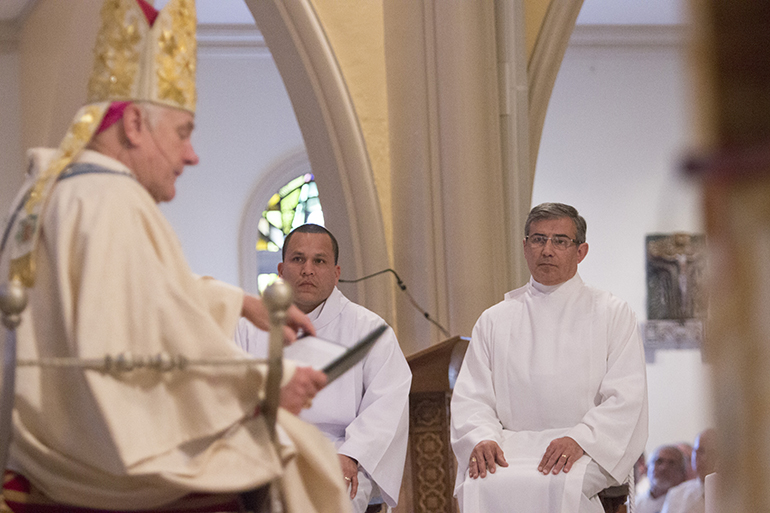
Photographer: ANA RODRIGUEZ-SOTO | FC
Ordination candidates Alfredo Valle and Jose Antonio Santos listen to Archbishop Thomas Wenski's homily.
Archbishop Thomas Wenski preached this homily at the ordination of 13 permanent deacons for the Archdiocese of Miami, Dec. 6, 2014 at St. Mary Cathedral.
With the imposition of hands and the prayer of consecration, the Lord will pour out the Holy Spirit upon these 13 acolytes, and consecrate them deacons. All will be permanent deacons ordained for the service of this local Church, the Archdiocese of Miami. I want to thank their wives for giving their permission for these men to pursue this ministry, and I thank them and their families for their continued support as these men assume the responsibilities of deacons.
My dear friends, these men receive the sacrament of Holy Orders in the order of deacons through the “laying on of hands � in the words of the Second Vatican Council, not for the priesthood, but for the ministry. Strengthened by sacramental grace, they serve the People of God, in the diakonia of liturgy, word, and charity, in communion with the bishop and his presbyterate.” (Lumen Gentium, 29). Through the ordained ministry of bishops, priests, and deacons, the Lord continues to shepherd his Church. We pray that as deacons these men will be, in the words of Pope Francis, “living icons of the Father’s loving concern for all his children.”
Mis hermanos, estos hombres serán diáconos de la Iglesia de Dios. Como tales, son ordenados para ser símbolo e instrumento de Cristo, quien vino “no para ser servido, sino para servir”.
Si podemos asociar las palabras “cristiano” y “ambición”, debe ser solamente cuando la “ambición cristiana” describe la pasión del cristiano por servir � ya que el “servicio” es la mayor vocación de cada cristiano.
My brothers, you will be deacons of the Church of God. As such, you are ordained to be a sign and instrument of Christ, who came “not to be served but to serve.”
If we can associate the words “Christian” and “ambition,” it should only be when “Christian ambition” describes the Christian’s passion to serve. For “service” is the highest calling of every Christian. Even the Pope � who is the “highest” figure in the hierarchy of the Church � is rightly called: the Servus servorum Dei, the Servant of the Servants of God.
Jezi ki rem�t travay li nan men mesaje l yo ba yo pouvwa kreye mwayen ki neses� pou Bon Nouv�l la kab gaye toupatou sou t� a, pou delivrans Jezi Kri kab rive nan lavi tout pitit Bondye yo. Nan premye tan Legliz la, mesaje Jezi yo te bezwen asosye pou ede yo okipe moun ki te malere, ki tap resevwa konkou nan men kominote a. Se nan sikonstans sa a, yo vin kreye w�l dyak yo. Paw�l “dyak” soti nan yon mo gr�k ki vle di “s�vit�”. Konsa chak fwa Legliz ap sakre yon dyak se yon nouvo s�vit� li bay P�p Bondye a.
As ordained deacons, you are to inspire, to promote and to help coordinate the service that the whole Church must undertake in imitation of Christ. Your diakonia or service is threefold: service of the Word, service of the Eucharist, and service of the poor.
As deacons you have the duty of proclaiming the Gospel and helping the priests explain the Word of God. Today, I will entrust you with the Book of the Gospel with these words: “Receive the Gospel of Christ, whose herald you have become.” Remember it is his Gospel, not yours; it is the Word of God, not our own! As heralds, you must always speak in his name and not in your own.
The Church is to live always in the world, but not to be of the world. Living in the world, the Church has a unique service to render to the world � it is the diakonia of the truth, the service of the truth. As ministers of the Church, you must understand that it is the truth that judges events � not vice versa, as so often happens today in our current culture. By your faithful service to the Gospel in its integrity � without compromise, without accommodation, hesitation or fear � you must help the world to discover that Truth which has a human face, the Truth that is a person: Jesus Christ.
La Iglesia siempre ha de vivir en el mundo, pero no ser del mundo. Viviendo en el mundo, la Iglesia tiene un solo servicio que prestarle al mundo � es la diakonia de la verdad, el servicio de la verdad. Por medio de su servicio fiel al Evangelio en su integridad � sin compromiso, sin acomodaciones, duda o temor � tienen que ayudar al mundo a descubrir esa Verdad que tiene un rostro humano, la Verdad que es una persona: Jesucristo.
As deacons, you are the first co-workers of the priest in the celebration of the Eucharist. As co-workers of the priest, you also are servers of the Mysterium fidei, the great mystery of faith.
At the altar, your language, your demeanor, should always underscore the “sacredness” of this sacramental encounter with the living Christ and must in no way be profane or given to an informal familiarity � for in this Holy Sacrifice we meet our Lord and Redeemer.
Yes, deacons assist at the altar; but they are called primarily to that other “service of the table” referred to in the Acts of the Apostles: the care of the orphans and widows. As co-workers with the bishop and his priests, you must be the living and working expression of the charity of the Church. To you, then, is entrusted in a special way the ministry of charity that is at the origin of the institution of the deacon.
Legliz pa voye n f� travay pa n. Men, li voye n kontinye travay Jezi a. Pout�t sa, f� nou toujou rete tache tout tan sou Jezi pou nou kab f� sa Legliz la ap tann nan men n nan, f� nou mache pye pou pye ak Jezi, pou nou kab ede fr� n ak s� n yo jwenn delivrans n ap ch�che pou kont pa n nan tou. Se ak lide sa a nan t�t nou, n ap pran angajman n ap pran nan.
Como compañeros de trabajo del obispo y de los sacerdotes, los diáconos deben ser la expresión viva y activa de la caridad de la Iglesia. A ustedes, pues, les es confiado de una manera especial el ministerio de la caridad que se encuentra en el origen de la institución del diaconado.
De modo que ustedes tienen la responsabilidad especial de identificar a la Iglesia con los necesitados y, en particular, con los que carecen del poder de la voz en los márgenes de nuestra sociedad.
Entre tales personas, el diácono ha de hablar sobre Cristo y ofrecerles la variada ayuda de la Iglesia. En la Iglesia, el diácono ha de hablar sobre los pobres, hacer conocidas sus necesidades, e inspirar y movilizar la respuesta de la comunidad católica.
As seen in the very origins of the diaconate, you, deacons, have a special responsibility to identify to the Church those who are in need and particularly those who are without the power of voice at the margins of our society.
Among such people, the deacon is to speak about Christ and to offer them the Church’s varied assistance. In the Church, the deacon is to speak about the needy, to articulate their needs, and to inspire and mobilize the Catholic community’s response. Imitate that early deacon of Rome, St. Lawrence, who was martyred in the year 258. When ordered by the pagan emperor to hand over the treasures of the Church, he gathered together the poor and sick and said: "This is the treasure of the Church."
Through the ministry of her deacons, the Church can make herself present to the world of need and pain that too often remains invisible to us within the walls our normal parish life. You must continually remind us that there, among the needy and the marginalized, lies the true treasure of the Church.
Como diáconos, ustedes nacen del altar � desde adentro del corazón del Sacrificio Eucarístico. El diaconado nace en oración. Y la oración � y solamente la oración � los sostendrá y los mantendrá fieles a su triple diaconía de la Palabra, la Eucaristía y la Caridad.
As this beautiful ordination ceremony so richly makes clear, as deacons, you are born from the altar � from within the heart of the Eucharistic Sacrifice. You are born in prayer. And prayer � and only prayer � will sustain you and keep you faithful to your triplediakonia of Word, Eucharist and Charity.
For this reason, I recommend to you, the Liturgy of the Hours. The Liturgy of the Hours is entrusted in a particular way to the ordained ministers of the Church. The Liturgy of the Hours belongs to you � no less than it belongs to the bishops and priests who are bound to it for their daily prayer.
As deacons you can be instrumental in better acquainting the laity with the Liturgy of the Hours. And your own efforts to pray daily the Liturgy of the Hours can help you to grow in apostolic vigor, to be strengthened in faithfulness, and thus to increase your ability to serve. And, since it is a prayer offered in the Spirit to the Father in the name of Christ for the Church and for the whole world, it is itself another form of diakonia.
Follow the example of the Lord himself: just as he himself has done, you also should do. Do God’s will from the heart: serve the people in love and joy as you would the Lord himself.
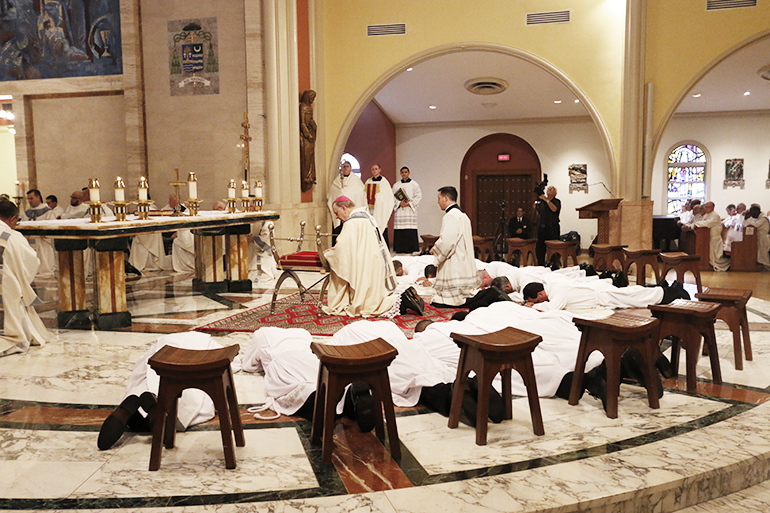
Photographer: ANA RODRIGUEZ-SOTO | FC
Before a standing-room only cathedral filled with their wives, children and friends, Archbishop Thomas Wenski ordained 13 men as permanent deacons for the Archdiocese of Miami.