By Florida Catholic staff - Florida Catholic
MIAMI SHORES | Florida Attorney General James Uthmeier publicly challenged the state’s Catholic bishops July 31 over their schools’ policy of not granting religious exemptions from state-mandated vaccinations, warning that the policy could jeopardize their participation in Florida’s school-choice scholarship programs.
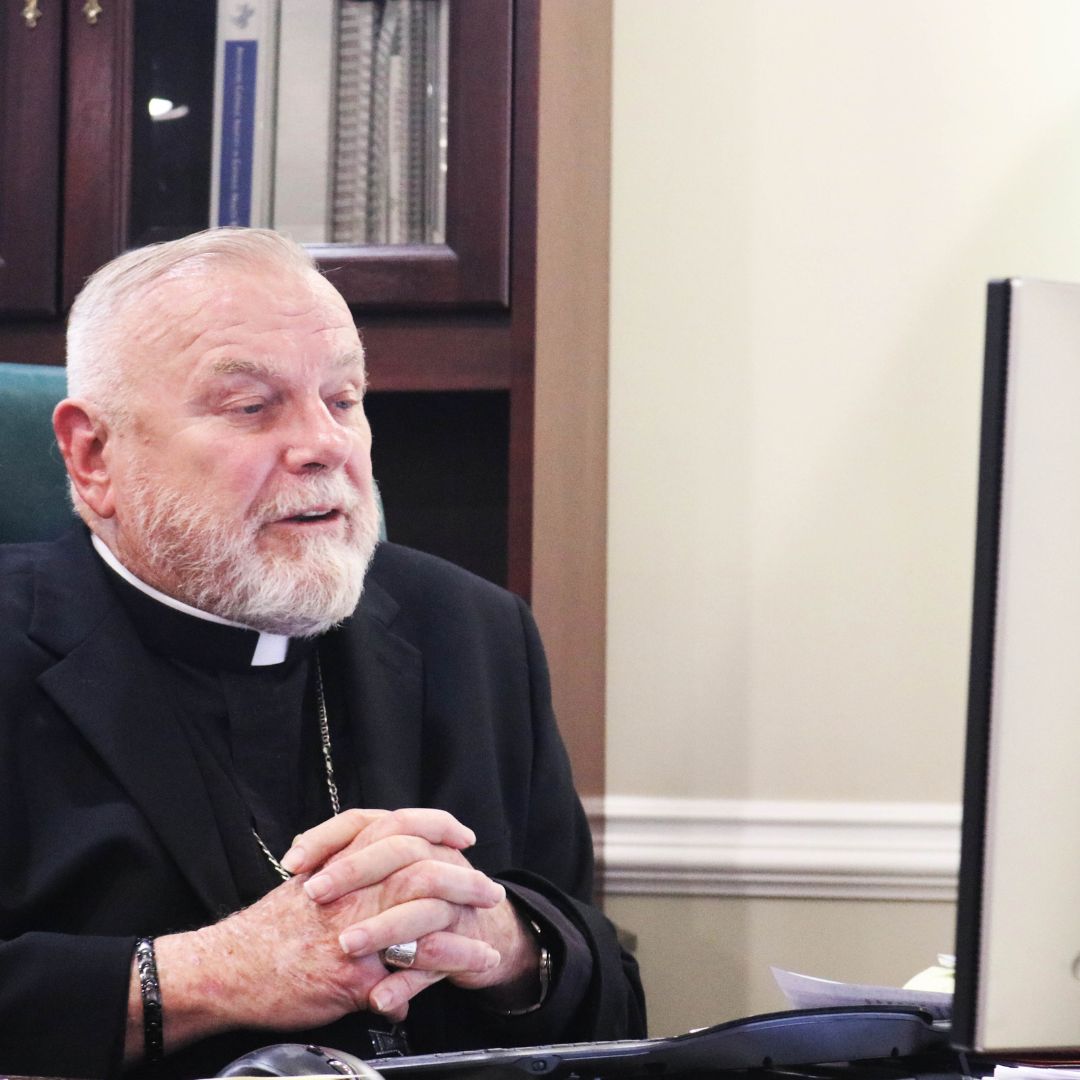
The open letter, sent to the executive director of the Florida Conference of Catholic Bishops (FCCB), caught Archbishop Thomas Wenski and his fellow bishops by surprise and ignited a dispute that extends beyond vaccination policy to a broader question of religious liberty: whether the state can determine what constitutes a legitimate Catholic religious belief.
At the center of the dispute is whether Catholic schools must grant a state-recognized religious exemption when Catholic teaching itself does not prohibit the vaccines. The bishops maintain that requiring them to do so would allow the state to define Church teaching — and interfere with the Church’s religious autonomy.
In his July 31 letter, Uthmeier referenced Florida Statutes subsection 1003.22(5)(a), which states that religious exemptions must be made if the “parent of the child objects in writing that the administration of immunizing agents conflicts with his or her religious tenets or practices."
“Catholic schools in Florida should comply with Florida law” by providing the option for religious exemptions, said Uthmeier. He argued that Catholic schools “[have] no legitimate religious reason to refuse granting religious exemptions to the taking of abortion-derived vaccines.”
He emphasized that if the bishops do not allow their schools to provide religious exemptions, then “[f]ailure to comply could jeopardize [Florida Catholic schools’] eligibility for state educational scholarship programs.”
During last year’s 2025-2026 academic year, nearly 86,990 students attending Florida’s Catholic diocesan schools participated in the state’s scholarship program, according to FCCB data.
However, Archbishop Thomas Wenski, FCCB president, maintains that Florida Catholic schools are neither in breach of Catholic teaching nor state law by declining to provide religious exemptions.
Clarifying Catholic teaching about vaccines
As Michael Sheedy, executive director of the FCCB, clarified in the Florida bishops’ Aug. 7 reply to Uthmeier, “Vaccinating a child—even with a vaccine developed or tested using historically abortive-derived cell lines—is morally permissible because the parent is not cooperating with the original immoral act and the protection of the common good provides a proportionate reason.”
That means, as Archbishop Wenski said in an Aug. 13 interview with EWTN News, that Florida Catholic schools “can't grant a religious [exemption] because we don't find any basis in Catholic teachings why these vaccinations should not be given.”
Under the current policy, students attending Florida Catholic schools in person must comply with state vaccination requirements unless they qualify for a medical exemption. Families who object to vaccination on conscience grounds may instead choose alternatives such as homeschooling, virtual education or a non-Catholic school.
The Archdiocese of Miami’s St. Carlo Acutis Virtual Academy is one such avenue for families seeking online Catholic education.
The archbishop noted that school vaccination requirements are set by the state: Florida Catholic schools do not make this decision but they comply with state law.
“The common good requires that we protect the children in the classroom,” he emphasized. “We've witnessed in recent months an upsurge of cases of measles, and we know that that presents certain dangers for pregnant women, and so we don't want to abet an outbreak of measles in our classrooms, for example.”
The religious liberty debate
For the bishops, the controversy extends beyond vaccination policy. At issue is whether the state can determine what constitutes a legitimate Catholic religious belief and require Catholic schools to act according to that interpretation. The bishops maintain that interpreting and applying Catholic teaching belongs to Church authorities, not government officials.
While Uthmeier warned that failure to comply could jeopardize Catholic schools’ eligibility for state educational scholarship programs, the attorney general does not directly administer those programs. Participating private schools are subject to scholarship compliance requirements overseen by the Florida Department of Education.
The bishops, however, maintain that their schools are complying with state law and that the state cannot condition participation in scholarship programs on the government’s interpretation of Catholic religious teaching.
To back up his point, Archbishop Wenski quoted Florida Statutes subsection 1002.42(2)(h): “It is not the intent of the Legislature to regulate, control, or monitor, expressly or implicitly, churches, their ministries, or religious instruction, freedoms, or rites.”
“The legislature had no intent to put a religious test on those [schools] that would be benefiting from those scholarships,” he told EWTN News, adding that the state government “may not condition our participation [in the scholarships] on a religious belief or on their agreement or disagreement with a religious belief.”
“So that says that we're within our rights to do what we're doing,” he told the Florida Catholic. “The Attorney General pretty much overstepped.”
A prominent Catholic advocacy organization has sided with the Florida bishops and characterized Uthmeier's position as government intrusion into ecclesiastical authority.
William Donohue, president of the civil rights organization Catholic League, published an open letter to Uthmeier on Aug. 18, expressing support for the Florida bishops.
Addressing Uthmeier, Donohue said in the Catholic League’s letter, “Your position smacks of overreach and is indeed a classic example of state encroachment on religion.”
“Your motives may be benign, but if the bishops were to accede to your demand, they would in effect render themselves impotent to any future impositions on their autonomy by a less-friendly attorney general,” he added.
For the bishops, the disagreement ultimately centers on who has the authority to interpret Catholic teaching.
“Where we differ is on your interpretation and application of Catholic teaching, an interpretation (and right) exclusively vested, by United States and Florida constitutional law, in the bishops of Florida’s dioceses,” Sheedy wrote to Uthmeier in the FCCB’s response.
The bishops said they remain willing to meet with Uthmeier or his staff to seek an amicable resolution, while maintaining that they are prepared to “protect our students, defend our rights, and preserve religious freedom.”