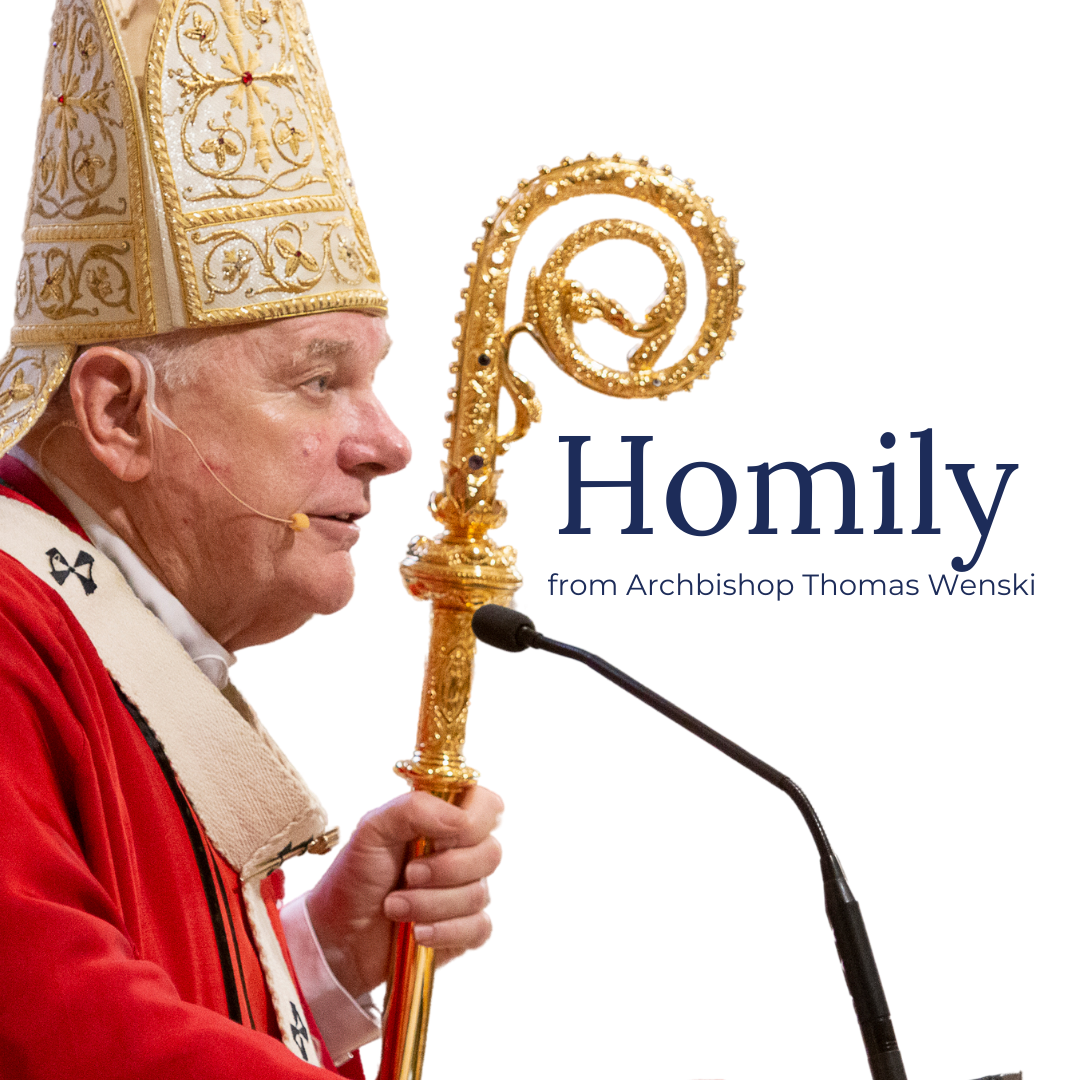
By Archbishop Thomas Wenski - The Archdiocese of Miami
Homily by Archbishop Thomas Wenski at vigil Mass at St. Hugh Catholic Parish with the seminarians of the Archdiocese of Miami. August 1, 2026.
If you were following the news this week, you might have seen this bishop advocating on behalf of Haitian TPS recipients. I went to Washington, DC, to seek support in the Senate for a bill already passed by the House that would grant a three-year extension of TPS – temporary protective status because deporting these Haitians now would be the equivalent on sending them into a house on fire. Also, this week, this bishop together with all bishops of Florida issued a pastoral letter on the death penalty seeking its abolition. On Tuesday, two elderly men were executed by the State of Florida. 19 executed last year. 12 so far this year.
What are we, bishops, doing? Some might say too much by addressing these issues. Others might say, thank God we’re doing something. But what we’re doing is probably not enough to stop deportations, or executions, or war or hunger. But we got to do what we can, even if they might seem like a couple of “Hail Mary” passes.
In any case, we are guided by a method of discernment, a framework to analyze what is happening around us and to evaluate it in the light of Scripture and Church teachings to find what we must do. Simply, this method might be called: See, Judge, and Act: First, See, what is the situation, the reality before us; Second, Judge –in the face of this reality, or situation, what does the Sacred Scriptures say, what does the Church teach? and then, third, to determine a course of action that is coherent with our teachings.
So, what do we see today? We see a moment of immense crisis, fear, and pain for the Haitian diaspora. On July 27, 2026, the official termination of Temporary Protected Status (TPS). This abruptly stripped work authorizations and legal protections from over 300,000 Haitian immigrants. These are not numbers or statistics – but they our grandparents’ caregivers in nursing homes, our waiters and busboys in restaurants, they are your neighbors and, in a few cases, they are your priests.
How to judge this? Today’s Gospel shows us a crowd of thousands stranded in a desert place, tired and facing a dark night. The disciples wanted to send them away to fend for themselves. Do not send them away. Jesus sharply rejects the disciples' indifference, commanding them, "Give them some food yourself."
And so, Act! The answer to indifference is solidarity with our Haitian brothers and sisters.
And what did we see with these executions this week – in a State with more death row exonerations than any other. We must acknowledge the unimaginable horror of the crimes committed. The pain of the victims' families is a profound sorrow. Like Jesus, after the murder of John the Baptist executed by King Herold, we must sit with this grief. However, "taking another human life cannot restore the lives that were lost... justice does not require execution."The execution of an 80-year-old man highlights a systemic belief that some lives are entirely empty of value or beyond redemption. Capital punishment operates on the premise that an individual's actions can permanently sever them from human dignity.
St. Paul’s words in today’s Second Reading leads us to judge differently: neither death, nor life, nor future things "will be able to separate us from the love of God in Christ Jesus." Gospel and church teachings on the dignity of every human being -even those who have done grievous wrongs, reminds us that even on death row a person cannot be separated from the love of God.
And so, we act – ministering to the marginalized – whether they are irregular migrants or those who face capital punishment. No human decree can nullify God’s capacity to love or redeem.
The miracle of the multiplication of the loaves and fishes, therefore, is a sign of that greater miracle, not of loaves broken and distributed to a hungry multitude one day on a hillside, but of the miracle that was to be anticipated on Holy Thursday and realized on Good Friday in Jesus’ sacrificial gift, the gift of his Body broken for us, the gift of his Blood shed for us and for the salvation of the world. This miracle is continued through all-time, until he comes, by the work of the Holy Spirit in every Mass in which Jesus’ gift of self is always newly present. The Holy Eucharist is God’ s gift for the life of the world.
As the manna once sustained Hebrews in the desert, the Eucharist is the indispensable food that sustains us as we cross the deserts of this world, dried by ideological and economic systems that do not promote life, but repress it, a world in which the logic of power and possession dominates, instead of the logic of service and love, a world in which a world in which the culture of violence and death often triumphs.
In a society dominated by a culture of death in which search for individual comfort, money or power only intensifies, the Eucharist reminds us of the rights of poor and the duty of justice and solidarity.
Pope Saint John Paul II once wrote: “...How can we exclude anyone from our care? Rather, we must recognize Christ in the poorest and the most marginalized, those whom the Eucharist – which is communion in the Body and Blood of Christ given up for us – commits us to serve. As the parable of the rich man, who will remain forever without a name, and the poor man called Lazarus clearly shows, ‘in the stark contrast between the insensitive rich man and the poor in need of everything, God is on the latter’s side.’ We, too, must be on this same side.”