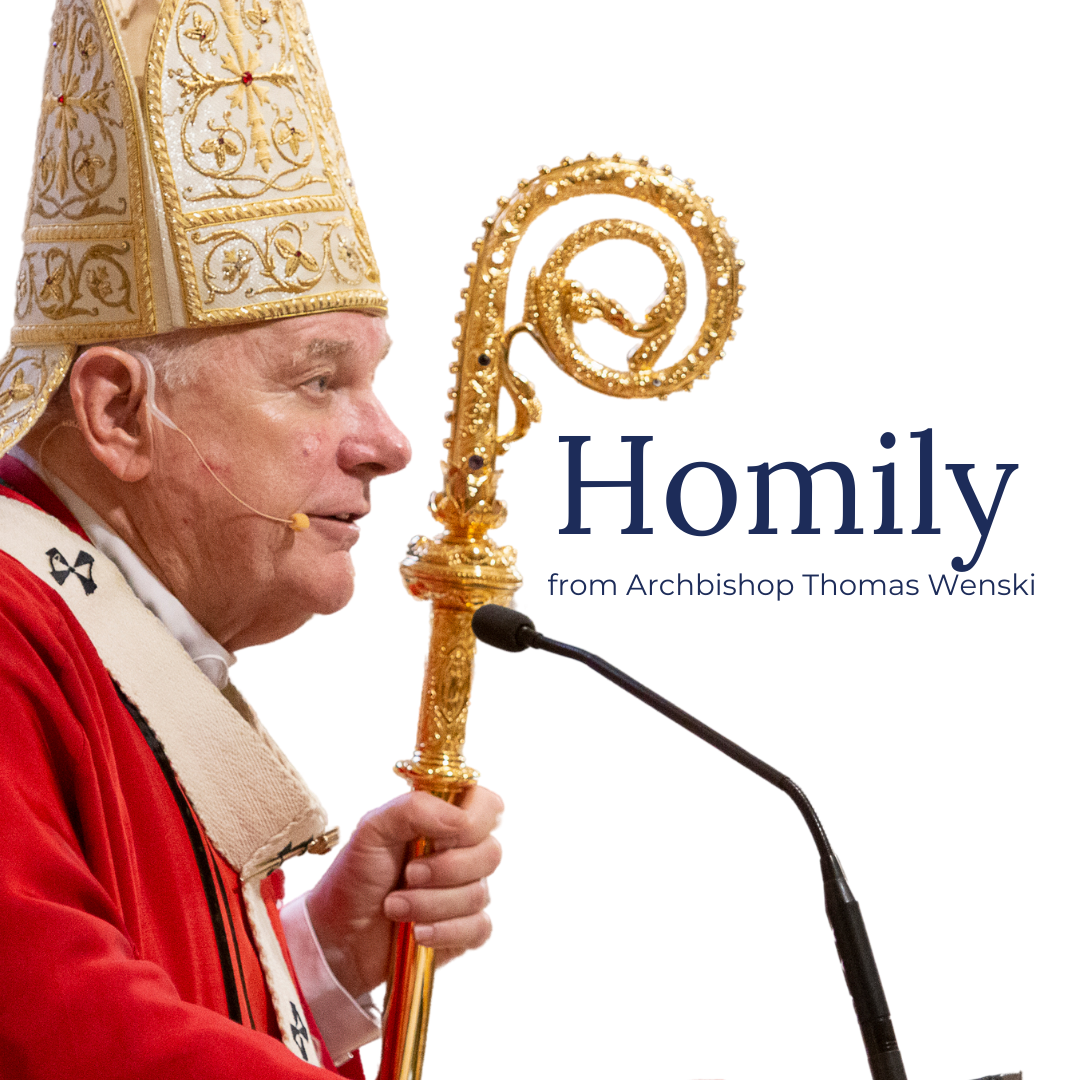
By Archbishop Thomas Wenski - The Archdiocese of Miami
Homily by Archbishop Thomas Wenski at Mass with members of the Napa Institute at St. Augustine Church in Coral Gables as part of the 2025 Miami Experience. Nov. 4, 2025.
In the first reading from Romans, St. Paul reminds us that “we though many are one body in Christ”. I love to tell people that best thing about Miami is that it is so close to the United States. A lot of people tell me that when they arrive at Miami’s airport for the first time and step off the plane, the first impression that many have is that they are not in the United States. But rest assured you are in the United States, and Miami is with its wonderful diversity truly an American city that exemplifies our national motto: E pluribus unum. The Cubans, the Haitians and other ethnic and national groups are well integrated in our South Florida community. And they are Americans to the core, because while maintaining their own identities they have become lawyers and judges in our courtrooms, doctors and nurses in our emergency rooms and hospitals, executives in our board rooms, and commissioners and mayors in our city halls. So, welcome to Miami and I hope that you enjoy your time with us.
Immigrants, legal or irregular, are already a force for the renewal of the Church in America. Their presence among us can be the antidote to the crisis of faith experienced by too many American-born Catholics. Through their faith, through their commitment to family life, through their openness to vocations to the priesthood and religious life, through their popular piety, they are bringing to the Catholic Church in America a new and welcomed vitality. And I would daresay to American society in general. Miami is a witness to this on both counts.
You may remember Victor Hugo’s 19th century novel, Les Miserables or perhaps the musical, Les Miz based on the novel. Inspector Javert motivated by a bitterly zealous legalism relentlessly pursues Jean Valjean, a man who had spent years in prison for stealing a loaf of bread. Today, modern day Javerts bent on enforcing a broken, and thus unjust, immigration regime are deporting agricultural, construction, service and hospitality workers in an irregular immigration status. And various personalities in the government and in the news media fan flames of resentment against these supposed law breakers equating them with terrorists intent on hurting us. And I describe these migrants as “irregular” migrants, not as undocumented or illegal, for the majority of them have some type of documentation or even legal status, albeit a temporary legal status and most are not guilty of any serious crime.
Today, many take umbrage at the Catholic bishops’ advocacy on behalf of these irregular migrants. But, in doing so, we stand in a proud moral tradition that holds positive laws should promote both the common good and the good of the individual in society. This is what Jesus meant when he said the Sabbath was made for man and not man for the Sabbath. And, as St. Augustine, is attributed to have said, “an unjust law is no law at all” which why we, a nation of laws, can honor law breakers like the patriots of the “Boston Tea Party” and allow the dignified defiance of Rosa Parks in her act of law breaking to touch its conscience. We can be a nation of laws, without becoming a nation of Javerts.
As Jesus reminded the embittered zealots of his day, positive laws, even divine positive law like the Sabbath observance, are designed for the benefit, not the harm, of humankind.
Today, the Church celebrates the Memorial of St. Charles Borromeo, a reformer of the Church at the time of the counter Reformation. He ranks up there with Ignatius of Loyola. As the Bishop of Milan and a Cardinal he restored disciple among his priests, made seminaries more effective in forming seminarians, set up what was called the Confraternity of Christian doctrine, or we might call religious education classes or Sunday school. As archbishop, he was a good shepherd to his people – feeding thousands daily who were suffering because of famine and plague. And he did all this before dying at 46 years old.
St. Charles Borromeo was a reformer of the Church of his day. NAPA wishes to make its own contributions to reforming the Church of our day – and it has, as I can witness from the conferences I have attended over the years.
I think anybody associated with NAPA would readily embrace Charles Borroemeo’s agenda: more zealous and faithful priests, better seminaries and religious education programs in our parishes and schools, not to omit mentioning his care for the poor. And he was the namesake of Karol Wojtyla, St. John Paul II. In Poland, saint’s days are celebrated more that birthdays, and so Karol Wojtyla celebrated November 4, his “name day” as we would celebrate a birthday.
After Mass, we will have a fine dinner; and the gospel reading speaks about a dinner. One of those at table with Jesus said to him, “Blessed is the one who will dine in the Kingdom of God." After which Jesus gives the parable about those invited to a wedding banquet and the various excuses they gave as they RSVP-ed their “regrets”. In Scripture, feasts, banquets, fine dinners are used allegorically to describe what heaven might be like. The Mass is a Eucharistic Sacrifice, but it is also a Meal, a meal that anticipates the Eucharistic banquet that awaits us in heaven when we will sit at table with the Lord himself. But as St. Charles Borromeo famously said: “Charity is that with which no man is lost and that that without which no man is saved.”
May your days in Miami give you another perspective on the immigrant experience. And as Catholics we can draw a parallel to Jesus’ coming among us as man and a newcomer’s arrival in a strange land. This perhaps will help us to contemplate the face of Jesus in the visage of the immigrant. May we all benefit from the intercession of St. Charles Borromeo, and may we learn from the example of his zeal for souls as we participate yet again in the Sacrum Convivium, the Sacred Banquet in which Christ is received, the memorial of his Passion is renewed, the mind is filled with grace, and a pledge of future glory is given to us, until we are blessed to “dine in the Kingdom of God”.