By Tom Tracy - Florida Catholic
Photographer: TOM TRACY | FC
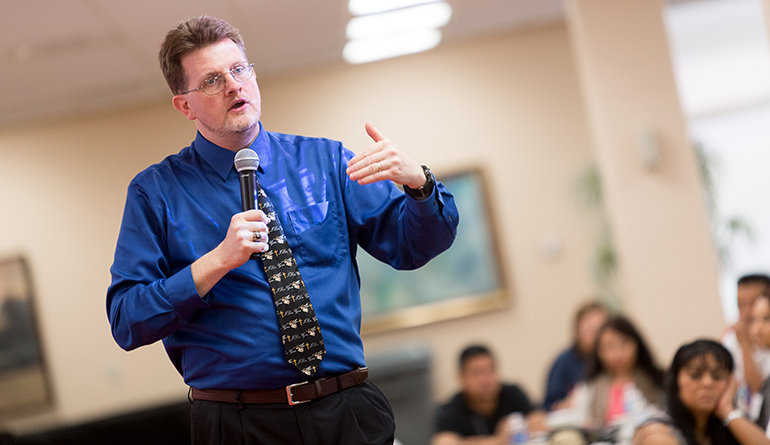
Bill Keimig, assistant director of The Catechetical Institute at Franciscan University of Stubenville, Ohio, and a past director of religious education at St. Mary’s of Piscataway Church in Clinton, Maryland, leads an RCIA training program for archdiocesan RCIA leaders and catechists Nov. 5 at St. Thomas University. He held a similar program for local clergy Nov. 4 at the archdiocesan Pastoral Center in Miami Shores.
MIAMI GARDENS | Just four months into his position as director of religious education at St. Michael the Archangel Church and School in Miami, Alfonso Balmaceda knows that his volunteer religious educators can’t always escape jobs and family commitments for ongoing education. So sometimes Balmaceda does the ongoing education for them and brings home the results.
“They couldn’t be here today because they are working and they have their lives, so whatever I take here I bring back to them and hand on whatever I learned at this workshop,” he said during a training program for archdiocesan RCIA leaders and catechists Nov. 5 at St. Thomas University.
RCIA � the Rite of Christian Initiation for Adults � is the process the Catholic Church uses to help non-Catholics learn more about the Church and, if they desire, to become full members of the Catholic community.
“At my parish I have two catechists who teach RCIA for our religious education programming but I am the RCIA teacher for the students at the school,” Balmaceda said. “So that is all the students between third grade and eighth grade who are missing any of the sacraments and are not fully initiated yet. It is my role to pull them out during recess or lunchtime to prepare them.”

Photographer: TOM TRACY | FC
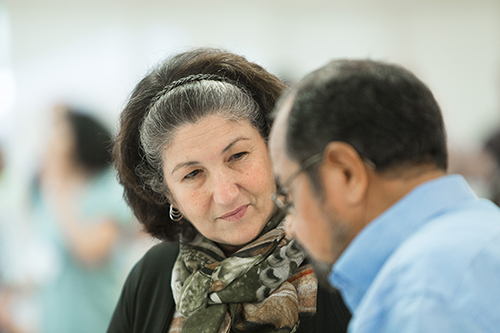
RCIA leaders and catechists from South Florida gathered Nov. 5 at St. Thomas University in Miami Gardens for one-day an RCIA training program facilitated by Bill Keimig, assistant director of The Catechetical Institute at Franciscan University of Stubenville, Ohio, and a past director of religious education at St. Mary’s of Piscataway Church in Clinton, Maryland. A similar program was held Nov. 4 for local clergy.
Photographer: TOM TRACY | FC
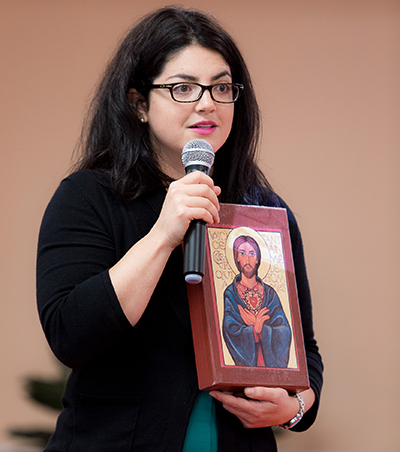
Mary Ann Wiesinger, director of Evangelization and Parish life in the Archdiocese of Miami, speaks at an RCIA training program for archdiocesan catechetical leaders and catechists held Nov. 5 at St. Thomas University. Wiesinger also hand made a number of icons of Christ which she gave out to attendees at the event.
“It is a very informal environment adapted to children,” he added. “They ask so many good questions that challenge me and I have to present it to them in a way that they can understand and relate.”
Leading the RCIA workshop was Bill Keimig, assistant director of The Catechetical Institute at Franciscan University of Steubenville, Ohio, and a past director of religious education at St. Mary’s of Piscataway Church in Clinton, Maryland. He noted the widely diverse backgrounds of clergy and laity in Miami in comparison with other regions around the country where he has led RCIA training.
Keimig said his efforts are geared toward making RCIA “what it was always intended to be,” something the U.S. Church has actually struggled with over the years.
Church's vision
“The Church’s vision for RCIA is wonderful, generous, gentle, pastoral and wise and based on a very long experience of how cultures receive the faith and how individuals get converted,” Keimig said, adding that doing RCIA well also enthuses the parish community in many areas of faith life.
But not all parishes even have an RCIA team.
“Once pastors and teams learn to work well together, and once that vision for RCIA begins, they find that a lot of problems they long worried about go away,” Keimig said. “The process begins to flourish and becomes an engine of renewal for the whole parish,” as sponsors and godparents, catechumens and candidates, and RCIA teams are “refreshed and rolled out with deeper convictions and deeper zeal.”
For parishes that have little to no formal RCIA programing or team, Keimig suggested starting by building up a team comprised of one or two faithful couples. Have a five-year process in mind and just pick one or two things to do each year, he suggested, such as conducting godparent and sponsor training, or implementing the minor rites and doing them well.
The best place to start is with the liturgical elements of RCIA, Keimig noted.
“A lot of people conceive of RCIA as a teaching thing, but the Church sees it as an outpouring of grace through liturgies that give people the means to convert,” he said. “The catechesis points them to the power and strength to be found through the sacraments. So the process is always pointing to the liturgy.”
'Loving embrace'
Mary Ann Wiesinger, director of Evangelization and Parish Life in the archdiocese, who coordinated the workshop, said it is critical that local churches do RCIA well. Every parish should have well-trained people to assist those seeking God, seeking Christ and seeking something better for their lives.
“We need to meet them with a loving embrace,” she said. “RCIA can be difficult or scary for some who are not sure if they are going to make this commitment so we need to be prepared to encounter them, to help them make that conversion. These people bring new life, new energy and new compassion to our church.”
Photographer: TOM TRACY | FC
RCIA leaders and catechists from South Florida gathered Nov. 5 at St. Thomas University in Miami Gardens for one-day an RCIA training program facilitated by Bill Keimig, assistant director of The Catechetical Institute at Franciscan University of Stubenville, Ohio, and a past director of religious education at St. Mary’s of Piscataway Church in Clinton, Maryland. A similar program was held Nov. 4 for local clergy.
Typically, many adults are directed to the RCIA process because they want to get married in the Church. Other situations that may prompt their participation include a personal crisis, an inviting friend, or a general sense that God has been tapping them on the shoulder, Wiesinger explained.
Others are already baptized and seek to finish their preparation and reception of the sacraments.
'I met a wonderful priest'
Workshop attendee Joanne Lambert, director of religious education at St. Lawrence Parish in North Miami Beach, recalled her own background: Raised in a non-religious family, she married a non-practicing Catholic with whom she later adopted a number of special needs children.
“I wished to have the children baptized, and I met a wonderful priest,” Lambert said. “He was kind and patient and he invited me into the RCIA inquiry process which I completed it in just over a year, in 1990.”
“I was ready. I had a relationship with Christ and I was looking for a home and I found it in the Catholic Church,” she added, noting that she subsequently started working in parish catechesis before earning a master’s degree in pastoral ministry at St. Thomas University.
“I think having the historical context for the understanding and the progression of the rites, and how we unfold the information, is really important,” Lambert said of the workshop. “It can never be reiterated too much that RCIA is not a giant CCD class for adults with a graduation. I think we are doing a really good job of opening our doors as a Church and I love the RCIA because it helps dispel any notion of a closed-door Catholic Church.”
Photographer: TOM TRACY | FC
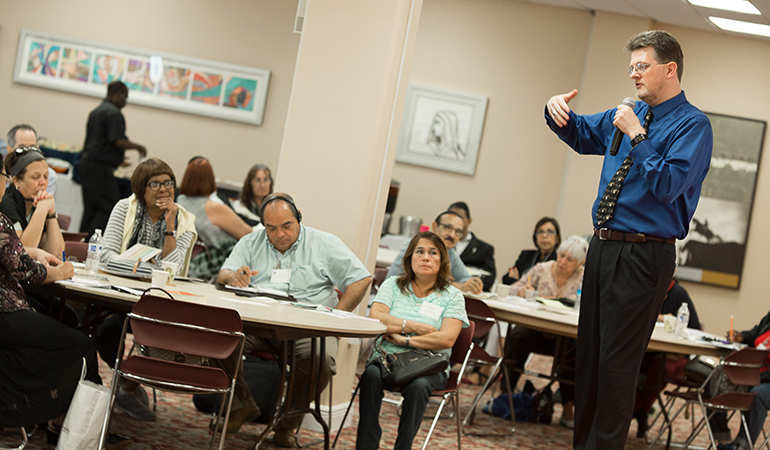
Bill Keimig, assistant director of The Catechetical Institute at Franciscan University of Stubenville, Ohio, and a past director of religious education at St. Mary’s of Piscataway Church in Clinton, Maryland, leads an RCIA training program for archdiocesan RCIA leaders and catechists Nov. 5 at St. Thomas University. He held a similar program for local clergy Nov. 4 at the archdiocesan Pastoral Center in Miami Shores.