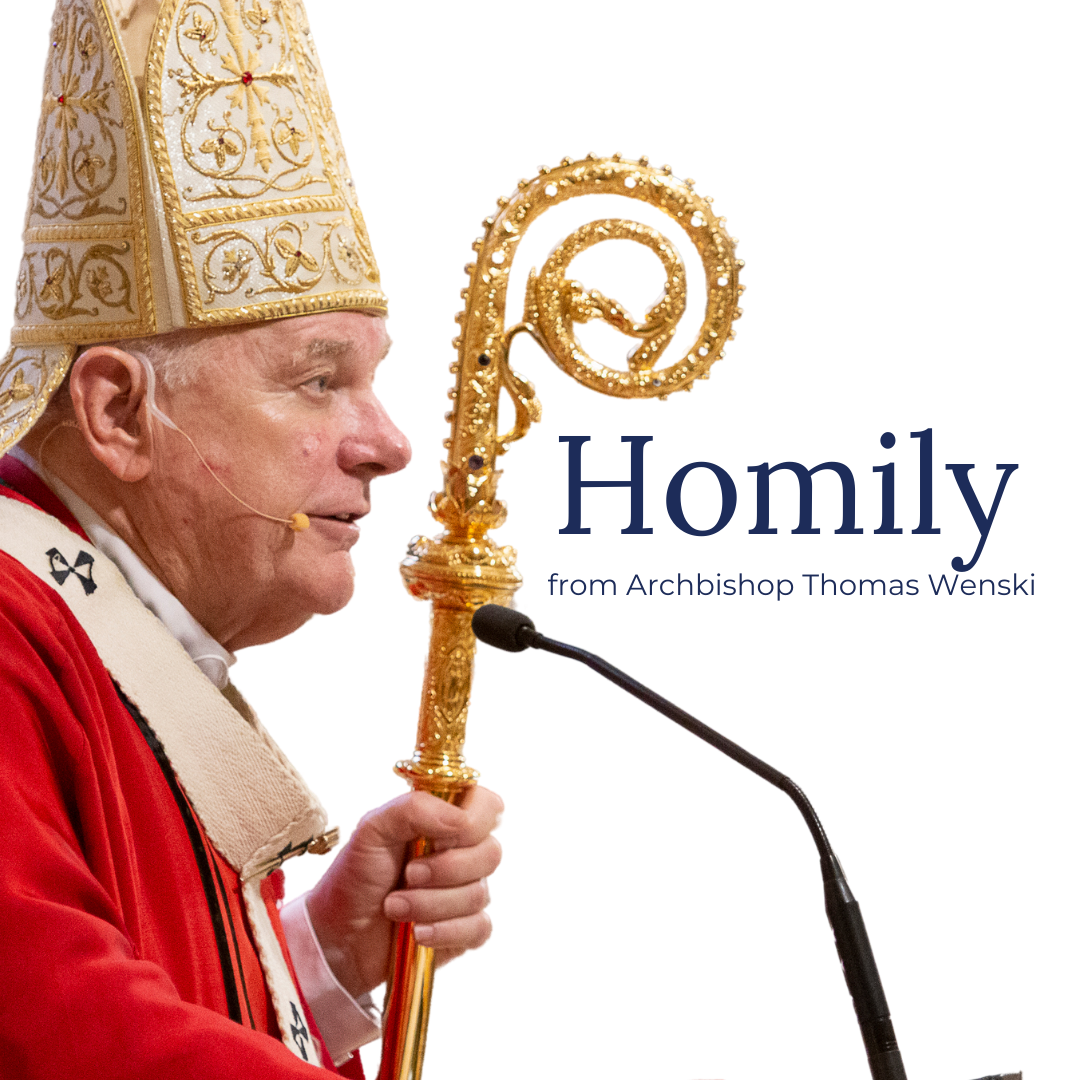
By Archbishop Thomas Wenski - The Archdiocese of Miami
Homily by Archbishop Thomas Wenski at Mass for the Feast of the Exaltation of the Cross with coronation of the statue of Our Lady Guardian of the Faith. Sept. 14, 2026, St. Martha Catholic Parish.
Today, we celebrate the Feast of the Exaltation of the Cross, a feast celebrated every year on September 14 to recall how in the year 326, St. Helen, the mother of the Roman emperor Constantine, found in Jerusalem relics of the cross of Jesus Christ.
But today’s feast day is about more than a commemoration of an archeological discovery; rather it draws our attention to that sign of our faith that still contradicts the supposed wisdom of the world. The cross is where human misery and divine mercy meet for on the wood of the cross Jesus redeemed the world.
Today we will also crown the image of Mary, Guardian of the Faith – as I did in 2014 at St. Mary’s Cathedral. Devotion to Mary under this title began in Cuenca, Ecuador, and it is related to a series of visions or apparitions of Mary to a then teenage girl, Patricia “Pachi” Talbot. in the late 1980’s. Here in the Archdiocese, inspired by the witness of “Pachi”, there are many prayer groups or cenacles – from Deerfield to Pinecrest – that gather to pray the rosary seeking Mary’s protection as Guardian of the Faith.
The cross was a horrible instrument of torture, to be crucified was a particularly hideous way to die (and Romans normally would only punish foreigners and not their own citizens in this way; for example, St. Paul, a Roman citizen, was beheaded but St. Peter, a Palestinian Jew, was crucified. But Jesus’ crucifixion, especially in the light of his resurrection, inspires not horror but faith, a faith that sees in the cross the remedy for all the world’s suffering.
It was that faith that led St. Helen on her quest to find and retrieve the true cross of Christ. We can understand why she sought out the relics of the cross for even today the cross is an important symbol and sign of our faith for without the cross there is no Christianity.
To be sure, today most of our crosses and crucifixes are quite sanitized; but nevertheless, the cross is more than just a symbol, or a sign. The Cross is a summons to live our lives in sacrificial, self-giving, self-emptying love. The cross is a summons for us to realize ourselves as human beings not through self-seeking or self-assertion but through the sincere gift of oneself to God and to one another.
There is a hymn we sing in church that is particularly appropriate today: “Lift high the Cross, the love of Christ proclaim, Till all the world adore his sacred name.” Just as Moses lifted up a bronze serpent in the desert so that those who had been bitten might be cured, Jesus was lifted up on the cross. As St. Paul says, “he was made sin so as to deliver us from sin.”
The Son of God became man; he became flesh and blood so that he could die. He came to die because we are destined for more than just to die one day. Created in his own image and likeness, we were made for God. As the old catechism taught us: God made us to know him, to love him, to serve him in this life and to be happy with him in the next. In other words, and in here lies our innate dignity as human beings, we were made for glory.
